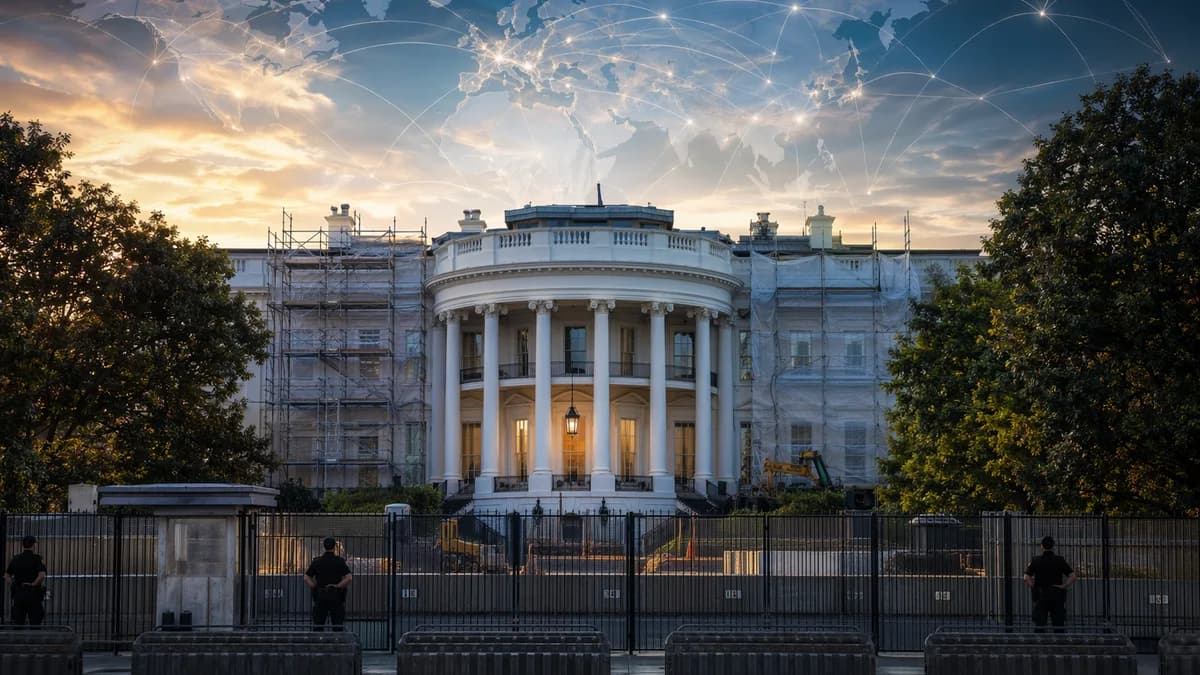
A Trump White House renovation that could have been framed as routine stone repair has turned into a fight over taste, security, public money, and how much of a president’s personality should be written onto the country’s most visible residence.
XOOMAR Intelligence
Analyst Take
President Donald Trump is renovating the North Portico entrance after calling the front of the White House “horrible” and in “deplorable condition,” according to Time. He has said the main entrance “will be a symbol of extraordinary beauty and pride” when the work is finished.
That language matters. A chipped column is maintenance. A “symbol” is politics.
Trump turns a front-door repair into a fight over power and permanence
The immediate work is narrow on paper: scaffolding and tarp around the North Portico columns, restoration work on the columns, and upgrades to the North Portico doors. A White House official told Time the doors are receiving security enhancements and upgrades, with the project expected to finish around mid-September.
But Trump’s own framing makes this more than a facilities job. He isn’t only saying the entrance needs repair. He is saying the front of the White House fails as a visual statement.
“President Trump comes out to greet a world leader, he sees door dings in the pillars and says, ‘Look at all this stuff that needs to be repaired,’” Interior Secretary Doug Burgum said on The Katie Miller Podcast. “It’s all historic renovation work.”
XOOMAR analysis: The central question is category. If this is limited restoration plus undisclosed security work, the politics are smaller. If it becomes part of a broader aesthetic overhaul, it joins Trump’s larger second-term pattern: visible building projects that turn government spaces into proof of command.
That’s the real tension in the Trump White House renovation story. The White House is both a working site and a national symbol. Trump is treating the symbol as something he can sharpen, polish, and brand in public view.
The North Portico project sits inside a wider Trump construction push
The North Portico work follows several White House and Washington-area projects Trump has launched since returning to office. Time lists plans for a multimillion-dollar granite helicopter landing pad on the South Lawn, the demolition of the White House East Wing to make way for a new ballroom, a proposed 250-ft triumphal arch near Arlington National Cemetery, and repairs tied to the Lincoln Memorial Reflecting Pool after its blue paint appeared to peel and algae turned the water green.
USA TODAY’s supplied reporting adds that the columns were built in 1830, that paint appeared chipped, and that the White House described the project as “standard restoration work” for “stone repairs in the columns.” CNN’s supplied reporting says Trump told supporters workers had taken “about 150 years of paint off of the columns.”
The shift is visible:
- Before: Maintenance could be treated as quiet preservation, handled with limited public drama.
- Now: Construction itself becomes a political image, with scaffolding, tarps, gold signage, flagpoles, and public statements carrying the message.
- Next pressure point: Whether the work remains repair-focused or moves toward permanent redesign.
This is not the same policy terrain as Trump’s fights over legislation or foreign affairs, but it reflects a similar instinct toward visible executive control. XOOMAR readers have seen that style in harder power contexts, including Trump Turns Iran Strikes Into Strait of Hormuz Blockade and Trump Loses as US Housing Law Takes Effect Without Him.
Costs, access, and approval gaps are now part of the story
The White House did not respond to Time’s questions about the estimated cost of the North Portico renovation. That absence matters because the project combines three sensitive elements: the president’s residence, a public landmark, and possible security changes.
Known details are limited but important:
| Project or proposal | Known fact from supplied sources | Open question |
|---|---|---|
| North Portico renovation | Expected to finish around mid-September | Cost, contractor details, full scope |
| North Portico doors | Security upgrades confirmed by White House official and Secret Service | What the upgrades entail |
| Lafayette Square fence proposal | Phased implementation could begin in 2027 | Federal approvals and access rules |
| Proposed arch | Described as 250-ft near Arlington National Cemetery | Whether it advances |
| Ballroom project | USA TODAY supplied reporting says projected cost is $600 million | Final cost and full approvals |
The Lafayette Square proposal widens the stakes. It would permanently fence the park across from the White House, with entrances that could open or close and pedestrian access restricted when the Secret Service determines heightened security is necessary. Time reports the plan still requires approval from several federal agencies.
XOOMAR analysis: Security is the strongest institutional argument for changes around the White House. It is also the least transparent. Once security becomes part of the rationale, critics have less visibility into design choices, costs, and necessity.
Trump’s style changes the preservation debate
Preservation fights usually turn on restraint, continuity, and reversibility. The supplied sources don’t provide enough verified detail to compare this project against specific renovations by past presidents, so the sharper comparison is within Trump’s own current construction record.
On one end are repairs: chipped paint, stone damage, door upgrades. On the other are highly visible changes: gold accents in the Oval Office, 88-foot-tall flag poles cited in USA TODAY’s supplied reporting, a paved Rose Garden, a demolished East Wing, and new exterior signage for the West Wing shown on Truth Social, according to CNN’s supplied reporting.
That mix creates the friction. A column repair may be defensible. A pattern of high-visibility alterations invites a different reading.
For supporters, the Trump White House renovation can be sold as overdue upkeep, stronger security, and a more polished stage for statecraft. For critics, the risk is that a public landmark becomes a canvas for one president’s preferred visual language.
Neither side is arguing only about stone. They’re arguing about ownership.
The next Washington building fights will test how much personalization the system allows
The North Portico project may end quietly if it finishes around mid-September as restoration plus security work. The bigger battles are likely to come from projects that are larger, pricier, harder to reverse, or more disruptive to public access.
The evidence to watch is concrete:
- Scope: Do officials describe the work as repair, or do visible design changes appear?
- Cost disclosure: Does the White House release estimates, contracts, or funding details?
- Approvals: Do federal agencies scrutinize projects like the Lafayette Square fencing plan before 2027 implementation begins?
- Access: Does security planning permanently narrow how the public uses spaces near the White House?
- Pattern: Do future projects keep pairing “restoration” language with Trump’s luxury-and-spectacle aesthetic?
The physical changes may outlast the news cycle. The precedent could last longer: a White House that future presidents feel freer to personalize in plain sight.
Impact Analysis
- The project raises questions about where routine maintenance ends and presidential branding begins.
- Security upgrades to a highly public White House entrance carry public-interest implications even when details are limited.
- Renovations to the White House can become symbolic because the building represents national identity as well as presidential authority.
Two Ways to Read the North Portico Renovation
| Routine Restoration | Symbolic Overhaul |
|---|---|
| Column restoration, scaffolding, tarp, and door upgrades | A visible effort to reshape the White House front entrance as a statement of beauty and pride |
| Framed by officials as historic renovation work | Framed by Trump as fixing a 'horrible' and 'deplorable' public-facing symbol |
| Political stakes are lower if work remains limited | Political stakes rise if it becomes part of a broader aesthetic imprint on government spaces |
Primary Sources & Disclosures

Written by
XOOMAR Insights Team
Research and Editorial Desk
The XOOMAR Insights Team pairs automated research with human editorial judgment. We track hundreds of sources across technology, fintech, trading, SaaS, and cybersecurity, cross-check the facts, and explain what happened, why it matters, and what to watch next. We do not just rewrite headlines. Every article is fact-checked and scored for reliability before it goes live, and we link back to the original sources so you can verify anything yourself.