
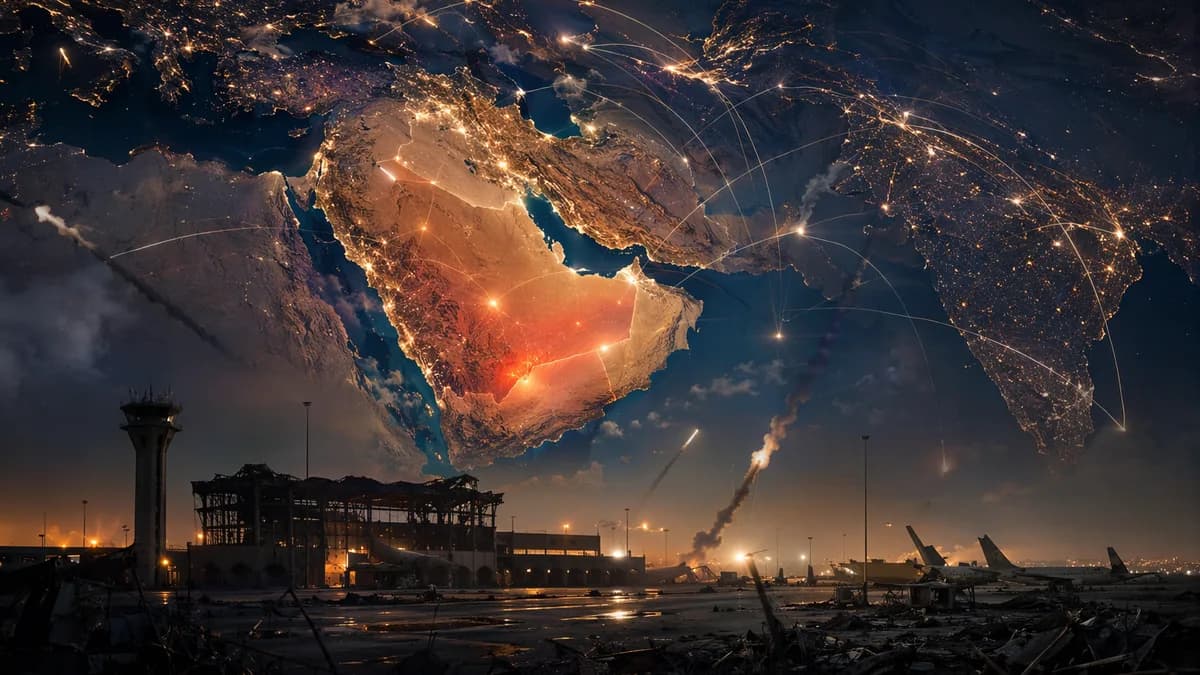
The urgent question after Yemen's Houthis said they launched missiles at Saudi Arabia is whether a largely dormant Saudi-Houthi front has just reopened.
Global TrendsJuly 14, 2026· 6 min read· By XOOMAR Insights Team
Houthi Missile Attack Jolts Saudi Arabia's Quiet Truce
Updated on July 14, 2026
XOOMAR Intelligence
Analyst Take
62/ 100
4 sources analyzedLow confidenceTrend20Freshness92Source Trust92Factual Grounding92Signal Cluster40
The Iran-backed Houthis said they fired missiles and drones at Abha International Airport in south-western Saudi Arabia on Monday after strikes hit Sanaa International Airport in Yemen's capital, according to BBC World. The Houthis blamed Saudi Arabia for the Sanaa strikes. Yemen's internationally-recognised government said its forces carried them out to stop an Iranian plane from landing.
The Saudi-led coalition said its air defences "dealt with" the missiles and that no casualties were reported. That is the clearest confirmed result so far. No confirmed damage report from Abha was included in the initial account.
Did the Houthis missile attack claim end four years of Saudi-Houthi quiet?
The Houthis said the strike on Abha came "in response to this criminal Saudi aggression", after accusing Saudi Arabia of hitting Sanaa airport's runway. Their military spokesman, Yahya Saree, said the Sanaa strikes ended "the de-escalation phase" and would not go "unanswered or unpunished".
That language matters. The BBC described the exchange as the most significant escalation between the Houthis and Saudi Arabia since an informal truce took effect four years ago.
Saudi authorities did not comment on the Sanaa strikes before Saree announced the Abha attack, the BBC reported. The Saudi-led coalition later posted on X that:
"air defences have dealt with ballistic missile threats launched by the terrorist Houthi militia towards the Southern Region"
The sequence is tight and dangerous: strikes at Sanaa airport in the afternoon, a Houthi retaliation claim in the evening, then a Saudi-led coalition interception claim.
The phrase Houthis launch missiles at Saudi Arabia now carries more weight than a single attack claim. It raises the question of whether the informal restraints that have held since the truce can survive a direct airport-for-airport exchange.
Why did a disputed Iranian plane trigger strikes at Sanaa airport?
The immediate trigger appears to be a dispute over an Iranian plane carrying a Houthi delegation back from Iran after the funeral of the late supreme leader Ayatollah Ali Khamenei.
Yemen's internationally-recognised government, based in Aden, said its forces struck the runway because the Houthis blocked Yemeni national aircraft while insisting that the Iranian plane be allowed into Yemeni territory.
"The terrorist Houthi militias, backed by the Iranian regime, prevented Yemeni national aircraft from landing at the airport in the capital, Sanaa, while insisting on allowing an Iranian plane to violate Yemeni territory; consequently, the airport runway was targeted," the Yemeni defence ministry said.
The Houthis' al-Masirah TV said the "departure and landing runways" were targeted. Social media footage showed plumes of smoke rising above rooftops in Sanaa after the strikes, according to the BBC.
The Iranian plane diverted and later landed in Hudaydah, about 150km (93 miles) south-west of Sanaa, according to the Houthis.
For more than a decade, aircraft entering Yemeni airspace have needed clearance from the Saudi-led coalition, which says it acts at the Yemeni government's request. That detail makes the aircraft dispute more than an operational issue. It goes straight to the contested authority over Yemen's skies.
How far can the Abha airport attack claim spread beyond Yemen?
Saree also warned airlines against flying through Saudi airspace "until the blockade on Sanaa International Airport is lifted". That warning is one of the most consequential parts of the Houthi statement because it tries to extend the dispute beyond the two airports named in the attack claims.
No confirmed flight disruption was reported in the supplied source material. No casualties were reported by the Saudi-led coalition. Still, the Houthi warning gives regional carriers, insurers, and governments a new signal to assess.
This is where the Yemen conflict can spill outward quickly. The fighting began in 2014, when the Houthis ousted the government from Sanaa. It escalated in 2015, after the Saudi-led coalition intervened to try to restore the government's rule.
The cost has been vast. The fighting has reportedly killed more than 150,000 people and helped trigger one of the world's worst humanitarian crises, with more than 22 million people needing some form of aid, according to the UN.
For readers tracking Iran-linked regional flashpoints beyond Yemen, XOOMAR has also covered how Four Iranian Missiles Pull Jordan Into a Wider War and how US Strikes Iran as Strait of Hormuz Crisis Threatens Oil. Those are separate files, but they sit inside the same widening security conversation around Iran-aligned actors and regional escalation risk.
Which signals will show whether this stays contained?
The next phase depends less on rhetoric and more on verifiable follow-through.
Watch for five concrete signals:
- Saudi response: Whether Riyadh directly addresses the Sanaa airport strikes or leaves the Yemeni government as the named claimant.
- Air defence claims: Whether the coalition provides more detail on what was intercepted, where, and with what effect.
- Airport status: Whether Abha or Sanaa report operational disruption after the exchange.
- Casualty and damage figures: Whether independent or official sources confirm injuries, deaths, runway damage, or aircraft damage.
- UN diplomacy: Whether emergency diplomacy can keep the exchange from becoming a cycle of retaliatory strikes.
At an emergency meeting of the UN Security Council in New York, Assistant Secretary General Khaled Khiari warned against another spiral.
"Yemen and the wider region cannot afford another cycle of escalation," he said. "We call on all actors to constructively engage in negotiations under UN auspices."
The UK's representative at the UN condemned the "reckless Houthi attacks on Saudi Arabia, which threaten regional security". Iran's foreign ministry condemned the attack on Sanaa's airport as a "clear violation of international law".
The near-term test is narrow but serious: whether Houthis launch missiles at Saudi Arabia remains a one-night retaliation claim after the Sanaa airport strikes, or becomes the opening move in a renewed cross-border campaign. The answer will come from interception evidence, airport operations, and the next statement from the parties with missiles, aircraft, and authority over Yemen's skies.
The Stakes
- The missile claims could signal a reopening of the largely dormant Saudi-Houthi front after years of relative quiet.
- Attacks involving airports raise risks for civilians, regional travel, and humanitarian access in Yemen.
- The exchange could complicate efforts to preserve de-escalation between Saudi Arabia and the Iran-backed Houthis.
Sources

Written by
XOOMAR Insights Team
Research and Editorial Desk
The XOOMAR Insights Team pairs automated research with human editorial judgment. We track hundreds of sources across technology, fintech, trading, SaaS, and cybersecurity, cross-check the facts, and explain what happened, why it matters, and what to watch next. We do not just rewrite headlines. Every article is fact-checked and scored for reliability before it goes live, and we link back to the original sources so you can verify anything yourself.
Explore More Topics
Related Articles
 Global Trends
Iran Strait of Hormuz Attack Jolts Global Oil Shipping
A US official says Iran fired missiles at commercial ships in Hormuz, putting oil flows, insurers, and Gulf routes on alert.
Jul 7, 20266 min
 Global Trends
US Strikes Iran After Hormuz Tanker Attacks Shatter Truce
US strikes on Iran turned a tanker crisis in the Strait of Hormuz into a direct military clash, with targets and damage still unclear.
Jul 7, 20265 min
 Global Trends
US Strikes Iran as Strait of Hormuz Crisis Threatens Oil
US strikes on Iran pushed the Strait of Hormuz crisis into markets, with Tehran calling diplomacy futile and shipping risk climbing.
Jul 13, 20266 min
 Global Trends
Hormuz Tensions Flare as Iran Accuses US of MoU Breach
Iran's speaker says the US breached a ceasefire MoU, putting Hormuz, oil sanctions and shipping risk back at the center of the dispute.
Jul 8, 20265 min
 Global Trends
Tehran Turns Khamenei Funeral Into Revenge Warning
Tehran turned Khamenei's funeral into a loyalty test and revenge signal, but inflation, fear and absences exposed a divided Iran.
Jul 7, 20268 min
 Trading
Oil Price Jump Puts UK and ECB Rate Rises Back in Play
Brent hit $87.08 after US strikes on Iran, reviving UK and ECB rate-rise bets as traders brace for another energy inflation shock.
Jul 14, 20268 min
 Trading
Hormuz Shock Pins Bitcoin at $62,600 Before CPI Test
Bitcoin is holding $62,600, but Trump's Hormuz blockade has oil and Fed hike fears leaning hard against crypto.
Jul 14, 20265 min
 Trading
Yen Bears Dare Tokyo as USD/JPY Defends the 162 Line
USD/JPY is holding above 162 as traders bet Japan's intervention threats can't overpower the rate gap and haven-dollar demand.
Jul 13, 20267 min
 Global Trends
Trump White House Renovation Turns Repair Into Power Play
Trump's North Portico repairs have become a fight over taste, security and presidential power at the White House.
Jul 14, 20266 min
 Trading
XRP Sentiment Spikes as Ether Bulls Ignore the Drop
XRP sentiment hit a five-week high as prices fell, while ether bulls got louder. Santiment says that split can favor sellers.
Jul 14, 20267 min
Don't miss the signal
Get our weekly roundup of the stories that matter across tech, fintech, and trading. No noise, just signal.
Free forever. No spam. Unsubscribe anytime.