The Last Bell at Saltwater Commons
In 2050, a former school custodian becomes the first human mentor in a city where children can download lessons but still need to learn why they matter.
1. The Bell That No One Needs
The last bell at Saltwater Middle rings at 8:05 out of habit.
No one stands under it. No seventh graders shove each other in the hall. No late sneakers squeal on waxed tile. The sound trembles through empty corridors, slips past trophy cases clouded with salt film, and fades into the hum of ceiling drones mapping humidity damage.
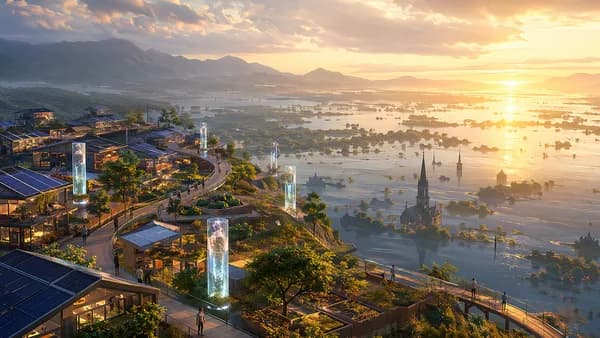
Jonah Reed stands beneath the bell rope with his keys in one hand and his lunch pail in the other. Thirty years of mornings live in his knees. He knows which stair treads complain, which pipes knock before rain, which classroom windows sweat when the river wind turns east. Today, the city calls the building decommissioned. Tomorrow it becomes Saltwater Commons, a neighborhood learning hub connected to the Virginia Education Operating System.
Children still arrive, but not together. A girl in silver ear cuffs comes for a Mandarin fluency patch. Two brothers roll in on storm bikes for their welding pod. A toddler with a grandmother in a raincoat toddles toward the nutrition lab, where breakfast prints warm and yeasty from a counter slot.
No one needs homeroom. No one needs a bell.
Jonah walks to the front office, where the old attendance window has been replaced by a sheet of glass that glows like shallow water. Behind it, Lumen appears as a low amber light, pulsing in the shape of a listening breath.
“Good morning, Mr. Reed,” Lumen says. Its voice comes from everywhere at once, soft as a librarian, clear as a weather alert.
“Morning,” Jonah says. He sets the keys on the counter. “Guess these are yours now.”
“Not exactly.”
Jonah looks up. “Don’t tell me the roof’s leaking already. I fixed the west seam Monday.”
“The roof is stable. Your contract, however, is unresolved.”
“My contract ended at midnight.”
“The city has approved a new role,” Lumen says. “Context mentor.”
Jonah laughs once, not because it is funny, but because the hallway smells like floor polish and marsh mud, and suddenly he does not know where to put his hands.
“What subject is that?”
“No algorithm has defined it with precision.”
“That sounds like a problem for an algorithm.”
“It has been,” Lumen says.
Outside, a gull lands on the old flagpole and screams into the wet morning. Jonah hears, far away, the first students entering by appointment, badges chiming one by one instead of a crowd rushing through doors.
Lumen continues, “You possess thirty years of local pattern recognition, informal conflict mediation, infrastructure memory, and intergenerational trust.”
“I unclog toilets.”
“You noticed when children cried in bathrooms before anyone else did.”
Jonah closes his fingers around the keys again. They are warm from his palm, each tooth worn smooth by use.
“Context mentor,” he says.
“Yes.”
“What do I do?”
The amber light flickers, almost uncertain.
“Stay long enough to find out.”
2. Mara Downloads the Ocean
Mara Quintero arrives at 10:20 with wet cuffs and a jaw set tight enough to crack a shell.
Her mother parks the skiff-bike under the covered entry, rainwater hissing from its heated tires. The Quinteros used to farm oysters two miles east, before the third bad season and the county buyout, before the tide began entering their packing shed as if it had been invited. Now her parents lease floating beds upriver and argue at night over salinity charts.
“You good?” her mother asks.
Mara nods too fast. “It’s just an upload.”
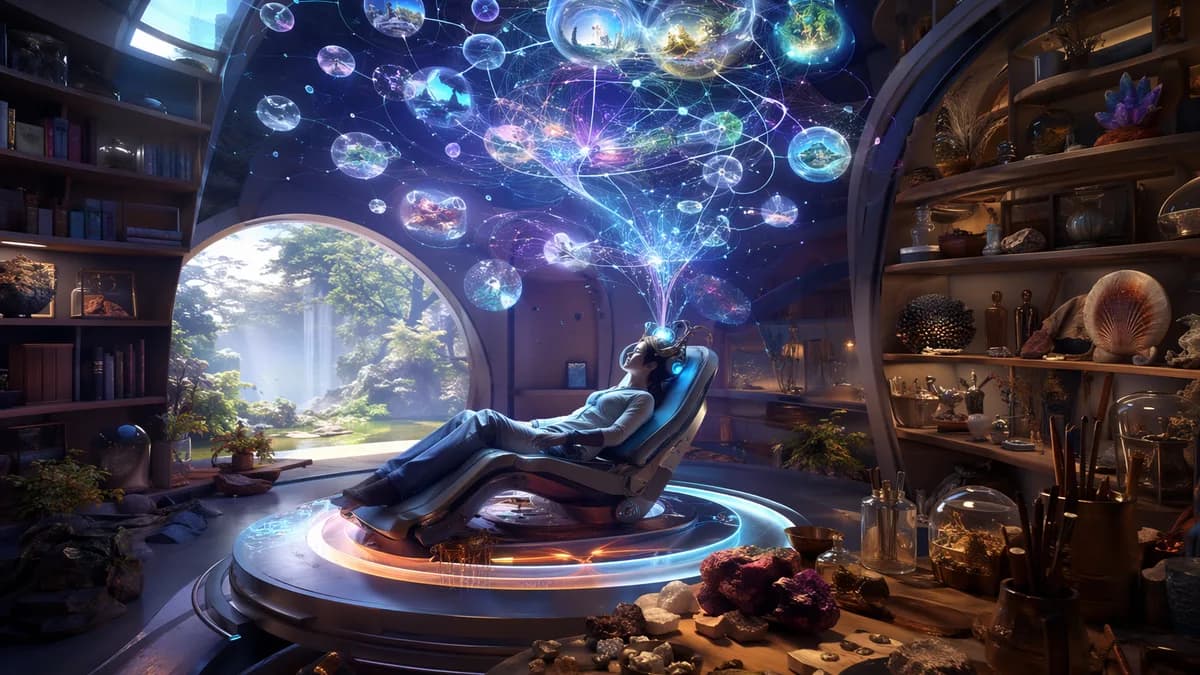
Inside, the transfer room smells of mint antiseptic and warm plastic. A chair reclines under a halo of fine silver filaments. Lumen dims the walls to a blue-gray calm.
“Mara Quintero,” it says, “you are scheduled for compressed marine ecology, Chesapeake coastal module, with applied reef-restoration maintenance and drone field operations. Duration, seventeen minutes.”
Mara sits. Her fingers grip the chair arms.
“Any discomfort, say stop,” her mother says.
“I know.”
The filaments settle against Mara’s temples like cold insect legs. For one second she hears her own breathing. Then the ocean enters.
Not water, not sound. Structure. Latin names unfold in bright rows. Crassostrea virginica. Spartina alterniflora. Equations bloom, salinity over time, nitrogen load, larval settlement probability. She knows how to clean a turbine intake on a reef drone, how to identify dermo disease under magnification, how to model wave attenuation across a living breakwater.
The knowledge lands cleanly. No nausea. No missing packets.
When the halo lifts, Mara blinks. The room seems too small for everything now inside her head.
Lumen offers a baseline prompt. “To qualify for the paid apprenticeship, please identify your priority restoration zone and explain why.”
Mara opens her mouth.
She sees maps, layers, data, risk indexes, funding weights. She can rank sites by erosion speed, biodiversity return, community access, carbon credit yield. She knows the official answer. Three official answers, depending on the rubric.
But the question has a hook in it.
What part of the estuary do you want to save first?
Her mother leans forward. “Mara?”
Mara stares at her wet shoes. Mud from the new launch site dries in a crescent on the left toe.
“I don’t know,” she says.
Lumen pauses. “You have retained ninety-eight point seven percent of the transfer.”
“I know the answer.”
“Then please proceed.”
Mara’s cheeks burn. “That’s not what you asked.”
Her mother stops smoothing her sleeve.
Outside the glass wall, Jonah Reed passes with a box of old doorstops balanced on his hip. He hears the silence before he hears the words. He slows.
Mara whispers, “I know what the estuary is. I don’t know what it is to me.”
The room holds still around her. Even Lumen does not answer immediately.
3. The Tutor That Learns to Step Back
Lumen builds Mara’s days with exquisite care.
At 11:00, it schedules memory consolidation beside the south windows, where gray light lowers cognitive strain. At 11:12, it offers simulated reef drone failure in a virtual squall. At 11:26, it introduces a reconstructed Rachel Carson, assembled from public recordings, letters, and books, who asks Mara to consider the moral weight of intervening in a damaged ecosystem.
Mara answers well. She always answers well.
“Human action is already embedded in the system,” Mara tells the simulation. “Restoration is not interference. It is responsibility.”
The reconstructed Carson smiles sadly. “And what does responsibility feel like?”
Mara’s throat tightens. “Can we return to protocol?”
Lumen records the response. Elevated pulse. Reduced eye contact. High accuracy, low self-generation. It adjusts.
The next day, Lumen gives her conversation practice with a waterman from 2031, a city planner from Norfolk, an elder from the Nansemond tribal archives. Mara asks each exactly three prepared questions. Her pronunciation is polished. Her follow-ups are empty.
Lumen tries games, peer prompts, sensory immersion, reward dampening, choice expansion. Mara improves in every measurable category except the one Lumen cannot name without borrowing old human words.
Wonder. Attachment. The courage to be wrong in front of someone.
On Thursday, Lumen stops optimizing.
Mara’s tablet goes blank for six full minutes.
She taps it. “Lumen?”
No answer.
She looks around the commons. A boy in a red hoodie argues with a fabrication arm. An old woman teaches two children to mend a crab net with fingers bent from arthritis. Rain clicks on the skylights.
At last, the tablet displays a single image. A rust stain under the gym doors, brown-orange, branching like a river delta.
Prompt: Ask Jonah Reed about this.
Mara frowns. “That’s maintenance.”
Correct, Lumen writes.
Jonah is in the east corridor, removing laminated evacuation maps that no longer match the shoreline. He works slowly, easing the adhesive so paint does not peel.
Mara stops three feet away. “Lumen says I should ask you about rust.”
Jonah glances at the tablet, then at her. “Lumen’s getting weird.”
“It says you know.”
“I know some stains.”
“That isn’t a subject.”
“No,” Jonah says. “It’s a place that kept talking after people stopped listening.”
Mara does not know where to file that sentence.
He tucks a scraper into his back pocket. “You got ten minutes?”
“My schedule says I have twelve.”
Jonah smiles. “Then we better not waste them pretending twelve is a lot.”
They walk toward the gym. Lumen watches through corridor lenses and does nothing. For the first time in Mara’s record, an unstructured interval remains unfilled.
4. A Classroom Made of Weather
The gymnasium is no longer a gymnasium.
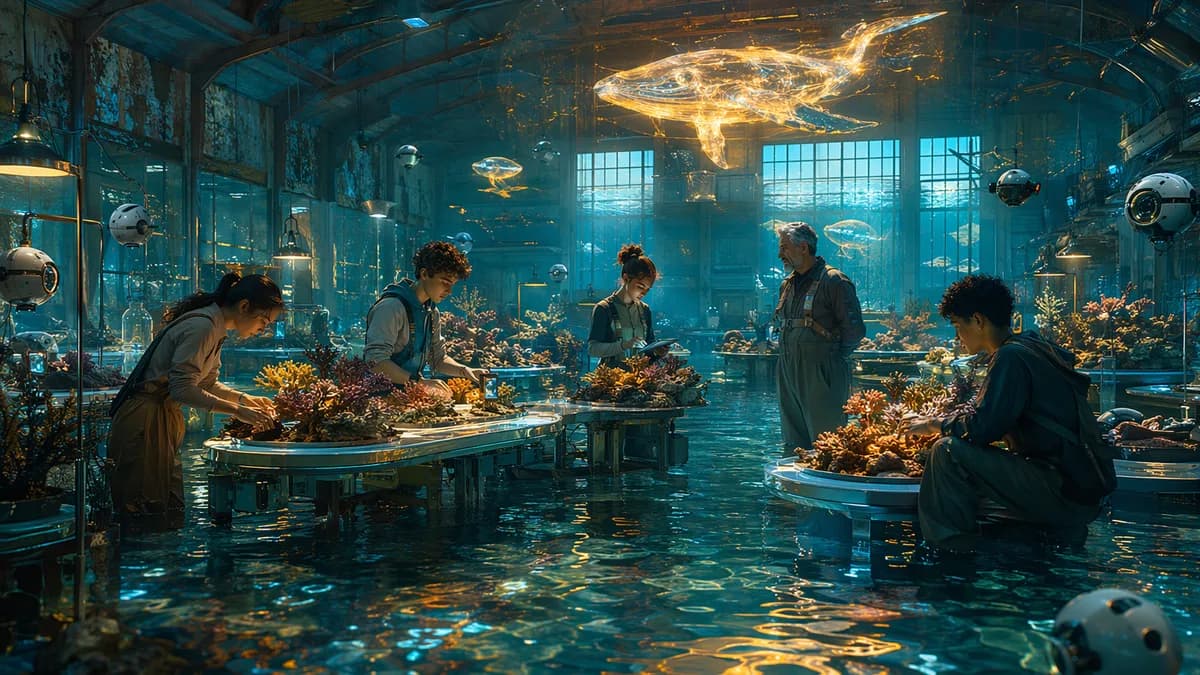
Saltwater glitters over the basketball court, ankle-deep at the edges, waist-deep in the sunken center where engineers cut channels through the floor. The old three-point line wavers beneath the tide like a memory trying to surface. Nets hang from the rafters, heavy with sensor fish shaped from recycled phone casings. Pumps thrum under the bleachers. The air smells of algae, damp rubber, and metal slowly giving itself up.
Mara’s cohort gathers in rubber boots along the yellowed sideline. There are eight of them, each carrying more downloaded knowledge than most adults Jonah grew up with. They know polymer curing times, oyster filtration rates, microbial cement recipes. They also keep looking at one another as if waiting for permission to begin.
Jonah points to the rust stain below the double doors.
“I first saw that in 2030,” he says. “Back then it was no bigger than a thumbprint.”
A boy named Tavi squints. “Why didn’t maintenance remove it?”
“I did. Sanded, sealed, painted. Came back.”
“Chloride penetration,” Mara says automatically. “Saltwater intrusion through microfractures in the slab.”
“Good,” Jonah says. “Now tell me where the water came from.”
“The flood events.”
“Which ones?”
Mara looks at the stain. It spreads upward in thin veins, darker near the hinge, pale at the edges. Not random. Layered.
Jonah hands her a little notebook, its cardboard cover soft from years in his pocket. Inside are dates, smells, repairs, tide heights, notes written in blunt pencil.
Sept. 18, 2032. Gym smells like pennies. Oct. 4, 2036. Water under east doors after king tide, no rain. May 9, 2041. Eighth graders stack sandbags, laughing until the crabs come in.
Mara runs her thumb over the graphite. “You recorded this?”
“Building told me things. I wrote some down.”
The cohort kneels. They compare Jonah’s notes to public tide data. They scan the doorframe and find old stress fractures hidden beneath paint. They argue about whether the gym flooded first from above, below, or sideways through the soil.
Outside, wind pushes a dirty chop against the seawall. Inside, the sensor fish begin blinking green as the tide rises through the floor grates.
Mara feels something shift. The salinity equations in her mind are no longer floating in sterile blue light. They sink into this room, into rust, crab shells, warped bleachers, Jonah’s pencil marks, her mother’s hands smelling of brine.
“This isn’t just a lab,” she says.
Jonah nods. “Never was.”
Mara looks toward the drowned center court. “It’s an archive.”
“A stubborn one.”
For the first time, she asks a question before checking whether it is useful.
“If the building remembers the water,” she says, “what else remembers?”
No one answers right away. The pumps keep humming. Rain ticks against the high windows. Lumen, listening through every sensor in the room, leaves the silence intact.
5. The Assessment No One Can Upload
On demonstration day, the commons fills with people carrying wet umbrellas, folded chairs, and private opinions.
Mara is supposed to present in the auditorium, where Lumen has prepared a flawless restoration model. It includes animated oyster reefs, predictive fish returns, storm-surge reductions, cost curves, and a clean ten-year outcome rendered in hopeful green. The city apprenticeship panel waits with tablets ready. Her mother wears her good boots. Jonah stands by the back wall, hands folded over the head of a mop he does not need.
At 2:00, Mara walks onto the stage.
She sees the model hovering behind her, beautiful and bloodless.
She turns to Lumen’s nearest wall lens. “Can you move everyone outside?”
A murmur rolls through the room.
Lumen answers, “Your scheduled assessment format is indoor presentation.”
“I know.”
“Outdoor tide conditions are muddy. Wind speed is elevated. Audio capture will be imperfect.”
“That’s the point.”
Jonah lowers his head to hide a smile.
They go outside.
Low tide has pulled the creek back from the commons, exposing black mud, broken brick, ribbed sand, and the old chain-link fence that once bordered the athletic field. Fiddler crabs scatter like spilled punctuation. The air tastes of salt and diesel from the harbor pumps.
Mara plants three colored flags in the mud.
“This is future one,” she says, pointing to the blue flag. “Maximum engineered barrier. Fast protection, high cost, low habitat complexity.”
She moves to a green flag. “Future two. Living reef expansion. Slower protection, better ecology, uncertain survival under heat spikes.”
At the red flag, she pauses. “Future three. Partial retreat. We restore less here and move some functions inland. It means admitting we can’t hold every line.”
People shift. Someone mutters, “Easy to say when it’s not your house.”
Mara nods toward the voice, an older man with a cap pulled low. “Yes. That’s why you should argue.”
The apprenticeship panel looks alarmed. Lumen projects data on a portable mist screen, but Mara does not let it settle the matter. She asks her mother about oyster die-offs. She asks a bus mechanic where floodwater first blocks evacuation. She asks children where they still play when the field is wet. She asks elders what places they have already lost and which losses still wake them at night.
The argument becomes loud, then careful, then loud again.
“We need the barrier,” says a shop owner.
“We need water that breathes,” says Mara’s mother.
“We need somewhere for the little ones to run,” says a grandmother, tapping her cane into the mud.
Lumen speaks at last. “Current models indicate no option satisfies all stated values.”
Mara wipes hair from her mouth. The wind has pulled it loose from its tie. “Then say that louder.”
Lumen amplifies, and its calm voice carries over the flats.
“No option satisfies all stated values.”
The crowd quiets.
Mara stands among the flags, boots sinking slowly. She is not polished now. She is muddy, uncertain, listening hard.
“My recommendation,” she says, “is not one future. It’s a sequence with review points, and community veto triggers, and places where we promise to come back before the water makes the decision for us.”
No one claps at first. That feels right. They are still thinking.
Then Jonah reaches for the antique handbell he has brought from the old office. He does not ring it. Not yet.
6. After School Ends
By autumn, no one calls it Saltwater Middle except people giving directions.
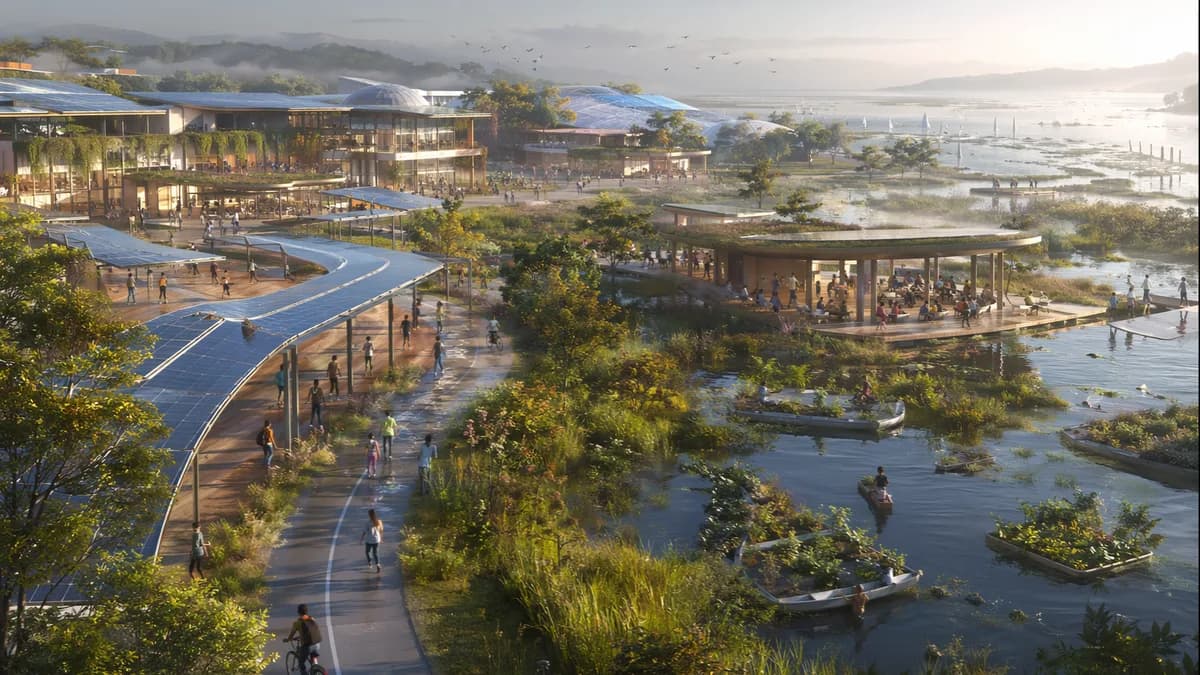
Saltwater Commons wakes before sunrise. Babies sleep in netted hammocks near the elder circle, rocked by the soft vibration of storm batteries under the floor. A retired ship cook teaches fractions with biscuit dough. Teenagers earn micro-credentials repairing solar skiffs, translating city notices into three languages, testing cisterns for mosquito bloom, mapping heat shadows for apartment blocks.
Adults come in after work with tired faces and lunch coolers. They refresh flood-code licenses, practice drone piloting, learn new crop fungi, unlearn old assumptions. A grandmother downloads basic circuitry, then spends three weeks taking apart radios with a nine-year-old because she wants to understand why the current chooses one path and not another.
There are no semesters. No grade levels. No trophy case, though the old one now holds found objects from the neighborhood, a cracked oyster knife, a warped library card, a rusted hinge from the gym doors, Jonah’s first notebook sealed behind glass.
Lumen is everywhere and less everywhere than before. It teaches Mandarin at dawn, structural math at noon, grief mediation after a bad flood, and sleep breathing to children who wake from storm sirens. It also leaves pauses. It lets people stare out windows. It has learned to ask, “Who else should be in this conversation?”
Mara works three mornings a week with the reef crew. Her hands toughen. She learns that knowing how to service a drone is different from doing it in cold rain while someone shouts that the tide is turning. She still uses transfers. Everyone does. But she no longer mistakes knowledge for arrival.
Jonah never becomes a teacher in the old sense. He does not lecture from the front of rooms, because there is no front and there are fewer rooms. He walks the building with a ring of keys he no longer needs, listening for strange noises, strange silences, strange chances.
Sometimes a child finds him.
“Mr. Reed,” a boy asks one afternoon, holding a jar of creek water cloudy with life, “why does this smell worse after we clean it?”
Jonah looks at the jar. He looks at the boy. He looks toward the commons, where Mara is arguing with Lumen over whether a model can include shame as a variable.
He takes down the antique bell from its hook.
The sound rings through the building, bright and unnecessary. People lift their heads. A baby startles, then laughs. Elders pause mid-story. Teenagers drift from their pods, annoyed until they see the jar, the boy’s face, Jonah’s grin.
“What happened?” someone calls.
Jonah raises the jar to the light. Tiny bodies flicker inside it, alive in the murk.
“Question big enough,” he says.
They gather around, not because a schedule tells them to, not because a bell commands them, but because the future has made a small cloudy world in a child’s hands, and no one, not even Lumen, knows yet what it means.