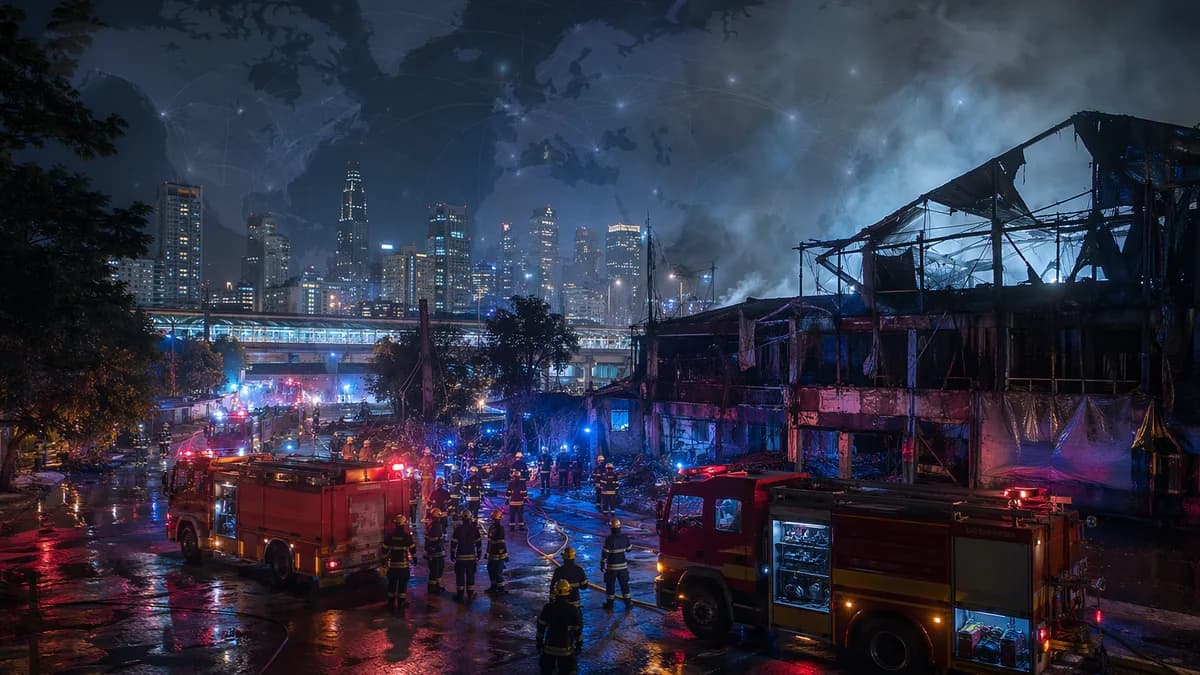
The Bangkok bar fire killed at least 27 people because a late-night venue appears to have become a trap faster than many inside could understand what was happening. For families and survivors, the immediate need is identification, treatment, compensation, and answers. For Thai authorities, the harder task is proving this was not just another preventable nightlife disaster filed away after the headlines fade.
XOOMAR Intelligence
Analyst Take
Thai authorities are investigating the blaze at the Na Ladprao music bar, which broke out shortly before midnight Sunday and injured dozens more, according to ABC International. The early evidence points toward a familiar and deadly mix: rapid fire spread overhead, thick smoke, crowd pressure, and escape routes that may not have functioned when people needed them most.
As we reported in 27 Die as Bangkok Bar Fire Engulfs Late-Night Crowd, this was not just a fire inside a bar. It was a mass-casualty event in a setting built around density, alcohol, music, low visibility, and enclosed movement. That combination demands more than ordinary commercial safety thinking.
Bangkok's deadly bar fire exposes the cost of treating nightlife safety like paperwork
The central question is not only what sparked the Bangkok bar fire. It is why conditions inside the venue allowed smoke and flames to overwhelm so many people so quickly.
Videos shared online by witnesses showed flames engulfing the bar as thick black smoke poured from the front entrance and people scrambled to escape. Photos and videos from Monday showed investigators inside a gutted building, with the heaviest damage overhead. Large sections of ceiling were destroyed, blackened, and charred, while tables below were covered in ash and debris.
That pattern matters. If a fire races across the ceiling, patrons below may lose visibility and breathable air before they can orient themselves. In a bar, reaction time is already compromised by loud music, alcohol, crowding, and unfamiliar exits.
XOOMAR analysis: Nightlife venues carry a different risk profile from standard retail or office spaces. The same design choices that create atmosphere, including soundproofing, ceiling decorations, dark interiors, tight layouts, and controlled entry points, can become lethal if materials burn fast or exits bottleneck.
Investigators are mapping a risk profile: 27 dead, dozens injured, four exits under scrutiny
The confirmed toll stands at at least 27 people killed and dozens injured. BBC reporting from the supplied material says 73 people were injured, including 25 in critical condition, while authorities said nine men and 18 women were killed. Casualty figures can shift as hospitals, families, and forensic teams reconcile records, but the scale is already clear.
The investigation now has to map more than the death count. The useful numbers are operational:
| Risk factor | Source-supported detail |
|---|---|
| Deaths | At least 27 killed |
| Injuries | Dozens injured, BBC reported 73, including 25 critical |
| Timing | Fire broke out shortly before midnight Sunday |
| Building layout | Police said the single-story bar had four exits |
| Exit concerns | Police are examining whether two rear exits were blocked or unusable |
| Fire spread | Damage appeared heaviest overhead, with ceiling sections destroyed |
| Possible ignition | A musician told Thailand Prime Minister Anutin Charnvirakul he saw smoke near a circuit breaker before power failed |
| Other inquiry lines | Police are examining ceiling materials, wiring, and whether gas canisters in the kitchen contributed |
One detail cuts through the technical language: most victims were found near the restrooms, according to the AP source material. Police chief Kittharath Punpetch said one exit near the restrooms had a table blocking the way, while another near the kitchen had a damaged exit sign and a sliding door missing its handle.
If confirmed, those details would point to a brutal evacuation problem. A fire does not need to consume an entire room to kill. Smoke, panic, and a blocked path can do the work first.
Ceiling materials, wiring, and gas canisters sit at the center of the technical inquiry
Thailand Prime Minister Anutin Charnvirakul said a musician performing at the bar told him he saw smoke coming from a circuit breaker near the stage before the power went out. An explosion was then heard, and thick smoke quickly filled the bar.
Fire safety professor Lee Young Ju of South Korea’s Kyungil University said the fire may have been caused by an electrical fault, possibly involving audio or lighting equipment or faulty wiring, which then spread quickly across the ceiling. That remains an expert assessment, not an official cause.
Huang Xinyan, a professor at Hong Kong’s Polytechnic University, said footage suggested the bar contained combustible foam materials, lacked a sprinkler system, and had small exits that may have slowed evacuation. He also said plastic ceiling decorations may have combined with combustible foam soundproofing materials, potentially fueling the fire’s rapid spread.
Lee added a caution that matters for investigators: even if sprinklers had been installed, it is unclear whether they would have slowed a fire spreading across the ceiling, because sprinklers are not designed to extinguish fires burning overhead.
So the inquiry cannot stop at the first spark. It has to answer how the ceiling was built, what materials were used, how wiring was installed overhead, whether gas canisters contributed, and whether exits were usable under pressure.
Thailand and the world have seen this pattern before
The Bangkok bar fire fits a grim global category: entertainment venue fires where victims have little time, poor visibility, and too few workable paths out.
AP cited a fire in the Swiss ski resort town of Crans-Montana in the early hours of New Year’s Day that killed about 40 people and injured more than 100. It also cited the 2013 Kiss nightclub fire in Santa Maria, southern Brazil, which killed more than 200.
BBC’s supplied reporting adds Thailand’s own history: a 2022 bar fire south of Bangkok killed 22 people, and on 1 January in 2009, 66 people died in a Bangkok nightclub fire that injured more than 200 others during New Year celebrations.
The recurring pattern is not mysterious after the fact. Experts in the source material point to crowded rooms, flammable interiors, obstructed exits, fast smoke buildup, and panic.
“Once there was a rapidly growing fire, large (numbers) of casualties might occur due to high density of people and fast accumulation of smoke,” Jiang Liming of Hong Kong’s Polytechnic University said.
XOOMAR analysis: The uncomfortable lesson is that entertainment venue fires rarely become catastrophic because of one defect alone. They become catastrophic when several weak points align: ignition, fuel, smoke, crowd behavior, and failed escape geometry.
Families, venue operators, officials, and tourists will read the fire differently
For families and survivors, accountability starts with names, medical care, and transparent updates. BBC’s supplied reporting says authorities announced 29,300 Thai baht ($880; £660) for families of deceased victims and 4,000 baht ($120; £90) for those receiving hospital treatment. That will not answer why people were trapped, but it shows the state has already moved into damage response.
For venue owners and workers, the fire raises a different pressure point. More inspections and temporary closures may follow, especially in bars with similar ceiling treatments, tight exits, or unclear evacuation routes. The risk is selective enforcement, where compliant venues absorb costs while unsafe operators adapt until attention fades.
Tourists and local patrons face the simplest practical lesson. Licensed does not always mean safe in the way customers assume. In an unfamiliar venue, a blocked rear exit, a narrow corridor, a missing handle, or a crowd packed against one entrance is not background detail. It is risk hiding in plain sight.
For Thai officials, public confidence now depends on whether the inquiry stays narrow or widens to the venue’s full safety chain. The source material does not yet provide inspection records, capacity approvals, prior complaints, or licensing findings. Those gaps matter because physical evidence can explain how the fire spread, but records may show whether warning signs existed before Sunday night.
Bangkok nightlife faces a harder safety test after the fire
The immediate watch item is forensic confirmation: ignition source, ceiling materials, wiring condition, gas canister role, sprinkler status, and whether the two rear exits were blocked or unusable. Those findings will determine whether this is treated as an isolated venue failure or evidence of broader safety weaknesses in nightlife enforcement.
A stronger response would focus on observable risks first: flammable ceiling installations, combustible soundproofing, blocked exits, damaged signs, missing handles, and crowding inside enclosed venues. Those are not abstract compliance issues. They decide whether customers can leave before smoke wins.
The thesis will strengthen if investigators confirm that obstructed exits, combustible overhead materials, or faulty electrical systems materially worsened the toll. It will weaken if the evidence shows a sudden, unusual ignition event with safety systems functioning as designed.
Either way, 27 deaths have turned the Bangkok bar fire into a test of whether nightlife safety is enforced before tragedy, not audited afterward.
Impact Analysis
- The fire killed at least 27 people and raised urgent questions about whether basic escape routes and safety systems failed.
- The disaster highlights how crowded nightlife venues can become deadly when smoke, flames, alcohol, and limited visibility collide.
- Thai authorities now face pressure to deliver accountability, compensation, and stronger enforcement before another preventable tragedy occurs.
Primary Sources & Disclosures

Written by
XOOMAR Insights Team
Research and Editorial Desk
The XOOMAR Insights Team pairs automated research with human editorial judgment. We track hundreds of sources across technology, fintech, trading, SaaS, and cybersecurity, cross-check the facts, and explain what happened, why it matters, and what to watch next. We do not just rewrite headlines. Every article is fact-checked and scored for reliability before it goes live, and we link back to the original sources so you can verify anything yourself.