
Jay-Z could have buried Yankee Stadium under fireworks and nostalgia bait. Instead, the Jay-Z Yankee Stadium concert worked because it made the opposite bet: strip the stage back, load the night with history, and let New York fill in the rest.
Global TrendsJuly 11, 2026· 12 min read· By XOOMAR Insights Team
Jay-Z Yankee Stadium Concert Turns Memory into Power
Updated on July 11, 2026
XOOMAR Intelligence
Analyst Take
57/ 100
4 sources analyzedLow confidenceTrend10Freshness97Source Trust88Factual Grounding86Signal Cluster20
The show marked the 30th anniversary of Reasonable Doubt and sat inside a three-night Yankee Stadium run tied to both Reasonable Doubt and The Blueprint, according to Wired. The headline was Beyoncé, Nas, Alicia Keys, Blue Ivy Carter, and Jaz-O appearing around Jay-Z. The deeper story was control. Control over catalog. Control over scarcity. Control over how a 1996 street-level debut gets recast as civic memory in 2026.
Jay-Z Turned Reasonable Doubt Into a New York Power Play, Not a Nostalgia Trip
The expected anniversary playbook is familiar: perform the classic album, invite the original collaborators, sell the merch, let fans relive the release year. Jay-Z did some of that. But the Jay-Z Yankee Stadium concert didn’t feel like a museum event for Reasonable Doubt. It felt like a live argument that the album still explains him.
Willo Perron, who planned the anniversary shows, told Wired the production philosophy was deliberately restrained.
“I think the statement piece in a Jay-Z show is Jay-Z,” Perron said. “This is more about storytelling than it is about stage design.”
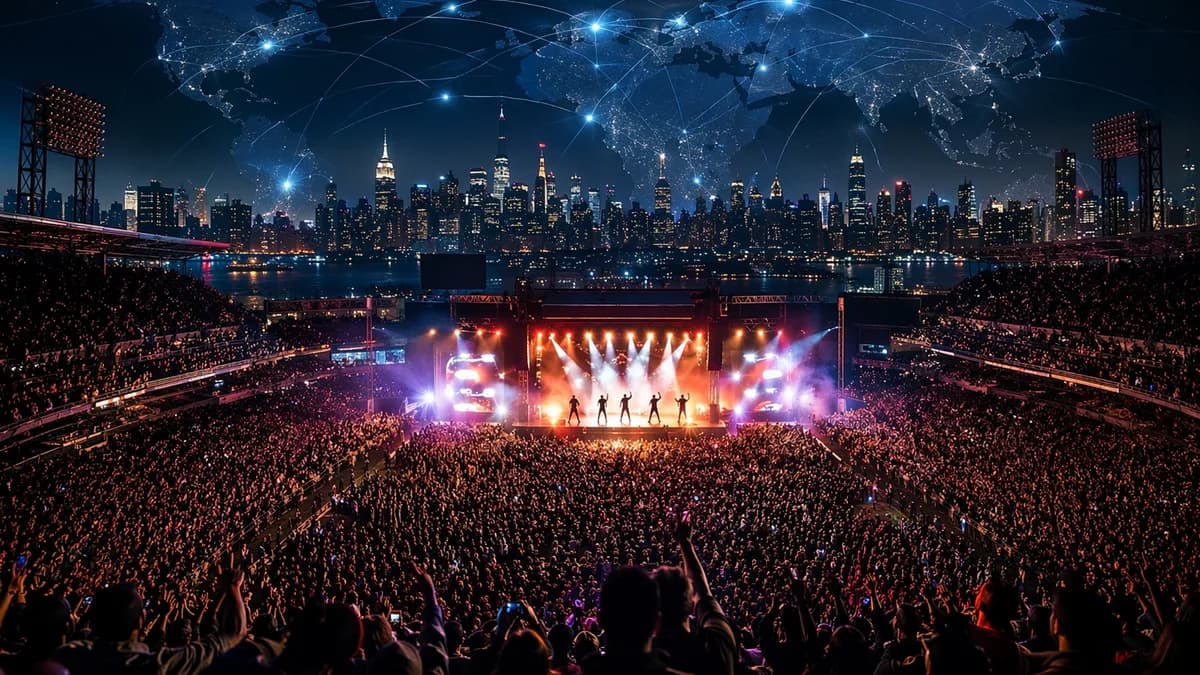
That decision matters. Jay-Z didn’t need to recreate 1996 with props. He could put the album’s ambition in front of some 45,000 people, at Yankee Stadium, with a 10-person band, an 18-piece string section, and a 2,952-square-foot outfield-spanning screen showing images from his early New York years. The scale did the talking.
XOOMAR analysis: That’s the move beneath the move. Reasonable Doubt began as a document of hunger and self-invention. At Yankee Stadium, Jay-Z treated it as a founding text. Not frozen. Not sentimental. Still useful.
The surprises made the night feel alive rather than commemorative. Beyoncé sang the chorus on “Can’t Knock the Hustle,” originally performed by Mary J. Blige. Nas joined for “Dead Presidents,” a song built around a sample from “The World Is Yours.” Blue Ivy Carter played keys on “Feelin’ It.” Jaz-O appeared too. Each guest widened the story without pulling Jay-Z out of the center.
The Numbers Behind Jay-Z’s Yankee Stadium Concert Gamble
The Jay-Z Yankee Stadium concert was a scarcity product wearing the clothes of a hometown celebration. It started as two shows: one for 1996’s Reasonable Doubt, one for 2001’s The Blueprint. A third Sunday show, called “Extra Innings,” was added after the first two sold out quickly.
Scott Krug, the Yankees’ chief financial officer, put it bluntly:
“The tickets sold as quickly for this event as any that I've ever seen,” Krug told Wired.
The source material does not provide ticket prices, resale data, sponsorship terms, or production costs. So the economics can’t be quantified responsibly. But the structure is clear enough to analyze.
Before vs. after the anniversary show model:
- Before: Catalog anniversaries often leaned on linear nostalgia, album memories, and predictable set lists.
- After: Jay-Z turned the anniversary into a limited-run civic event, where attendance carried social status because the guest list and set list weren’t fully knowable in advance.
- Before: A stadium show could be judged mostly by production size.
- After: This show turned restraint into premium positioning. The guests, not the machinery, created the shock value.
- Before: Fans bought access to songs they already knew.
- After: Fans bought the chance to witness who might walk out next.
That last point is central. Beyoncé changed the value of the opening minutes. Nas changed the historical meaning of “Dead Presidents.” Alicia Keys turned “Empire State of Mind” into a full New York ceremony after introducing it with Billy Joel’s “New York State of Mind.” The value proposition shifted in real time, inside the stadium and across social feeds.
Perron also understood that every minute would be captured for Instagram, TikTok, and other platforms. But he rejected designing the show purely for viral clips.
Trying to design a show just for the ’gram “has really hindered good shows,” Perron said.
That line explains why the night traveled online without feeling built only for online consumption. Jay-Z’s surprise guests created shareable moments. The stage design did not beg for them.
Complex framed the run as a three-night Yankee Stadium event, with Reasonable Doubt on the first night, The Blueprint on the second, and “Extra Innings” as the third set, according to Complex. That format gave the run scarcity without making it random.
From 1996 Hustler Mythology to 2026 Stadium Canon: How Reasonable Doubt Changed Shape
Reasonable Doubt has always carried tension. It’s a debut album about ambition, paranoia, money, loyalty, and escape. In 1996, that story belonged to a rapper building from Brooklyn with a sharply controlled sense of self. In 2026, the same material lands differently because Jay-Z is also a billionaire industry mogul, a family patriarch, and one of New York’s most visible cultural exports.
That shift could have made the anniversary awkward. The album’s original anxiety doesn’t neatly fit the current power position. Jay-Z solved that by refusing to pretend nothing had changed.
The setting did the reinterpretation. Yankee Stadium made Reasonable Doubt feel less like a cult classic and more like a civic monument. The outfield screen showed early New York images, the stage stayed bare, and the performance leaned into biography without becoming a reenactment.
The stadium logistics sharpened the point. Because the concerts took place during baseball season, nothing was allowed on the diamond. Perron turned that restriction into a design feature, covering the area with a vinyl-mesh cover that doubled as a projection screen. During Friday’s show, it carried a live feed of Jay-Z’s performance.
Krug said protecting the 3-acre field was the Yankees’ top operational concern. No vehicles were allowed on the diamond, and the outfield areas used for seating were covered in polypropylene panels designed not to dig into the Kentucky bluegrass beneath. The Yankees were due to host the Los Angeles Dodgers the next Friday.
“At the end of the day, our responsibility, our primary responsibility, is for baseball,” Krug said. “So when the team comes back next Friday, we have to make sure that the playing field is in the best possible condition.”
XOOMAR analysis: That’s a useful metaphor, but only one is needed. Jay-Z’s catalog was being honored on ground that couldn’t be damaged. The past had to carry the show, but the field still had to be playable afterward.
Beyoncé, Nas, and Alicia Keys Made the Stage a Map of Jay-Z’s Alliances
The guest list told a compressed history of Jay-Z’s world.
| Guest | Song or role cited in source | What the appearance signaled |
|---|---|---|
| Beyoncé | Sang on “Can’t Knock the Hustle” | Family, pop dominance, and opening-night voltage |
| Nas | Joined “Dead Presidents” | Rivalry converted into shared canon |
| Alicia Keys | Joined “Empire State of Mind” after playing Billy Joel’s “New York State of Mind” | New York grandeur and civic release |
| Blue Ivy Carter | Played keys on “Feelin’ It” | Generational handoff inside the family story |
| Jaz-O | Appeared as Jay-Z’s mentor | Origin story and old ties restored in public |
USA TODAY Network, via AOL, reported that Jay-Z opened around 9:27 p.m. in a New York bomber jacket and matching fitted cap, with Beyoncé joining on “Can’t Knock the Hustle,” according to AOL. The same report said Blue Ivy Carter played piano during “Feelin’ It” and that Jay-Z called her “the legendary Blue Ivy Carter.”
Wired also captured one of the night’s sharper lines:
“They said I sold out,” Jay-Z said from the stage. “Hell yeah, I sold out. Three nights. Yankee Stadium.”
That line worked because it carried two meanings at once. It answered old accusations about commerce while bragging about actual sellouts. It also fit the larger New York argument around wealth, access, and belonging.
Isra Ali, a professor of media, culture, and communication at NYU Steinhardt, told Wired that this summer had “a very explicit component” of “the people versus the billionaires.” Jay-Z sits inside that tension. He grew up in Bed-Stuy. He is also a billionaire mogul. The show gave him a way to inhabit both identities without resolving the contradiction.
The Knicks were part of the wider context too. Ali wondered before the show whether Jay-Z might bring them out for “Empire State of Mind.” He didn’t. OG Anunoby was spotted in the audience, but the performance stayed Jay-Z’s story, not the Knicks’ victory lap.
That absence mattered. The show used the city’s sports emotion without surrendering the stage to it.
New York’s Chaotic Summer Turned Jay-Z’s Yankee Stadium Concert Into Civic Theater
The Jay-Z Yankee Stadium concert landed during what Wired framed as an unusually charged New York summer, with the city’s music, sports, and civic energy already pressing in around the stadium run.
By the time the concerts arrived, “Empire State of Mind” had become part of the city’s broader soundtrack, alongside Frank Sinatra’s cover of “Theme From New York, New York.” That raised expectations. Jay-Z wasn’t just returning home. He was stepping into a city already performing itself.
The broader public mood matters here. Wired cited a Royal Philharmonic Orchestra survey finding that 78 percent of respondents believed live performance was one part of the arts where “AI will not touch human creativity.” The source also noted artists like Phoebe Bridgers choosing smartphone-free shows to keep concerts more intimate.
XOOMAR has tracked a similar hunger for real-world anchors across very different 2026 stories, from summer culture in Best Summer Books Turn Escape Into a Survival Guide to public anxiety around costs in Tariff-Driven Price Hikes Threaten to Haunt 2026 Inflation. Jay-Z’s event sits in that wider appetite for shared experiences that feel difficult to fake, download, or fully replay.
Yankee Stadium intensified that effect. Krug said the venue can usually host only one or two concerts per year because of baseball and NYCFC soccer matches. That makes the booking window narrow and selective.
“So that's one of the reasons that we're a little bit, say, picky or particular about who it is,” Krug said, “because we really want to make sure we have the best possible artist for that small window that we have.”
Jay-Z fit that window because the venue wasn’t neutral. Bronx stadium. Brooklyn origin story. New York anthem. Charged summer. The city became part of the production.
Jay-Z’s Surprise-Filled Show Raises the Bar for Legacy Hip-Hop and Premium Live Events
The obvious industry read is that veteran rappers with major catalogs will study this model. The careful version of that claim is narrower: this show demonstrates that a catalog anniversary can be built as a scarce, high-attention stadium event when the artist has enough city identity, cross-generational draw, and guest relationships to sustain it.
Not every artist has those ingredients. Jay-Z does.
The concert also reset fan expectations. If a show is marketed as a rare anniversary event and sells out quickly enough to add another date, fans will expect more than a clean album run-through. They’ll expect unrepeated moments. They’ll expect guests. They’ll expect the feeling that being in the building mattered.
That creates pressure.
If every anniversary event tries to become a blockbuster, surprise fatigue follows. If every set hides its guest list, secrecy becomes routine. If every legacy artist prices the moment as scarce without delivering a night that feels singular, the model breaks.
Jay-Z avoided that trap because the surprises were not random celebrity cameos. They were narrative nodes.
- Beyoncé linked the first song to family and global pop power.
- Nas turned an old competitive history into shared New York memory.
- Alicia Keys gave the city its cathartic anthem.
- Blue Ivy Carter made the family succession visible.
- Jaz-O pulled the origin story back into frame.
The staging helped by not competing with those meanings. Perron’s bleachers on each side of the stage put hardcore fans close to the action, echoing Jay-Z’s early club days at venues like The Tunnel. Perron said Jay-Z had sent him a video of an older concert where people appeared almost onstage, prompting the idea to “maybe just put people on stage.”
That choice made intimacy visible inside a stadium.
Jay-Z’s Next Era Points to Rare Appearances, Catalog Control, and Stadium-Sized Mythmaking
The practical takeaway is not that Jay-Z needs to tour more. It’s the opposite. The Yankee Stadium run suggests his live business works best when appearances stay rare, stakes stay high, and the catalog is framed as an asset he can reactivate on his own terms.
The leadup already showed that strategy. Wired reported that Jay-Z partnered with Spotify for a takeover of parts of the New York City subway, worked with Brooklyn Public Library on special “JAŸ-Z30” library cards, and set up a Dumbo pop-up shop in a warehouse featured in the “Dead Presidents” video. Those were not just promo stops. They placed the album across transit, public memory, retail, and local geography before the stadium lights came on.
The next evidence to watch is whether this becomes packaging rather than a one-off: more tightly curated catalog milestones, more city-specific activations, and possibly more limited-run events built around albums instead of conventional tours. The supplied sources do not confirm streaming specials, documentaries, or new brand deals tied to these shows, so those remain scenarios, not facts.
The thesis would be confirmed if future Jay-Z appearances stay limited but expand the surrounding cultural footprint: library cards, subway takeovers, pop-ups, stadium nights, and guest lists that rewrite old chapters in public. It would weaken if the model turns into a routine anniversary circuit, where scarcity disappears and surprise becomes just another line item.
For now, the Yankee Stadium show lands as a clean statement. Jay-Z didn’t simply celebrate Reasonable Doubt. He repriced its meaning in front of New York.
Why It Matters
- The concert reframed Reasonable Doubt as more than nostalgia, positioning it as part of New York’s cultural history.
- Jay-Z’s restrained production showed how scarcity and control can create more impact than spectacle.
- The surprise appearances from Beyoncé, Nas, Alicia Keys, Blue Ivy Carter, and Jaz-O turned the show into a generational hip-hop moment.
Anniversary Concert Playbook vs. Jay-Z’s Yankee Stadium Approach
| Typical Anniversary Show | Jay-Z Yankee Stadium Concert |
|---|---|
| Leans on nostalgia and recreating the release era | Used restraint and scale to recast Reasonable Doubt as civic memory |
| Often centers album performance, original collaborators, and merch | Centered Jay-Z’s storytelling, catalog control, and selective surprise guests |
| Production can rely on spectacle like fireworks and props | Used a stripped-back stage, live musicians, and archival New York imagery |
Jay-Z Yankee Stadium Live Music Setup
Band members
people10
String section
people18
Sources

Written by
XOOMAR Insights Team
Research and Editorial Desk
The XOOMAR Insights Team pairs automated research with human editorial judgment. We track hundreds of sources across technology, fintech, trading, SaaS, and cybersecurity, cross-check the facts, and explain what happened, why it matters, and what to watch next. We do not just rewrite headlines. Every article is fact-checked and scored for reliability before it goes live, and we link back to the original sources so you can verify anything yourself.
Explore More Topics
Related Articles
 Global Trends
109 Heat Index May Trap New York in Dangerous Humidity
New York's heat index could near 109, making humidity the real danger as Northeast cities brace for extreme holiday heat.
Jul 4, 20268 min
 Global Trends
400 Cases Send CDC Chasing 18-State Cyclospora Trail
More than 400 cyclospora cases across 18 states have no confirmed source, leaving the CDC chasing scattered food-safety clues.
Jul 3, 20268 min
 Global Trends
Tehran Turns Khamenei Funeral Into Revenge Warning
Tehran turned Khamenei's funeral into a loyalty test and revenge signal, but inflation, fear and absences exposed a divided Iran.
Jul 7, 20268 min
 Global Trends
Trump FIFA Call Turns Balogun Ban Into World Cup Scandal
Trump's call helped clear Balogun, but it blew up FIFA's claim to neutral World Cup discipline.
Jul 6, 20267 min
 Global Trends
16 Girls Dead as Kenya School Fire Turns Into Murder Case
Kenya plans murder charges against students after the Utumishi Girls' School fire killed 16 teenage pupils and injured dozens.
Jul 5, 20266 min
 Fintech
Sony Stablecoin Bank Clears U.S. Hurdle With $40M Bet
Sony Bank won conditional OCC approval for a $40M U.S. trust bank, but its stablecoin can't launch until final approvals arrive.
Jul 10, 20266 min
 Technology
Sony 1000X Exposes Bowers & Wilkins Px8 S2's Flaw
Sony looks like the smarter long-wear pick. The Px8 S2 trades comfort for luxury materials, battery life, and richer sound.
Jul 11, 20267 min
 Technology
Fat Tires Devour Mud in This Hiboy P6 Ebike Review
The Hiboy P6 wins on mud, gravel, and bad pavement, but its fat-tire confidence comes with real city bulk.
Jul 11, 20267 min
 Global Trends
10 Die as Bahamas Plane Crash Shakes Island Routes
A Cessna 402 crash killed nine passengers and a pilot, putting Bahamas small-aircraft safety and oversight under scrutiny.
Jul 11, 20267 min
 Trading
Delta Airfares Stay High as $1.4B Profit Tests Flyers
Delta says fares can stay high even after oil falls, after posting $1.4 billion profit and passing 60% of fuel costs to flyers.
Jul 11, 20266 min
Don't miss the signal
Get our weekly roundup of the stories that matter across tech, fintech, and trading. No noise, just signal.
Free forever. No spam. Unsubscribe anytime.