
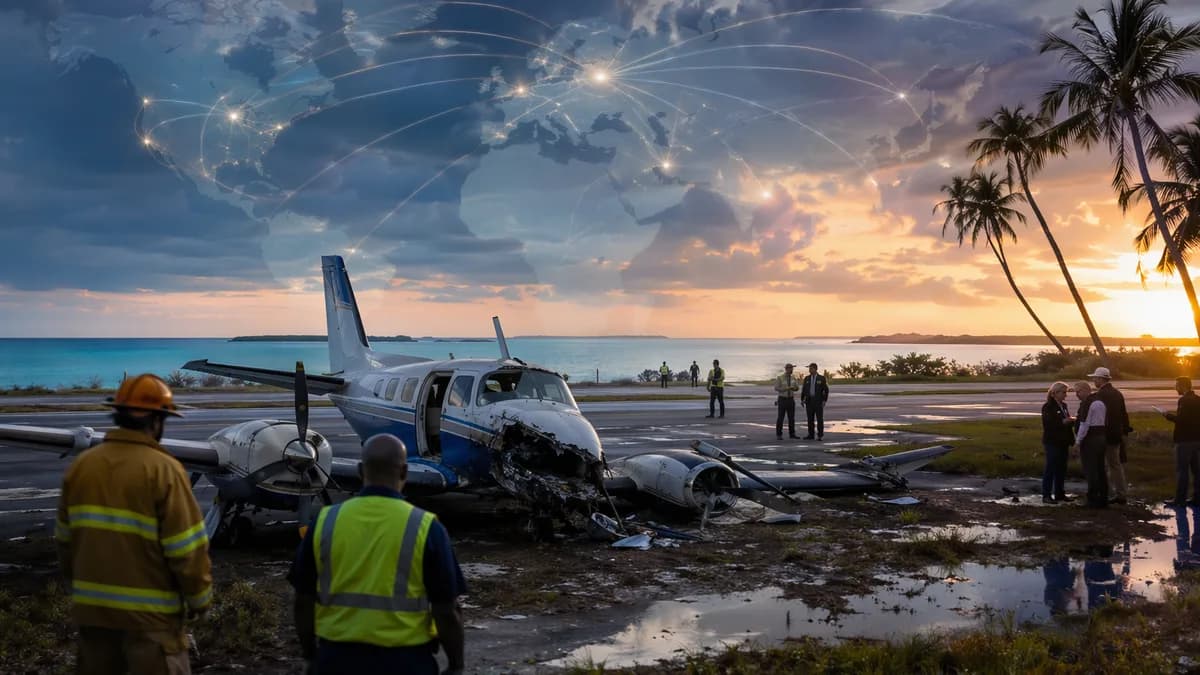
The Bahamas plane crash turned a national celebration into a test of public trust in small-aircraft travel after nine passengers and a pilot died on a short inter-island flight.
Global TrendsJuly 11, 2026· 7 min read· By XOOMAR Insights Team
10 Die as Bahamas Plane Crash Shakes Island Routes
Updated on July 11, 2026
XOOMAR Intelligence
Analyst Take
58/ 100
4 sources analyzedLow confidenceTrend10Freshness96Source Trust92Factual Grounding88Signal Cluster20
The aircraft had left Lynden Pindling International Airport near Nassau for San Andros Airport when it “reportedly encountered difficulties” and crashed into bushes before landing, according to BBC World. The crash happened on the Bahamas’ 53rd independence anniversary, giving the disaster a national weight beyond the aviation file.
XOOMAR analysis: the central question is not only what brought down this Cessna 402. It is whether the safety, oversight, and communication systems around small-aircraft routes can withstand scrutiny when one flight fails so publicly, and so devastatingly.
For a concise breaking-news version of the same incident, see XOOMAR’s earlier update: Bahamas Plane Crash Kills Several, Grounds Flamingo Air.
A day of celebration became a national aviation crisis
Prime Minister Philip Davis captured the contradiction bluntly.
“Today is a day of celebration but it has become a day of mourning,” Davis told a media conference.
He added:
“Once again, a chapter in our nation's story has been marked by tragedy.”
That language matters. Officials did not frame the Bahamas plane crash as a routine transport incident. They placed it inside the country’s national story, partly because of the date, partly because all 10 people on board ultimately died.
Davis initially said there was one survivor. Hours later, he confirmed that person had died from their injuries. The victims’ names, ages, and other details have not been released.
That restraint is appropriate. In fatal crashes, the public wants names quickly, but families need notification first. The investigation also needs room to establish facts before political anger, grief, and speculation harden into a public narrative.
A short Nassau-to-San Andros flight ended with 10 deaths
The confirmed facts are stark:
- Death toll: 10 people, including nine passengers and one pilot
- Aircraft: Cessna 402
- Operator: Flamingo Air, a Bahamas-based airline
- Route: Lynden Pindling International Airport to San Andros Airport
- Crash phase: before landing, after the aircraft reportedly encountered difficulties
- Location described by officials: bushes prior to landing
- Regulatory response: temporary suspension of Flamingo Air’s air operator certificate
The Bahamas is an archipelago, and this was a short island route. XOOMAR analysis: that geography makes small-aircraft operations more visible and more socially important than they might be in larger mainland markets. When a route like this suffers a fatal crash, the consequences are not abstract. Families, local communities, pilots, airport staff, and passengers all feel the shock quickly.
The harder analytical point is risk perception. Large commercial aviation often conditions travelers to expect near-total reliability. Smaller aircraft on regional routes are judged differently by regulators and operators, but passengers rarely separate those categories emotionally. A crash involving 10 deaths collapses that distinction for the public.
Flamingo Air’s grounding shows caution, not a finding of fault
The Ministry of Aviation temporarily suspended Flamingo Air’s air operator certificate as a “precautionary safety measure.” It also said the grounding “should not be treated as an adverse compliance action against Flamingo Air.”
That wording is doing heavy work. It tells the public that officials are acting, while also warning that the suspension is not a conclusion about blame.
The ministry said there had been two safety incidents on Friday. Aviation Minister JoBeth Coleby-Davis told reporters that a Flamingo Air plane had earlier routed back to Nassau after the pilot reported an issue. After that aircraft landed and passengers had disembarked, a fire broke out on board, CBS News reported via the BBC.
The same-day sequence will intensify scrutiny, even if the two incidents turn out to be unrelated.
Before vs. after Friday’s events:
- Before: Flamingo Air operated as a Bahamas-based carrier on domestic routes.
- After: its air operator certificate was temporarily suspended while officials investigate.
- Before: the crash route was a short trip from Nassau to San Andros.
- After: that route became the center of a national investigation.
- Before: independence day was a public celebration.
- After: the prime minister described it as a day of mourning.
Flamingo Air told local media:
“At this time, the details are being gathered, and we are committed to cooperating with the relevant authorities.”
The BBC said it has contacted the airline for comment.
Families, passengers, pilots, and regulators now want different answers
The Bahamas plane crash will produce several overlapping demands.
Families will want identification, timelines, accountability, and direct communication before details surface publicly. Passengers will want to know whether Flamingo Air flights, and similar small-aircraft services, are safe to board. Pilots may focus on factors investigators have not yet established, including aircraft condition, operational decisions, weather, airport conditions, and the final moments before landing.
Regulators face a different pressure. Their job is to preserve evidence, reconstruct the flight, examine the operator’s procedures, and resist premature conclusions. The public wants speed. Investigations require sequence.
Travel operators and local businesses may also watch the response closely. That is XOOMAR analysis, not a reported finding from officials. A single fatal crash can unsettle confidence, especially when the government grounds an operator on the same day. The fastest way to limit damage is not reassurance by slogan. It is clear disclosure of verified facts.
For readers tracking how governments handle deadly events under public pressure, XOOMAR’s wider global coverage includes Rohingya Camp Landslide Buries School, Kills 5 Children, another case where identification, grief, and official response sit at the center of public attention.
The investigation has to answer more than one technical question
The Aircraft Accident Investigation Authority said the plane “reportedly encountered difficulties.” That is a starting point, not an explanation.
A serious inquiry will likely need to establish the aircraft’s condition, the flight’s timeline, communications with air traffic or ground personnel if any were involved, conditions near San Andros, and the sequence between the first reported difficulty and the crash into bushes before landing. The source material does not identify the cause. It also does not provide weather details, maintenance records, pilot history, or airport infrastructure information.
That gap should shape coverage. Until investigators release findings, claims about mechanical failure, pilot error, weather, or systemic negligence remain speculation.
The earlier same-day Flamingo Air incident adds urgency, but not proof. The ministry’s own language makes that distinction clear by calling the suspension precautionary and not an adverse compliance action.
The next test is whether officials turn grief into public safety evidence
The most important next developments will be concrete: victim identification, preliminary findings from the Aircraft Accident Investigation Authority, any further action on Flamingo Air’s certificate, and clarification of whether Friday’s two safety incidents share any operational link.
Pressure for transparency will build because of the death toll, the independence day timing, and the temporary grounding. The government has already signaled seriousness. Now it has to keep the process factual.
The credibility of the response will rest on three things:
- Families: clear notification and support before public disclosure
- Investigation: evidence-led findings, not political shortcuts
- Oversight: safety actions tied to facts, not optics
For the Bahamas, the lasting measure of this tragedy won’t be the first press conference. It will be whether investigators and regulators can show, in public and with evidence, what failed, what did not, and what changes if the facts demand change.
Impact Analysis
- The crash killed all 10 people aboard a short inter-island flight, making it a major national tragedy.
- It raises scrutiny of safety oversight and reliability on small-aircraft routes in the Bahamas.
- The disaster occurred on the country’s 53rd independence anniversary, intensifying its public and political impact.
People Killed in Bahamas Plane Crash
Passengers
people9
Pilot
people1
Sources

Written by
XOOMAR Insights Team
Research and Editorial Desk
The XOOMAR Insights Team pairs automated research with human editorial judgment. We track hundreds of sources across technology, fintech, trading, SaaS, and cybersecurity, cross-check the facts, and explain what happened, why it matters, and what to watch next. We do not just rewrite headlines. Every article is fact-checked and scored for reliability before it goes live, and we link back to the original sources so you can verify anything yourself.
Explore More Topics
Related Articles
 Global Trends
Bahamas Plane Crash Kills Several, Grounds Flamingo Air
A Bahamas plane crash killed several people, left one survivor, and triggered a temporary Flamingo Air grounding.
Jul 10, 20265 min
 Global Trends
Firework Slams Delta Plane on Final Chicago Descent
A Delta A319 landed safely at Chicago Midway after a firework strike at about 200 feet. No injuries or damage were reported.
Jul 5, 20266 min
 Global Trends
Essex Plane Crash Kills Two on Short Cessna Flight
Two people died after a two-seat Cessna crashed in a field near Ongar during a short flight experience.
Jul 2, 20265 min
 Technology
Sony 1000X Exposes Bowers & Wilkins Px8 S2's Flaw
Sony looks like the smarter long-wear pick. The Px8 S2 trades comfort for luxury materials, battery life, and richer sound.
Jul 11, 20267 min
 Technology
Fat Tires Devour Mud in This Hiboy P6 Ebike Review
The Hiboy P6 wins on mud, gravel, and bad pavement, but its fat-tire confidence comes with real city bulk.
Jul 11, 20267 min
 Global Trends
Jay-Z Yankee Stadium Concert Turns Memory into Power
Jay-Z made Reasonable Doubt feel bigger than nostalgia, turning Yankee Stadium into a controlled flex with Beyoncé, Nas and Blue Ivy.
Jul 11, 202612 min
 Trading
Delta Airfares Stay High as $1.4B Profit Tests Flyers
Delta says fares can stay high even after oil falls, after posting $1.4 billion profit and passing 60% of fuel costs to flyers.
Jul 11, 20266 min
 Technology
Open Web Fights Back With HyperTexting App's Social Feed
HyperTexting turns sites, newsletters and podcasts into a social feed, betting ease can pull users back to the open web.
Jul 11, 20267 min
 Technology
Record $26.5B SK Hynix IPO Puts New US Fabs in Play
SK Hynix's record $26.5B U.S. IPO shows AI memory has become strategic infrastructure, with Washington pushing fabs onto U.S. soil.
Jul 11, 20269 min
 Technology
Meta Glasses Backlash Turns AI Eyewear Socially Toxic
Meta sold millions of glasses, but privacy backlash is making owners treat AI eyewear like a social risk, not a camera upgrade.
Jul 11, 20268 min
Don't miss the signal
Get our weekly roundup of the stories that matter across tech, fintech, and trading. No noise, just signal.
Free forever. No spam. Unsubscribe anytime.