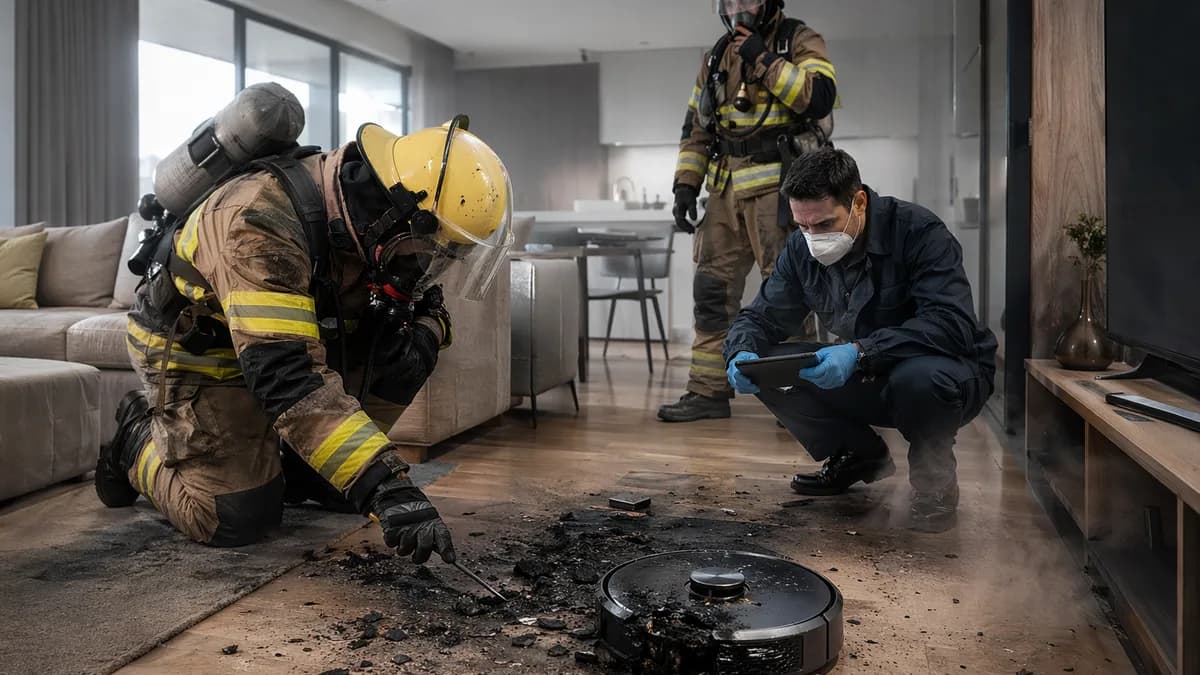
A robot vacuum explosion has left Lachie Perrem critically injured in Perth, turning a routine smart-home appliance into the focus of a serious product safety investigation that matters most to renters, housemates, manufacturers, insurers, and anyone charging battery-powered devices indoors.
XOOMAR Intelligence
Analyst Take
Perrem, aged in his 20s, suffered life-threatening burns after an explosion and fire at his share house in Brabham, north-east of Perth, on Thursday 2 July, according to Guardian World. The reported cause is a fault in a robotic vacuum cleaner, though authorities have not yet confirmed whether the ignition source was the vacuum’s electrics or its lithium-ion battery.
Perth robot vacuum explosion puts a low-attention appliance under high scrutiny
The sharpest lesson from the Brabham fire is not that every robot vacuum is dangerous. The evidence does not support that. The lesson is narrower and more useful: devices people treat as background furniture can become central to a house fire investigation when they contain rechargeable electronics and sit inside kitchens, living rooms, laundries, and bedrooms.
Investigators from Western Australia’s Department of Fire and Emergency Services found the fire was an accident caused by a fault in a robotic vacuum cleaner. The device has been sent to the state’s building and energy office for further investigation.
That distinction matters. A confirmed appliance fault is not the same as a completed technical finding on exactly what failed inside the product.
XOOMAR analysis: The public concern will naturally focus on battery safety because robot vacuums are typically rechargeable and often dock themselves. But the supplied reporting does not prove a battery failure. It only says the cause could involve the vacuum’s electrics or lithium-ion battery.
One question now matters more than the headline: was this a one-off appliance failure, a battery issue, a charging issue, or something else in the fire’s origin?
Lachie Perrem’s injuries show the human cost behind the device failure
Perrem was taken to Fiona Stanley Hospital with life-threatening burns after the blaze. A South Metropolitan Health Service spokesperson said he remained in a critical condition on Tuesday evening.
His mother, Fiona Perrem, wrote on a GoFundMe page that he had burns across about 75% of his body and was sedated in hospital.
“He is facing an incredibly long road ahead, with multiple surgeries, extensive medical treatment, rehabilitation, and months of recovery,” she said.
The fire broke out in the kitchen of Perrem’s home in Brabham. A triple-zero call was made at 5pm on Thursday, and four fire trucks attended. The blaze was fully extinguished more than two hours later, according to the department.
The damage also displaced Perrem’s fiancee, Bri Thompson, and his housemates. Thompson wrote on social media that Perrem was “fighting the biggest battle of his life.”
“Our entire life has changed in a matter of moments,” Thompson said.
For shared households, the risk profile is harsher than for a single-owner home. One appliance can affect several people’s shelter, possessions, insurance position, and recovery timeline. That does not prove shared housing caused or worsened this fire. It shows why the consequences spread fast once a device incident becomes a structure fire.
Investigators have a narrow data set, not a recall wave
The available numbers are stark because they are so limited.
The Department of Fire and Emergency Services said this was the first reported case of a robotic vacuum cleaner fire. It also said there had been four fires involving standard vacuum cleaners in the past two years.
That makes the Perth robot vacuum explosion unusual in the department’s records. It does not make it statistically interpretable on its own. One case cannot establish a product category risk rate.
A useful comparison from the supplied reporting:
| Category | Reported by authorities | Timeframe |
|---|---|---|
| Robotic vacuum cleaner fires | First reported case | As stated after Brabham incident |
| Standard vacuum cleaner fires | Four fires | Past two years |
ABC reported that the vacuum cleaner was one of a number of items seized from the home and being tested by officers from the Department of Local Government, Industry Regulation and Safety. That agency warned it was “too early to draw any conclusions about the cause or source of the fire.”
The Australian Competition and Consumer Commission also told ABC it did not usually comment on complaints or reports it received. ABC reported there had been no voluntary recalls of robotic vacuum cleaners listed on the ACCC’s product safety recall website since the accident.
So the evidentiary position is messy but clear enough for now: DFES has linked the fire to a robotic vacuum fault, while the deeper technical investigation is still open.
Makers, retailers, renters, and insurers now face different questions
The Brabham case creates different problems for each stakeholder group.
For manufacturers and retailers, the concern is product confidence. If investigators identify a specific defect, the pressure shifts quickly from incident response to compliance, customer notifications, and possibly recall mechanics. The supplied sources do not name the vacuum model, so no brand-specific conclusion is possible.
For fire crews and regulators, the priority is establishing origin and ignition source. The device has been sent for further investigation, and other items were reportedly seized for testing. That work determines whether this remains an isolated accident or becomes a wider product safety matter.
For renters and housemates, the consequences are immediate. Perrem’s fiancee and housemates lost their home. Fiona Perrem launched a GoFundMe on Saturday to help cover his “long recovery and rehabilitation” plus essential living expenses, including car repayments and housing costs for his displaced fiancee and housemates. The fundraiser had surpassed $26,000 by Tuesday evening.
For insurers, the reporting does not provide claim details, policy positions, or liability findings. The sensible inference is simpler: a device fire in a shared rental can produce overlapping questions about ownership, use, damage, contents, and temporary housing.
This is where consumer technology stops being abstract. As XOOMAR has argued in other home-tech coverage, including Deadly Heat Rewrites the Best Home Air Conditioners List, household devices become safety decisions when they run for long periods inside occupied homes.
Robot vacuum owners should treat the dock like part of the appliance
No official safety bulletin in the supplied material tells consumers exactly what to do after the Brabham fire. Still, the case supports a cautious approach without pretending the cause is settled.
Practical, low-regret steps for smart-home owners:
- Check recalls: Search official product safety recall channels for your appliance model.
- Use original equipment: Avoid unknown replacement chargers or parts unless the manufacturer approves them.
- Inspect the device: Stop using appliances that show heat damage, swelling, cracking, unusual smells, or repeated charging faults.
- Place docks carefully: Keep charging areas away from exits where possible and avoid surrounding them with loose combustible materials.
- Keep smoke alarms working: The Brabham fire required four trucks and more than two hours to fully extinguish.
The point is not to panic-buy or dump robot vacuums. The point is to stop treating autonomous appliances as harmless because they are familiar.
A robot vacuum has motors, electronics, a rechargeable power system, and a charging routine. That makes the charging setup part of the safety picture, not an afterthought.
For readers tracking how robotics moves from demos into everyday life, our coverage of $517-a-Day Robot Rentals Crack the Humanoid Buying Myth looked at a different category entirely. The shared thread is practical: machines are judged not only by what they can do, but by how safely they fit into real spaces.
The next evidence will decide whether this stays isolated or becomes an industry warning
The smart-home market does not need a broad scare story from one terrible fire. It needs a precise technical answer.
If investigators confirm a lithium-ion battery failure, charging defect, or product-specific fault, regulators and retailers will face sharper pressure to explain whether similar units are in homes and whether warnings, testing, or recall action are needed. If the investigation points to a unique chain of circumstances, the case may remain a rare tragedy with narrower product implications.
The strongest evidence to watch is concrete: the final origin and ignition finding, the vacuum model, whether any defect is reproducible, and whether the ACCC or a supplier announces further action.
Until then, the Perth robot vacuum explosion should be read as a warning about complacency. Battery-powered appliances are now ordinary household objects. When one is implicated in a catastrophic fire, safety can’t stay hidden under the plastic shell.
Impact Analysis
- The incident highlights potential fire risks from rechargeable smart-home devices kept indoors.
- Authorities have not yet confirmed whether the failure involved the vacuum’s electrics or lithium-ion battery.
- The investigation could affect renters, housemates, manufacturers, and insurers concerned with appliance safety.
Primary Sources & Disclosures

Written by
XOOMAR Insights Team
Research and Editorial Desk
The XOOMAR Insights Team pairs automated research with human editorial judgment. We track hundreds of sources across technology, fintech, trading, SaaS, and cybersecurity, cross-check the facts, and explain what happened, why it matters, and what to watch next. We do not just rewrite headlines. Every article is fact-checked and scored for reliability before it goes live, and we link back to the original sources so you can verify anything yourself.