
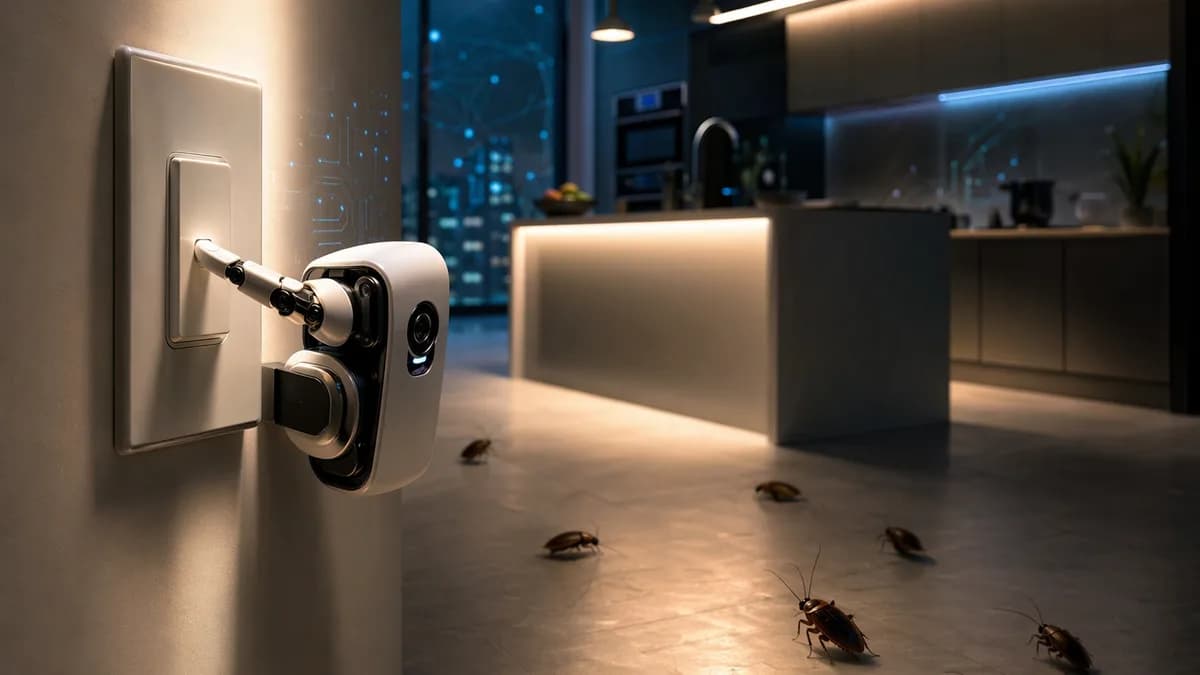
The SwitchBot Bot Rechargeable shows why the most convincing smart-home pitch may be the least glamorous one: turn on the kitchen light before you walk into a room with cockroaches in it.
TechnologyJuly 8, 2026· 8 min read· By XOOMAR Insights Team
Cockroaches Sell SwitchBot Bot Rechargeable Better Than AI
Updated on July 8, 2026
XOOMAR Intelligence
Analyst Take
69/ 100
4 sources analyzedMedium confidenceTrend10Freshness100Source Trust88Factual Grounding91Signal Cluster20
That was the use case in Sheena Vasani’s hands-on review for The Verge, where a $33.99 stick-on robot arm solved a very specific morning problem. No rewiring. No smart switch replacement. No whole-home upgrade. Just a tiny device that presses a physical switch from across the apartment.
“It’s been nice confidently walking into a brightly lit kitchen instead of fearfully tiptoeing through the dark.”
That sentence is the real product review. The SwitchBot Bot Rechargeable isn’t selling futuristic domestic intelligence. It’s selling control over one annoying moment.
Bug-haters get the clearest pitch for the SwitchBot Bot Rechargeable
The funniest detail in The Verge review is also the strongest commercial argument. Roaches made a light switch feel farther away than it was. The SwitchBot Bot Rechargeable collapsed that distance.
Who benefits most from that? Anyone with one dumb switch, one awkward button, or one small daily friction that doesn’t justify replacing hardware.
The device attaches near a switch or button with adhesive. A small robotic arm then physically presses or pulls the control. The Verge lists coffee makers, light switches, garage door openers, and laundry machines as examples of devices it can automate if they have physical power buttons.
The question buyers should ask is simple: which exact switch in your home annoys you enough to deserve a robot finger?
XOOMAR analysis: that narrowness is the point. A lot of smart-home gear asks users to commit to a platform. This device asks for a surface, a button, and patience during setup. That makes it less elegant than a fully connected lighting system, but more realistic for the messy edges of ordinary homes.
The cockroach scenario works because it’s not hypothetical. It’s not a demo room. It’s a kitchen, in the dark, with a reason to want light before entry.
Makers are betting that old switches still have economic value
The SwitchBot Bot Rechargeable keeps the original device intact. That’s the product’s core design bet.
Instead of replacing the switch, it automates the human gesture. Press mode handles push buttons or one-way controls. Switch mode uses a small plastic attachment that lets the arm push and pull a rocker switch. The Verge review says that attachment was the hardest part of the installation, partly because the written instructions were vague about placement.
That matters for builders. Physical automation is forgiving in one way and unforgiving in another.
| Approach | What changes | Main advantage | Main friction |
|---|---|---|---|
| SwitchBot Bot Rechargeable | Adds a stick-on robotic arm | No rewiring or device replacement | Alignment and adhesive placement matter |
| Smart bulb | Replaces the bulb | Cleaner control when compatible | Less useful for non-lighting buttons |
| Smart plug | Moves control to the outlet | Good for plug-in devices | Doesn’t press appliance buttons |
| Smart switch | Replaces wall hardware | More integrated result | More installation work |
The Verge reviewer found that installation required more trial and error than expected. The arm had to be positioned precisely enough to reach the switch, push it in, and pull back. SwitchBot includes an extra adhesive pad, which the reviewer needed.
Is that a flaw or the cost of retrofitting? Both.
XOOMAR analysis: retrofit hardware lives or dies on tolerances. A smart plug either works with an outlet or it doesn’t. A robot arm has to negotiate shape, spacing, adhesive grip, switch resistance, and user patience. That makes the category charming, but also more brittle than software-first smart-home products.
This is where consumer trust becomes practical rather than abstract. We’ve seen adjacent gadget questions play out in areas like Tiny Light Fails Meta Smart Glasses Privacy Trust Test, where the issue is whether hardware behaves in a way people can understand. With SwitchBot, the trust test is more physical: will the arm hit the switch every time?
Buyers should do the smart-home math before chasing the discount
The price is the headline number: $33.99 for the SwitchBot Bot Rechargeable. The Verge also listed it at $25 at Amazon and $27 at SwitchBot at the time of publication.
The rechargeable model’s capabilities are described as identical to the original SwitchBot Bot, which costs a little less. The tradeoff is power. The new model uses USB-C charging instead of disposable batteries, but its advertised battery life is much shorter: up to six months on a charge if triggered once per day, versus up to 600 days for the original model.
That comparison is sharper than it looks.
Battery: The rechargeable model cuts disposable battery replacement, but needs more frequent charging.
Convenience: USB-C is easier if you don’t want to keep replacement batteries around.
Reliability: A dead robot arm is just a decoration until charged.
Control: Pairing with a SwitchBot Hub enables voice assistant control through Amazon Alexa and Google Assistant, plus control from outside the home.
What does the full cost look like if you want remote or voice control? The Verge is clear that a hub is needed for those features. So the $33.99 price is not necessarily the whole setup cost for every buyer.
That doesn’t kill the value case. It clarifies it. If you only need nearby app control for one switch, the Bot can stay small and cheap. If you want it tied into voice commands and out-of-home access, the system expands.
For readers who track gadget safety and certification questions, our earlier piece on CE Mark Lets Gadget Makers Police Their Own Safety is a useful parallel. Small hardware often looks simple until you ask how it behaves over time, where it’s installed, and what risks users create by automating physical actions.
Renters and tinkerers will see a workaround, skeptics will see clutter
The SwitchBot Bot Rechargeable makes obvious sense for renters because it avoids rewiring. It sticks on with adhesive and leaves the underlying switch usable by hand. The Verge review also notes that it’s significantly easier than rewiring a switch or replacing it with a smart one.
That doesn’t mean it disappears into the room. The reviewer wished she had chosen the white Bot because it would have blended in better than black. She also called it “a little chunky.”
Who will tolerate that bulk?
Renters may, because the alternative could be no automation at all. Tinkerers may, because watching a physical arm flip a switch is part of the appeal. Anxious users may, because walking into a lit kitchen beats stepping into the dark.
Skeptics have a case too. Some homes already have smart bulbs and smart plugs. The Verge explicitly says the Bot makes less sense in a house already filled with them. Others may decide that a better pest-control plan, a different lamp placement, or a conventional smart switch solves the same problem more cleanly.
The practical buying question is this: are you solving a recurring irritation, or just buying a gadget because the mechanism is fun?
XOOMAR analysis: this is where SwitchBot’s product earns respect. It doesn’t need to be the best automation answer for every room. It only needs to be good enough for the one switch that other smart-home gear hasn’t solved.
The market signal is hiding in one cockroach-fighting light switch
The smartest read on the SwitchBot Bot Rechargeable is that it exposes a gap in smart-home adoption: plenty of homes still run on physical buttons, and many people don’t want to replace them.
Before buying, the checklist should be blunt.
- Identify the switch: Is it a rocker, a push button, or something too recessed or oddly shaped?
- Check the surface: Adhesive placement determines whether the arm can reach and retract properly.
- Decide the control mode: Pressing a button is simpler than pushing and pulling a light switch.
- Price the hub: If you want voice control or out-of-home access, the Bot alone may not be enough.
- Plan for charging: Up to six months on one trigger per day is useful, but not invisible.
The resilience angle is underrated. Even when automated, the underlying appliance or switch still exists. If the app, hub, or battery fails, the physical control remains there. That’s less polished than a fully integrated smart-home setup, but it’s also less final.
The next evidence to watch is not whether tiny robot arms can look sleek in product photos. It’s whether they keep working after months of adhesive tension, charging cycles, and real household use. If users keep finding specific, annoying switches that justify the setup, the retrofit case strengthens. If alignment pain and hub costs dominate the experience, the SwitchBot Bot Rechargeable stays a clever niche gadget with one very memorable enemy: cockroaches.
Key Takeaways
- The $33.99 device shows how small, targeted automation can solve real household annoyances.
- It offers a smart-home option for renters or users who do not want rewiring or hardware replacement.
- Its value depends on whether one physical switch or button is irritating enough to automate.
Smart-Home Upgrade Approaches
| Approach | What It Requires | Best For |
|---|---|---|
| SwitchBot Bot Rechargeable | Adhesive placement near a physical switch or button | Automating one annoying switch, button, or daily friction |
| Smart switch replacement or whole-home upgrade | Rewiring, hardware replacement, or platform commitment | More integrated home automation setups |
Sources

Written by
XOOMAR Insights Team
Research and Editorial Desk
The XOOMAR Insights Team pairs automated research with human editorial judgment. We track hundreds of sources across technology, fintech, trading, SaaS, and cybersecurity, cross-check the facts, and explain what happened, why it matters, and what to watch next. We do not just rewrite headlines. Every article is fact-checked and scored for reliability before it goes live, and we link back to the original sources so you can verify anything yourself.
Explore More Topics
Related Articles
 Technology
Matic Robot Vacuum Price Jumps $250 After Sept. 9 Deadline
Matic's robot vacuum jumps to $1,495 on Sept. 9, forcing premium buyers to decide before a $250 hike hits.
Jul 4, 20267 min
 Technology
Tiny Fan Rescues Qi2 Chargers From Their Heat Trap
The Kuxiu D5 shows fan-cooled Qi2 chargers aren't a gimmick. They're a practical fix for wireless charging's heat problem.
Jul 4, 20267 min
 Technology
Tiny Light Fails Meta Smart Glasses Privacy Trust Test
Meta's camera lock raises the bar on tampering, but one tiny LED still can't carry public consent.
Jul 8, 20268 min
 Technology
Anker Soundcore Sleep A20 Deal Cuts Sleep Buds to $100
Anker's Sleep A20 hit $99.99, making purpose-built sleep earbuds feel less niche and more practical for noise-hit sleepers.
Jul 7, 20267 min
 Technology
iFixit Megalodon Driver Kit Invades the Junk Drawer
iFixit’s $34.95 Megalodon Driver Kit pushes beyond gadgets with 16 long bits for appliances, furniture, cars, and everyday DIY.
Jul 7, 20266 min
 Fintech
Paradigm Fund III Pulls $1.2B Beyond Crypto's Core
Paradigm’s $1.2B Fund III keeps crypto in play while widening its hunt to AI, robotics, drones and space startups.
Jul 8, 20266 min
 Fintech
AI Banking Jobs Hit Standard Chartered's 7,800-Role Cut
Standard Chartered’s 7,800-role plan shows AI is already shrinking banking’s back office and threatening the analyst talent pipeline.
Jul 8, 20268 min
 Global Trends
Trump's Patriot Missile Licence Won't Save Kyiv Soon
Trump offered Ukraine a Patriot production licence, but factory timelines mean Kyiv's interceptor shortage won't ease fast.
Jul 8, 20268 min
 Technology
$13,995 Fiat Topolino Shrinks the EV Dream to 19 MPH
Fiat Topolino hits the U.S. at $13,995, but 19 mph and 46 miles of range make it a micromobility gamble, not a bargain EV.
Jul 8, 20266 min
 Trading
Trump’s Iran Shock Knocks Gold Toward $4,000 as Dollar Wins
Gold slid as Trump’s Iran warning sent traders into the US Dollar, testing whether $4,000 support can hold.
Jul 8, 20268 min
Don't miss the signal
Get our weekly roundup of the stories that matter across tech, fintech, and trading. No noise, just signal.
Free forever. No spam. Unsubscribe anytime.