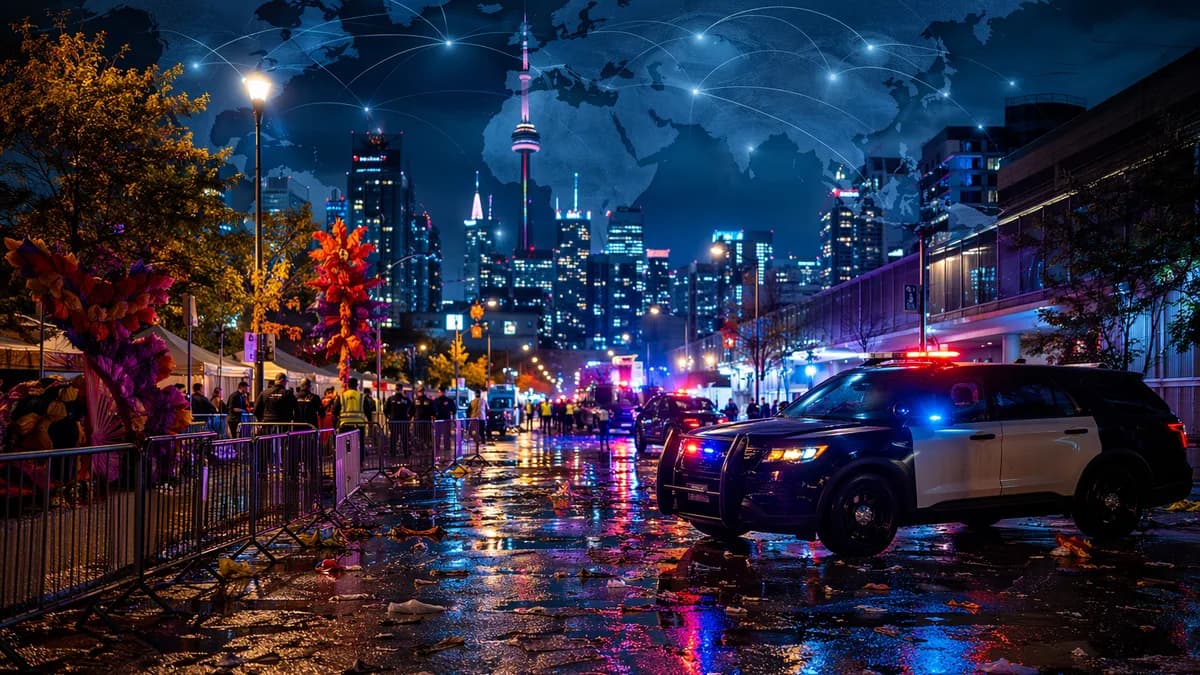
The Toronto festival shooting signals a harder summer for public safety planning in a city that sells its street life as open, crowded, and safe. Two men were killed and four other people were wounded Saturday evening near Salsa on St. Clair, after what police described as an exchange of gunfire between two people targeting each other, according to ABC International.
XOOMAR Intelligence
Analyst Take
That detail matters. Police said the initial fear of an active shooter did not hold, but the public risk was still severe. Toronto Police Deputy Chief Frank Barredo said investigators recovered two firearms after the shooting, which was reported at 8:12 p.m. near St. Clair Avenue West and Arlington Avenue. No suspect or suspects had been arrested by the time of a late-night news conference.
Toronto festival shooting turns a public celebration into a test of city safety
The sharpest fact is also the most painful: a street festival built around music, food, dancing, and Latin American culture became the scene of a fatal shooting. Salsa on St. Clair draws thousands into Toronto’s St. Clair West neighborhood for a public celebration that depends on density. People come because the street is full.
That is exactly why the Toronto festival shooting carries weight beyond the crime scene. XOOMAR analysis: the incident challenges the operating assumption behind big neighborhood festivals, that crowded public space can stay welcoming without becoming militarized. A city can secure a stadium with gates. A street festival is different. It spills across sidewalks, side streets, storefronts, patios, vendor tents, transit approaches, and family clusters moving at different speeds.
The public safety debate starts with the human cost, a theme also reflected in the East St. Louis family shooting and the ICE shooting in Maine. Police confirmed that both deceased victims were men. Four others were wounded. Witnesses described confusion and fear, not abstract policy failure.
“A bunch of people … told us to lay down onto the floor,” Valerie Rodriguez said. “We got scared because we didn’t know exactly what was happening.”
That sentence captures the practical terror of gunfire in a crowd. Most people don’t know whether the threat is moving, whether it has ended, or where to run. For more on the developing law enforcement side, see our earlier report, Suspect on Run After Toronto Festival Shooting Kills 2.
Six victims, two deaths, and the hard numbers behind public shooting risk in Toronto
The confirmed toll is six victims: two men dead and four people wounded. Police said the shooting happened near the festival, not that the festival itself was the intended target. That distinction matters because it separates what is known from what is still under investigation.
Here is the cleanest read of the record supplied so far:
| Confirmed by source material | Still unresolved |
|---|---|
| Two men killed | Identities of the deceased |
| Four others wounded | Full condition of the wounded |
| Shooting reported at 8:12 p.m. | Motive |
| Location near St. Clair Avenue West and Arlington Avenue | Whether more than two shooters were involved |
| Two firearms recovered | Whether any suspect or suspects have been arrested since the late-night news conference |
| Police first warned of an active shooter, then secured the scene | Whether the incident was connected to any broader dispute |
The strongest counterpoint to a broader interpretation is obvious: one incident does not define Toronto. The source itself says Toronto, Canada’s largest city, is among North America’s safest major cities, and that fatal public shootings with multiple victims are relatively rare.
Still, public perception does not move only on annual totals. XOOMAR analysis: a shooting that kills two and wounds four near a family-oriented cultural festival can affect behavior more quickly than citywide crime statistics, because it hits a setting people associate with normal life. Parents, vendors, performers, and residents don’t calculate risk like a spreadsheet when deciding whether to attend the next event. They remember where they had to drop to the ground.
Barredo tried to draw a line between an active-shooter scenario and what investigators believe happened.
“There was some concern about an active shooter. That turned out not to be the case,” Barredo said.
But he also said the two gunmen involved “indiscriminately put vast numbers of people in danger.” That is the core safety problem. Even if two people were targeting each other, everyone nearby became exposed.
Open street festivals create both visibility and vulnerability
Street festivals are hard to secure because their openness is the product. Salsa on St. Clair was not a closed venue. It was an annual celebration in a neighborhood, with live music, dancing, food, cultural performances, vendors, customers, and pedestrians flowing through public space.
That openness can protect people in some ways. Crowds create witnesses. Vendors, residents, and passersby notice abnormal behavior. Police presence is visible. But the same density turns dangerous fast once shots are fired. People run in waves. Sound direction becomes unreliable. Music and crowd noise can obscure the first moments of danger. Side streets give both escape routes and approach routes.
Festival vendor Patsy Gutierrez described the shift from commerce to panic.
“Everybody started getting frantic and then we stopped serving,” she said. “I don’t think it should be something that’s happening at these types of events.”
XOOMAR analysis: city officials now face a practical security puzzle, not a slogan. More bag checks, camera coverage, lighting, emergency lanes, private security, and police deployment may all be reviewed. None is a simple fix. Heavy screening can slow entry and push crowds into choke points. More barriers can help control vehicles or movement, but they can also make evacuation harder if poorly placed. More police may reassure some families and unsettle others, especially in neighborhoods sensitive to surveillance or aggressive enforcement.
The best test of any response will be whether it improves response time, threat detection, evacuation routes, and medical access without turning neighborhood festivals into fenced compounds. If future reviews show the shooting was highly targeted and moved quickly through open space, that would weaken the case for broad crowd screening as the main answer. If investigators find missed warnings, poor access, or gaps in deployment, the case for tighter planning becomes stronger.
Residents, organizers, police, and City Hall will read the same shooting differently
The same gunfire creates four different crises. For residents, it is grief and fear. For organizers, it is a trust problem. For police, it is an urgent public order test. For City Hall, it is a political and civic credibility challenge.
Toronto Mayor Olivia Chow framed the attack in moral and civic terms.
“I’m deeply disturbed and angry about this reckless and irresponsible act of violence right in the middle of a festival attended by families,” Chow said.
Ontario Premier Doug Ford also focused on the victims and families.
“I am devastated by the senseless violence at the Salsa on St. Clair Festival that has claimed two lives and injured others,” Ford said.
The organizer perspective is not fully detailed in the source material, so it should be treated as XOOMAR analysis rather than reported fact. Festivals like this depend on trust, volunteer energy, vendor revenue, insurance coverage, foot traffic, and the belief that the neighborhood will feel welcoming. If families stay away after the Toronto festival shooting, vendors lose sales, performers lose audience, and organizers face harder permit and security talks.
Police will be judged on two timelines. The first is immediate: securing the scene, treating victims, finding suspects, and preventing further violence. The second is slower: explaining how two armed people were able to put a dense public crowd at risk. Barredo’s statement that the scene was not an active-shooter event narrows the tactical frame, but it does not remove the public danger.
Civil liberties concerns also belong in the conversation, with care. The source does not report any proposed policing changes yet. Still, XOOMAR analysis: if the response leans heavily into surveillance, searches, or saturation policing, community advocates may ask whether those moves reduce violence or simply shift the burden onto festivalgoers and nearby residents. A visible crackdown can look decisive while missing the harder question of how guns reached a crowded public event in the first place.
For related coverage of the immediate aftermath, see Toronto Shooting Leaves 2 Dead as Shooter Escapes Festival.
A rare public shooting cuts against Toronto’s safety reputation
The symbolic damage comes from the setting. The source describes Toronto as one of North America’s safest major cities and says fatal shootings, especially public multi-victim shootings, are relatively rare. That makes this incident stand out.
The supplied material does not provide a detailed history of prior Toronto public shootings, annual homicide totals, clearance rates, or neighborhood-level gun violence patterns. That limit matters. Without those data points, it would be wrong to claim a trend from this single incident.
Still, the setting carries its own logic. Public festivals are where cities perform confidence. People bring children. Vendors set up for long days. Restaurants open patios. Visitors move through unfamiliar blocks because the crowd itself feels like reassurance. Violence near that kind of event can reshape perception faster than official messaging can repair it.
The counterpoint remains strong: Toronto’s broader safety reputation is not erased by one shooting. Barredo made that case directly.
“Toronto is one of the safest cities in the world but we are 3 million people and unfortunately we are not immune,” Barredo said.
That is both reassurance and warning. XOOMAR analysis: a large city can be statistically safe and still face sudden, concentrated failures in public space. The question is whether this remains a rare shock or becomes part of a pattern that changes how residents behave during summer events.
Festivalgoers, vendors, and neighborhood events face immediate changes
The near-term effect is likely to be visible security, tighter planning, and more nervous crowds. That is an inference from the scale and location of the incident, not a confirmed city policy. Police had already urged the public to avoid the area, later announced the scene had been secured, and maintained a large presence around the festival area.
For attendees, practical caution does not require retreating from public life. It means treating crowded events with the same situational awareness people already bring to transit hubs and stadiums.
- Exits: Know the nearest side street or open route before you settle into a crowd.
- Phones: Keep your phone charged enough to receive alerts and contact others.
- Crowd movement: If people surge, move with control and avoid stopping in bottlenecks.
- Reports: Tell police or event staff about threats, fights, visible weapons, or abandoned items.
- Instructions: Follow official directions quickly, especially after police secure or clear an area.
For vendors and small businesses, the risk is economic as well as physical. The source does not give revenue figures or insurance details. But XOOMAR analysis: if families skip future festivals, if vendors hesitate to book booths, or if organizers must pay for more private security, the cost of one shooting can spread beyond the victims and the crime scene.
That is why the response has to be calibrated. Empty streets are not public safety. The goal should be smarter event planning: clear emergency lanes, coordinated communication, better lighting where needed, faster medical access, and police deployment that matches actual risk rather than political pressure alone.
Toronto’s next safety decisions will decide whether festivals stay open or become fortified
The next phase will test whether Toronto can respond without overcorrecting. Expect continued pressure for police updates, suspect information, and a clearer account of how the shooting unfolded near Salsa on St. Clair. The late-night briefing left major questions unresolved, including motive and arrests.
A measured response would likely review coordination among event organizers, police, paramedics, transit officials, local businesses, and nearby residents. That review should ask concrete questions. Were emergency routes clear? Could first responders reach victims quickly? Did the initial active-shooter warning help protect people, or did it create confusion once the scene changed? Were there gaps around side streets or crowd flow?
The risk is reactive policy that looks tough and solves little. More barriers, cameras, and police can make officials appear responsive. They may also raise costs, chill attendance, and change the character of neighborhood events. If investigators conclude this was a fast exchange between two armed people targeting each other, the deeper issue may be less about festival entry controls and more about how armed disputes reach crowded civic spaces.
The evidence that would confirm XOOMAR’s thesis is a security review that treats open public gatherings as the central challenge, not just this one corner of St. Clair West. The evidence that would weaken it is a narrow investigative finding showing the danger was highly isolated, quickly contained, and unrelated to festival conditions.
Toronto’s choice now is not between fear and denial. It can harden events, invest in prevention, or try to do both. The future of the city’s summer street life may depend on whether officials can protect crowded public space without stripping away the openness that makes those gatherings worth attending.
Impact Analysis
- The shooting killed two people and wounded four near a major public street festival.
- Police said the incident involved targeted gunfire, but crowded public spaces still faced serious risk.
- The attack raises pressure on Toronto officials to reassess safety planning for open street events.
Toronto Festival Shooting Reported Toll
Primary Sources & Disclosures

Written by
XOOMAR Insights Team
Research and Editorial Desk
The XOOMAR Insights Team pairs automated research with human editorial judgment. We track hundreds of sources across technology, fintech, trading, SaaS, and cybersecurity, cross-check the facts, and explain what happened, why it matters, and what to watch next. We do not just rewrite headlines. Every article is fact-checked and scored for reliability before it goes live, and we link back to the original sources so you can verify anything yourself.