Robot rentals are the first believable mass-market business model for humanoids, because consumers won’t treat a $19,000 to $100,000-plus machine like a dishwasher until it works like one, lasts like one, and can be fixed without turning the household into a robotics lab.
XOOMAR Intelligence
Analyst Take
That is the hard signal inside the latest robotics-as-a-service push. AGIBOT launched Sharebot in December 2025, offering humanoid robot rentals from 3,500 yuan, roughly $517 a day, including shipping and a human operator, according to PYMNTS. In three months, Sharebot logged more than 5,500 orders. That doesn’t prove families are ready for robot butlers. It proves the ownership pitch is ahead of the product.
Household robot rentals will arrive before household robot ownership
The consumer robotics industry has a pricing problem and a trust problem. The pricing problem is obvious: entry models start around $19,000, while advanced systems climb past $100,000. That doesn’t compete with phones or appliances. It competes with cars, home repairs, tuition money and every other serious household capital decision.
The trust problem is more dangerous. A consumer buying a robot outright has to believe the machine will do useful work, survive daily use, get repaired quickly, receive meaningful software updates and not become obsolete in two years. That is a lot to ask from a category still proving what it can reliably do outside staged demos.
Renting changes the transaction. The customer stops betting on hardware and starts paying for access, support and outcomes. That is why the primary search keyword here should be robot rentals, not consumer robot sales. The market’s first scalable product is not the humanoid itself. It is the managed service around the humanoid.
| Model | What the customer buys | Main risk | Why it matters now |
|---|---|---|---|
| Outright ownership | A costly robot asset | Obsolescence, repairs, uncertain utility | Hard to justify while capabilities are narrow |
| Robot rentals | Access for a period or task | Service quality and reliability | Fits short-duration use cases already working |
| Subscription robotics | Recurring access plus support | Long-term customer trust | Could make home adoption financially tolerable |
The price tag makes home robot ownership a luxury purchase
A robot priced above $19,000 needs to earn its place in a home with daily utility. Washing machines, dishwashers and smartphones won adoption because their value became obvious and repeatable. Humanoid robots are not there yet. The reporting points to machines that can dance, sort packages or scoop popcorn, not systems that can handle the messy range of household labor.
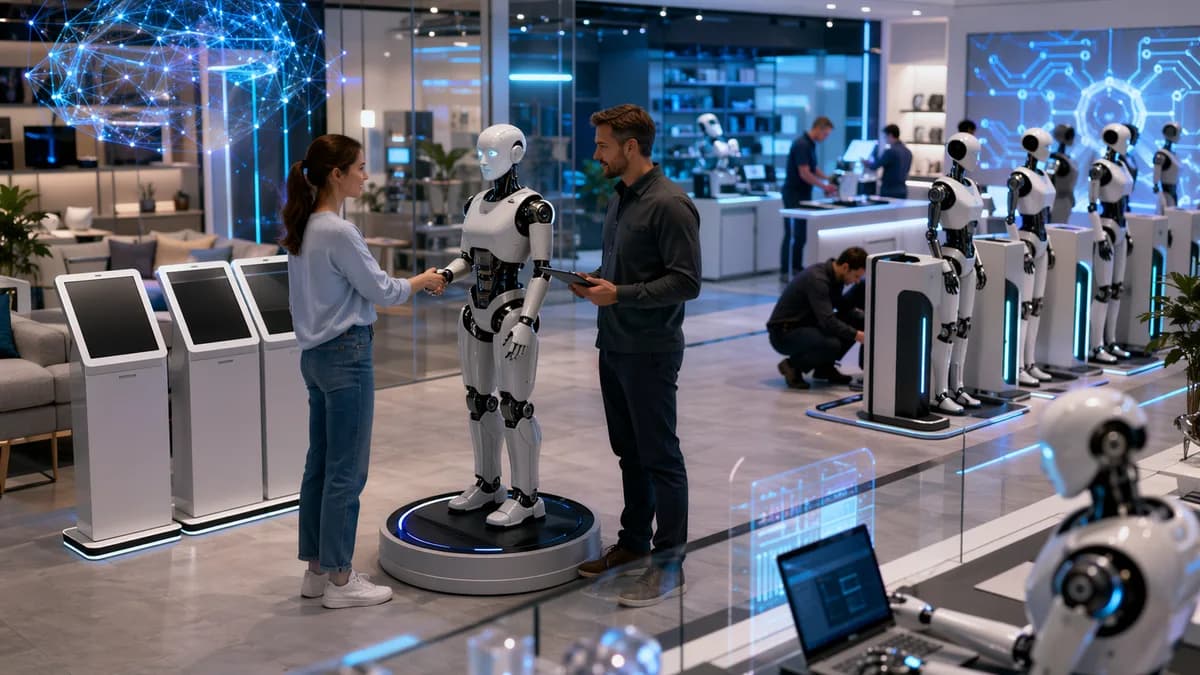
That does not make the technology unserious. It means the business model has to be honest about maturity. AGIBOT’s Sharebot is rented for corporate galas, retail promotions, trade shows, tourism and live-stream content creation. In Europe, the rental price starts at 899 euros, about $1,027, per day, and the service covers 17 countries and regions, including Spain, Germany, France, the U.K. and North America.
Those are controlled environments. They are temporary. They usually include human help. That is exactly why they work.
The strongest counterargument is that wealthy early adopters will buy robots anyway. They will. Developers, affluent technophiles and households with unusual needs may prefer ownership for customization, privacy or status. But early buyers don’t define a mass market. They define a showroom.
Narrow jobs make robot subscriptions more honest than robot hype
The gap between the imagined home robot and the current deployed robot is still wide. Consumers picture a capable domestic helper. The reported use cases point to specific jobs under specific conditions: event hosting, entertainment, hospital supply runs, farm weeding, robot bartending and industrial tasks.
That is not failure. A limited robot can be valuable if the pricing matches the limitation. Renting a humanoid for an event is rational if it drives attention. A hospital using Moxi, the robot from Diligent Robotics, can make sense if it shuttles supplies and support comes bundled into the service. The BBC reported that Diligent has around 100 Moxi robots in operation, with service, maintenance and upgrades included in the robotics-as-a-service model.
“It lowers the expense and the outlay for the hospital because you're not paying for the full purchase up front. Secondly, and I think more importantly, this tech is evolving very quickly… we're routinely evolving the software and capabilities of the robot.”
That quote from Todd Brugger, Diligent Robotics’ chief operating officer, captures the consumer logic too. People don’t want to own a machine that improves fastest after they buy it. They want access to the improved version.
This is also where robot rentals become useful data machines. Li Yiyan, CEO of Sharebot, told CNN:
“It ultimately helps robots transition faster from mere exhibition pieces to large-scale deployment.”
Each deployment teaches the company something that a lab cannot. The customer is paying for a task. The robotics company is also collecting operational feedback from the real world.
Repairs and updates will push robots into managed service plans
Robots are not static appliances. They move around people, pets, furniture and fragile objects. They rely on sensors, batteries, software and, in many cases, remote or on-site human assistance. When something fails, the household does not want to debug the machine.
That is why the service wrapper matters more than the chassis. Customers will expect software updates, repair coverage, technical support and a clear path when the robot gets stuck. PYMNTS notes that Sharebot rentals include a human operator who helps program and control the machine on-site. The BBC reported that robotics-as-a-service often bundles service, maintenance and upgrades, with a human engineer sometimes available remotely to take control if needed.
The risk shifts back to the provider. That is where it belongs. If a robotics company wants recurring revenue, it has to own uptime, repairs and operating standards. If it can’t, consumers should not be asked to swallow a five-figure purchase.
The same logic appears in industrial robotics. Formic, based in Chicago, has a fleet of more than 250 industrial robots operating on a robot-as-a-service basis. Its chief revenue officer, Shawn Fitzgerald, told the BBC: “Everything is included. If the robot arm burns out, that's on us and we need to come bring you a new one.”
That sentence is the future consumer contract in plain English.
Buyers will exist, but they won’t set the default
The cleanest case for ownership is falling cost. If components get cheaper, AI systems improve and humanoids become more capable, prices may eventually drop enough for broader purchasing. Some consumers will also reject subscriptions. A robot inside the home raises obvious sensitivities around control, data and dependence on a provider.
That objection deserves respect. A managed robot service that is opaque, hard to cancel or vague about support will earn consumer suspicion. The home is not a trade-show booth.
Still, early market structure matters. If subscriptions solve affordability, maintenance and trust first, they can become the default habit before robots ever reach appliance-like pricing. 1X already points in that direction with NEO, its home helper robot. The BBC reported that early access customers in the U.S. can pay $20,000 outright or $499 per month on a subscription basis.
That contrast is the whole argument in one product. Ownership asks for conviction. Subscription asks for curiosity.
For readers tracking how affordability pressure shapes consumer decisions more broadly, XOOMAR’s coverage of Costs Trap 49% of Young Adults Living With Parents is a useful companion. And for the software side of the same trust problem, our analysis of Microsoft Copilot App Merger Exposes Its AI Sprawl Problem shows why packaging and reliability matter as much as raw capability.
Robotics companies should sell dependable labor, not shiny machines
The winning consumer robotics pitch will not be “buy the future.” It will be simpler: pay monthly, get a job done, call us when it fails.
That means transparent pricing, support that answers quickly, clear upgrade paths and service terms consumers can understand. It means selling cleaner homes, safer mobility assistance, easier delivery or reliable monitoring only when the robot can actually perform those tasks. If the machine needs a human operator, say so. If it works only in narrow conditions, price it that way.
Companies chasing luxury hardware sales may impress early adopters and still miss the larger market. The useful lesson from AGIBOT’s 5,500-plus Sharebot orders is not that humanoids are ready to invade every living room. It is that people will pay for robots when the commitment is small, the task is clear and the vendor carries the operational burden.
What would prove this thesis wrong? A home robot under mainstream appliance pricing that performs broad daily tasks without heavy support, frequent intervention or rapid obsolescence. The supplied evidence says the industry is not there yet.
So robotics firms should stop asking households to finance unfinished ambition. The first mass-market home robot probably won’t arrive in a box a family owns forever. It will arrive on a service plan, do a specific job, get fixed by someone else and quietly become normal.
The Bottom Line
- Robot rentals reduce the financial risk of trying expensive humanoid machines.
- AGIBOT’s 5,500-plus Sharebot orders suggest demand exists for access before ownership.
- The first mass-market robotics opportunity may be services, not hardware sales.
Robot Ownership vs. Robot Rentals
| Model | What the customer buys | Main risk | Why it matters now |
|---|---|---|---|
| Ownership | A humanoid robot as a household capital purchase | High upfront cost, reliability concerns and obsolescence risk | Consumers are unlikely to commit before robots prove appliance-like durability and support |
| Rental | Access to a robot, support, shipping and a human operator | Service quality and availability | It shifts the market from selling hardware to delivering managed outcomes |
Humanoid Robot Purchase Costs vs. Sharebot Daily Rental
Primary Sources & Disclosures

Written by
XOOMAR Insights Team
Research and Editorial Desk
The XOOMAR Insights Team pairs automated research with human editorial judgment. We track hundreds of sources across technology, fintech, trading, SaaS, and cybersecurity, cross-check the facts, and explain what happened, why it matters, and what to watch next. We do not just rewrite headlines. Every article is fact-checked and scored for reliability before it goes live, and we link back to the original sources so you can verify anything yourself.