The First Night Without Generators
When fusion power becomes as free as rain, a Lagos energy cartographer must decide what abundance should not erase.
The Last Diesel Shop on Adebayo Street
Amina Bello hears the silence before she sees the shop.
Adebayo Street has always been a throat of metal noise, coughing and rattling from dawn until the last buka closes. Diesel generators used to sit behind gates and under stairwells, sweating black smoke, shaking the zinc roofs, giving every conversation a tremor. As a child, Amina learned to sleep through the roar of twenty engines and wake if one stopped, because stopping meant heat, spoiled soup, dead phones, darkness.
Now the street breathes.
She steps from the autonomous danfo and stands with her work tablet under one arm, listening to sandals slap wet concrete, to a woman laughing at the pepper stall, to a radio playing highlife at a volume that no longer has to fight machinery. Somewhere, a pigeon coos. The sound feels illegal.
Her father’s sign still hangs above the narrow shop: BELLO & DAUGHTERS GENERATOR REPAIR, STARTERS, COILS, AVR, HONEST WORK. The blue paint has peeled in commas. Inside, shelves hold carburetors wrapped in oily cloth, spark plugs sorted in baby-food jars, pull cords looped like sleeping snakes. The air still carries the old perfume, diesel, iron filings, warm rubber, sweat.
Her father sits on a stool beneath the wall fan. The fan turns silently now, powered by the rooftop receiver that looks like a black glass flower.
“You came late,” he says.
“You said the ceremony was at noon.”
“I said come before the politicians start lying.”
Amina smiles and kisses his cheek. His skin smells of palm soap and machine oil, though he has not opened an engine in weeks.
Outside, city workers in green uniforms move along the street, unbolting the last neighborhood diesel microgrid junction box. A small crowd watches. Nobody cheers. Nobody protests. They stand the way people stand at a burial for a difficult uncle, grateful and guilty at once.
A boy points at a generator being rolled onto a municipal truck. “Mama, what is that?”
His mother says, “That is what we used before the sky learned to share.”
Amina’s father snorts. “Before people remembered the sun is older than Shell.”
The official loudspeaker crackles, then clears. “As of today, Surulere District Twelve retires all registered diesel backup systems. Continuous clean power is now guaranteed under the West African Beam Commons...”
Applause rises, polite at first, then warmer. Amina claps too. She thinks of hospitals without fuel queues, students reading through humid nights, mothers no longer choosing between fan and fridge. Still, when the truck carries away the old yellow Mikano from the barber’s shop, she feels a tug in her ribs.
That machine paid her school fees. Its broken alternator taught her Ohm’s law before any teacher did. Its stubborn engine gave her father a place in the world.
He watches the truck turn the corner. “Good riddance,” he says softly.
But his hand rests on a rusted starter coil like it is the wrist of an old friend.
Weather Reports for Power
At the West African Beam Commons office on Victoria Island, power arrives as weather.
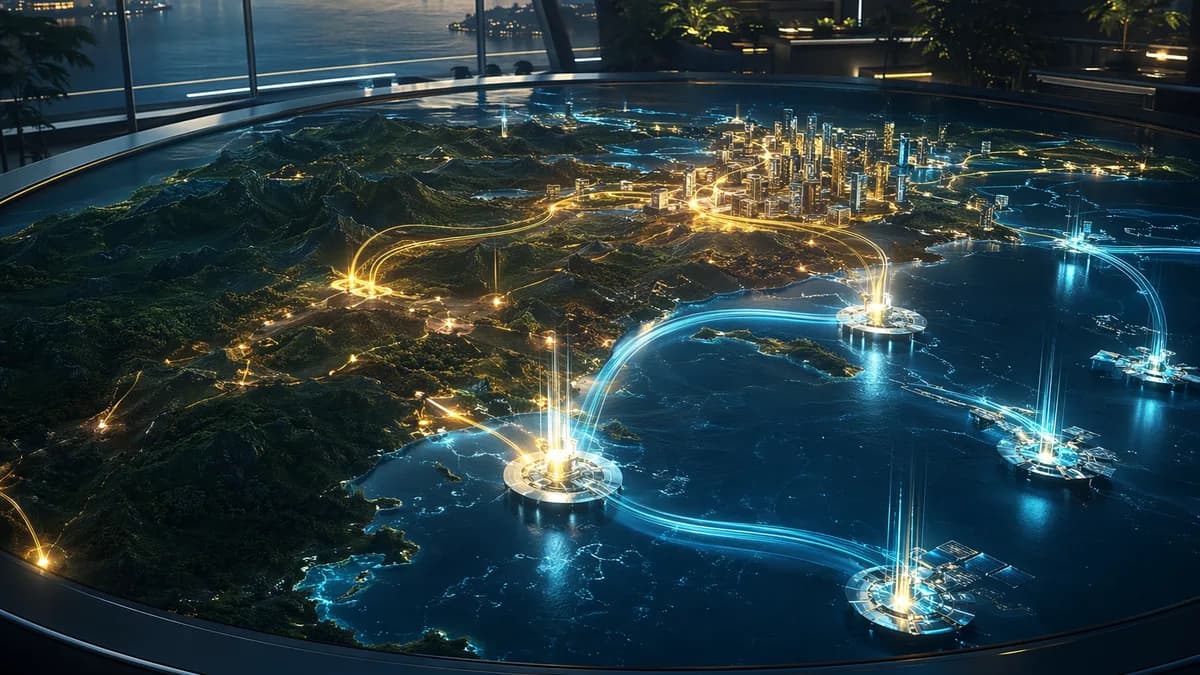
Amina stands before a wall of living maps, all of them breathing in color. Thin gold bands cross the Sahara and bend southward over Niger, Benin, Togo, Ghana, and Nigeria. Green pulses bloom over clinics and irrigation grids. Blue rings mark floating desalination gardens anchored off the coast, their membranes flashing in the morning sun. Every rooftop receiver in Lagos appears as a bright freckle.
Her job is to make abundance legible.
“Beam density over Epe is dropping two percent,” says Kojo, her Ghanaian colleague, tapping the air with two fingers. “Maintenance shadow from Tower Seven.”
“Two percent is not dropping,” Amina says. “Two percent is gossip.”
“It becomes news when fishermen call me before breakfast.”
She magnifies the lagoon. Thousands of receivers shimmer in stacked layers, homes, markets, ferries, cold rooms, water pumps, traffic lights, schools. A ferry crossing from Ikorodu draws power while moving, its roof rectenna sipping invisible waves and feeding the quiet motors beneath its deck. On the map, it glides like a silver fish.
Once, people checked fuel prices before planning a wedding, a surgery, a factory shift. Now they check beam forecasts.
Community surplus hours in Mushin, 18:00 to 03:00.
Maintenance shadow over Badagry coast, expect mild dimming after midnight.
High-density beam available for kiln cooperatives in Abeokuta from Tuesday.
Amina records it all in language people can feel. Not megawatts alone, but promises. Cold insulin. Pumped water. Charged wheelchairs. Refrigerated tomatoes. Light.
Her tablet vibrates with a message from her mother: Come by before festival. I need your eyes on something.
Amina replies with a fish emoji and returns to the maps.
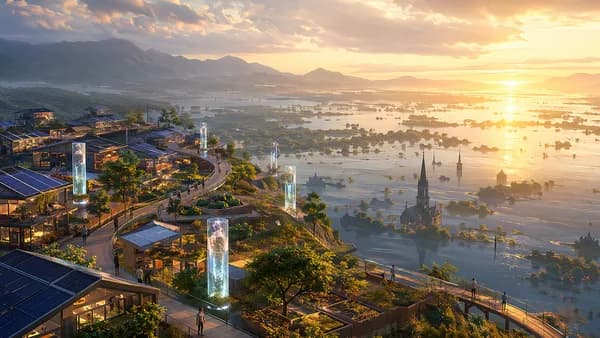
Beyond the office glass, Lagos shines under a clean noon. Solar skins glitter on towers, but the real work happens farther north, where fusion plants rise from the Sahara like white baobabs, each one ringed with mirrors, cooling fields, and receiver arrays. They fuse hydrogen drawn from seawater and desert wells, then beam power across the continent in carefully shaped corridors. No smoke. No flare stacks. No blackened walls.
Not free, exactly. Nothing built by human hands is free. But unmetered at the point of use, maintained as a commons, paid through treaties, taxes, labor, and the memory of what scarcity cost.
Kojo tosses her a packet of roasted groundnuts. “You are mapping the festival tonight?”
“The first unmetered night,” she says.
He whistles. “Lagos with no meter and no shame. God help the coastline.”
On the map, the city’s projected demand swells into a crown of light. It is beautiful. It is also enormous.
Amina looks at the brightness until her eyes ache.
The New Diplomats of Light
The summit hall in Abuja smells of polished wood, cold air, and expensive anxiety.
Amina is not supposed to speak. She sits behind the Lagos delegation with her tablet on her knees, present as technical staff, invisible unless a map fails. Around the circular table sit ministers from former oil states, elected coordinators from Saharan desert cooperatives, mayors of coastal megacities, engineers from the Beam Commons, and envoys from island nations whose shorelines shrink each year like cloth in hot water.
The old flags hang above them. The new map glows beneath the glass table, beam corridors crossing borders in patient threads.
A Nigerien cooperative leader in a white turban taps the table. “The desert is not an empty socket for coastal appetite. Our maintenance crews breathe the dust. Our water cools your fusion cores. We require voting weight equal to output.”
A former petroleum minister from Port Harcourt leans toward his microphone. His voice is smooth as lacquer. “And what of legacy infrastructure? Our ports, our trained workers, our losses? The transition did not erase obligations.”
An envoy from São Tomé says, “Obligations include not drowning us with yesterday’s carbon and today’s arrogance.”
The room tightens.
Amina watches the map shift as disputed corridors turn amber. The arguments are not about oil wells anymore, not tankers or pipelines, not sabotage in mangrove creeks. Now they are about beam transparency, redundancy rights, cooling reservoirs, orbital reflectors, repair drones, and the terrifying question of whether one country can dim another’s hospitals during a dispute.
“No sovereign authority should hold unilateral dimming power,” says the mayor of Dakar.
“No city should demand infinite draw without ecological accounting,” says the desert leader.
The petroleum minister smiles. “Infinite is a word used by people who do not pay invoices.”
Someone laughs. Nobody relaxes.
During the break, Amina stands beside a window overlooking Abuja’s clean electric buses moving below in bright lanes. Her supervisor, Madam Okonkwo, joins her with two paper cups of bitter coffee.
“You are quiet,” Madam says.
“I was hired to draw lines, not to decide who owns light.”
Madam Okonkwo hands her a cup. “Every line decides something.”
Across the hall, diplomats cluster under soft ceiling panels, their faces lit evenly, democratically. Amina thinks of her father’s shop, of old engines assigned to those who could pay, of poor streets going dark while rich towers purred. The Beam Commons is meant to end that. Yet here are powerful people, learning a new grammar for old hunger.
Inside the summit hall, the map waits, glowing like a question nobody can turn off.
Festival of the Unmetered Night
By sunset, Lagos is preparing to become a story it will tell about itself for generations.
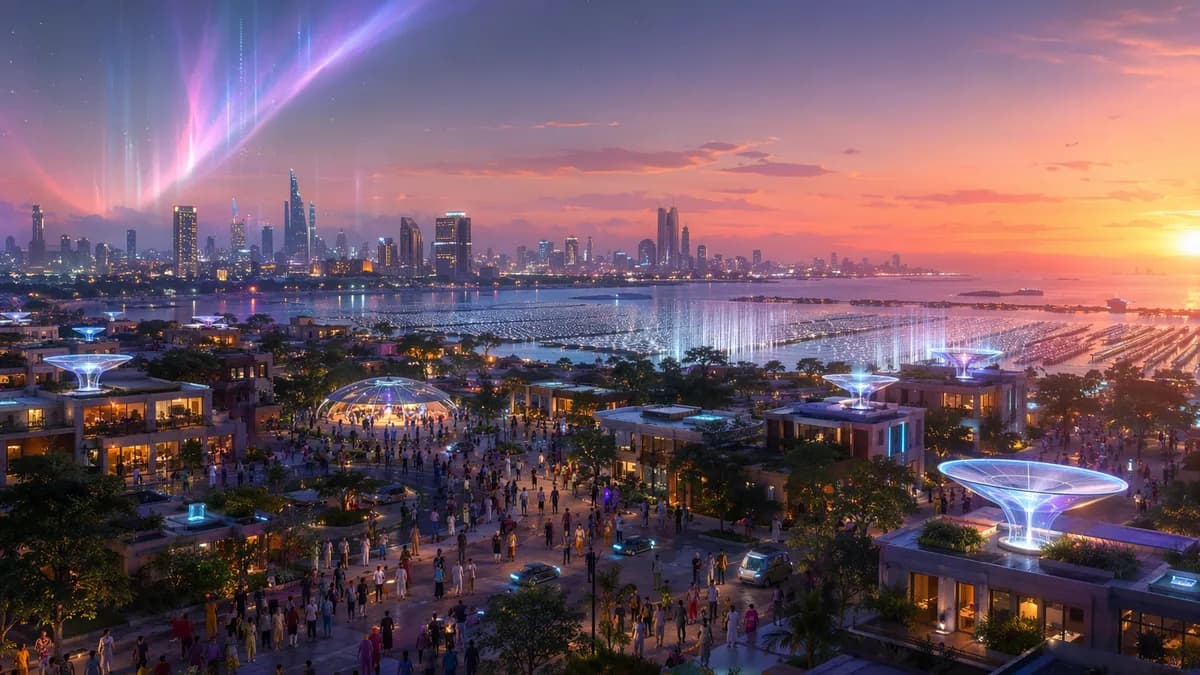
Workers bolt mist fountains along the marina, where seawater will rise in silver columns and fall back clean through desalination filters. Public kitchens unfold in schoolyards, their induction vats big enough to bathe in, already fragrant with jollof rice, egusi, goat stew, and plantain frying in oil. All-night classrooms hang banners from balconies: Learn coding at midnight. Repair drones before dawn. Yoruba poetry under the stars.
Open-air cinema screens bloom against walls in Ajegunle and Lekki. Refrigerated medicine kiosks hum beside mosques, churches, bus stops, and markets. Children run beneath strings of bioluminescent fabric that blush pink when touched. Nobody checks a meter. Nobody buys a recharge token. Nobody listens for the old choking cough of a generator failing under load.
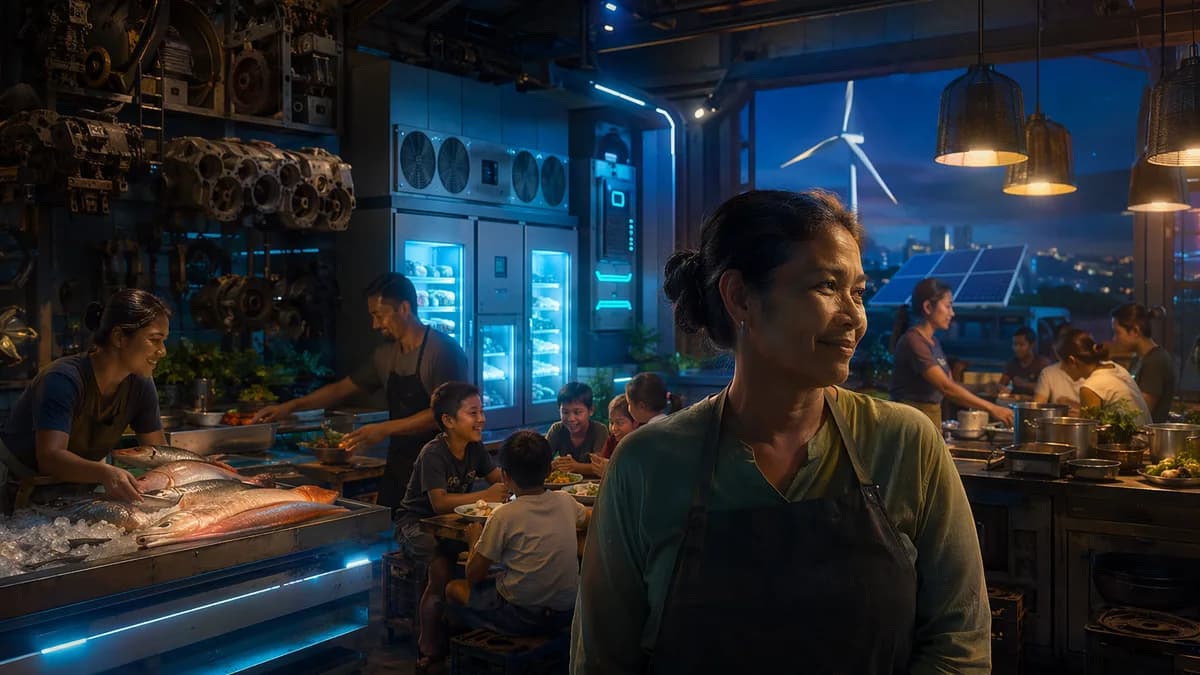
Amina walks through Makoko with her mother, following the wooden walkways above the water. The lagoon smells of salt, fish, algae, and smoke from cooking fires kept for flavor now, not necessity. Their family’s new cold-room floats on blue plastic pontoons beside the fish market. Its walls are bright white. Its door opens with a sigh of cold air that fogs Amina’s glasses.
Inside, silver croaker and catfish lie in neat crates. Women in rubber aprons laugh as they slide in the day’s catch.
Mama Bello stands with her hands on her hips, proud as a general. “See? No spoilage. No begging hotel kitchens for ice. No losing half your money because NEPA did nonsense.”
“Mama,” Amina says, smiling, “NEPA has been dead for twenty years.”
“And still I curse them. Respect your ancestors.”
One fish seller, Auntie Risi, takes Amina’s hand in both of hers. Her palms are rough and cold. “Your mother says the room stays free during surplus hours.”
“It does,” Amina says. “The Commons covers the draw.”
Auntie Risi looks toward the glowing receiver mast. “Then tonight my fish can wait for morning, and I can dance.”
Outside, speakers begin to test their bass. A deep note rolls over the water, joined by drums, whistles, the shriek of delighted children as the first fountain leaps into the purple evening. Across the city, power rises without smoke.
Mama Bello watches the lights come on, one district after another. “Your father would say we are wasting it.”
“Papa wastes nothing except advice.”
Her mother laughs, then grows quiet. “Still. This much light. It can make a person forget night is also a gift.”
Amina looks out across the lagoon. The festival grid brightens on her tablet, a jeweled beast waking under her hand.
The Darkness Petition
The petition arrives as Amina is approving the final surplus release.
It is not a government memo. It comes as a crowd.
They wait outside the district beam office near the waterfront: fishermen in faded caps, astronomers from the university carrying folded sky charts, elders in white lace, schoolchildren with cardboard signs painted in blue and black. One sign shows a turtle with tears under a streetlamp. Another reads, LET THE BIRDS READ THE STARS.
Amina steps outside into the hot evening. Festival music thumps in the distance. Above the roofs, receiver masts glow in readiness.
An old fisherman named Baba Seyi speaks first. His beard is white, his hands curled by years of nets and rope. “Engineer Bello, the light over the coast tonight will be too much.”
“I am a cartographer,” she says gently.
“You map power. Then map mercy.”
A girl in a green school uniform lifts a tablet. On it, a migration model shows bright coastal zones pulsing red. “The terns are passing tonight. Also hatchlings near Ilashe. If the beach stays bright, they crawl inland.”
An astronomer adds, “We have measured skyglow rising every festival rehearsal. The birds use stars. Turtles use the moon path on water. We are replacing heaven with entertainment.”
Behind Amina, one of the district officials mutters, “This is sentimental sabotage.”
The crowd hears. A ripple of anger moves through them.
Amina raises her hand. “What are you asking?”
“Dim the coast,” says Baba Seyi. “From Tarkwa Bay to Badagry. Four hours.”
The official barks a laugh. “On the first unmetered night? Do you want riots? People have waited their whole lives for this.”
“So have the turtles,” says the schoolgirl.
Amina feels the sentence enter her like a small knife.
Within an hour, the petition is everywhere. News feeds split into fury. Some call the request sacred, others call it elitist darkness. Market unions fear losing customers. Festival planners accuse conservationists of humiliating Lagos before the world. A senator posts, We did not defeat scarcity to worship shadows.
Her father calls while she sits in the control room, surrounded by maps bright enough to stain her face gold.
“Are you the one causing wahala?” he asks.
“I am the one receiving it.”
He is silent a moment. “When your mother gave birth to you, the hospital generator failed. I spent twenty minutes outside in rain, pulling the cord until my palms tore. When light came back, everyone shouted like God had entered.”
“I know the story, Papa.”
“Good. Then remember why people love brightness.”
Amina looks at the petition on her screen, at the turtle drawn by a child’s careful hand.
“I remember,” she says. “That is what scares me.”
A Treaty for Shadows
Amina does not cancel the festival. She redraws it.
At 21:00, while Lagos trembles with music and expectation, she stands before the emergency civic council in a linen jacket damp at the collar. The room is packed, market leaders, ecologists, festival sponsors, ferry unions, clergy, youth delegates, and officials already rehearsing who to blame.
On the wall behind her, the city map glows too brightly.
“We built the Beam Commons because scarcity was cruel,” Amina says. Her voice shakes once, then steadies. “But if abundance means every quiet thing must surrender, then we have only invented a cleaner kind of conquest.”
A man from the entertainment council folds his arms. “People want light.”
“Yes,” Amina says. “And medicine wants cold. Ferries want charge. Children want classrooms. Fish sellers want storage. Birds want stars. Turtles want the moon on water. These are all real demands.”
She brings up a new layer on the map. The blaze breaks into shapes, low-energy corridors along the coast, dimmed bridges over migration paths, shielded festival zones, bright islands around hospitals, kitchens, transit docks, and night schools. Public screens shift from white glare to warm amber. Fountains reduce height near the lagoon. Coastal music stages keep sound but cut skyward beams. For four hours, the beach districts breathe darker.
“I call it chosen dimness,” she says. “Scheduled low-energy corridors. Cultural quiet hours. Ecological dark zones protected the same way we protect clinics and water systems. Not failure. Not shortage. Choice.”
The argument lasts forty-seven minutes. It feels longer. People shout. People accuse. Auntie Risi appears on a public feed from the cold-room and says, “My fish can stay cold with half the light. Let the small animals pass.” A classroom of children votes live to move their astronomy lesson outdoors. The entertainment council negotiates amber lighting in exchange for extra surplus after midnight. The fishermen offer boats to monitor turtle beaches.
At 22:00, Lagos dims by design.
Not everywhere. Never that. The hospitals remain clear and bright. The public kitchens steam under warm lamps. Cinemas glow in courtyards. Trains slide like lit beads across the mainland. But along the coast, towers soften. Billboards lower their voices. The lagoon stops reflecting a hard electric noon and begins to hold the scattered shimmer of stars.
People notice. Some complain. Some fall quiet.
On a darkened beach near Ilashe, Amina stands with Baba Seyi, the schoolgirl, and her mother. The sand is cool beneath her shoes. Out at sea, the festival glows in islands, gold, blue, green, each one surrounded by living black.
A tiny turtle breaks from the sand. Then another. They move toward the water, awkward and urgent, following a silver path the city has agreed not to erase.
Mama Bello slips her hand into Amina’s. “Your father is watching from the shop,” she says. “He says the darkness is working.”
Above them, a line of birds crosses the sky, invisible until it passes through the moonlight.
Amina’s tablet hums with surplus alerts, complaints, praise, requests from other cities already asking for the chosen dimness protocol. She silences it. For once, the map can wait.
The future does not blaze. It glows, pauses, listens. And in the space Lagos leaves unlit, something older than electricity finds its way home.