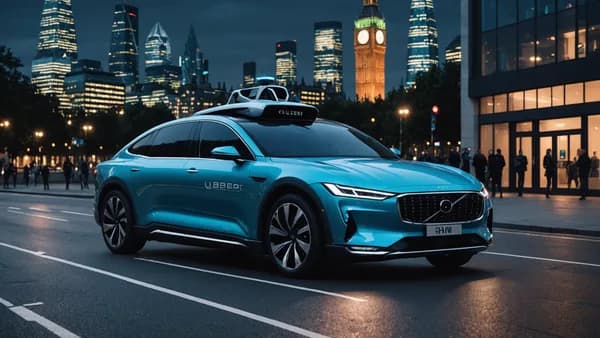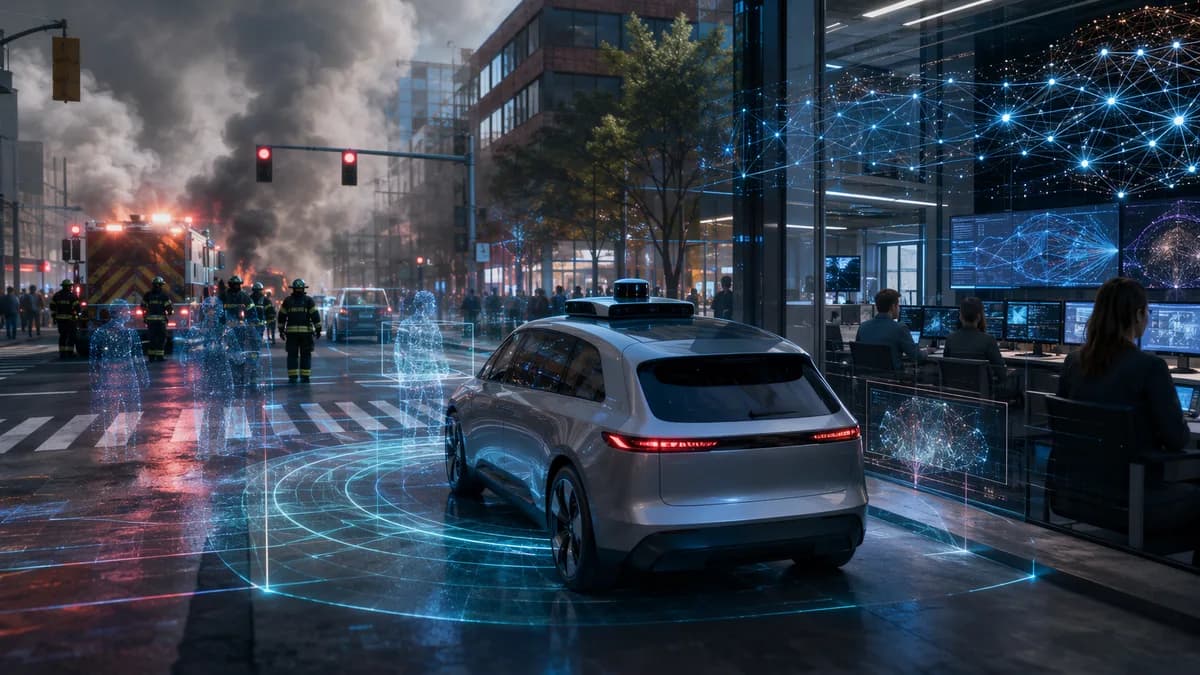
Zoox recall action now covers 105 robotaxis after one of the Amazon-owned company’s driverless vehicles entered a smoke-obscured fire scene, braked hard, and had to be backed out by a remote operator.
XOOMAR Intelligence
Analyst Take
The company shipped a software update to its public-road fleet after the June incident, according to TechCrunch. The recall puts a sharp spotlight on a problem regulators are now pressing across the autonomous-vehicle sector: robotaxis must recognize emergency scenes before they create new hazards for firefighters, police, ambulances, or crash crews.
Zoox recall follows a smoke-filled fire scene failure
Zoox told TechCrunch the update “enhances the existing capability of detecting active [emergency] scenes by adding the ability to detect and respond to heavy smoke in certain situations.”
That wording matters. This is a software recall, not a conventional mechanical defect. For AV companies, recalls increasingly function as the formal mechanism for correcting behavior exposed by real-world driving, especially when the vehicle’s decision-making fails under messy street conditions.
The incident happened on June 20, according to the National Highway Traffic Safety Administration report described by TechCrunch. A Zoox robotaxi “encountered heavy smoke that obscured an active emergency fire scene that was not cordoned off with cones.”
The vehicle then “braked hard while attempting to steer away before coming to a stop.” A Zoox teleoperator reversed the vehicle away from the scene, which allowed first responders to place traffic cones.
Nobody was inside the vehicle. Zoox told NHTSA it isn’t aware of any injuries tied to the issue.
The exact location remains undisclosed. TechCrunch reported that NHTSA’s report doesn’t identify where the incident occurred, and Zoox declined to say.
XOOMAR analysis: The important failure was not just that smoke reduced visibility. It was that the vehicle reached an active emergency scene before it treated that scene as something to avoid. For a robotaxi, heavy smoke is not a rare spectacle. It can be part of a fire response, crash scene, road closure, or emergency diversion, exactly the kinds of environments regulators now want AV companies to handle cleanly.
Heavy smoke put Zoox in the path of NHTSA’s first-responder warning
Zoox decided to issue the recall on July 7, one day before NHTSA administrator Jonathan Morrison sent a letter to self-driving car companies warning them to stop interfering with first responders.
Morrison’s language was unusually blunt.
“Let me be clear: the inability to detect and appropriately respond to such situations represents a functional insufficiency,” he wrote. “Emergency scenes are not rare or extreme ‘edge cases.’ As such, NHTSA is today issuing a call to action for AV developers and operators to immediately focus their resources on fixing this issue.”
That statement turns the Zoox recall into more than a one-company fix. It lands inside a broader federal push to force AV developers to prove their vehicles can behave safely around emergency personnel.
TechCrunch also reported that Waymo has had repeated run-ins with first responders as it expands into new cities. As of March, the company had at least six incidents in which first responders had to physically move robotaxis from an emergency scene.
The common thread is not brand. It’s operational credibility. A robotaxi that blocks an ambulance, enters a fire scene, or freezes where firefighters need to work can turn a software gap into a public-safety problem within seconds.
| Event | Reported detail | Immediate consequence |
|---|---|---|
| Zoox June 20 incident | Vehicle encountered heavy smoke at an active fire scene not cordoned with cones | Braked hard, stopped, then was reversed by a teleoperator |
| Zoox recall decision | Company decided on recall on July 7 | Software update sent to 105 vehicles |
| NHTSA warning | Morrison letter sent one day later | AV companies told to focus resources on emergency-scene response |
Zoox said it investigated the root cause and looked for similar incidents. The company told NHTSA “this is the only event of this kind that Zoox has experienced,” and said it had multiple conversations with the regulator in late June and early July about the “severity, frequency, and root causes.”
For readers tracking the wider tech-policy pressure around products that operate in public systems, XOOMAR has also covered DOJ Guts TikTok Federal Device Ban After ByteDance Deal and OpenAI First Hardware Snubs AI Companion Hype for Coders. Different sectors, same underlying scrutiny: software choices are now public-policy events when they affect safety, access, or institutional control.
Zoox now has to prove emergency-scene behavior before commercial scale
This is not Zoox’s first recall. TechCrunch reported the company voluntarily recalled vehicle software in March 2025 to resolve a hard-braking issue that NHTSA had been investigating since 2024.
Zoox issued two more recalls in May 2025. One followed a collision with a passenger car. Another followed an incident in which a Zoox vehicle was struck by an e-scooter rider.
The timing is awkward. Zoox has been expanding testing into new cities and is offering free rides in Las Vegas and San Francisco ahead of a planned commercial launch.
That launch depends on NHTSA granting Zoox an exemption from certain Federal Motor Vehicle Safety Standards, because Zoox’s robotaxis don’t have a steering wheel or pedals. NHTSA has also recently proposed removing the brake-pedal requirement for vehicles built to be fully autonomous.
The immediate question is whether the new software update fully resolves the specific smoke-response failure. Zoox says it has shipped the fix to its fleet of 105 vehicles, but the public record, as described by TechCrunch, does not disclose detailed validation results, test scenarios, or whether operating limits changed while the recall was handled.
XOOMAR analysis: The next pressure point is evidence. Regulators and cities won’t just care that Zoox patched the software. They’ll want to know how the company proves the updated system reacts properly when a fire scene is partially visible, not yet marked with cones, and changing in real time.
The practical watch item is narrow but consequential: whether NHTSA treats this Zoox recall as a closed software correction, or folds it into a tougher standard for how all robotaxis must detect and avoid emergency scenes before they scale into more public streets.
Impact Analysis
- The recall shows how autonomous-vehicle safety fixes increasingly depend on software updates rather than mechanical repairs.
- The incident highlights the challenge robotaxis face in recognizing emergency scenes under difficult conditions like heavy smoke.
- Regulators are scrutinizing how driverless fleets behave around first responders before these services expand further.
Zoox Robotaxis Covered by Software Recall
Primary Sources & Disclosures

Written by
XOOMAR Insights Team
Research and Editorial Desk
The XOOMAR Insights Team pairs automated research with human editorial judgment. We track hundreds of sources across technology, fintech, trading, SaaS, and cybersecurity, cross-check the facts, and explain what happened, why it matters, and what to watch next. We do not just rewrite headlines. Every article is fact-checked and scored for reliability before it goes live, and we link back to the original sources so you can verify anything yourself.