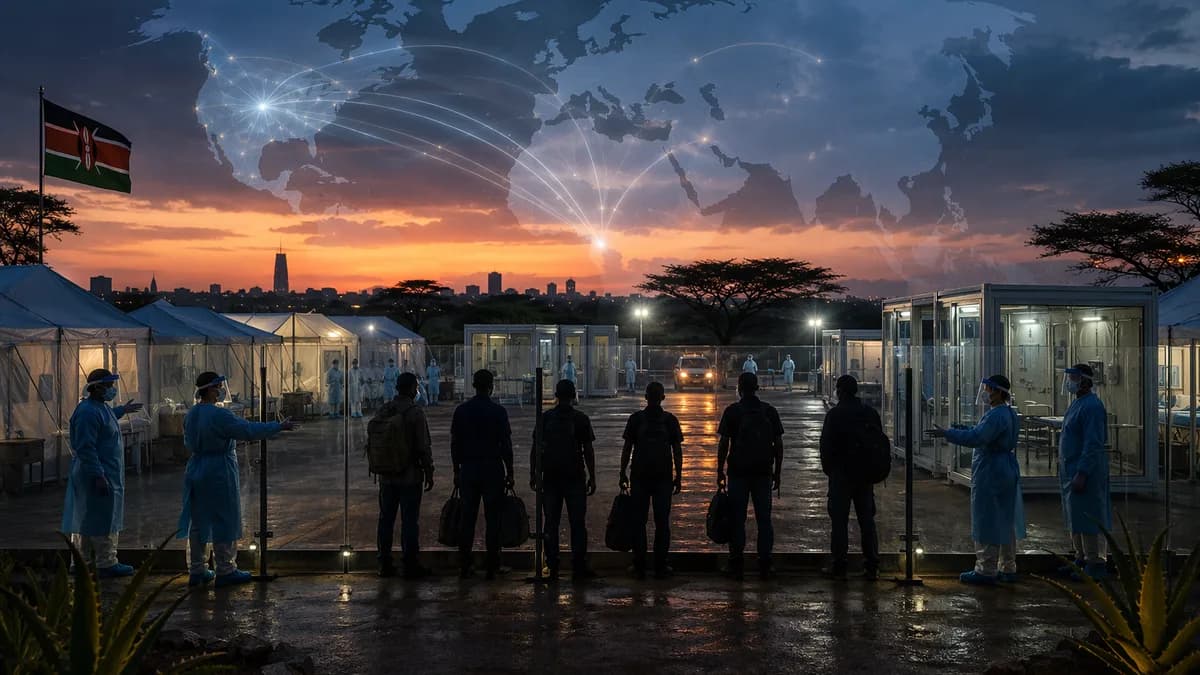
Seven asymptomatic American aid workers have turned a 50-bed Kenya Ebola quarantine facility into a test of whether emergency disease controls can survive public anger, court orders, and cross-border politics.
XOOMAR Intelligence
Analyst Take
The workers, employed by Samaritan’s Purse, had been in the Democratic Republic of the Congo responding to a Congo Ebola outbreak and are now quarantining in Kenya after Washington imposed new return rules for Americans leaving Congo, according to Guardian World. The policy requires American citizens returning from Congo to spend three weeks in a third country before entering the United States.
7 aid workers turned a 50-bed Kenya Ebola quarantine facility into a legitimacy test
The headline fact is small in case-count terms: seven people, no reported symptoms, 21 days of monitoring. The political signal is larger. The first known use of the Kenya Ebola quarantine facility has landed inside a Kenyan legal and public backlash over whether the US is shifting risk to a partner country.
That tension matters because quarantine systems depend on consent as much as containment. A facility can have clinicians, fences, tents, and protocols. If local residents believe it was imposed on them, even routine isolation can look like foreign risk management at Kenya’s expense.
“Samaritan’s Purse has seven American Disaster Assistance Response Team staff members there,” Franklin Graham, president and CEO of Samaritan’s Purse, told Reuters.
“None of them have any symptoms, but they are being quarantined by the Kenyan government for 21 days,” Graham said.
A US State Department official gave a different emphasis, saying the asymptomatic Americans had “voluntarily moved to the Kenya facility for precautionary monitoring and isolation” and that Kenyan authorities had authorized the move under observation by US Public Health Service clinicians. The official said the decision was taken “strictly out of an abundance of caution.”
Both versions can be true. They also reveal the friction. The workers may be complying with public health rules, but the facility receiving them is already contested.
The numbers behind the Kenya Ebola quarantine dispute
The confirmed figures explain why this case has become symbolic faster than it became medically alarming.
- Seven workers: Samaritan’s Purse says seven American Disaster Assistance Response Team staff are quarantining.
- 21 days: The quarantine period matches the monitoring window cited by the charity and US policy.
- 50 beds: The US government is building the bio-isolation unit on an air force base in central Kenya.
- 72-member team: ABC News reported that Samaritan’s Purse said its Disaster Assistance Response Team in Congo has 72 members.
- 44 Americans: The same team includes 44 Americans, with other members from nine countries.
- 2,124 confirmed cases and 828 deaths: ABC News cited WHO figures for Congo’s outbreak as of Thursday.
The facility is intended for asymptomatic Americans exposed to Ebola in Congo or Uganda. That design choice is the source of the Kenyan backlash. Critics in Kenya argue the country is being asked to host the consequences of exposure that happened elsewhere.
One source familiar with the matter told Reuters that the group arrived at the site in central Kenya on Monday and was sleeping in army cots in tents. Some had treated Ebola patients at Samaritan’s Purse treatment centers in Congo, while others did work such as construction and had no direct contact with the sick.
“There is one potential high-risk exposure,” the source said, adding that the group’s health was being monitored.
That detail sharpens the policy question. If exposure risks vary by person, blanket travel rules can still produce one destination: a third-country quarantine site already under political strain.
A court fight reached the facility before Ebola patients did
Kenya’s isolation site became a legal controversy before it became a functioning health tool. A court ordered work suspended pending a final ruling. Kenya’s health minister later announced an immediate halt to construction after being found in contempt of court for failing to observe that order.
Yet construction continued, according to US officials and satellite imagery reviewed by Reuters. That sequence is damaging for trust. If a court says stop and the project still appears to advance, the public argument shifts from epidemiology to authority.
This is where the Kenya Ebola quarantine facility stops being a technical matter. Public health infrastructure needs clear answers before people arrive:
- Admission rules: Who qualifies for quarantine there, and who decides?
- Duration: Is every person held for 21 days, regardless of exposure level?
- Safeguards: What clinical, environmental, and transport protections apply?
- Liability: Who carries responsibility if protocols fail?
- Oversight: How do court orders and health emergency decisions interact?
Without answers that residents trust, the site becomes a symbol. Not of preparedness, but of decisions made above local heads.
For readers tracking how state authority becomes contested under public pressure, XOOMAR has covered similar governance flashpoints in Rohan Dennis Driving Ban Breach Threatens Court Leniency and Trump Turns Wildfire Smoke Into Canada Tariffs Fight.
Four groups, four different crises inside one quarantine order
The same seven-person quarantine looks different depending on where you stand.
| Stakeholder | The crisis they see |
|---|---|
| Aid workers | They took risk in Congo’s Ebola response and now face isolation in a third country before returning home. |
| Kenyan residents and critics | They fear imported health risk, weak consultation, and a foreign-backed site operating despite legal opposition. |
| US officials | They want a buffer between Ebola exposure and US entry, while still supporting frontline response work. |
| Kenyan courts and authorities | They must manage public anxiety, legal orders, health preparedness, and international pressure at once. |
The US policy is easy to defend domestically. It says Americans leaving an Ebola outbreak zone cannot directly reenter the United States until three weeks have passed in a third country. The problem is operational. Those three weeks have to happen somewhere.
Kenya is now that somewhere for these seven workers.
Kenya has used 21-day Ebola monitoring before, but this case carries different politics
The source material recalls a 2014 episode in which nine Kenyans arriving from Ebola-hit Liberia went through screening at Jomo Kenyatta International Airport and were placed under 21-day home quarantine under surveillance by health workers.
That earlier example matters because it shows Kenya has handled Ebola-related monitoring before. The current dispute is different. This time the quarantined group is American, the facility is US-backed, and the site sits inside a court fight and local opposition.
The lesson is not that quarantine is inherently illegitimate. It is that coercive or poorly explained controls can backfire. If responders fear they may be stranded by changing travel rules, aid groups may face harder recruitment and deployment decisions. If host communities believe they are being used as holding zones, cooperation weakens.
XOOMAR analysis: the central risk is not the seven asymptomatic workers. It is the precedent. A donor country can restrict reentry, an NGO can keep operating in an outbreak zone, and a partner country can become the buffer. Unless those roles are negotiated in advance, the next quarantine will inherit the same trust deficit.
NGO deployments now need quarantine diplomacy before staff enter Ebola zones
Aid groups working in Ebola zones will likely need more than medical evacuation plans after this. They will need pre-negotiated quarantine routes, host-country approvals, staff consent protocols, insurance clarity, and legal contingencies before teams deploy.
That’s the practical takeaway. Disease control is not only about borders. It runs on transport, tents, clinicians, court orders, public messaging, and the credibility of governments that ask people to accept risk.
The evidence that would confirm this case as a turning point would be concrete: written quarantine agreements before deployments, clearer public disclosure around isolation sites, and travel rules that distinguish exposure levels rather than dumping everyone into the same bottleneck.
The evidence that would weaken the thesis would be equally clear: Kenyan courts resolving the dispute, local opposition easing, and future Ebola responders rotating through without confusion or diplomatic strain. Until then, the Kenya Ebola quarantine facility is a warning sign for global health planners: a small quarantine can expose a much larger system failure.
Impact Analysis
- The case tests whether emergency quarantine rules can withstand legal, political, and public resistance.
- Kenya’s role highlights tensions over whether powerful countries are outsourcing health risks to partners.
- The outcome could shape how future cross-border disease controls are accepted during outbreaks.
Competing framings of the Kenya Ebola quarantine
| Actor | Position/Framing | Key detail |
|---|---|---|
| Samaritan’s Purse | Workers are being quarantined by the Kenyan government | Seven asymptomatic American Disaster Assistance Response Team staff are in the facility for 21 days |
| US State Department | Workers voluntarily moved for precautionary monitoring and isolation | Kenyan authorities authorized the move under observation by US Public Health Service clinicians |
| Kenyan public/legal backlash | Concern that the US is shifting risk to Kenya | The facility’s first known use has triggered questions about consent and sovereignty |
Kenya Ebola quarantine facility use
Primary Sources & Disclosures

Written by
XOOMAR Insights Team
Research and Editorial Desk
The XOOMAR Insights Team pairs automated research with human editorial judgment. We track hundreds of sources across technology, fintech, trading, SaaS, and cybersecurity, cross-check the facts, and explain what happened, why it matters, and what to watch next. We do not just rewrite headlines. Every article is fact-checked and scored for reliability before it goes live, and we link back to the original sources so you can verify anything yourself.