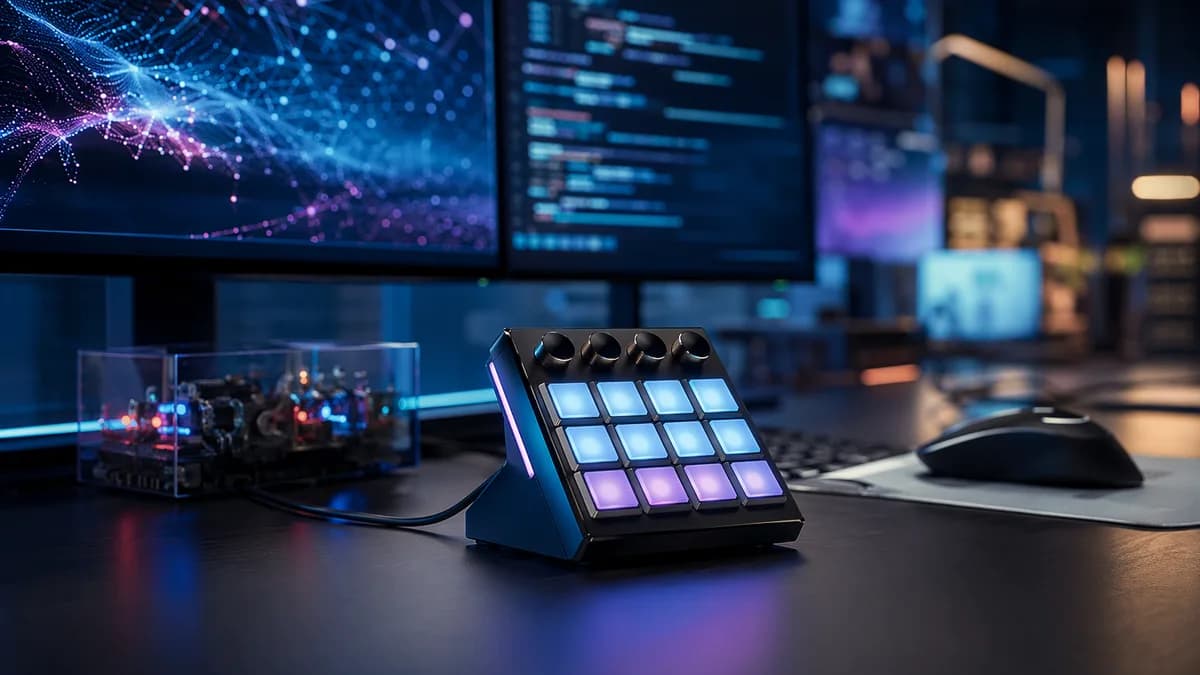
OpenAI first hardware signals restraint, not retreat: the company answered months of Jony Ive device speculation with a $230 developer macro pad built for Codex users. That mismatch is the story. The market expected a screenless AI companion. OpenAI introduced Codex Micro, a programmable keyboard accessory for people already managing AI coding agents, according to PYMNTS.
XOOMAR Intelligence
Analyst Take
The move punctures the myth that AI hardware will jump straight from software demos to mass-market companion devices. OpenAI’s first hardware is narrower, less glamorous and more revealing. It starts where user behavior already exists: at the desk, inside coding workflows, beside a regular keyboard.
OpenAI first hardware lands where Codex already has users
Codex Micro is not trying to replace the phone, laptop or smart speaker. It sits next to a developer’s existing keyboard as a physical controller for Codex, OpenAI’s coding agent platform. That matters because the device doesn’t ask users to invent a new habit from scratch.
The hardware was co-designed with boutique keyboard maker Work Louder. It has 13 mechanical switches, a joystick and a rotary dial. Six illuminated Agent Keys show live status for Codex tasks: white for idle, green for unread chat, blue for thinking, pink for a question or user approval needed and red for error.
Work Louder Co-Founder Mike Di Genova described the Agent Keys as a “live view of your Codex threads.” OpenAI’s product page calls the device a “command center for agentic work.”
That phrasing is the tell. OpenAI first hardware is not a consumer object searching for a daily use case. It is an interface layer for a workflow OpenAI is already pushing through Codex and ChatGPT Work. As we covered in ChatGPT Work’s agent push, OpenAI has been moving beyond chat toward agents embedded in professional tasks.
The strongest counterpoint is obvious: a $230 macro pad is a niche accessory. It is. But that niche may be the point. It is easier to validate physical controls with power users than to convince the public to carry a new AI object everywhere.
July 14, July 15 and the 2027 gap explain the real hardware timeline
The sequence was blunt. On Tuesday, July 14, PYMNTS reported that the screenless consumer companion being developed with former Apple designer and io Co-Founder Jony Ive remained under development and would not ship before 2027. The next day, OpenAI released Codex Micro.
That timing makes OpenAI first hardware look less like a detour and more like a staging move. Software can roll out fast. Consumer hardware cannot. A companion device has to clear harder questions around price, battery life, latency, manufacturing volume, margins, returns and support. None of those details have been reported for the Jony Ive-linked device, which is exactly why the 2027 timing matters.
Codex Micro has simpler economics and a narrower promise. It costs $230, comes in clicky and silent versions and is available while supplies last. Gizmochina reported that it supports Bluetooth and USB-C, works with Windows and macOS, and ships with 32 interchangeable keycaps.
| Product path | Reported status | Core challenge |
|---|---|---|
| Codex Micro | Released as a $230 macro pad | Prove physical controls help Codex users |
| Jony Ive-linked companion | In development, not before 2027 | Justify a new consumer AI category |
| Humane AI Pin | Humane raised $230 million and shut down after HP acquired the company in 2025 | Failed consumer AI hardware adoption |
| Rabbit R1 | Sold 100,000 units and faced criticism after failing to match demos | Gap between demo and daily utility |
That table is why OpenAI’s caution looks rational. AI software can tolerate rough edges in a way consumer hardware cannot. A flawed app update can be patched. A disappointing device becomes a return, a support problem and a brand problem.
The keyboard strategy is really an interface strategy
Codex Micro is best read as an input bet. The product gives developers dedicated buttons, a joystick and a dial for agent workflows. The joystick launches common workflows. The dial adjusts how much computing power an agent applies to a task.
That is a different ambition from a screenless companion. A companion has to explain when users should talk to it, how it handles interruptions, what context it sees and why it deserves space beside the smartphone. Codex Micro avoids those fights. It makes an existing workflow more visible.
Axios described the device as a niche product for power users, with developers able to track every agent without switching windows. That is the practical promise. Less window hopping. More direct control. Clearer status signals when multiple agents are running.
The counterargument is that software shortcuts could do the same thing. Maybe they can. But physical controls have one advantage: they stay visible when the screen is crowded. For AI agents that run in parallel, visibility may matter as much as raw capability.
AI device history makes a modest launch look smarter
OpenAI is entering a category where recent consumer bets have struggled. PYMNTS notes that Humane raised $230 million and shut down after HP acquired the company in 2025. Rabbit R1 sold 100,000 units and then faced broad criticism when the product failed to match its demos.
Both tried to redefine how consumers interact with AI. Both show the trap. A futuristic form factor is not enough if the daily behavior is unclear.
The Jony Ive connection gives OpenAI design credibility, but design cannot solve product-market fit by itself. A screenless AI companion still has to prove it can do something valuable enough to change habits. Codex Micro does not carry that burden. It targets developers already using Codex.
There is also a legal overhang. The Codex Micro launch came days after Apple sued OpenAI, alleging the company used stolen trade secrets to accelerate its hardware push. OpenAI has denied the claims. For more context on that dispute, see our analysis of the Apple OpenAI lawsuit over data access.
Developers, consumers and platform owners will read this very differently
Developers may see Codex Micro as practical if it cuts friction around agent management. Six live status keys, programmable commands, a reasoning dial and workflow shortcuts are all aimed at people running Codex often enough to care about seconds and context switching.
Consumers expecting an AI companion may see the launch as underwhelming. That creates a communications problem for OpenAI. The company has to maintain excitement around future devices without making its actual first product look like a consolation prize.
Platform companies will likely read the signal another way: AI companies want more control over the interface, not just model access through apps. That does not mean Codex Micro threatens laptops or operating systems today. It does mean OpenAI is experimenting with where AI work begins, not just where model output appears.
Investors may prefer this lower-risk first step, but they will still want evidence that accessories can lead to a broader hardware line. The company has one useful data point already. OpenAI said more than 5 million people use Codex every week, and more than 1 million use it for work outside software development. Tibo Sottiaux, Codex engineering lead, posted on X that Codex and ChatGPT Work reached 8 million active users as of Tuesday.
“Hello. We have reached 8M active users across Codex and ChatGPT Work.”
The next chapter depends on whether Codex Micro becomes a habit
The test is not whether Codex Micro looks futuristic. It doesn’t. The test is whether developers keep reaching for it after the novelty fades.
If users treat the keyboard as a daily control surface for Codex, OpenAI gets a stronger case for deeper hardware integration across ChatGPT, desktop apps and professional workflows. If it becomes a collector’s item for AI enthusiasts, the launch will look more like brand merchandise than a serious interface wedge.
Sam Altman’s July 14 post adds pressure to that question. He called GPT-5.6 Sol growth “insane” and warned that “it is possible there are some hiccups soon” as OpenAI scales infrastructure. If demand for agentic work keeps rising, physical controls that reduce friction may become more valuable.
The evidence that would strengthen the thesis is simple: repeat usage, broader Codex integration and more hardware controls tied to real workflows. The evidence that would weaken it is just as clear: limited uptake, little follow-on support or a 2027 companion that launches as a disconnected novelty.
For now, OpenAI first hardware looks modest. That may be the point. The company is starting at the keyboard, where the work already happens.
The Bottom Line
- OpenAI’s first hardware shows the company is prioritizing practical workflow tools over speculative consumer devices.
- Codex Micro targets developers already using AI coding agents, reducing the risk of asking users to adopt entirely new habits.
- The launch suggests early AI hardware may emerge first as specialized accessories rather than mass-market companions.
Market Expectation vs. OpenAI’s First Hardware
| Expected AI Hardware | Codex Micro Reality |
|---|---|
| Screenless AI companion device | $230 developer macro pad |
| Mass-market consumer gadget | Keyboard accessory for Codex users |
| New habit-forming device category | Interface for existing coding workflows |
| Potential phone, laptop or speaker replacement | Sits beside a regular keyboard |
Codex Micro Hardware Controls
Primary Sources & Disclosures

Written by
XOOMAR Insights Team
Research and Editorial Desk
The XOOMAR Insights Team pairs automated research with human editorial judgment. We track hundreds of sources across technology, fintech, trading, SaaS, and cybersecurity, cross-check the facts, and explain what happened, why it matters, and what to watch next. We do not just rewrite headlines. Every article is fact-checked and scored for reliability before it goes live, and we link back to the original sources so you can verify anything yourself.