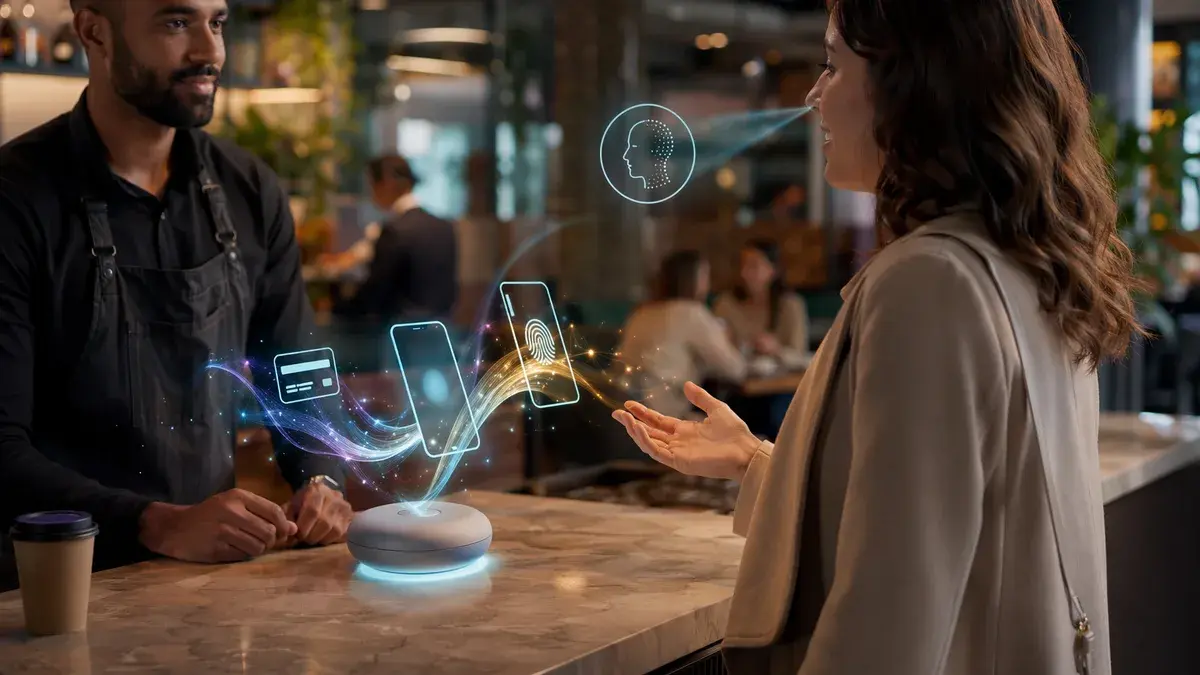
Who authorizes a payment when the checkout screen disappears into a conversation with an OpenAI device?
XOOMAR Intelligence
Analyst Take
That is the real question behind screenless AI payments. OpenAI’s first consumer hardware product is reportedly a portable smart speaker that can move room to room and act as a humanlike AI companion in the home, according to PYMNTS, citing Bloomberg’s reporting. The device is still under development and has not been confirmed by OpenAI.
Bloomberg reported that the device is expected to control smart-home appliances, play media, answer questions and respond to messages through natural conversation. It reportedly includes a camera, sensors and a rechargeable battery, and is designed to become more personalized as it learns a user’s habits.
That sounds like a consumer hardware story. It is also a payments story. If an AI companion lives in the home and starts making purchase decisions, checkout stops being a page. It becomes a spoken exchange.
Can OpenAI make checkout vanish before consumers trust the agent?
The reported device may be unveiled in the second half of 2026, TechCrunch reported, while a court filing cited by Built In indicates it will not ship before February 2027. Built In also reported that a trademark dispute with hearing aid startup iYo means the device will no longer be called “io.”
That timeline gives payment companies time, but not much comfort. The hard part is not putting a payment credential behind a voice interface. The hard part is proving intent.
A screen forces structure. A shopper sees the merchant, the cart, the price, the shipping address, the payment method and the final button. A screenless agent compresses those steps into dialogue. That compression is convenient. It is also where disputes are born.
XOOMAR analysis: The core design challenge for screenless AI payments is not speed. It is consent. A home AI companion will need to know who is speaking, whether that person is allowed to spend, which payment method applies, what limits are in place, and when a spoken “yes” counts as authorization.
That is a higher bar than playing music or dimming lights.
What breaks when the screen no longer stages the purchase?
Digital commerce uses screens as evidence machines. They show the offer. They capture selection. They present the final price. They create receipts, logs and customer service trails.
Remove the screen and the AI has to translate messy human intent into executable payment instructions:
- Merchant choice: Which seller gets the order?
- Payment method: Which card, wallet or account should fund it?
- Delivery details: Which address, time slot or pickup location applies?
- Loyalty and discounts: Should rewards or stored offers be used?
- Approval: Was the user informed enough to commit?
PYMNTS has already framed the deeper issue in agentic commerce: when an AI agent completes a purchase on behalf of a consumer, the traditional chain of authorization breaks down. There may be no human at checkout and no moment where a real person reviews the cart.
That fits the OpenAI device exactly. The reported product is designed for ordinary home scenarios, which could include replenishing household goods, ordering food, booking services, paying bills, managing subscriptions or coordinating family expenses. Those are not exotic transactions. They are routine. That is why they matter.
For related context on the device side, see XOOMAR’s ChatGPT Smart Speaker Threatens Your Phone's Grip at Home. The payments layer raises a separate issue: a device can be useful before it is financially trusted.
Which numbers explain why payments firms cannot ignore this?
The money behind the interface is large enough to force attention. Global retail eCommerce is expected to exceed $8 trillion by 2028, Statista projects. Digital advertising is projected to surpass $1 trillion globally in 2026, WARC reported, citing GroupM data.
Those two markets depend heavily on screens. Screens show ads. Screens drive product discovery. Screens host checkout.
A screenless AI companion attacks both assumptions.
| Signal | Source-backed data | Payments implication |
|---|---|---|
| Retail eCommerce | More than $8 trillion by 2028 | Even a small shift in interface behavior matters |
| Digital advertising | More than $1 trillion globally in 2026 | Product discovery could move from visual ads to AI recommendations |
| Consumer comfort with agents buying | 45% of U.S. consumers, 54% among Gen Z | Interest exists, but trust is not settled |
| Consumer concern | 95% report at least one concern | Payment controls cannot be an afterthought |
| Trust with protections | Only about half would trust agentic commerce even with fraud protections | Fraud tools alone will not solve adoption |
The infrastructure race is already visible. Stripe announced an AI foundation model for payments trained on tens of billions of transactions, TechCrunch reported. Stripe said its previous models reduced card-testing attacks by 80% over two years, while the new model increased detection of such attacks on large businesses by 64% practically overnight.
“Previously, we couldn’t take advantage of our vast data. Now we can.”
That quote, from Stripe’s Emily Glassberg Sands, points to the real split. AI agents may create new payment demand, but payment companies will need AI-native risk systems to police it.
Why do Humane and Rabbit make OpenAI’s hardware bet harder?
The AI hardware category has not earned consumer trust yet.
Humane raised $230 million from investors including Sam Altman, launched the AI Pin in April 2024 at $699, and discontinued it by February 2025 after returns surpassed purchases between May and August 2024, Dataconomy reported. HP later acquired Humane’s assets for $116 million, after fewer than 10,000 units shipped.
Rabbit R1 sold 100,000 units following its debut at CES 2024, then faced criticism after the shipped product failed to match many of its demonstrations, Digital Applied reported.
OpenAI has advantages those devices lacked. Its $6.5 billion acquisition of io Products brought in Jony Ive, LoveFrom, and former Apple engineers who worked on the iPhone and Mac, Bloomberg reported. The reported device also appears closer to a home smart speaker than a smartphone replacement, which gives it a narrower and more familiar starting point.
Still, better design does not automatically create payment trust. The device must prove it can understand household context without turning routine conversation into financial ambiguity.
There is also legal friction. Bloomberg reported that Apple sued OpenAI July 10, alleging trade secrets were used to accelerate device development. OpenAI denied wrongdoing. For more on that dispute angle, read XOOMAR’s Exit Gap Haunts Apple OpenAI Lawsuit Over Data Access.
Who controls the AI checkout layer inside the home?
If screenless AI payments work, the fight shifts to the control point.
XOOMAR analysis: OpenAI would want the home companion to become a durable consumer touchpoint. Banks would want to protect account relationships. Card networks would want tokenized transaction volume. Merchants would want access to AI-mediated shoppers without surrendering margin or customer data.
That creates a new checkout stack. Wallet providers and processors can position themselves as the safe rails for agentic commerce, handling authentication, tokenization, chargebacks, spending limits and transaction records.
The consumer risks are obvious. A child could place an order. An elderly user could be nudged by a recommendation they do not understand. A household member could dispute whether they approved a purchase. Sponsored recommendations could blur into advice if the device sounds human enough.
The reported OpenAI hardware also includes cameras and sensors, according to Bloomberg. That makes privacy part of the payments question. A device that perceives the home may improve context, but every extra signal raises the standard for disclosure, retention and user control.
Which evidence would show screenless AI payments are becoming real?
The first credible uses will likely be low-risk and repeatable: household staples, grocery reorders, food delivery reorders, ride bookings, subscription cleanup and bill reminders. These are the transactions where convenience is clear and the downside can be capped.
The strongest confirmation would be specific payment behavior, not launch hype:
- Credential enrollment: Do users actually connect payment methods?
- Repeat use: Do households buy through the device more than once?
- Approval tiers: Do families set different limits by user?
- Refunds and disputes: Do screenless purchases create more claims?
- Merchant access: Do retailers expose inventory and pricing in agent-readable form?
- Trust recovery: Do users keep using the agent after an error?
Screenless AI payments will not replace mobile checkout soon. The phone is too entrenched, and screens still solve many trust problems cheaply.
But OpenAI’s reported device shows where the pressure is heading. If the AI companion can make invisible transactions feel controlled, reversible and auditable, it can create a new payment habit. If it chases volume before trust, it will inherit the same problem that hurt earlier AI hardware: impressive demos, weak daily use.
Disclaimer: This XOOMAR analysis is for informational and educational purposes only. It is not financial, investment, legal, tax, or professional advice. It does not provide buy, sell, hold, price-target, portfolio, or personalized recommendations. Verify information independently and consult qualified professionals before making decisions.
Impact Analysis
- If AI agents begin making purchases at home, payment authorization rules may need to be redesigned.
- Voice-based checkout could make buying easier but may increase disputes over consent and intent.
- OpenAI’s reported device timeline gives payments firms limited time to prepare for screenless commerce.
Screen Checkout vs. Screenless AI Payments
| Traditional Screen Checkout | Screenless AI Payment |
|---|---|
| Shows merchant, cart, price, shipping address and payment method before purchase | Compresses purchase steps into a spoken exchange with an AI agent |
| User intent is confirmed through a visible final action, such as a button tap | User intent must be inferred or confirmed through conversation |
| Disputes can reference on-screen disclosures and checkout records | Disputes may hinge on what the AI heard, understood and was authorized to do |
Primary Sources & Disclosures
Disclaimer: Content on XOOMAR is produced using AI-assisted research, drafting, and verification workflows and is intended for informational and educational purposes only. It does not constitute financial, investment, legal, tax, medical, or professional advice of any kind. All analysis reflects available information at the time of publication and may not be current. Verify information independently and consult qualified professionals before making decisions. Editorial policy

Written by
XOOMAR Insights Team
Research and Editorial Desk
The XOOMAR Insights Team pairs automated research with human editorial judgment. We track hundreds of sources across technology, fintech, trading, SaaS, and cybersecurity, cross-check the facts, and explain what happened, why it matters, and what to watch next. We do not just rewrite headlines. Every article is fact-checked and scored for reliability before it goes live, and we link back to the original sources so you can verify anything yourself.