
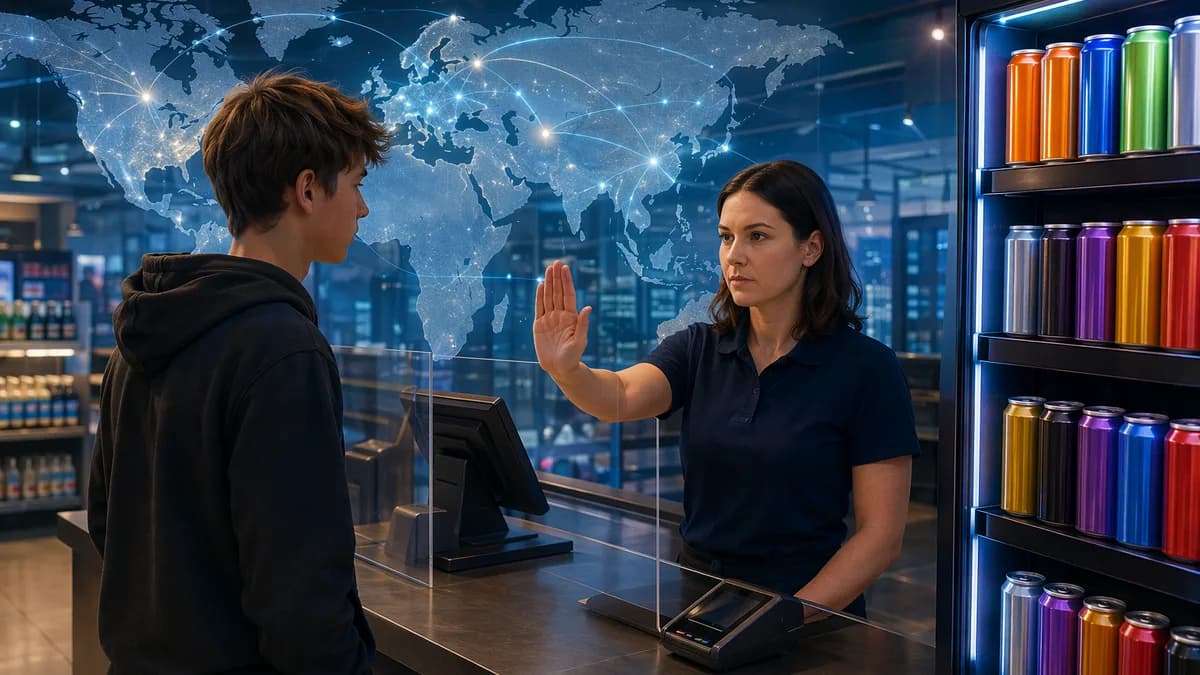
England will ban high-caffeine energy drink sales to under-16s from April 2027, putting shops, vending machines and online retailers on the hook for blocking purchases by children and younger teenagers.
Global TrendsJuly 16, 2026· 6 min read· By XOOMAR Insights Team
Energy Drinks Ban Forces England Shops to Police Teens
Updated on July 16, 2026
XOOMAR Intelligence
Analyst Take
67/ 100
4 sources analyzedMedium confidenceTrend10Freshness98Source Trust90Factual Grounding93Signal Cluster20
The move targets about 100,000 children in England who drink high-caffeine energy drinks every day, with children in more deprived areas and households more likely to consume them, according to Guardian World.
England’s under-16 energy drink ban targets shops, vending machines and online sellers
The energy drinks under-16 ban in England will apply to drinks containing more than 150mg of caffeine per litre, excluding tea and coffee. The government says the rule is designed to improve health outcomes among young people, not simply police checkout aisles.
Public Health Minister Sharon Hodgson framed the policy in blunt terms:
“High-caffeine energy drinks have no place in children’s hands. We know thousands of kids in England consume them daily, but the evidence is clear that this can cause anxiety, affect their sleep and concentration and can have a detrimental impact on their education.”
The ban will cover sales in:
- Shops: supermarkets, corner shops and convenience stores that stock energy drinks.
- Vending machines: a harder channel for age checks.
- Online retailers: where compliance will depend on digital age controls and delivery processes.
The products affected are high-caffeine canned or bottled drinks commonly sold as energy drinks. The law does not cover lower-caffeine soft drinks, and the supplied sources say tea and coffee are excluded.
The immediate question for sellers
How will a small shop worker, vending operator or online checkout system verify that a buyer is not under 16?
That’s where the next stage matters. Ministers plan to bring in the ban through secondary legislation using powers under the Food Safety Act 1990, subject to parliamentary approval, according to the BBC and ITV. Retailers will then need practical rules for till prompts, online checks, staff training and refusals.
XOOMAR analysis: the policy’s force comes from standardization. Some industry players already point to voluntary restrictions, but a legal ban changes the risk calculation because every seller faces the same statutory line.
Drinks makers face a legal threshold, not a vague health warning
For manufacturers and distributors, the most important number is 150mg of caffeine per litre. Above that threshold, sales to under-16s become illegal in England once the measure takes effect.
The BBC reported that drinks including Red Bull, Monster, Relentless and Prime would breach the limit. It also reported that lower-caffeine soft drinks such as Diet Coke are not affected.
| Category | Covered by the ban? | Detail from supplied sources |
|---|---|---|
| High-caffeine energy drinks above 150mg/litre | Yes | Illegal to sell to under-16s in England |
| Tea and coffee | No | Explicitly excluded |
| Lower-caffeine soft drinks | No | BBC cites Diet Coke as unaffected |
| Online sales | Yes | Covered alongside shops and vending machines |
| Vending machines | Yes | Enforcement question is practical age control |
The British Soft Drinks Association pushed back, calling the ban “unnecessary.” A spokesperson said members have followed a voluntary code since 2010 and that high-caffeine beverages already carry a “not recommended for children” label.
That is the policy clash in miniature: ministers say labels and voluntary codes have not stopped daily consumption by about 100,000 children. The industry says legislation is not justified by the evidence.
XOOMAR analysis: the threshold-based approach gives drinks makers a clean compliance line. Reformulate below it, accept under-16 restrictions, or rely on adult buyers. The harder burden lands on retailers, not brands.
Children in deprived households sit at the center of the health case
The government says children in more deprived areas and households are more likely to consume high-caffeine energy drinks. That makes the energy drinks under-16 ban in England an equity policy as much as a health rule.
Ministers link consumption with anxiety, sleep disruption, reduced concentration and harms to education. Doctors have previously said heavy consumption may raise the risk of heart disease and pose a serious risk of stroke, according to the Guardian source material.
Katharine Jenner, executive director of the Obesity Health Alliance, backed the ban and tied it directly to deprivation:
“This is a hugely popular policy, backed by parents, health professionals and the public, and a vital step towards protecting children’s health. Strong evidence links high-caffeine energy drinks to anxiety, poor sleep, reduced concentration and harm to learning and wellbeing – restricting sales to children at a vital time in their life is just common sense.”
The government also says the initiative will help combat childhood obesity and support parents. Sugary versions of energy drinks add a second policy concern, although the legal trigger here is caffeine concentration, not sugar content.
Parents get a clearer rule, but not total control
For families, the ban creates a clear external barrier. A child under 16 should not be able to buy a high-caffeine energy drink in a shop, from a vending machine or online.
That doesn’t answer every route of access. Older friends, household purchases and informal sharing are outside the direct retail rule. The measure narrows opportunity. It doesn’t remove caffeine from children’s lives.
XOOMAR analysis: that distinction matters. The policy is strongest where sales are formal and traceable. It is weaker where access is social.
Retailers now face the compliance burden before April 2027
Retailers will be responsible for ensuring they do not sell covered drinks to under-16s. Local authorities will enforce the law, and businesses that break it face fines of up to £2,500.
The consultation received nearly 1,100 responses from businesses, public health organisations, enforcement bodies and members of the public, with strong support for introducing an age restriction, according to additional reports from the BBC and ITV.
Health campaigners will likely press for fast and consistent enforcement. Retailers and drinks makers will want clarity on definitions, checks, staff liability and the treatment of online orders. Vending machines may become the most awkward edge case because they remove the human age-check moment.
For XOOMAR readers tracking UK execution risk across sectors, this is another test of whether ministers can turn policy intent into enforceable systems. We’ve covered similar delivery questions in UK Risks Losing the Tokenized Wholesale Markets Race, where legal clarity and implementation speed also define the outcome. The same operational theme runs through wider UK state capacity stories, including 250,000 Drones Haunt Keir Starmer’s Kyiv Farewell Visit, where policy commitments meet hard logistics.
The deadline is now the story. If Parliament approves the secondary legislation, the months before April 2027 will decide whether the ban becomes a clean checkout rule or a patchwork of uneven enforcement. Watch for draft guidance on age checks, online sales and vending machines. That is where the real compliance fight starts.
Impact Analysis
- The ban targets around 100,000 children in England who consume high-caffeine energy drinks every day.
- Retailers, vending operators and online sellers will need systems to prevent under-16 purchases from April 2027.
- Ministers say the policy aims to reduce anxiety, poor sleep, concentration problems and education impacts linked to high caffeine intake.
What England’s Under-16 Energy Drink Ban Covers
| Covered by ban | Not covered |
|---|---|
| High-caffeine energy drinks with more than 150mg of caffeine per litre | Tea and coffee |
| Sales to under-16s in shops, vending machines and online | Lower-caffeine soft drinks |
Children in England Drinking High-Caffeine Energy Drinks Daily
Daily consumers
children100,000
Sources

Written by
XOOMAR Insights Team
Research and Editorial Desk
The XOOMAR Insights Team pairs automated research with human editorial judgment. We track hundreds of sources across technology, fintech, trading, SaaS, and cybersecurity, cross-check the facts, and explain what happened, why it matters, and what to watch next. We do not just rewrite headlines. Every article is fact-checked and scored for reliability before it goes live, and we link back to the original sources so you can verify anything yourself.
Explore More Topics
Related Articles
 Global Trends
England Banishes Erling Haaland’s World Cup Dream to Bench
Haaland’s World Cup ended on Norway’s bench as England’s 2-1 win exposed the limits of a one-striker fairytale.
Jul 12, 20269 min
 Global Trends
Amazon Steals Walmart’s Basket as Grocery Trips Split
Walmart still owns the grocery run, but Amazon is peeling off planned purchases, weakening the store traffic moat.
Jul 14, 20268 min
 Global Trends
2,800 Cases Push Cyclosporiasis Outbreak Into 31 States
A cyclosporiasis outbreak has topped 2,800 cases, but investigators still haven't named the contaminated food source.
Jul 13, 20268 min
 Global Trends
Unpaid Staff Turn Congo Ebola Strike Into a Crisis
Unpaid Ebola workers in Ituri walked off the job, exposing a payroll failure that could weaken Congo's outbreak response.
Jul 13, 202612 min
 Global Trends
M&S Crashes London Fashion Week to Bury Frumpy Past
M&S is taking a 100-year fashion story to London Fashion Week to prove its frumpy past is finally dead.
Jul 9, 20268 min
 Fintech
June Retail Sales Expose the Consumer Spending Fault Line
June retail sales rose 0.2%, but consumers are getting pickier. Durable demand now depends on category, confidence and financing.
Jul 16, 20267 min
 Global Trends
Texas Floods Trap Guadalupe River Region Again, 1 Dead
Guadalupe River flooding has killed at least one and forced 80 rescues, reviving questions after last summer's 130-plus deaths.
Jul 16, 20268 min
 Fintech
BitPay MiCA License Ignites EU Crypto Payments Fight
BitPay’s MiCA approval gives it one EU rulebook for crypto payments, turning compliance into a weapon in the merchant land grab.
Jul 16, 20267 min
 Technology
OpenAI First Hardware Snubs AI Companion Hype for Coders
OpenAI’s first device is a $230 Codex Micro macro pad, signaling AI hardware may start with coders, not mass-market companions.
Jul 16, 20268 min
 Cybersecurity
Fairlife Ransomware Attack Freezes US Dairy Production
A ransomware attack forced Coca-Cola to halt Fairlife's U.S. dairy production, with no restart date and Canada spared so far.
Jul 16, 20265 min
Don't miss the signal
Get our weekly roundup of the stories that matter across tech, fintech, and trading. No noise, just signal.
Free forever. No spam. Unsubscribe anytime.