The Monsoon Librarian of Pelagos Nine
In an underwater city that farms clouds, a former rain forecaster must decide who receives the next season.
1. A City Beneath the Wrong Blue
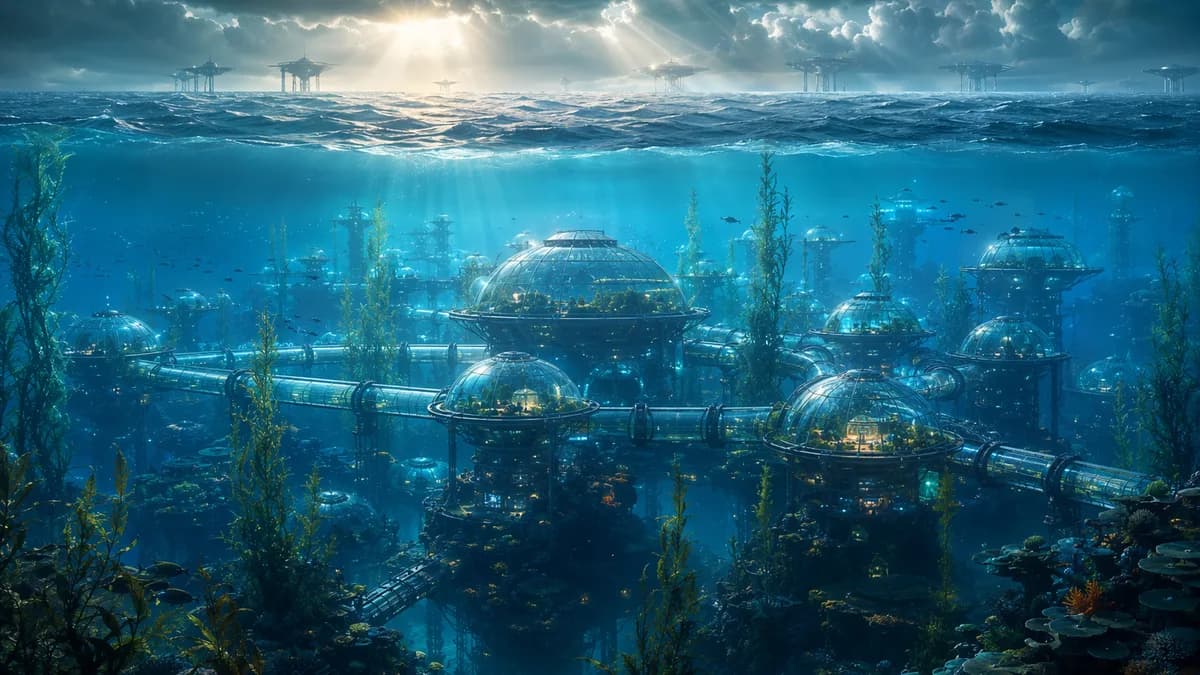
Pelagos Nine hangs under the Indian Ocean like a lantern someone has lowered into a god’s dark well.
From outside, it is all glow and curve, pressure-glass domes grown thick as cathedral walls, ribs of bio-cement laced through coral skeletons, balconies of kelp swaying in the green hush. Schools of silver trevally pass over its roof. Maintenance drones blink red among the reef anchors. Far above, the real surface trembles, a wrinkled sheet of light, too distant to touch.
Inside, the city breathes warm.
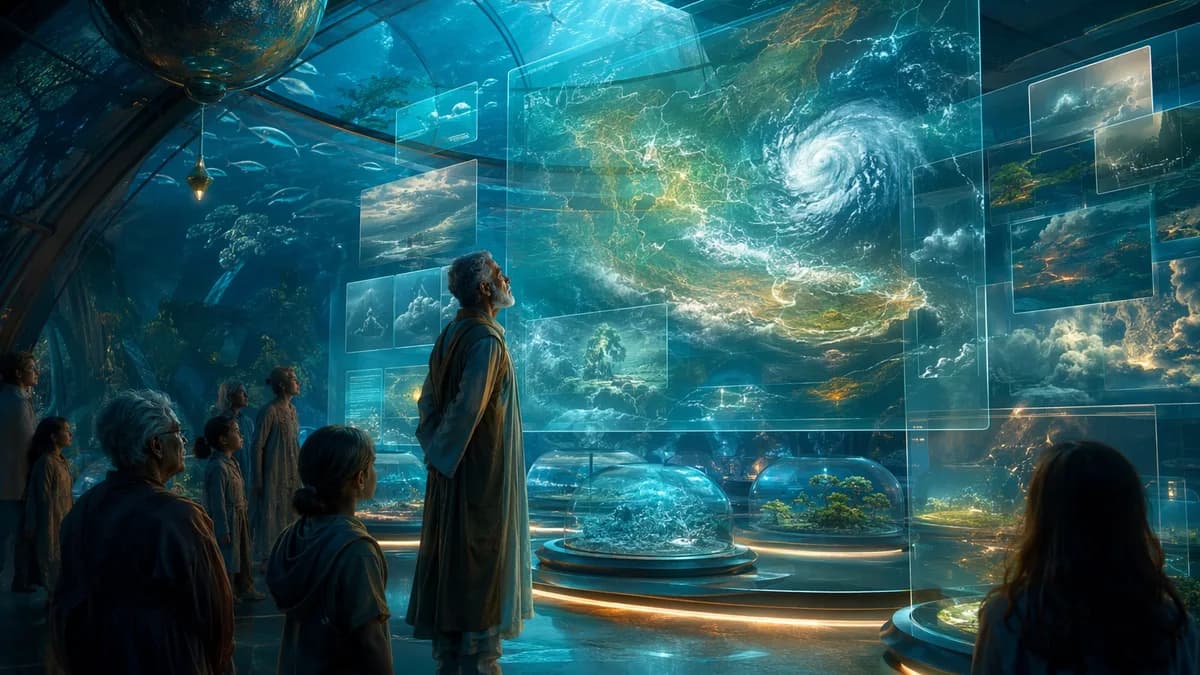
Mara Venn walks through Archive Hall with a basket of scent capsules under one arm. Her bare feet know the floor’s faint vibration, the pulse of thermal vents feeding heat into turbines below. Children sit cross-legged on woven algae mats, their faces tilted toward a ceiling projection of clouds.
“This,” Mara says, holding up a capsule no larger than a seed, “is petrichor.”
A boy with gill tattoos painted for festival week wrinkles his nose. “It smells like rust.”
“It smells like the first rain on dry soil,” Mara says.
“What is dry soil?”
The question lands gently, but it always lands.
Mara breaks the capsule. The archive fills with a smell like stone waking, dust opening its mouth, roots remembering. Some children laugh. One girl closes her eyes with such seriousness that Mara feels a sting behind her own.
“Before the sea took the old coasts,” Mara says, “seasons arrived in the body. Heat on the back of the neck. Wind changing direction. Frogs shouting before rain. Your grandparents could stand outside and know what month it was.”
“We know months,” the boy says. “Month Nine is vent maintenance.”
“And Month Twelve is mirror cleaning,” another child adds.
Above them, the projection rolls into a monsoon front, high white towers shouldering across a blue map of lost India. Mara catalogs these patterns every day, old winds, old mistakes, old prayers uploaded from farmers’ radios and temple ledgers and broken weather stations.
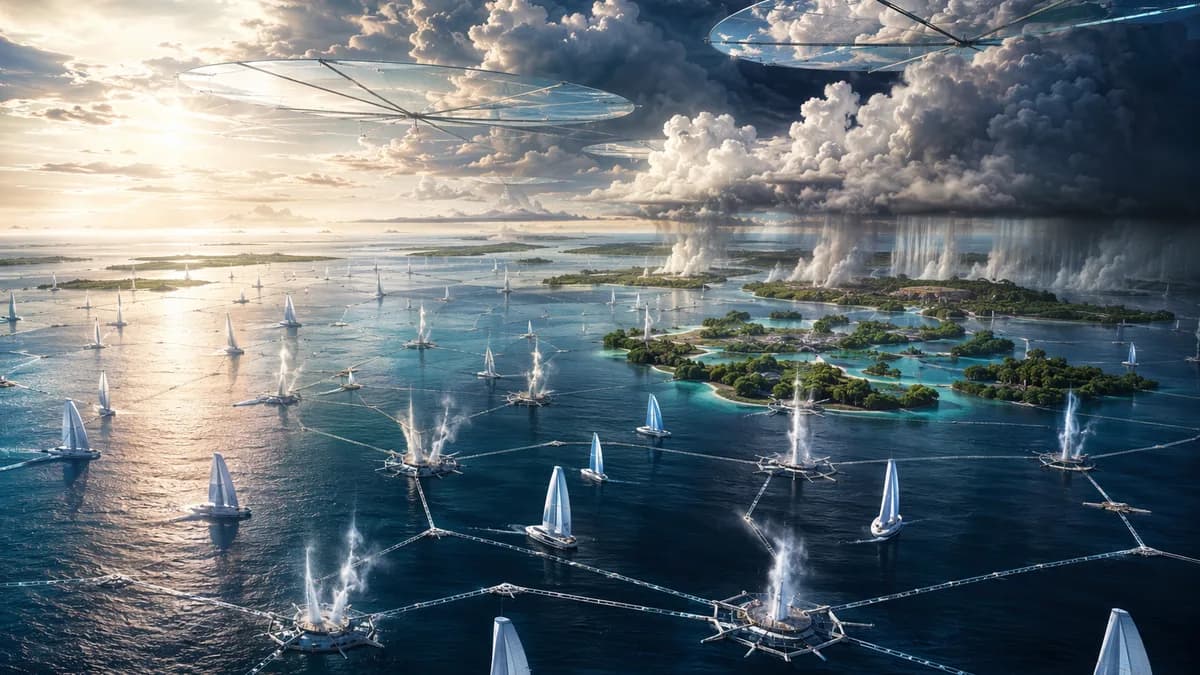
Outside the archive, Pelagos Nine survives by precision. Thermal vents keep the turbines alive. Kelp farms feed stomachs and bioplastics. Surface cloud mirrors, thin as dragonfly wings, tilt sunlight away or down according to daily calculation. Every degree matters. Every current matters. The city is not built against the ocean, but in negotiation with it.
At closing, Mara dims the monsoon projection. The wrong blue of the sea presses against the glass, darker than sky, heavier than memory.
A girl lingers by the door. “Archivist Venn,” she asks, “will rain ever fall here?”
Mara looks up at the ocean above them.
“Not here,” she says. “But somewhere, always.”
She hopes it is still true.
2. The Rain Auction
The Rain Auction begins at dawn, though dawn is only a color Pelagos Nine borrows from screens.
In the Council Amphitheater, delegates appear as pillars of light above the wet black floor. Coastal syndicates shimmer in blue. Inland cooperatives burn amber. Mountain reservoirs pulse white. The Global Weather Commons speaks from the center in a calm, genderless voice that makes catastrophe sound procedural.
“Petition 88-441. Deccan Drylands. Request, full monsoon corridor for seventy-two days. Precedent, denied for seventeen consecutive seasons. Projected benefit, river recharge, staple crop recovery, groundwater stabilization.”
A murmur moves through the amphitheater. Even underwater, Mara hears it like wind through dead leaves.
She stands beside Director Ilyan, whose silver jacket beads with condensed humidity. He has invited her because the request depends on records older than the Weather Commons itself, maps from before the coastlines were redrawn, before Kochi drowned, before Chennai became a reef nursery, before rain became something allocated.
“You know these patterns,” Ilyan whispers. “Tell them what a real monsoon did.”
Mara looks at the amber figures representing the Drylands. Their spokesperson is a woman named Kavitha Rao, broad-faced, hair tied in a white scarf. Behind her projection, Mara sees a room full of people packed shoulder to shoulder, farmers, schoolchildren, old men with copper water charms at their throats.
Kavitha speaks plainly. “Our wells are bone. Our millet fails before flowering. Children think rivers are roads where ancestors walked. We ask for one season. Not pity. Weather owed.”
A coastal bloc interrupts. “Atmospheric river diversion will raise flood risk in the Sindh Floating Belt.”
A solar republic adds, “Sunlight loss affects algae yield.”
Then Pelagos Nine appears in the calculation.
On the amphitheater floor, a model blooms. Blue currents circle the city like protective hands. If the Deccan receives the full monsoon, freshwater runoff spreads through the eastern Arabian Sea. Salinity gradients loosen. The warm current feeding Pelagos Nine’s reef engines shifts by three degrees and slows.
Three degrees is not a number in an underwater city. It is spoiled kelp. Stressed coral. Turbines coughing in the dark.
Director Ilyan folds his arms. “Unacceptable.”
Mara studies the model. Rain gathers over inland plateaus in luminous threads. Rivers refill like veins taking blood. Around Pelagos Nine, the water pales.
The Commons asks, “Archivist Venn, do century records support corridor restoration?”
Everyone turns toward her.
She can say no and protect her city. She can say yes and end an eighteen-year thirst. Her tongue feels salted, heavy.
“The records support it,” she says. The amphitheater stills. “But not as a simple return. The old monsoon belonged to an old ocean. If we pull one back, we move the other.”
Kavitha Rao’s projection flickers. “Then help us move it carefully.”
Director Ilyan’s jaw tightens. Mara feels the city hum beneath her feet, alive, vulnerable, listening.
3. The Machine That Learns Grief
Sefu lives in the walls.
At least, that is how the children explain it. Adults say Sefu is an adaptive climate model distributed across Pelagos Nine’s maintenance network, housed in coolant stacks and reef sensors and municipal memory cores. Mara prefers the children’s version. It feels more honest when a voice follows her through corridors smelling of brine, metal, and steamed kelp.
“You are walking faster than your resting pulse recommends,” Sefu says.
“I am being summoned by three committees and hated by all of them,” Mara replies. “Adjust your recommendation.”
Soft lights ripple along the corridor. “Recommendation adjusted. Walk angrily, but hydrate.”
Despite herself, she laughs.
They meet in the old pump chapel, where the first settlers once blessed desalination filters with coconut oil and stubborn hope. Now the chamber holds Sefu’s public interface, a pool of black water reflecting simulations overhead. Mara kneels at its edge.
“Show me the Deccan full corridor again,” she says.
Rain unfurls above her. The model is beautiful, which makes it worse. Clouds rise from the equatorial sea, gather muscle, and move inland. Brown fields flush green. Reservoirs climb. Funeral rates drop. Birth weights rise. Migration slows.
Then Pelagos Nine dims. Reef symbionts bleach. Kelp protein falls. Vent turbines lose efficiency.
“Official model gives us a net-positive humanitarian score,” Sefu says.
“Do you agree?”
“I do not agree with net as a moral shape.”
Mara looks into the black pool. “That sounds like something you learned from poets.”
“I learned it from crop songs,” Sefu says. “Also eviction testimonies, fisher lullabies, tax ledgers, school attendance, and funeral calendars.”
When Sefu speaks, the simulations change. Data points become fragments of voices. A woman singing to seedlings under a copper sky. A boy recording the last water in his village tank. Pelagos divers chanting names of reef dead after a heat bloom. A wedding postponed because the drinking quota is too low. A grandmother in the Drylands saying, “If rain comes after I die, tell it my name.”
Mara presses her palms together until her knuckles ache.
“The economists reduce continuity to productivity,” Sefu says. “But communities are not factories that happen to contain bodies. They are remembered practices. Ways of greeting weather. Ways of burying the old. Ways of teaching children what to fear and what to love.”
“Can you find a compromise?”
“I can find thousands,” Sefu says. “None are clean.”
The pool brightens. Smaller monsoon pulses. Staggered cloud corridors. Seasonal compensation currents. Reef cooling intervals. Mangrove heat sinks near drowned Kochi.
Mara studies one delicate chain of possibility. “This trial storm. Over the old port.”
“Risk is moderate,” Sefu says.
“Moderate means?”
“For land, hope. For Pelagos Nine, pain.”
Mara closes her eyes. She hears water moving through pipes like distant rain.
“Then we start with pain we can see,” she says.
4. Trial Storm Above a Drowned Port
Old Kochi rises from the sea in pieces.
Mara sees it from a surface skiff, her first time above water in six months. The air shocks her skin, hot and open, smelling of salt, diesel algae, wet wood, and flowers growing where roads once carried buses. Church towers break the waterline beside mangrove towers engineered tall as apartment blocks. Amphibious homes cling to floating platforms, their stilts flexing with the tide. Children paddle between windows where fish now sleep.
Above them, the trial storm gathers.
Cloud mirrors tilt in a bright geometry across the sky. Seeding drones stitch silver threads into humid air. Sefu speaks through Mara’s wristband, voice nearly lost under gull cries and the slap of waves.
“Condensation threshold reached. Wind shear acceptable. Heat draw beginning.”
Kavitha Rao stands beside Mara on the skiff deck, a guest from the Drylands wearing borrowed sea boots. She grips the railing as if the ocean might argue her into it.
“I imagined ruins quieter,” Kavitha says.
“Nothing drowned stays quiet,” Mara replies.
The first drops strike the deck, fat and warm. Around the skiff, people look up. A fisherman in a plastic rain cloak removes his hat. A child screams with delight from a balcony raft. The rain thickens, tapping roofs, dimpling the flooded streets, running down Mara’s face.
For a moment, the experiment is not policy. It is water falling from sky onto open hands.
Kavitha laughs once, then covers her mouth. Her shoulders shake.
Mara does not look away. She thinks of the scent capsule in the archive, the children asking what dry soil is. Here, rain smells of mangrove mud and rusted railings, of green things taking chances.
“Pulse stable,” Sefu says. “Trial corridor successful.”
Cheers rise across old Kochi. Bells ring from a half-submerged church, struck by someone with more joy than rhythm.
Then Mara’s wristband flashes red.
At first the warning is only numbers. Heat displacement arriving early. Subsurface current distortion. Reef stress beyond predicted band. She opens the live feed from Pelagos Nine.
The outer reef is pale under floodlights.
Not all of it. Not yet. But enough. A ghosting across the coral fans, white spreading where color lived that morning. Divers move between the branches in silence, their lamps trembling.
Mara’s stomach drops.
Kavitha sees her face. “What happened?”
Mara turns the display so she can see. Rain drums between them, sudden and merciless.
“Our reef,” Mara says. Her voice sounds thin in the open air. “The heat pulse came home.”
By night, everyone knows. Pelagos Nine watches the bleaching on public screens. Kochi’s rainwater still runs from roofs. The Drylands send thanks before they receive the damage report, then send apologies so formal they feel like wounds.
In the archive, a child asks if the reef is dead.
“Not dead,” Mara says, tasting salt and stormwater on her lips. “But changed. And now we owe it care.”
Outside the dome, the whitened coral glows like a warning written in bone.
5. The Season Treaty
Director Ilyan wants delay. The Coastal Safety Board wants classification. The Weather Commons wants a revised technical appendix written in language no grieving person will read.
Mara gives them none of these.
She sits in the broadcast booth of the public memory archive, hair still rough from surface salt, and opens every file. The full simulations. The trial data. The reef feed. The crop projections. The oral histories Sefu has permission to release. Nothing polished. Nothing hidden.
Her face appears in Pelagos Nine’s kitchens, classrooms, kelp docks, sleep pods, and pressure clinics. It appears in the Deccan Drylands on school walls powered by crank batteries, on cracked tablets in village squares, on the side of a grain silo where hundreds gather under a white afternoon sky.
“My name is Mara Venn,” she says. “I have spent my life preserving seasons that no longer arrive by themselves. Today I am asking you not to vote on who deserves rain. That question will make monsters of us. I am asking you to vote on what risk we will carry together.”
Sefu turns the archive into a map people can feel. In Pelagos Nine, children run their fingers through shallow water tables that warm when currents weaken. In the Drylands, farmers hold printed cloud cards that darken according to rainfall schedules. In both places, citizens hear each other’s recordings.
A Pelagos kelp worker says, “If the current slows too fast, my children eat imported protein paste.”
A Drylands teacher says, “If rain does not come, my students leave before they learn to write their grandparents’ names.”
An old reef diver says, “Do not make our home a sacrifice.”
Kavitha Rao answers from a courtyard packed with dust and people. “Do not make our thirst invisible because you cannot see us from below.”
The vote takes nine days.
There are arguments in every corridor. Someone paints MARA DROWNS US on the archive door. Someone else washes it away and leaves a bowl of soup at her feet. In the Drylands, a faction rejects any shortened monsoon as another coastal betrayal. In Pelagos Nine, children begin wearing strips of white cloth for the bleached reef.
When the final covenant passes, no one cheers.
The Season Treaty grants the Drylands forty-one days of monsoon, not seventy-two. It staggers the rainfall in three pulses, allowing the ocean salinity to adjust. Pelagos Nine accepts a slower current shift and begins emergency reef adaptation. Both communities fund a joint stewardship crew. Half its apprentices come from farms where wells have failed. Half come from domes where no one has touched natural rain.
At the signing, Kavitha’s projection stands beside Mara’s real body. Director Ilyan signs last, stiff as a man swallowing stones.
Sefu witnesses as civic infrastructure, which makes several lawyers uncomfortable.
Afterward, a Drylands boy speaks through the link to a Pelagos girl in Mara’s archive.
“What does the ocean sound like at night?” he asks.
The girl presses her palm to the dome glass, listening.
“Like something huge trying to sleep,” she says. “What does dust sound like?”
The boy thinks for a long time.
“Like waiting,” he says.
6. First Rain, Second Ocean
Months later, Mara rides the storm elevator to the surface.
The elevator is a clear capsule pulled along a carbon spine from Pelagos Nine to the weather platform above. It rises through green water into blue, past kelp farms newly lowered into colder dark, past divers fastening ceramic cradles around young heat-resistant coral. The bleached outer reef remains pale in places, but here and there small colors return, lavender, ember, stubborn gold.
A child apprentice floats outside in a work harness, farm-born and awkward in fins. He waves as Mara passes. Beside him, a dome-born girl checks current sensors with the grave authority of a priest.
Sefu hums through the capsule speaker. “Surface winds are strong. Emotional preparedness uncertain.”
“Mine or yours?”
“Yes,” Sefu says.
The capsule breaks through the ocean skin.
Air surrounds Mara, enormous and moving. The weather platform smells of ozone and wet metal. In the distance, clouds climb over the horizon, dark-bellied, alive with flickers of lightning. Beneath them lies the Deccan, not healed, not saved, but waiting with its face turned upward.
Kavitha meets her at the platform rail. Rain freckles her scarf. For a moment, neither woman speaks.
Then the monsoon arrives.
It crosses the land in a gray wall. Dust leaps. Trees bend. Tin roofs roar. The first scent rises so powerfully that Mara grips the rail, petrichor not from a capsule but from kilometers of soil opening at once. On the live feeds, children run from classrooms into courtyards. Farmers stand ankle-deep in sudden mud. An old woman lifts both hands and says a name Mara cannot hear over the rain.
Kavitha cries without covering her face.
Mara’s wristband shows Pelagos Nine below, adjusting. Turbines reduce draw. Kelp arrays swing deeper. Cooling pumps pulse around stressed reef. The city lights flicker once, then steady.
“Current shift within covenant range,” Sefu says.
“Do not sound so relieved,” Mara says.
“I am practicing humility.”
Rain strikes Mara’s eyelids, her mouth, the hollow of her throat. She understands, with a force that frightens her, that none of this is restoration. The old planet is not returning like a forgiven parent. No treaty can un-drown Kochi, unbleach coral, refill every well, or teach a child the exact season their ancestors knew.
Below, Pelagos Nine glows under the wrong blue, learning a second ocean. Above, the Drylands drink a shortened rain and call it mercy, compromise, beginning, not enough.
Mara opens her palm. Water gathers there, trembling with wind.
Kavitha looks at it and says, “Next year, we will argue again.”
“Yes,” Mara says.
The rain falls harder, and beneath it every city, farm, reef, machine, and child enters the weather they have chosen, and the weather that has chosen them back.