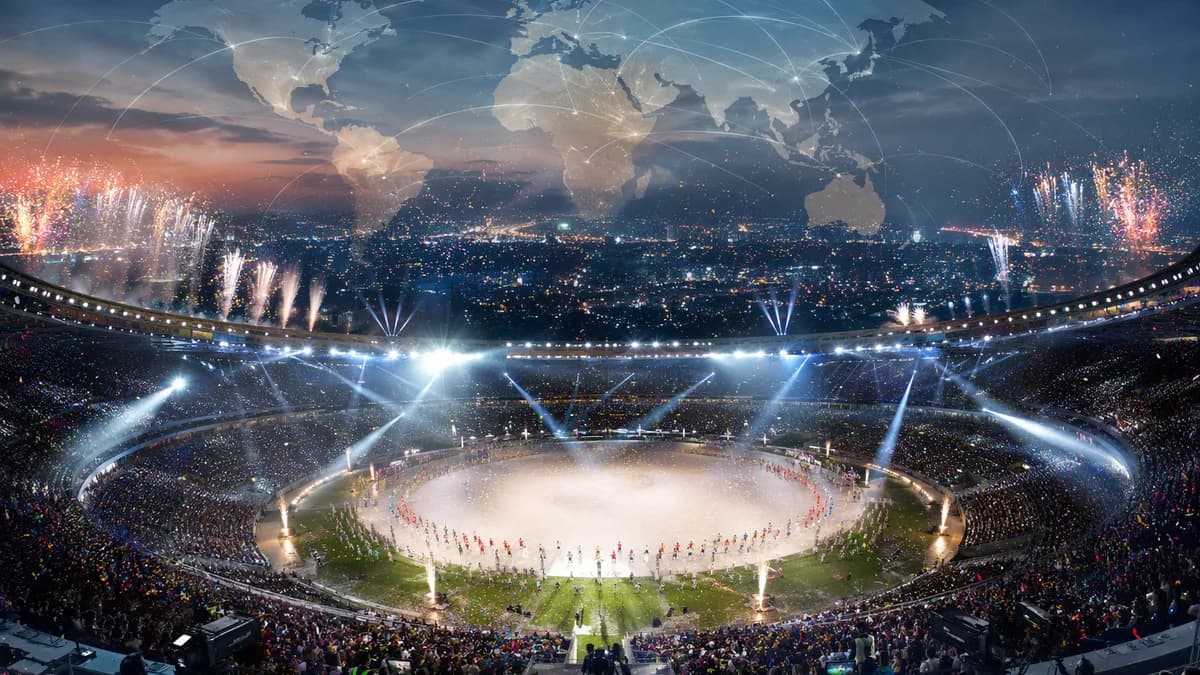
Did FIFA prove the World Cup needs a halftime show, or only that it can stage one?
The question after FIFA's first World Cup halftime show is not whether it could gather enough famous people, but whether it had any reason to exist between the two halves of the biggest football match on earth.
XOOMAR Intelligence
Analyst Take
On Sunday, with Spain and Argentina tied 0-0 at New York New Jersey Stadium, FIFA staged its first-ever final halftime production, curated by Chris Martin of Coldplay and stacked with Madonna, BTS, Shakira, Justin Bieber, Burna Boy, Gustavo Dudamel, the Muppets, and more, according to Time. That is not a lineup. That is a crowd-control problem.
My view is blunt: the show had the names and the global stage, but it lacked a convincing argument for itself. It proved FIFA can mount an American-style pop interlude. It did not prove the World Cup is better with one.
The problem wasn’t ambition. A global football final can handle ambition. The problem was confusion. The World Cup already has scale, pressure, memory, nationalism, rivalry, and release. A halftime show should deepen that charge. This one mostly decorated it.
FIFA promoted the show as a celebration of “football, music and our shared values.”
That phrase explains the failure. When every value is shared, no value feels specific.
Did Madonna, BTS, Justin Bieber, and Shakira create a show, or a traffic jam?
Madonna opening with “Music” should have been a clean statement: pop as a universal language, delivered by an artist who understands spectacle. She arrived with dancers and was flanked by Brazilian legends Ronaldinho and Ronaldo. Safe. Recognizable. Effective enough.
Then the show lurched.
A rainbow-colored globe spread across the field. Gustavo Dudamel conducted the New York Philharmonic, the Simón Bolívar Symphony Orchestra of Venezuela, and the Muppets through “Seven Nation Army.” BTS entered for “Dynamite.” Jason Sudeikis and Brendan Hunt appeared as Ted Lasso and Coach Beard. Bieber got a pep talk, then performed “Everything Hallelujah.” Shakira and Burna Boy lifted the energy with “Dai Dai,” joined by the Ghetto Kids. The PS22 Chorus closed with more Muppets and Coldplay’s “We Dance.”
That is too much plot for 11 minutes.
The strongest case for the lineup is obvious. Each artist carried a massive audience. BTS brought K-pop gravity, which matters in a global broadcast. Shakira brought World Cup credibility. Madonna brought generational pop history. Bieber brought familiarity across markets.
But star power is not the same as identity. The production treated global culture as a checklist. One icon from here, one group from there, one sentimental ballad, one children’s chorus, one puppet cameo. The result was not planetary unity. It was an awards-show medley wearing a football shirt.
Shakira made the most sense because her World Cup history gave her presence context. BTS made sense as a global pop force, especially in a year when K-pop’s cultural reach keeps breaking into unlikely arenas, as we covered in K-pop Breaches North Korea's Kim Jong Un Idol Cult. Bieber’s stripped-down moment was more awkward. A closeup ballad can work on television. Inside a stadium built for football tension, it risks vanishing into the air.
Can football copy the Super Bowl without flattening its own rhythm?
The Super Bowl halftime show is the wrong template for the World Cup halftime show, even when the production values are tempting.
The Super Bowl has trained U.S. viewers to expect a mid-game entertainment takeover. The World Cup has a different pulse. Its halftime is tactical, nervous, and brief. Players regroup. Managers adjust. Fans process the first half and brace for the second. At 0-0 in a final between Spain and Argentina, the silence matters as much as the noise.
Time’s review points to the structural problem: the World Cup final audience was expected to approach 2 billion, while 48 national teams competed in the tournament. FIFA seemed to respond by trying to represent everyone. That sounds inclusive. In practice, it becomes impossible.
| Event model | What the source material supports | Why it matters |
|---|---|---|
| Super Bowl halftime | Usually built around a single superstar act | Easier to create one coherent artistic statement |
| Olympic opening ceremonies | Span hours and spotlight host culture | Time allows symbolism to breathe |
| World Cup final halftime | Built around soccer’s customary 15-minute break | Too little room for a whole-world pop anthology |
This is where FIFA misread the room. Football’s rituals already carry music: chants, anthems, drums, flags, call-and-response, collective panic. A halftime show that barges into that space has to earn the interruption.
This one didn’t earn it. It crowded out the match’s emotional suspense instead of sharpening it.
For context, the final itself already had a tactical and symbolic frame, as XOOMAR explored in Control vs Messi Grips Spain vs Argentina World Cup Final. A halftime show in that setting should have felt like part of the same event. Too often, this felt imported from another entertainment category.
Did the unity message say anything the match didn’t already say better?
The show’s message was broad: togetherness, love, music, gratitude, global celebration. That is unobjectionable. It is also weak.
The World Cup does not need vague unity slogans to show the world gathered in one place. It does that through shirts, songs, flags, arguments, tears, and the brute fact of national teams meeting under pressure. The event contains unity and conflict at the same time. That tension is why people watch.
FIFA’s production sanded that tension down. The rainbow-colored globe, the “Love” insignia, the children’s chorus, the Muppets, Bieber’s gratitude ballad, and Coldplay’s uplift all pointed in the same direction: no friction, no danger, no sharp edge.
That may have been intentional. Time noted that the North American World Cup had already seen controversy, including the reversal of U.S. striker Folarin Balogun’s red card after a phone call by Donald Trump, restrictions American officials placed on the Iranian team, and fans walking from New York City to New Jersey to avoid high transit costs. XOOMAR also tracked the political theater around the final in Marine One Turns Trump World Cup Final Into Power Play.
So yes, FIFA had a reason to want a safe spectacle. But safe is not the same as meaningful.
A better version would have engaged the host cities, football history, and living fan cultures more directly. It could have used fewer celebrities and more specificity. When every symbol is broad enough to offend no one, the result often moves no one.
Can viral pop clips serve the tournament instead of competing with it?
The counterargument deserves respect. A halftime show with Madonna, BTS, Bieber, and Shakira creates clips. It pulls in casual viewers. It gives fans who may not care about Spain’s midfield shape or Argentina’s defensive line another reason to watch. Modern sports events are media products too. FIFA does not operate in a vacuum.
The production also improved on the previous Club World Cup halftime experiment at the same venue, which Time described as a crowded performance that looked better on video than it likely did to many in-person spectators. This final show was clearly designed for both television and the stadium.
That matters. A first attempt should not be judged as if the format were mature.
Still, the defense only goes so far. Entertainment should serve the game. If it feels bolted on, it sends the wrong message: that the football itself needs decoration. The World Cup final does not need help feeling consequential. It needs restraint around it.
The smartest path is integrated culture. Fewer acts. Stronger links to the finalists, the host country, and football communities. More fan sound. More football memory. Less celebrity pileup.
Give Shakira room if she is carrying a World Cup song. Give BTS room if the idea is global pop. Give one artistic idea enough time to land. Don’t ask every famous person on earth to sprint across a tarp and call it unity.
Should the next World Cup halftime show get smaller to feel bigger?
If FIFA brings back the World Cup halftime show, it should stop chasing the biggest lineup and start chasing the truest idea.
The next version needs discipline: fewer performers, clearer visual storytelling, and a direct relationship to the match being played. The host culture should not be a backdrop. The finalists should not feel incidental. Football’s own sound should not be buried under generic uplift.
This first show will be remembered because it happened first. That is not the same as being remembered because it worked.
The practical lesson is simple. FIFA can build entertainment around the World Cup, but it should not build entertainment over it. The tournament does not need to become a concert with a match attached. It needs a halftime show that knows when to step back and let the game breathe.
The Bottom Line
- FIFA’s first World Cup halftime show signals a push to make the final feel more like a U.S.-style entertainment event.
- The crowded celebrity lineup raised questions about whether spectacle enhanced or distracted from the match itself.
- The reaction could shape whether future World Cup finals include halftime productions or keep the focus on football.
Primary Sources & Disclosures

Written by
XOOMAR Insights Team
Research and Editorial Desk
The XOOMAR Insights Team pairs automated research with human editorial judgment. We track hundreds of sources across technology, fintech, trading, SaaS, and cybersecurity, cross-check the facts, and explain what happened, why it matters, and what to watch next. We do not just rewrite headlines. Every article is fact-checked and scored for reliability before it goes live, and we link back to the original sources so you can verify anything yourself.