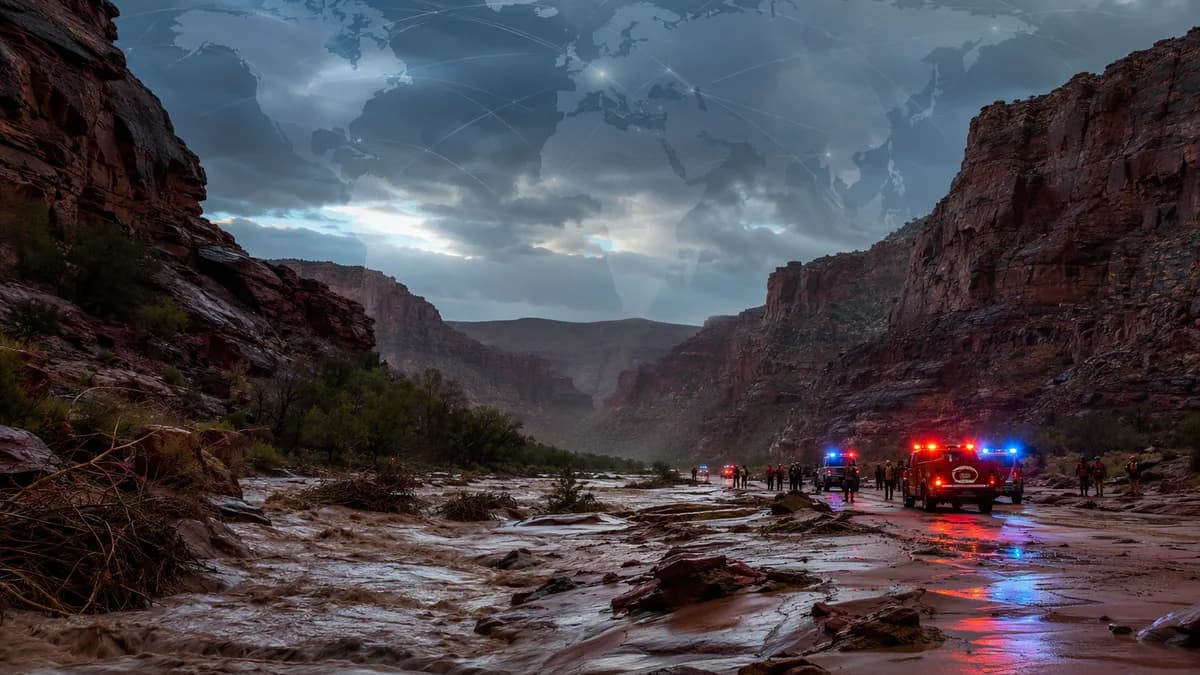
The question raised by the Utah flash flood deaths is not only how five members of one family died, but whether canyon recreation near heavy rain still depends too much on people making the right call at the worst possible moment.
XOOMAR Intelligence
Analyst Take
Five family members who had gone hiking near Sunglow Campground in Bicknell, Utah, were killed Friday after a flash flood swept through southern Utah canyons, according to Guardian World. The victims were Provo Fire Department Captain Spencer Long, his wife Katrina Long, and their sons Reid, Thayne and Gage. A daughter who was not on the trip survived.
“It is believed the family fell victim to flooding caused by heavy rains,” the Wayne county sheriff’s office said in a news release.
That sentence carries the central warning. This was not a remote case involving people with no connection to emergency response. One of the victims was a fire captain. XOOMAR analysis: if a trained first responder and his family can be overtaken during an ordinary day trip, the safety problem is bigger than individual judgment.
Why do the Utah flash flood deaths hit differently when one victim was a Provo fire captain?
Because emergency experience doesn't make canyon terrain forgiving.
The Provo fire department confirmed that Captain Spencer Long and members of his family were killed. The department did not frame the loss in operational language. It used grief.
“We are absolutely heartbroken by the death of Captain Spencer Long and his family. Our thoughts are with his family, friends, and colleagues during this difficult time,” officials with the fire department wrote.
That matters. Firefighters understand response time, terrain limits, and how quickly a rescue attempt can become impossible. But the sources do not say what conditions the family saw at the trailhead, what warnings existed, or whether they received any alert before entering the area.
The known sequence is spare and grim. The family arrived Friday at Sunglow campground, near Bicknell, for a day excursion. KSL reported officials said the family arrived around 11:30 a.m. to go hiking and canyoneering. Deputies were later called after the body of a young male was found in a flood wash. Other bodies were recovered late Friday and Saturday.
The public safety implication is narrow but serious: when recreation moves through washes and canyon terrain during heavy rains, the margin for correction can collapse before outside help arrives.
What do the confirmed numbers actually tell us about the flood?
The confirmed toll is five deaths from one family.
That is the hardest number in this story. Spencer Long, Katrina Long, and three sons died. Their daughter survived because she was not on the trip. A GoFundMe set up by a family friend was created to support her after the loss of her family, and KSL reported it had raised more than $12,000 toward a $25,000 goal at the time of its article.
The timeline is also important:
| Confirmed detail | Source-supported status |
|---|---|
| Family arrived Friday at Sunglow Campground | Reported by Wayne County officials |
| KSL reported arrival around 11:30 a.m. | Local report citing officials |
| Deputies called around 5 p.m. Friday | KSL report citing sheriff’s office release |
| First body found in a wash near the campground | Reported by Guardian and AP |
| Other bodies recovered late Friday and Saturday | Reported by Guardian and AP |
| Incident remains under investigation | Reported by KSL |
The sources describe heavy rains and flooding, but they do not provide rainfall totals, official warning language, cell service conditions, canyon closure status, or a detailed reconstruction of where the family was when the flood hit.
That absence should restrain the analysis. The Utah flash flood deaths show the lethal outcome. They do not yet prove which specific warning, planning, or access control failed.
Where does the decision point happen before a canyon hike near Bicknell?
It happens before people enter the canyon or wash.
That is the uncomfortable part. By the time a body was found and deputies were called, the event had already moved from prevention to recovery. Wayne County Search and Rescue crews searched the surrounding area for additional members of the family group, and officials later said search personnel had left the area and it had reopened to the public.
XOOMAR analysis: the practical decision window for hikers is earlier than the emergency window for responders. The public record does not establish whether better signs, alerts, closures, or forecast messaging would have changed this outcome. But it does show that once the flood struck, the family could not simply be pulled out by emergency crews in time.
That is why trailhead-level communication matters. Not as a claim about this specific site, since the sources do not describe the signage there, but as a general safety principle tied to the known facts: if heavy rain is affecting the area, canyon and wash routes should be treated differently from ordinary trails.
For readers following severe-weather coverage, XOOMAR has also tracked flooding events in Flash Flooding Swamps New York, New Jersey Weekend. The Utah case is different in terrain and setting, but it belongs to the same public-safety category: fast-moving water turning routine movement into a fatal exposure.
How are firefighters, families and local officials likely reading the same facts?
They are not reading the same tragedy in the same way.
For the fire department, this is the death of one of its own. The Provo statement is personal, not procedural. The loss of a captain carries institutional weight because emergency services are built around risk awareness, response discipline, and the limits of control.
For families and hikers, the case lands differently. The Longs were on a day trip. That ordinary detail is what makes the story frightening. The sources do not describe reckless behavior, ignored warnings, or extreme adventure planning. They describe a family excursion that intersected with heavy rain and flooding.
For local officials, the burden is practical. Search teams had to recover bodies in and around a flood wash. The sheriff’s office also had to communicate uncertainty while the incident remained under investigation. Public access was later restored after search personnel left the area.
Mass-casualty public safety incidents often force authorities to move between grief, identification, recovery, and prevention messaging. XOOMAR has covered that same reporting challenge in 13 Dead in Los Gallardos Fire as Spain Names Victims, where the human toll, not abstraction, was the center of the story.
What should hikers change now without pretending we know every missing fact?
The safest lesson from the Utah flash flood deaths is blunt: if heavy rain is in the area, do not treat a canyon hike or wash route like a normal walk.
That does not require inventing facts about this incident. It follows from what officials said: the family is believed to have fallen victim to flooding caused by heavy rains.
Practical steps should stay simple:
- Delay: If heavy rain is reported near the destination, postpone canyon and wash hikes.
- Exit early: Turn around before conditions deteriorate, not after water appears.
- Share plans: Leave a route, group size, and return time with someone outside the trip.
- Check locally: Look for sheriff, emergency management, campground, and weather updates before departure.
- Respect uncertainty: If the risk is unclear, choose terrain where retreat is easier.
Park managers and local agencies face the harder question. The sources do not say whether signs, live alerts, or closures were present at Sunglow Campground. Those details matter. If an investigation finds visitors had little usable warning before entering flood-prone terrain, the policy response should focus on plain-language alerts at the point of decision.
Not technical ambiguity. Not buried advisories. Direct warnings that a family can understand before the hike starts.
Which unanswered facts will decide whether this tragedy changes canyon safety?
The investigation still has to establish the conditions around the family’s route, the available warnings, and the precise sequence of events before the flood.
Those facts will determine whether this remains a devastating accident with few preventable points, or becomes evidence that canyon recreation near heavy rain needs more aggressive public communication. The difference matters.
Evidence that would strengthen the case for safety changes includes proof that visitors lacked clear local warning, that conditions changed faster than normal communication channels could reach them, or that the area was open despite known flood concerns. Evidence that would weaken that case would include clear warnings, closures, or guidance that were available and specific before the family entered the area.
For now, the confirmed record is enough to justify caution but not enough to assign blame. Five people died. One daughter survived because she was not there. A fire department is mourning a captain. A community is mourning a family.
The next step should be factual, not performative: reconstruct what the Long family could reasonably have known before they entered the canyon area, then decide whether future hikers need warnings that are earlier, clearer, and harder to miss.
Impact Analysis
- The deaths show how quickly flash floods can turn canyon recreation deadly, even for experienced emergency responders.
- The incident raises questions about whether warnings and trailhead alerts are enough during heavy rain conditions.
- Families visiting canyon areas may need to treat nearby storms as a serious risk, not just bad weather.
Primary Sources & Disclosures

Written by
XOOMAR Insights Team
Research and Editorial Desk
The XOOMAR Insights Team pairs automated research with human editorial judgment. We track hundreds of sources across technology, fintech, trading, SaaS, and cybersecurity, cross-check the facts, and explain what happened, why it matters, and what to watch next. We do not just rewrite headlines. Every article is fact-checked and scored for reliability before it goes live, and we link back to the original sources so you can verify anything yourself.