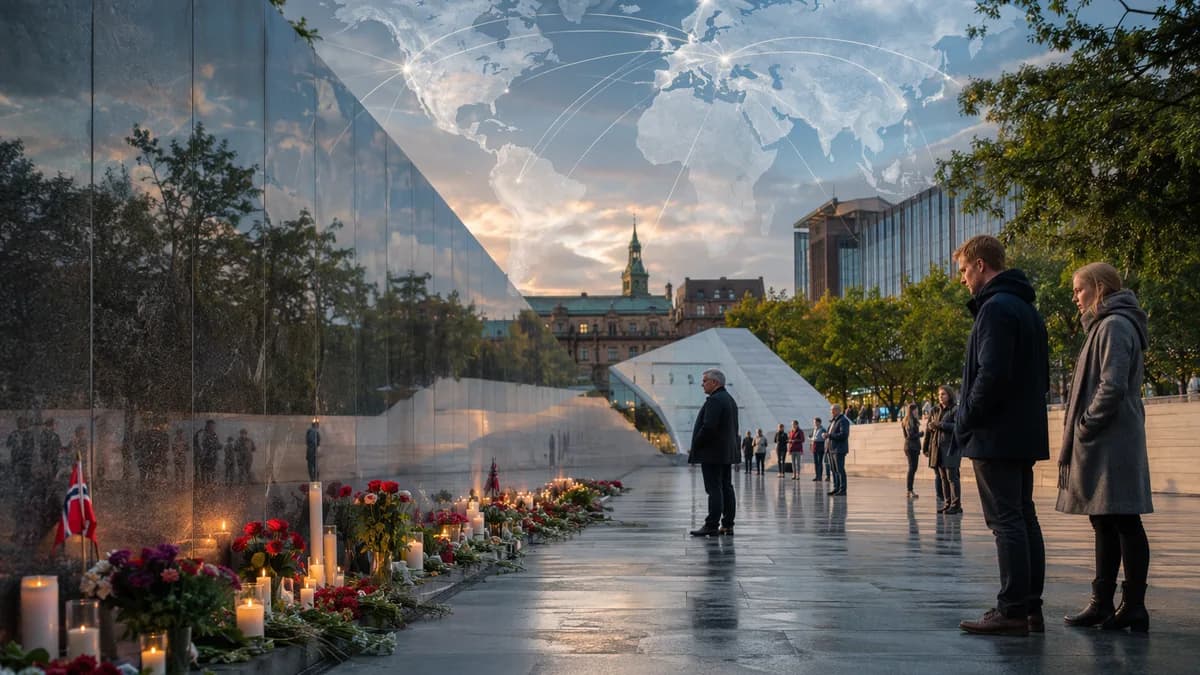
The new 22 July memorial in Oslo does more than mark the 77 people killed by Anders Breivik. It forces Norway to keep naming the attack as political violence aimed at democracy, young Labour activists, and multicultural society.
XOOMAR Intelligence
Analyst Take
The memorial, unveiled on Sunday ahead of the 15th anniversary of the 22 July 2011 attacks, opened in Oslo’s renovated government district, close to where Breivik’s car bomb first exploded, according to BBC World. Survivors, bereaved relatives, Crown Prince Haakon, and government officials attended the ceremony.
Oslo’s new 22 July memorial puts victims, not Breivik, at the center
The core tension is sharp: a memorial is meant to console, but this 22 July memorial also asks the public to confront the ideology behind the massacre.
Breivik, described in the source material as a neo-Nazi and far-right extremist, killed eight people with a car bomb in Oslo, then shot dead 69 others, mostly teenagers, at a youth camp on Utoeya island. Many of those killed there were connected to the Norwegian Labour Party’s youth wing, the AUF.
What should a democracy choose to remember first: the attacker’s ideology, or the names of the people he tried to erase?
The design answers by refusing to make Breivik the visual subject. The artwork, titled Upholding, shows a small wading bird native to Utoeya, set in a 12-metre (39ft) stone mosaic held by a large blue steel frame. Straw and sticks appear reflected in water. The names of all 77 victims are engraved on the memorial.
“July 22, 2011 was a brutal attack not only on individuals, but also on our democracy,” said Merete Stamneshagen, head of a support group for victims and survivors, quoted by AFP.
XOOMAR analysis: that sentence is the memorial’s real thesis. The attack is remembered as murder, but also as an assault on democratic participation itself.
The numbers behind the 2011 Norway attacks still carry the story
The facts remain stark because they are the point.
| Element | Source-supported detail |
|---|---|
| Date | 22 July 2011 |
| Total killed | 77 people |
| Oslo bombing | Eight people killed by a car bomb |
| Utoeya shooting | 69 people shot dead, mostly teenagers |
| Injured | Hundreds more were injured |
| Memorial site | Oslo’s renovated government district, near the bomb blast location |
| Artwork height | 12 metres (39ft) |
The memorial opened days before the 15th anniversary of the attacks. The supplied sources do not explain why this permanent national memorial opened at this point, so the timing should not be overstated. What can be said is simpler: Norway is now placing this memory in a permanent civic location in the capital.
That matters because public memory competes with other records: court files, survivor testimony, annual ceremonies, news archives, and temporary tributes. A permanent memorial does something different. It makes absence part of the city’s architecture.
The same discipline applies in other tragedies, from Utah flash flood deaths to New York and New Jersey flash flooding. Naming victims changes public attention from event scale to human consequence, a pattern visible in XOOMAR’s coverage of 13 Dead in Los Gallardos Fire as Spain Names Victims. The contexts differ, but the editorial burden is similar: numbers tell the scale, names carry the loss.
Matias Faldbakken’s artwork tries to resist spectacle
The artist Matias Faldbakken said he had seen the bird on Utoeya island. That detail matters. The work links Oslo, where the bombing began, to Utoeya, where most victims died.
Can public art carry grief, politics, and restraint at the same time?
Faldbakken’s answer is indirect. The memorial does not recreate violence. It does not center the perpetrator. It uses a bird, water, straw, sticks, steel, stone, names. That is a careful language for a public site tied to an attack whose perpetrator repeatedly sought attention through legal challenges and public proceedings.
Breivik was sentenced in 2012 to 21 years in jail, the maximum a court in Norway can impose, though the sentence can be extended for as long as he is deemed a threat. He later challenged aspects of his imprisonment. In 2016, he partially won a human rights case against Norway before that decision was overturned the following year. In 2022, he failed in a parole bid, with the court ruling he had not changed and remained a risk to society. In 2024, he unsuccessfully sued the government over claims of isolation.
XOOMAR analysis: this legal history helps explain why memorial design is politically sensitive. A memorial must preserve the truth without giving the killer a new stage.
Survivors, families, and officials are asking the memorial to do different jobs
For survivors and relatives, the memorial offers recognition at a national site. It gives each victim a name in public stone, not only a place in a casualty count.
For officials, the ceremony carried another message. Crown Prince Haakon attended the inauguration and also visited the new 22 July Centre, Norway’s national memorial and education centre dedicated to the attacks. Xinhua reported that Minister of Digitalisation and Public Governance Karianne Tung said the far-right attack targeted not only individuals, but also AUF, the Labour Party, and Norwegian democracy.
The educational role is explicit. Xinhua also reported that Minister of Education Kari Nessa Nordtun said a new generation is growing up without personal memories of the attacks, making memorial and educational work more important. Physical traces and accounts from those who experienced the attacks could help counter disinformation and conspiracy theories, she said.
That is the practical civic function of the 22 July memorial. It gives schools, families, visitors, and officials a fixed place to tell the story without reducing it to a courtroom name or an anniversary headline.
Public accountability takes many forms, including how institutions control access, memory, and narrative. XOOMAR readers can see that theme in a different arena in Google Opens Android App Stores but Keeps the Cash, where the question is not remembrance, but who gets to shape the rules people live under.
The memorial names far-right violence without turning it into abstraction
The supplied reports identify Breivik as a neo-Nazi or far-right extremist. The artist said the work was meant both to remember the victims and to engage the public in democratic resilience against the far-right ideologies that inspired the attack.
That wording is important. It keeps the memorial from becoming only a symbol of national sadness. It identifies the political target.
Breivik attacked government offices in Oslo, then a Labour youth camp on Utoeya. The sequence matters because it shows the attack was not random in the ordinary sense. It moved from the state to young political participants.
XOOMAR analysis: the strongest public memorials do not soften motive into vague evil. They record who was attacked, where, and why the public must keep looking at it. Norway’s new memorial does that by combining victim names, a Utoeya image, and placement in the government district.
The next test is whether Norway keeps telling the full story
The unveiling was the easy part, at least compared with what comes next.
The 22 July memorial will now have to serve people who bring different needs to it: relatives seeking dignity, survivors carrying memory, students with no direct recollection of 2011, and officials trying to defend democratic norms without turning mourning into political performance.
Evidence that the memorial is working will be concrete: continued use of the 22 July Centre, careful education about the attacks, public ceremonies that keep victims at the center, and language that names far-right extremism without amplifying Breivik’s self-mythology.
Evidence against that thesis would be drift. If the memorial becomes only a backdrop for anniversaries, or if public discussion slides toward the perpetrator rather than the 77 victims, then the artwork’s civic purpose will narrow.
For now, Oslo has made a clear choice. The city has placed the names in public view, near the first blast site, and tied national memory to democratic warning. The cameras will leave. The memorial’s real work starts after that.
Impact Analysis
- The memorial centers the names of the 77 victims rather than the attacker.
- It frames the massacre as political violence against democracy and multicultural society.
- Its location in Oslo’s government district makes remembrance part of Norway’s civic landscape.
Two parts of the 22 July 2011 attacks
| Location | Method | People killed | Primary target |
|---|---|---|---|
| Oslo government district | Car bomb | 8 | Government buildings |
| Utoeya island | Mass shooting | 69 | Labour Party youth camp attendees |
Victims killed in the 22 July 2011 attacks
Primary Sources & Disclosures

Written by
XOOMAR Insights Team
Research and Editorial Desk
The XOOMAR Insights Team pairs automated research with human editorial judgment. We track hundreds of sources across technology, fintech, trading, SaaS, and cybersecurity, cross-check the facts, and explain what happened, why it matters, and what to watch next. We do not just rewrite headlines. Every article is fact-checked and scored for reliability before it goes live, and we link back to the original sources so you can verify anything yourself.