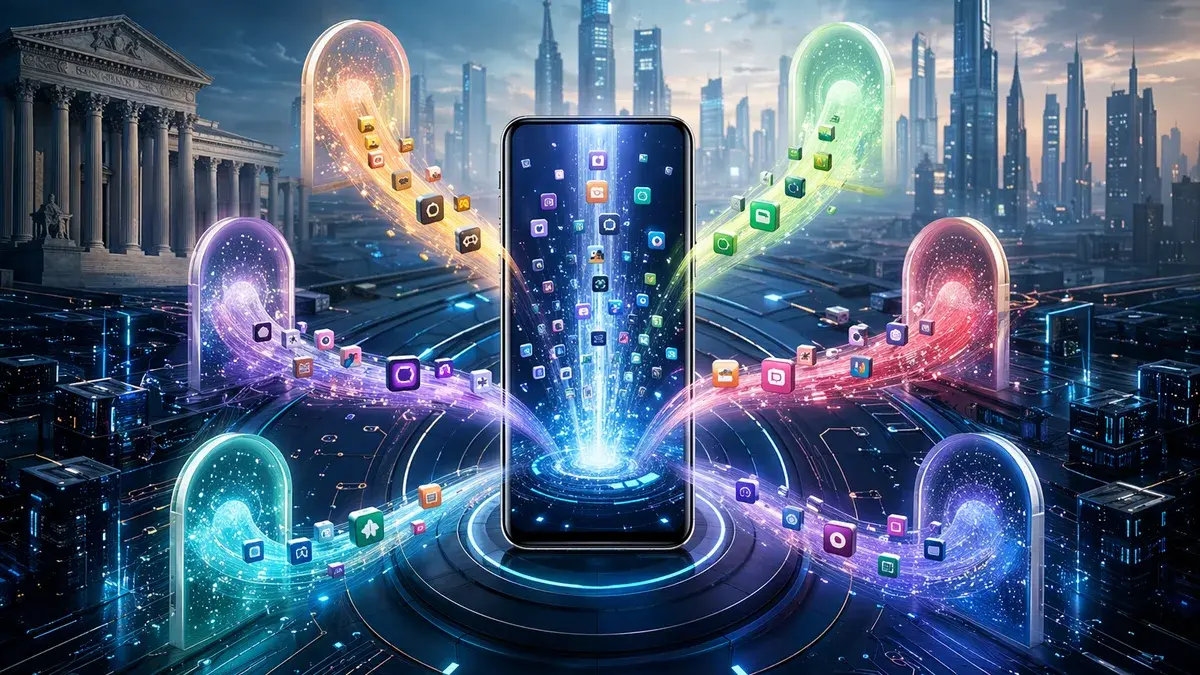
The unanswered question in Google’s July 22 rollout is whether third-party app stores on Android will become real distribution channels or Play Store windows with different branding.
XOOMAR Intelligence
Analyst Take
Starting July 22, 2026, Google will let third-party US Android app stores access the Google Play catalog, according to Engadget. That means outside app stores can offer apps and games whose listings were submitted to Google Play, though downloads will still be completed through Google Play and Google’s service fees will still apply.
Will third-party app stores on Android really get Google Play’s catalog?
Yes, but with limits that matter.
Google has launched a Play Catalog Access Program page and told developers that their US app and game listings will be made available to enrolled third-party US Android app stores starting July 22. Those listings include app names, icons, descriptions, screenshots and videos submitted to Google Play, according to Google’s own developer notice.
“Starting on July 22, 2026, your US apps and games listing(s), including the name of your apps and games, their icons, their description, and any screenshots and videos you provided to Google Play, will be made available to third-party US Android app stores.”
Developers can opt out in Play Console under Settings > Catalog Settings. Google lists three choices: publish all app listings on all third-party app stores, manage stores individually, or publish none of the listings on any third-party app stores. If developers do nothing, Google says their listings will begin flowing to third-party US Android app stores on July 22.
The change doesn’t mean these outside stores can freely host and deliver every app package themselves. Google says app downloads through external stores will be completed through Google Play “on the same terms” as downloads made directly through Google Play. Google Play’s service fee will still apply.
That makes the rollout more controlled than the phrase “third-party app stores” suggests. The outside storefront may handle discovery and presentation, but Google remains embedded in the download path.
Why did Google drop the older Registered App Stores plan?
The move follows Google’s long legal fight with Epic Games and a US court order imposed after Google lost the case. Google and Epic reached a settlement in November 2025, then filed a modified version of the order from US District Judge James Donato.
In March, the companies described a Registered App Stores program. That plan would have made registered third-party stores easier to install than unregistered sideloaded stores, but they still would have had to be sideloaded.
Google is now moving away from that approach. The Verge reported that Google and Epic withdrew their modified settlement and would no longer argue it in court on July 16.
Google spokesperson Dan Jackson framed the retreat as a way to cut uncertainty:
“We’ve agreed with Epic to withdraw our motion to modify the US Court’s injunction rather than prolonging this process which creates uncertainty for the ecosystem. This allows us to focus on executing our recently announced global business model evolution to deliver greater app store choice, lower prices, and more opportunities for developers and users. We remain committed to maintaining Android’s industry-leading security and fostering a competitive ecosystem where every app store and developer has the freedom to compete. In parallel, we continue to comply with the US Court’s injunction.”
The practical difference is sharp.
| Program | How it works | Key limit |
|---|---|---|
| Registered App Stores | Stores would get a more simplified installation flow | They still had to be sideloaded |
| Play Catalog Access Program | Third-party US Android app stores can access Google Play app listings | Downloads still complete through Google Play, and Google Play fees still apply |
For readers tracking Google’s broader Android strategy, this software distribution shift sits separate from hardware coverage such as XOOMAR’s report on the Amazon leak tied to the Google Pixel 11 launch. It also affects a different layer of the Android market than device stories like OnePlus exiting the US and Europe.
Who gets access, and what will Google charge?
Third-party stores won’t get automatic access just by asking.
Google will charge an upfront $5,000 service fee for a security review during onboarding, plus $5,000 every year to maintain access to the Play catalog. The stores also must meet a lengthy set of requirements.
The biggest boundary is geographic. Participating stores must target users in the US, and they legally can’t use the Play catalog to distribute apps to users outside the United States.
Google’s developer notice also warns that third-party US Android app stores are not governed by Google Play’s content and other policies. They may have their own content and other policies. That detail matters for developers deciding whether to opt out, because listing exposure may expand into storefronts with different rules.
Outside reporting from 9to5Google says participating stores must have “clear, non-discriminatory” trust and safety policies, be open to eligible developers, avoid distributing apps outside the US and keep malware-related install attempts below 1 percent. Ars Technica also reported that approved stores must block malware, respect intellectual property, and include mechanisms to update and uninstall apps.
Analysis: Google is complying, but it is not stepping out of the transaction entirely. The company keeps security review, catalog access terms, download execution and service fees inside its orbit.
Does this give developers more power, or just more settings to manage?
Developers get a new distribution option, but the economics are mixed.
On one side, app makers can appear in third-party app stores on Android without rebuilding every listing from scratch. That could help alternative stores build useful catalogs faster, which was one of the major barriers to making them relevant.
On the other side, Google Play’s service fee continues to apply when downloads happen this way. That limits how much the new model can change developer economics unless billing changes also matter for a specific app.
Google has separately opened the Play store to outside billing and lowered its commission for app purchases from 30 percent to 10 percent as part of its settlement with Epic Games, according to the supplied source material. Developers can now offer alternative payments or link users to their own websites for purchases within app or game listings.
The decision facing developers is tactical. Opting in may expand reach through new storefronts. Opting out may preserve tighter control over where the brand appears and which store policies sit next to the app.
Which July 22 details will decide whether this is real competition?
The first test is participation. If credible third-party US Android app stores enroll quickly and developers allow listings to appear, users may see meaningful new discovery routes inside Android.
The second test is design. Google’s warnings, approval flows, default settings and store presentation inside Google Play will shape adoption. The sources confirm the program structure, fees and US-only scope, but they don’t yet show exactly how the user experience will look on phones.
The third test is developer behavior. Google lets developers opt out at any time. If major publishers block distribution through outside stores, the catalog may look broad on paper but thinner in practice.
For now, July 22 marks a compliance deadline with commercial consequences. The watch item is whether third-party app stores on Android become a practical alternative for discovery and distribution, or whether Google’s remaining control over downloads, fees and access turns the shift into a tightly managed version of choice.
Impact Analysis
- Third-party Android app stores may gain access to Google Play listings, but downloads will still run through Google Play.
- Developers must decide whether to allow, limit, or block their app listings from appearing in outside stores.
- Google’s service fees and download terms remain in place, limiting how much this changes Android app distribution.
Developer Options for Third-Party Android App Store Listings
| Option | What It Does |
|---|---|
| Publish all listings | Makes US app and game listings available on all enrolled third-party US Android app stores |
| Manage stores individually | Lets developers choose which third-party stores can show their listings |
| Publish none | Opts out of making listings available through third-party US Android app stores |
Primary Sources & Disclosures
- [1]Engadget
- [2]Google is opening the floodgates to third-party app stores on Android next week
- [3]Third-party app stores coming to Google Play next week as Epic settlement withdrawn
- [4]Play developers’ app and game listings in the US will be made available to third-party US Android app stores starting July 22, 2026 - Play Console Help

Written by
XOOMAR Insights Team
Research and Editorial Desk
The XOOMAR Insights Team pairs automated research with human editorial judgment. We track hundreds of sources across technology, fintech, trading, SaaS, and cybersecurity, cross-check the facts, and explain what happened, why it matters, and what to watch next. We do not just rewrite headlines. Every article is fact-checked and scored for reliability before it goes live, and we link back to the original sources so you can verify anything yourself.