The Garden That Remembered Rain
When quantum computers make perfect climate materials possible, one village must decide who gets to rewrite the weather first.
The Last Orchard in Qanat-e Sorkh
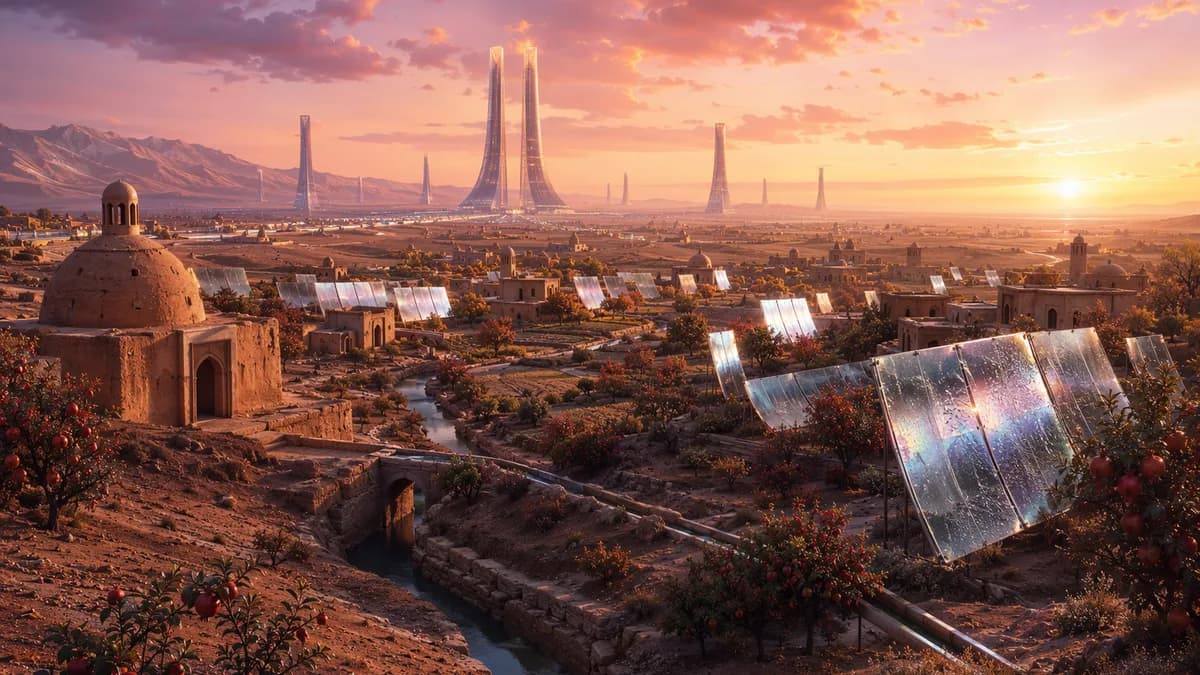
Laleh Aram returns to Qanat-e Sorkh with dust in her hair and her father’s name still glowing on her wrist screen, the funeral notice blinking in formal blue script. The village lies low against the red hills, flatter than she remembers, as if the sun has pressed it down with one enormous palm. The road is cracked white at the edges. Goat bells click somewhere behind a wall. Every breath tastes of gypsum, diesel, and old heat.
Her mother waits at the courtyard gate in a black scarf faded brown by years of washing. She does not cry when she sees Laleh. She only touches her daughter’s cheek, thumb rough as walnut bark, and says, “You have become thin in the city.”
“So have the trees,” Laleh says before she can stop herself.
They bury her father before noon. Men murmur prayers under a canvas shade that snaps in the wind. Women pass rosewater from hand to hand, the scent bright and impossible in the dry air. Laleh watches the soil fall onto the white cloth around her father and thinks of all the models she has built, all the projections with their elegant curves and colored uncertainty bands. None of them sound like earth hitting a body.
Afterward, her mother takes her to the orchard.
Once, it is a place of green shadow. Pomegranates hang like lanterns. Apricot leaves shine silver in the afternoon wind. As a child, Laleh sleeps here on summer nights while water from the qanat whispers through channels cut by hands older than any nation now drawing maps of thirst.
Now the orchard lives in islands. A row of figs still clings to life near the main channel, leaves curled inward like fists. Two pomegranates bloom in stubborn red. Beyond them, trunks stand gray and hollow, their bark split, their branches lifted like questions.
“The qanat runs twice a month now,” her mother says. “Sometimes three hours. Sometimes one.”
On the orchard wall, someone has painted names beside dark vertical marks. Laleh steps closer. Each mark is a tree. Each name is a family.
Rahimi, seven almond trees. Farzan, two mulberries. Aram, four apricots, one pear, fourteen pomegranates.
Her fingers hover over the Aram marks. The paint is thick, finger-applied, flaking in the heat.
“Your father started it,” her mother says. “He said if we counted them only as trees, people would forget. So we count them like relatives.”
Laleh presses her palm to the wall. It is warm enough to sting.
In Isfahan, drought is a variable. In papers, it is rainfall anomaly, aquifer depletion, atmospheric deficit. Here it has handwriting. Here it has her father’s careful numerals, her mother’s silence, and a pear tree that is gone from the world.
That evening, when the wind drags dust through the courtyard and the village loudspeaker crackles with another water schedule, Laleh sits beside her mother and listens.
“I thought I was working on the future,” she says.
Her mother pours tea dark as dates. “The future comes here too. It just arrives thirsty.”
## A Machine That Dreams in Molecules
At the Isfahan Quantum Materials Observatory, Simurgh fills an entire district beneath a skin of white ceramic domes. From the desert highway it looks like a sleeping animal, enormous and pale, its cooling towers breathing mist into air that has forgotten clouds. Inside, Laleh walks through corridors chilled to a winter bite, past glass walls where technicians move like ghosts in blue clean suits.
Simurgh does not hum like old computers. It sings in clicks, pulses, and low magnetic groans that tremble in Laleh’s teeth. Its fault-tolerant cores sit in layered cryogenic chambers, colder than starlight, where logical qubits hold their shape against noise the way a skilled singer holds a note against wind.
Laleh arrives with Qanat-e Sorkh packed into data.
She feeds in desert air chemistry gathered from roof sensors and shepherd drones. She feeds in night humidity, salt dust from the old lake bed, basalt grit from the red hills, the rhythm of winds slipping down the mountains before dawn. She includes the mineral scars inside the qanat tunnels, the pH of brackish wells, the microscopic pollen left in her father’s orchard soil.
Her colleague Farid leans against the console, eating pistachios from a paper bag. “You know,” he says, “most people ask Simurgh for superconductors, batteries, armor. You ask it for a clay cup that sweats.”
“A useful clay cup,” Laleh says.
“Ambitious.”
“Necessary.”
Before Simurgh, discovery means exhaustion. Thousands of compounds. Thousands of failed wafers, cracked gels, poisoned catalysts, promises too expensive to leave a laboratory. But Simurgh dreams in molecules without wasting matter. It folds quantum fields into prediction. It watches electrons bargain, bonds flex, pores drink, ions crowd at surfaces no microscope can fully see.
For six days, the machine returns almosts.
Almost enough capture.
Almost cheap enough.
Almost stable in salt.
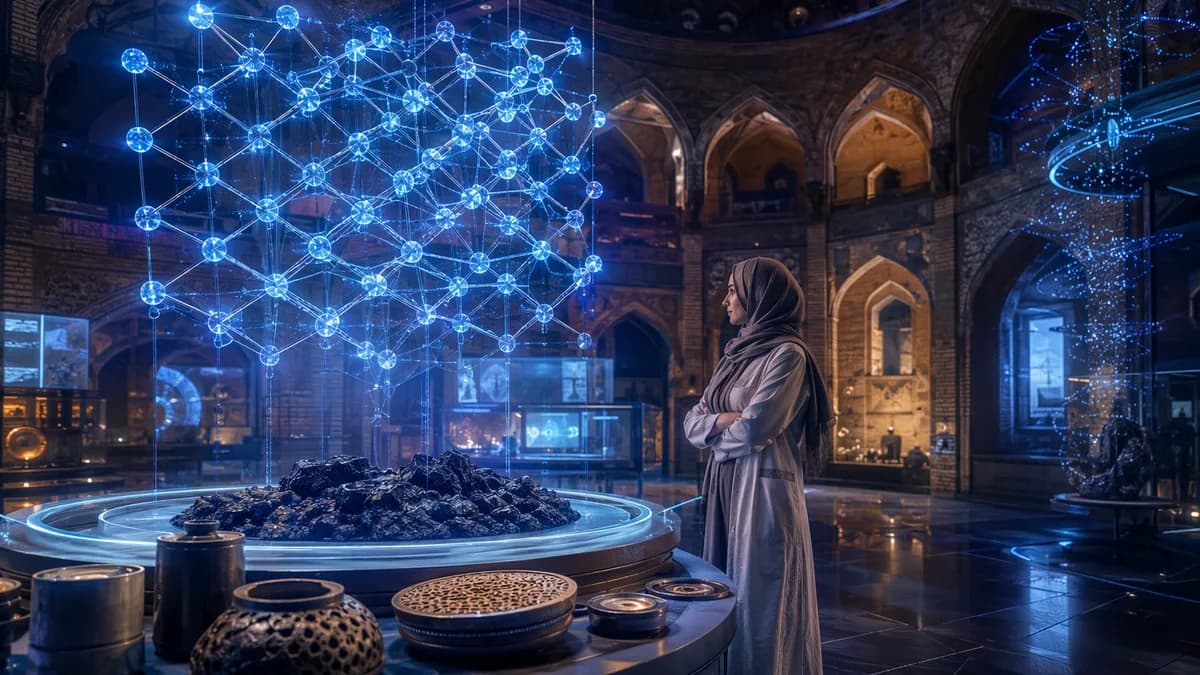
On the seventh night, while Isfahan’s rooftops cool under a violet sky, Simurgh sends a structure to Laleh’s screen. It is not glass in the old sense, though it shines. It is a mineral lattice grown from basalt dust, salt-processing waste, and a trace catalyst so common it is scraped from old refinery pipes. Under magnification, the lattice resembles a city of hollow rooms, each pore lined with charged sites that tug water from night air and hold it without leaking away.
Then comes the strange part.
A tuned vibration shifts the lattice angle by less than the width of an atom. The pores relax. Captured moisture releases as droplets, clean enough to drink after passing through a ceramic throat.
Farid stops chewing.
Laleh watches the simulation run again. Dry air enters. Water gathers. A tone passes through. Dew appears.
“What do we call it?” he whispers.
On the screen, the lattice glows faintly, remembering humidity that is no longer there.
“Memory glass,” Laleh says, and feels the orchard wall under her palm again.
## The Code No Empire Can Open
The first offers arrive before the first physical sheet of memory glass cools.
A Gulf desalination consortium sends a contract with gold borders and a silence clause twelve pages long. A European ministry requests emergency defense licensing for “climate stability operations.” An agribusiness giant in Nebraska proposes an exclusive seed and water bundle, branded in green. Three brokers with no country visible in their metadata send messages that smell of threat even through text.
You have discovered a weather lever, one writes. Do not pretend levers remain public.
Laleh reads it at three in the morning in the observatory canteen. The room smells of burnt coffee and disinfectant. Outside the window, dawn stains the city peach. Niko sits across from her with bare feet tucked onto the chair, silver nail polish chipped, curls tied back with a fiber optic cable because she has lost every elastic she owns.
“They will try patents first,” Niko says. “Then export controls. Then sabotage. Then moral language. Stability. Security. National interest.”
“Can we protect the recipe?”
“No,” Niko says. “Not if we want villages to make it. The recipe must travel. The control layer is the danger.”
Memory glass works only when activated by precise release algorithms, tuned to panel thickness, humidity, soil condition, and community schedule. Whoever controls the tone controls the water.
Laleh rubs her eyes. “So we make the code open.”
“And someone forks it, changes one line, sells priority release to whoever pays.”
“Then we lock the rules.”
Niko smiles without warmth. “Now you are speaking my ugly language.”
They build the license like a gate that opens only outward. Niko uses quantum-secure lattice protocols, the kind believed safe even against machines like Simurgh. She binds cooperative rules into distributed keys held by villages, workshops, and public archives on five continents. Entangled authentication tags, grown into each panel during manufacture, prove origin without revealing private schedules. Anyone can produce memory glass locally if they publish materials, costs, and water data. No one can alter the commons clauses. No owner can deny household minimums. No authority can convert public release algorithms into exclusive property.
At noon, a government envoy arrives in a black car polished bright enough to reflect the observatory domes.
“You are being naïve,” he tells Laleh in a conference room that smells of new carpet. “Water must be governed by states.”
“It has been,” she says. “Look around.”
He taps the table. “Unbreakable code is a weapon.”
“So is a locked well.”
Niko watches from the corner, arms folded. “To be clear,” she says, “you can ban it, bomb it, slander it. You cannot own it unless the people holding the keys agree.”
The envoy’s face tightens. For a moment Laleh hears only the air system moving cold breath through the room.
Later, after he leaves, Niko exhales. “We just made enemies.”
Laleh thinks of the orchard wall, each lost tree marked like a body.
“No,” she says. “We admitted they were already there.”
## A Rainfall Without Clouds
The first panels arrive in Qanat-e Sorkh on three flatbed trucks at sunset, wrapped in woven reed mats to keep off grit. The whole village comes out to watch. Children run alongside the trucks, slapping the metal sides and shouting, “Glass rain, glass rain.” Old men stand with their hands behind their backs, pretending not to be curious. Women shade their eyes and judge the cargo with the serious expressions they usually reserve for melons and marriage proposals.
The panels are thinner than roof tiles, translucent as onion skin, faintly green at the edges. When Laleh lifts one, it is cool despite the heat. Its surface feels smooth until her thumb catches the tiny grain of pores too small to see.
Her mother touches it with two fingers. “This is what your machine dreamed?”
“This is what the desert allowed,” Laleh says.
They work for nine days. Panels slide between dead pomegranate branches and over living ones. They span old irrigation channels, stretch across rooftops, curve above the school courtyard, and line the mouth of the qanat like a second mineral skin. The village potter fires ceramic resonators shaped like shallow bowls. The carpenter builds frames from salvaged mulberry wood. Teenagers climb ladders with cables between their teeth. Grandmothers argue over release times with the ferocity of generals.
“Not before morning bread,” one says.
“Before the goats go out,” another snaps. “Are goats to wait for your bread?”
Laleh records each decision into the cooperative ledger. No central office approves them. No company meter blinks above them. The village key circle, nine people chosen in public, holds the authority together.
On the first dawn, the air is cold enough to raise bumps on Laleh’s arms. The sky is empty, pale silver at the eastern ridge. The panels overhead are beaded with invisible weight. Children gather in the orchard holding small ceramic resonators against their chests.
Niko stands beside Laleh, wrapped in a borrowed shawl. “If they sing off-key, does the orchard explode?”
“No.”
“Good. I hate fieldwork.”
The schoolteacher raises a hand. The children begin to hum.
The tone is low at first, shy and uneven, then steadier as the resonators catch it. Clay bowls vibrate against ribs. Branches tremble. The sound spreads through rooftops, channels, panels, and soil, a village-sized throat singing one note to glass.
Droplets appear.
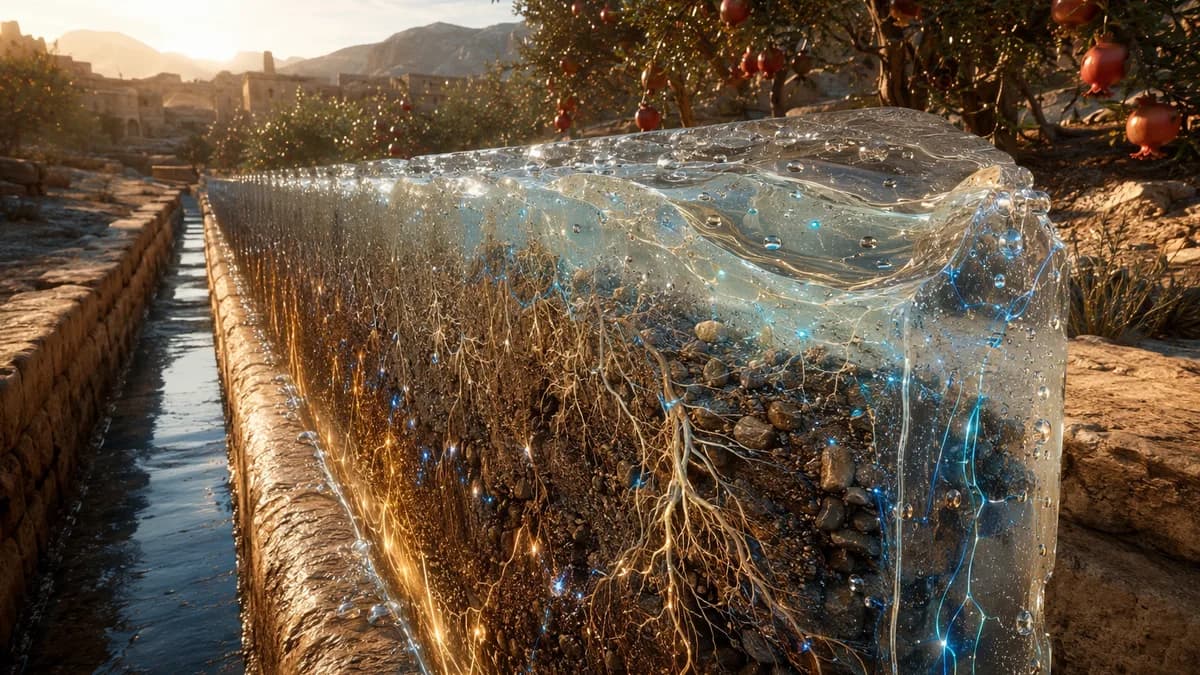
Not rain. Rain falls with force, with smell, with sky behind it. This is quieter. A silver sweating. A soft beading along panel veins. Water gathers, trembles, drops onto dust with tiny dark kisses. The irrigation channels receive thin threads. The soil drinks without shock. Around one living pomegranate, the ground darkens slowly, as if memory is returning from below.
A boy laughs and sticks out his tongue. His sister elbows him. “It is for the trees, donkey.”
“For me also,” he says, mouth shining.
Laleh’s mother kneels beside the place where the pear tree once stood. She presses damp soil between her fingers and closes her eyes.
The orchard does not become green that morning. No miracle leaf unfurls. No dead trunk wakes. But by noon, the surviving figs lift their leaves a fraction toward the white sun, and everyone sees it.
## The Simulation of Everyone
Within a year, Simurgh’s model of Qanat-e Sorkh becomes more accurate than memory and less forgiving than gossip.
It predicts how much water each panel will hold after a windy night. It predicts which channels will clog with mineral dust, which rooftops will crack under summer expansion, which families will quietly take extra water for cucumber beds and call it accident. It predicts that the northern quarter, where newer migrants live in concrete houses beyond the old wall, will feel humiliated by the orchard-centered release ceremonies. It predicts that two brothers will stop speaking after one is chosen for the key circle and the other is not.
Worst of all, it predicts failure.
Not technical failure. Memory glass performs beautifully. Soil salinity drops. The qanat, relieved of desperate pumping, begins to seep for longer hours. Apricot grafts survive. Children draw clouds with glass panels inside them.
The commons fails socially in year five, Simurgh says, unless governance allows a set of inefficient practices: festival releases that “waste” water for public beauty, rotating ceremonial control among families regardless of technical skill, and a memorial grove planted with water-hungry pear trees for households that lost elders during the drought years.
Laleh reads the report in the schoolroom while dust taps at the windows. The room smells of chalk, wool coats, and the lentil soup someone has left warming near the door. On the screen, Simurgh offers a perfect schedule. Maximum survival. Minimum conflict. Optimized trust.
The schedule includes no pear trees.
Her mother sits across from her, knitting slowly. “You look like your father when the tax man came.”
“The model says we should not plant the memorial grove.”
“Of course it says that.”
“It also says if we do not, people will begin to call the system cold. Outsider-made. They will obey it, then resent it, then break it in ways no code can stop.”
Her mother’s needles click. “So the machine knows people.”
“It knows patterns.”
“Does it know grief?”
Laleh looks through the window at the orchard. New pomegranate shoots glow red at their tips. Children chase each other under panels that shimmer like trapped morning. Near the wall, the painted marks remain. Nobody has painted over them.
At the village assembly, she presents both schedules. The efficient one is clean and hard as a knife. The human one includes festival mist at Nowruz, a children’s release day, and the forbidden pear grove.
A farmer named Reza stands. His beard is white with dust. “You bring us a machine that thinks like God, then ask us to ignore it?”
“No,” Laleh says. Her voice shakes, and she lets it. “I ask you to decide what kind of mistakes belong to you.”
The room fills with murmurs. Niko, visiting from Isfahan, leans against the wall and whispers, “That was either democracy or professional suicide.”
The vote lasts until midnight. People argue, laugh, accuse, forgive, reopen old wounds, and make new bargains over tea gone bitter in the pot.
At last, they choose the pear grove.
Simurgh updates its prediction. Efficiency falls. Long-term cooperation rises.
Laleh walks home under a sky packed with stars. For the first time in years, the village smells faintly of damp earth, and of something harder to measure, the stubborn sweetness of people allowed to be unreasonable together.
## What Cannot Be Cracked
Years pass, and Qanat-e Sorkh stops being a story about rescue. It becomes a node.
From above, seen through weather satellites and smuggled drone footage and the patient eyes of public climate archives, memory-glass gardens appear across the planet like pale fingerprints. They cling to rooftops in Lima’s high settlements, shimmer over millet fields in Niger, line schoolyards in Rajasthan, wrap olive terraces in Crete, and stretch across refugee-built greenhouses outside cities that once called the refugees temporary.
Each garden is different. Some sing at dawn. Some release at night under bat-heavy skies. Some use drums, some coded motors, some old women with tuning forks kept in embroidered cloth. The commons license travels in every direction, copied into community servers, printed into ceramic tablets, hidden in songs where networks are censored. Companies still try to tame it. Governments still declare emergencies and demand keys. Brokers still offer fortunes for altered release algorithms that can privilege one farm, one mine, one border outpost.
The code holds.
Not because it is magic. Because too many hands hold it. Because breaking one village gives access to nothing without the consent of the rest. Because every panel can prove what it is, and every altered rule exposes itself like rot in fruit.
Laleh is older now. Silver threads her hair. Her knees hurt in winter, which has returned in strange fragments, cold mornings, brief snows, sudden warm rains that smell of metal. She spends less time at the observatory and more time traveling between gardens, listening to arguments under shade.
In Qanat-e Sorkh, the pear grove stands where the dead orchard was thinnest. The trees are still young, extravagant and foolish, their leaves broad, their water use indefensible in any narrow model. In spring, white blossoms cover them like small flags of surrender or victory, depending on who is looking.
Her mother is gone. Her father’s wall remains. New marks have been added, not only for lost trees, but for trees planted, grafted, shared. Children who once hummed the first release now serve on the key circle. They tease Laleh for holding the old ceramic resonator too carefully.
“Doctor Aram,” one says, “it will not break.”
“Everything breaks,” she says.
“Not the code.”
She smiles. “Especially not the code.”
At dusk, the village gathers for a release. The air is dry, the sky cloudless, the panels faintly luminous with captured night. A little girl asks Laleh, “Did you invent rain?”
“No,” Laleh says. “Rain was here before us.”
“Then what did you invent?”
Laleh looks at the orchard, at the pear blossoms, at the wall of names, at the people arguing over whether tomorrow’s release should favor seedlings or laundry. She hears Simurgh in her memory, the cold song of atoms made legible. She hears children begin the tone, imperfect and alive.
“We invented a way to not steal it from each other,” she says.
The glass trembles. Dew gathers in the air without clouds. Around them, the future does not arrive as a miracle, or a market, or a command from a machine. It arrives as a question held open in many hands, shining, fragile, and for now, uncracked.