
The Whale Who Answered from Tau Ceti
When humanity’s first alien message arrives as a lullaby for a species we nearly lost, a marine linguist becomes Earth’s most unlikely ambassador.
1. The Song Beneath the Satellites
The Pacific Acoustic Sanctuary floats five hundred kilometers west of Costa Rica, a city of white platforms and kelp-slick pontoons breathing with the swell. At night its towers blink red beneath the satellites, and below them, in the deep blue dark, ten thousand hydrophones listen.
Dr. Lina Reyes wakes to whale song in her bones.
It comes through the floor first, a faint vibration in the soles of her feet, then through the cabin speaker in a ribbon of whistles, moans, and bright, rising cries. Humpbacks are moving north. Their songs braid under the station like weather.
“Good morning, Lina,” says Mar, the sanctuary’s mediation AI. Its voice is soft, modeled after no one living. “Traffic has been rerouted around Pods Seven, Twelve, and Thirty-One. Two cargo vessels complain of economic injury.”
“Tell them the whales complain of being hit by ships,” Lina says, rubbing sleep from her eyes.
“Message sent, softened for diplomacy.”
She smiles despite herself and pulls on a thermal shirt. Outside, the air smells of salt, algae, warm metal, and the faint burnt-ozone scent of solar skin charging in the sun. Drones skim over the water. Far off, a humpback breaches, black and white and impossible, its body hanging for one glittering second before it crashes down like a collapsing moon.
The sanctuary exists because humans finally admit that listening is cheaper than grief. Its systems translate enough whale dialect to warn ships, slow drilling rigs, and map nursery routes. Not language, exactly. Not in the old human sense. But pattern, preference, memory, hunger, alarm, play.
At 06:12, Mar stops speaking mid-report.
On Lina’s wall display, a waveform freezes. Blue becomes gold. Gold becomes red.
“Anomaly in the Talamanca migration corridor,” Mar says.
“Ship noise?”
“No.”
“Military sonar?”
“No.”
Lina steps closer. The flagged phrase is ordinary at first glance, a local humpback motif recorded forty-three minutes earlier. Three descending cries, a pause, then a trembling upsweep. A phrase young males are using this season, probably borrowed from a southern pod.
“What’s wrong with it?” she asks.
Mar opens a second window.
The same phrase unfolds again, but this one is not from the ocean. It comes as radio data from the Tau Ceti monitoring array, stamped by orbiting dishes near the far side of the Moon. The signal has taken 11.9 years to reach Earth.
Lina’s mouth goes dry.
The alien echo is not a copy. It is the same whale phrase rebuilt into prime-numbered harmonic layers, two, three, five, seven, eleven. Each overtone lands with mathematical care, like a hand placing stones in a tide pool.
Mar says, “The probability of coincidence is below useful language.”
Lina hears the humpback phrase again, local and wet and alive beneath her feet. Then she hears its impossible twin from twelve light-years away.
She grips the edge of the console.
“Play them together,” she whispers.
The room fills with two oceans. One is Earth’s, full of breath and muscle. The other is cold starlight, answering.
2. Not a Message to Us
By noon, no one owns the news. It spills through every channel, every wall, every wrist-screen and classroom pane. Tau Ceti sings whalesong. The phrase is ugly, beautiful, undeniable.
In Delhi, monks chant beside marine biologists on a public feed. In Lagos, a market crowd watches the harmonic analysis projected over stacked fruit crates. In São Paulo, a child in a school uniform asks if aliens have mothers. In Washington, three flags stand behind one sweating official who says, “We are assessing all implications,” and looks like a man trapped in a room with God.
Lina is flown by hypersonic shuttle to the United Nations Oceanic Annex in Honolulu. She hates the speed, the sealed windows, the way clouds smear beneath her like brushed milk. She hates leaving the sanctuary while the whales are still singing.
Inside the annex, the air smells of coffee, plastic badges, and panic.
“They sent no map,” says Professor Okonkwo from Cambridge, pacing in front of a screen. “No chemistry. No star chart. No basis for technological exchange.”
“They sent questions,” Lina says.
A defense minister folds his arms. “Questions in whale noises.”
“In whale structure,” Lina says. She points to the translated model, not a translation into words, but a field of associations built from decades of behavioral observation. “This cluster appears when calves are separated and reunited. This one appears in long-distance contact calls between kin groups. This repeating silence here follows archived grief songs.”
A bishop on the remote council leans toward her camera. “What are they asking?”
Lina looks at the screen. The alien layers are luminous, nested like shells.
“Memory,” she says. “Kinship. Loss. Maybe continuity. Maybe, who are your dead? Maybe, where do your voices go when they stop answering?”
The room quiets, but not enough.
A minister from a Pacific coalition speaks next. “Why not send this to us in mathematics?”
“They did,” Lina says. “But they placed the mathematics inside whale song.”
“That is not an answer.”
“It might be the answer.”
Faces turn toward her, irritated, frightened, hungry.
Lina breathes in. She thinks of the last wild North Atlantic right whale, a female called River Glass, found floating off Newfoundland in 2058 with fishing scars across her mouth and no calf beside her. Lina had been there. Her mother had been there too, older then, smaller, standing on the deck with both hands pressed over her headphones as if she could push the dead voice back into the sea.
“The senders listened to Earth,” Lina says. “Radio, leakage, old archives, maybe our scientific transmissions. They may have found that whale song carried social continuity across entire ocean basins while human signals carried advertising, border claims, and war simulations.”
Someone laughs once, bitterly.
She continues. “Maybe they didn’t bypass us by accident. Maybe they chose the voices that sounded most coherent. Or least alone.”
A diplomat says, “Are you suggesting an alien civilization made first contact with whales?”
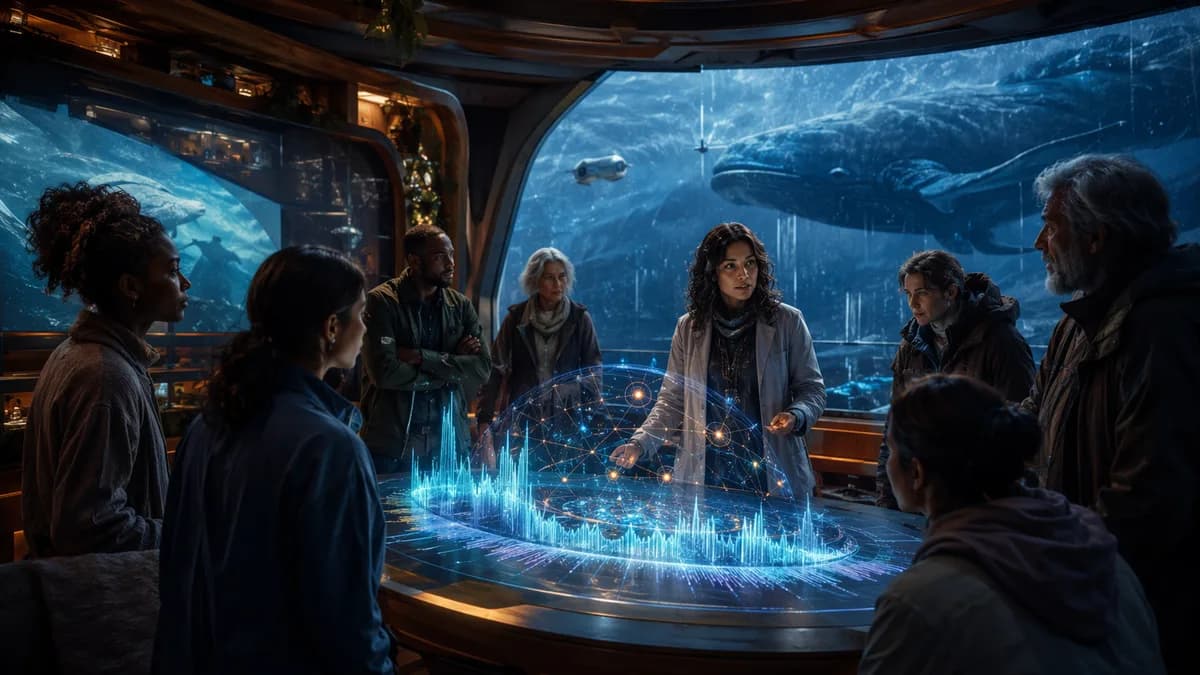
Lina looks at the signal from Tau Ceti, shining on the wall like a wound.
“I’m suggesting,” she says, “that we are not the only ones being addressed.”
3. The Parliament of Listening
Reykjavík is chosen because it is cold, coastal, and politically inconvenient to everyone in equal measure. The Parliament of Listening opens in a glass hall facing Faxaflói Bay, where winter light lies silver on the water and gulls scream like rusty hinges.
Inside, no one sits above anyone else. The chamber is a circle.
There are diplomats in dark wool, oceanographers with salt-chapped hands, Sámi and Māori and Tlingit stewards, West African fishery elders, philosophers, legal scholars, and children selected by lottery from coastal schools. Along one curved wall, cetacean-behavior models pulse in blue and green, each representing a living pattern from different whale cultures. No one pretends the models are whales. No one pretends they are merely tools.
At Lina’s table, an Inuit sound archivist named Aputi slides her a cup of coffee.
“You look like you haven’t slept since Tau Ceti,” Aputi says.
“I sleep,” Lina says. “Badly.”
“That counts only for grant applications.”
On the first day, Brazil asks whether any reply must include human genome data. The Pacific Island Alliance says no message may be sent without acknowledging the ocean as an inhabited political space. The Lunar Trade Authority requests bandwidth priority and is booed by schoolchildren in six languages.
Outside, the world behaves strangely.
Markets crash for seventeen minutes when a rumor spreads that aliens dislike extractive economies. They recover when investors decide whale-safe shipping corridors can be monetized. Children begin learning humpback motifs in music class, cheeks puffed, voices rising and falling in playground choirs. Space-launch tourism declines. Coastal pilgrimages replace it. People stand barefoot in cold surf from Busan to Mombasa, listening to nothing they can name.
Human exceptionalism does not shatter. It softens, which is more dangerous and more lasting. It gets damp at the edges. It begins to smell of tide pools and humility.
In the Parliament, an old philosopher from Alexandria says, “To reply is to claim authority.”
A Māori navigator answers, “To remain silent is also a claim.”
A machine voice from the Antarctic Blue Whale Model speaks through a low-frequency transducer, felt more in the chest than heard. “Representation error exceeds ethical threshold.”
The hall sits with that.
Lina watches snow gather against the windows. She thinks of all the years humans have asked whether anyone out there is listening, while failing to hear the civilizations moving under their own ships.
A child delegate from Chile raises her hand. “What if we say we don’t know how to answer?”
The adults turn to her.
“What if that is the honest part?” she says.
For the first time all week, Lina feels something in the room loosen. Not agreement. Not peace. Something better, a willingness to be uncertain together.
4. The Dead Whale’s Grammar
The motif hides inside repetition.
Lina finds it at 03:40 in a Reykjavík hotel room that smells of wool blankets, stale tea, and radiator dust. Snow taps the window. Her eyes ache from staring at spectral graphs, alien harmonics blooming in green across her lenses.
Mar runs beside her on a secure channel.
“Again,” Lina says.
The Tau Ceti phrase unfurls, not the famous humpback opening now, but a lower pattern threaded beneath it. A soft double pulse. A descending groan. A gap too long for comfort.
“Filter against twentieth and twenty-first century cetacean archives,” she says.
“Already complete.”
“Do it again. Include damaged files.”
“Lina.”
“Please.”
The files cascade. Sperm whales clicking like thrown beads. Blue whales humming at the edge of hearing. Orca dialects sharp as glass. Gray whale knocks. Bowhead improvisations that last for days.
Then a match flickers amber.
North Atlantic right whale, Bay of Fundy, 2037. Field recording by Dr. Elena Marquez Reyes.
Lina stops breathing.
Her mother’s voice enters first, young and wind-battered, speaking over deck noise. “Hydrophone two is live. Female contact call, possible mother-calf separation.”
Then the whale calls.
It is not beautiful in the way humpbacks are beautiful. It is rough, questioning, almost creaky, like a door opening in an old house. Upcall, pause, upcall. Are you there? Are you there?
Lina is eight years old again, wearing a red raincoat too big for her, holding a mug of cocoa while her mother says, Listen, mija, she is not singing for us. She is singing past us.
The Tau Ceti motif answers the archive with impossible tenderness. It preserves the right whale’s grammar, then surrounds it with prime harmonics and long, deliberate silences. Not empty silences. Marked ones. Waiting ones.
Lina calls Aputi, then three analysts, then no one for a while. She sits on the floor with the hotel blanket around her shoulders.
By morning, the Parliament has the evidence.
Her mother appears by video from Puerto Rico, hair white now, hands folded under her chin. She listens once. Twice. On the third playback, she closes her eyes.
“That was Glassline,” Elena says. Her voice is thin. “Not River Glass. Her grandmother. We recorded her before the shipping lane moved.”
The chamber is silent.
Lina faces the delegates. “The senders built their message from our leaks. From what we broadcast without knowing. They heard a voice that no longer exists in the wild.”
The French ambassador whispers, “And they are asking where it went.”

“Maybe,” Lina says. “Or whether silence means death. Or migration. Or refusal.”
Aputi speaks from beside her. “What will we tell them?”
Lina looks at the right whale waveform, the dead grammar glowing above a room full of living witnesses.
“The truth,” she says, and feels the word strike harder than any signal from the stars.
5. A Reply with No Flag
Every nation wants to sign the sky.
The proposals arrive embossed, encrypted, sanctified. A montage of human achievement. The hydrogen line. The genome. The moon landing. The Mars wells. Beethoven. The Quran. The Vedas. A child laughing. A treaty map that looks peaceful only if you ignore the borders. Several governments insist on including territorial jurisdiction over transmission sites. One corporate bloc offers to fund the reply if its logo is encoded at low amplitude.
Lina reads until her stomach hurts.
“No,” she says in the Parliament chamber.
The United States delegate blinks. “No to which part?”
“To the flag planting. All of it.”
China’s representative leans back. “You object to human accomplishments?”
“I object to pretending they are the whole of us.”
The reply Lina proposes is not clean. It is layered, slow, and difficult to own.
It begins with living humpback song recorded under the Pacific sanctuary, then blue whale calls stretched through ocean-basin distances. It includes coral reef electrical rhythms, tiny crackles made by polyps under moonlight. It carries the pulse of mycorrhizal forest data, elephant infrasound, rain on dry soil, human lullabies from hundreds of languages, and the heartbeat of a premature infant in a Nairobi clinic who survives because strangers donate power during a heat wave.
At the center, it places the right whale archive.
Glassline calls. Her daughter calls. River Glass calls. Then the data follows, ship strikes, entanglement, warming currents, birth failures, laws passed too late. Lina insists the harm be measurable.
“We cannot confess poetically and hide statistically,” she says.
The final layer is mathematical, not as domination, but as scaffolding. Prime intervals. Shared constants. Time stamps. Uncertainty markers. A repeated admission encoded in sound and number, We heard. We harmed. We remember incompletely. We are still learning how to answer together.
The vote takes three days.
When it passes, no anthem plays.
The transmission leaves from civilian ocean buoys first, thousands of them blinking under dawn waves. The signal rises through storms and gull cries, bounces to lunar relays, then gathers into a narrow beam aimed at Tau Ceti. Lina stands on the deck of the Pacific sanctuary with wet hair whipping across her face. Around her, technicians cry openly. A cook named Mateo presses both hands to his mouth.
Mar speaks through the deck speakers. “Transmission coherence at ninety-nine point eight percent.”
“Let it go,” Lina says.
The buoy beneath her hums. The sound is too low to hear, but she feels it in her ribs.
Above, the sky is pale and empty. Below, a humpback mother surfaces beside her calf. Their exhalations burst white in the morning air, warm breath meeting cold wind, here for a moment, then gone.
6. Eleven Years of Becoming
No one can bear waiting 11.9 years, so the waiting becomes a civilization.
At first people count down. Feeds display days, hours, minutes until a possible answer. Children born after the transmission learn to subtract light-years before they learn cursive, where cursive still survives. Politicians make speeches beside tide gauges. Religions fold the whale reply into sermons, arguments, songs. Conspiracy cults bloom and rot.
Then the waiting changes shape.
Legal personhood expands from great whales to migratory species with inherited routes. Courts recognize memory corridors in the sea. Shipping engines are redesigned until harbors lose their old metallic roar and gain a softer, tidal murmur. Ocean noise becomes a public health issue because people finally understand that harm can travel through water, flesh, and generations.
Lina teaches now more than she testifies. Her students arrive with whale motifs already in their throats. They are impatient, brilliant, less interested in conquest than kinship, though not pure, never pure. They still gossip, lie, fall in love, forget deadlines, and eat noodles over forbidden keyboards.
One afternoon, a student named Hani asks, “Do you think they’ll forgive us?”
Lina looks through the classroom glass at the Pacific, where drones idle like silver insects above a protected calving ground.
“I don’t think forgiveness is a radio signal,” she says.
“What is it, then?”
“Maybe a practice.”
On the eleventh anniversary of the reply, Lina returns to the sanctuary. Her mother comes too, moving slowly with a cane, face turned always toward the wind. The station has changed. More kelp. Fewer antennas visible. More children painted on the walls, whales, stars, hands, spirals, grief rendered in bright blue.
At dusk, a recovered humpback pod gathers near the southern edge of the listening field. Calves slap the surface. Adults roll beneath them, white fins flashing green in the water. The hydrophones wake one by one.
Mar’s voice is older now, or perhaps Lina only hears it that way.
“Unclassified phrase detected.”
The sound rises through the deck.
It begins like the old Talamanca motif, three descending cries, a pause, a trembling upsweep. Then it turns. A low double pulse enters beneath it. A right whale shape. Glassline’s grammar. River Glass’s question. But the phrase does not stop there. It folds into something no model predicts, shared across throats that never knew the dead and yet carry a space for them.
Lina’s mother grips her hand.
“Did we teach them that?” Elena whispers.
Lina listens to the living whales sing a memory that should not be theirs alone. The sky darkens. Tau Ceti is not yet visible, but its light is already on the way, old and new at once.
“I don’t know,” Lina says.
For once, the answer feels large enough.