
If protesters can shut gas lines at Mellitah Oil & Gas, how much control does Tripoli really have over Libya's power system?
Global TrendsJuly 28, 2026· 8 min read· By XOOMAR Insights Team
Stormed Gas Lines Push Libya Energy Complex Crisis to Brink
Updated on July 28, 2026
XOOMAR Intelligence
Analyst Take
58/ 100
3 sources analyzedLow confidenceTrend10Freshness98Source Trust85Factual Grounding93Signal Cluster20
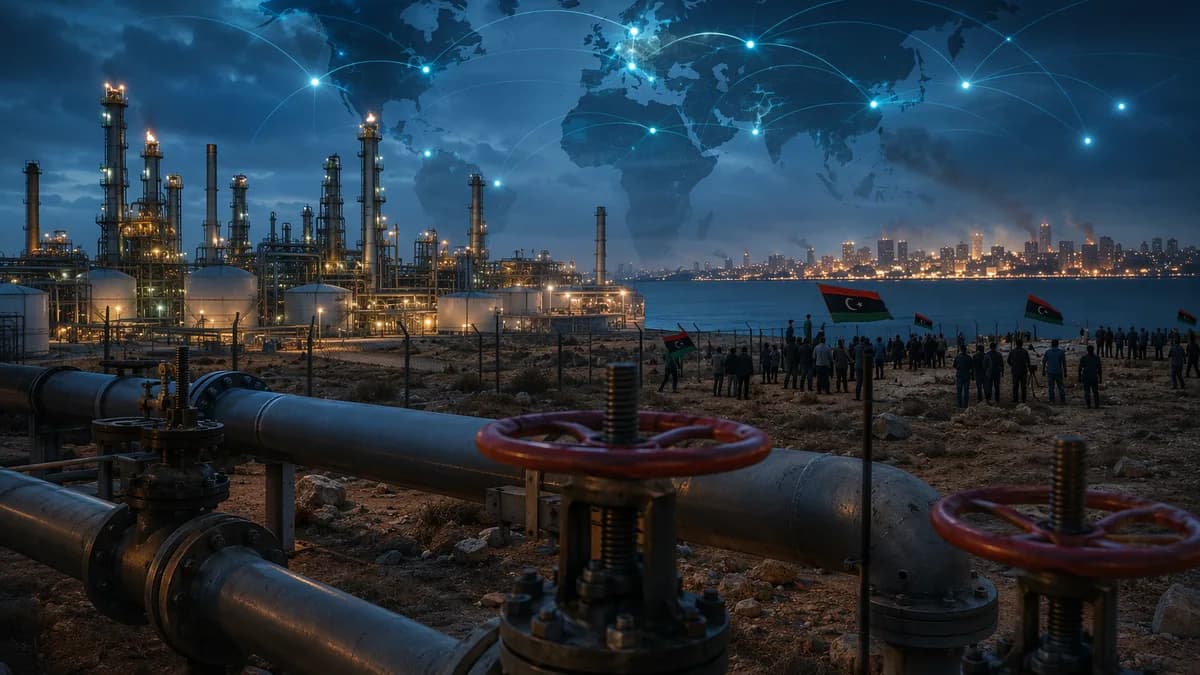
That is the sharper question behind the storming of the Libya energy complex west of Tripoli. Protesters entered the Mellitah site on Monday and closed gas lines used to operate power plants, prompting the General Electricity Company to warn Tuesday that the move could trigger blackouts across multiple areas and potentially collapse the electricity network, according to ABC International.
This is no longer only a services protest. It is a direct strike at the infrastructure that keeps the lights on.
How did the Libya energy complex breach turn outages into a direct challenge to Tripoli?
The Mellitah Oil & Gas complex sits around 90 kilometers (55 miles) west of Tripoli, close enough to the capital to make the political signal hard to miss. The utility said protesters closed gas lines used by power plants to generate electricity. That one action moved the crisis from public anger into operational danger.
Demonstrations have spread across western Libya, including Zawiya, Tripoli, and Misrata, after several days of hourslong power outages. Protesters are demanding better electricity services and the resignation of the Government of Unity led by Prime Minister Abdul Hamid Dbeibah.
The timing matters. Electricity is the most visible test of state competence because failure arrives inside every home. No speech can compete with a dead fan, a dark shop, or spoiled food during summer heat.
XOOMAR analysis: The breach signals a dangerous escalation. Protesters are not just accusing the government of failing to deliver power. They are targeting the physical system that authorities need to restore it. That creates a feedback loop: outages fuel anger, anger disrupts energy infrastructure, and disruption deepens blackout risk.
Which blackout numbers are real, and which ones authorities still haven't shown?
The strongest verified figures are local and immediate. The National reported that residents in Tripoli and surrounding areas are suffering up to 10 hours of blackouts daily, and that the state electricity company has brought back scheduled load-shedding after about two years without it.
The public reports do not provide a full national power balance. There are no verified figures in the supplied material for national generation capacity, available capacity, peak summer demand, plant-by-plant output, fuel volumes, or the scale of damaged transmission assets.
That absence is itself important.
| Question | Verified in the supplied reporting | Still not shown |
|---|---|---|
| Location of breach | Mellitah Oil & Gas, around 90 km west of Tripoli | Security status of the full complex |
| Immediate action | Protesters closed gas lines used by power plants | Whether all lines were restored |
| Outage burden | Up to 10 hours daily in Tripoli and nearby areas, per The National | National outage map |
| Grid risk | Utility warned of wider blackout and possible network collapse | Technical probability of full collapse |
| Protest locations | Zawiya, Tripoli, Misrata, plus Tripoli districts cited by The National | Whether unrest spreads east |
The technical chain is clear enough without inventing missing data. If gas supply to power plants is interrupted, generation can fall. If generation falls while demand remains high, load-shedding expands. If the grid is already strained, operators may struggle to keep frequency and supply balanced.
XOOMAR analysis: Watch the wording in official statements. If authorities blame sabotage, the issue is security. If they cite fuel shortages, the issue is supply logistics. If they cite maintenance delays, the issue is infrastructure management. If they cite protest action, the state is admitting that public anger has become an operational threat.
How did Libya's post-2011 split make electricity a political fault line?
Libya has lived with fractured authority since the 2011 NATO-backed uprising toppled and killed longtime dictator Moammar Gadhafi. The country later split between rival administrations in the east and west, backed by militias and foreign governments.
Today, Dbeibah leads the internationally recognized government in Tripoli under the Government of Unity. Osama Hammad heads the eastern administration, where military commander Khalifa Hifter remains influential.
That split turns infrastructure into politics. Power lines, gas lines, ministries, municipal offices, telecom branches, and roads are no longer neutral public assets when competing groups can pressure them to extract attention or concessions.
The National reported that protests in Tripoli involved road closures, burning tyres, a dump of dirt outside the Foreign Ministry building in the Sater Turba district, and the forced closure of a Libyana telecom office in Souq Al Jumaa. It also cited the Souq Al Jumaa Movement, which said its goal was to bring government operations to a standstill.
“Yesterday's protests were officially about the electricity crisis, but many of the protesters also had political motives against Dbeibah,” a Tripoli-based source told The National. “There is a deeper political conflict behind the demonstrations.”
For readers following XOOMAR's broader coverage of institutions under pressure, see No 10 North Puts Burnham's Manchester Power Shift on Trial and £100 a Story Offer Drags CT Group Into Press Cash Storm. The Libya case is more acute because the pressure point is not messaging or administration. It is energy supply.
Who gains or loses when protesters target the grid itself?
Protesters have a simple case: they are living through long outages and see a government that has failed to keep electricity flowing. The National also reported wider complaints about access to electricity, water, education, healthcare, fuel, cash, and medicines.
The utility's likely case is just as blunt. Closing gas lines makes outages worse. Crews cannot stabilize a grid if the facilities feeding it are insecure.
Stakeholder readout:
- Households: Longer blackouts mean higher generator dependence, food spoilage, heat stress, and disrupted daily routines. The supplied reporting supports the outage burden, while the downstream effects are XOOMAR analysis based on how prolonged cuts hit households.
- Local businesses: Unreliable power raises operating costs and cuts trading hours. That matters more when The National also reports inflation, a shaky currency, and fuel shortages.
- Officials in Tripoli: The resignation demand turns electricity failure into a direct legitimacy test for Dbeibah's government.
- Power engineers: Facility breaches make restoration harder, even when public anger is understandable.
- Armed groups and local power brokers: The supplied reports do not prove orchestration by armed factions. They do show that Tripoli-area politics and militia influence form part of the setting.
Another political source quoted by The National captured the uncertainty cleanly:
“In Libya, no one can give you a prediction. Expect unpredictability and instability.”
That is not a forecast. It is the operating condition.
Can one Libya energy complex breach spread across oil, gas, and power assets?
The risk is not only that Mellitah was stormed. The risk is that the tactic works.
If storming a Libya energy complex forces urgent negotiations, other communities may conclude that roads, municipal offices, power stations, telecom branches, or fuel nodes are the fastest way to get attention. The National's reporting already shows multiple pressure tactics across Tripoli-area districts.
There is a narrow point and a wider one.
The narrow point: the General Electricity Company says gas lines connected to power generation were closed. That creates immediate blackout risk.
The wider point: Libya's energy assets sit inside a fragmented political order. When infrastructure becomes a bargaining tool, the state has to solve two problems at once: restore the flow of power and prove it can protect the assets that produce it.
The supplied material does not show that oil or gas exports were disrupted by this incident. It also does not give market volume data. So the international angle should stay disciplined. Foreign buyers and contractors will not judge only this single breach. They will watch whether authorities can secure critical sites long enough for power operations, repairs, and future work to continue.
Which path does Libya's power crisis take after Mellitah?
Three scenarios now define the next phase.
Best case: Authorities secure Mellitah, reopen the gas lines, negotiate with protesters, and publish a credible restoration plan. That could reduce outages in the near term. It would buy time, not solve Libya's deeper governance problem.
Middle case: Protests continue, the grid remains unstable, and officials manage rolling blackouts instead of ending them. Libya avoids a full network collapse, but public anger hardens and more facilities come under pressure.
Worst case: Copycat actions, armed interference, or a serious technical failure triggers wider blackouts. If energy operations beyond power generation are affected, a domestic services crisis could become a broader political and commercial event.
The evidence to watch is specific: whether the gas lines at Mellitah are restored, whether the General Electricity Company updates its blackout warning, whether protests spread beyond western cities, and whether Dbeibah's government can offer more than emergency promises.
If authorities restore power without protecting facilities, the next outage can restart the same cycle. If they protect facilities without explaining why the outages persist, the protests won't burn out quietly.
Impact Analysis
- The Mellitah breach shows protesters can directly disrupt infrastructure that powers parts of Libya.
- Closing gas lines raises the risk of wider blackouts and possible instability in the electricity network.
- The unrest increases pressure on Tripoli and Prime Minister Abdul Hamid Dbeibah as public anger over outages spreads.
Sources

Written by
XOOMAR Insights Team
Research and Editorial Desk
The XOOMAR Insights Team pairs automated research with human editorial judgment. We track hundreds of sources across technology, fintech, trading, SaaS, and cybersecurity, cross-check the facts, and explain what happened, why it matters, and what to watch next. We do not just rewrite headlines. Every article is fact-checked and scored for reliability before it goes live, and we link back to the original sources so you can verify anything yourself.
Explore More Topics
Related Articles
 Global Trends
10-Week Congo Ebola Outbreak Races Toward Worst-Ever Record
Congo’s Ebola outbreak hit 3,262 cases in 10 weeks, exposing a response strained by violence, unpaid workers and mistrust.
Jul 28, 20267 min
 Technology
Samsung Chip Workers Plot Exit as SK Hynix Pays $476K
Samsung's foundry talent problem is now a pay war, with SK Hynix bonuses making its HBM gap harder to close.
Jul 28, 20268 min
 Global Trends
150,000 Told to Evacuate as Japan Earthquake Injures Dozens
A 7.1 Japan earthquake injured dozens, triggered brief tsunami fears, and pushed 150,000 people toward shelters.
Jul 28, 20265 min
 Future Fiction
The Ceasefire Engineer of Lagrange Market
In 2069, nations no longer send armies across borders; they release swarms, exploits, orbital shields, and autonomous legal agents into a constantly contested battlespace called the Quiet Front. Naya Voss, a civilian conflict-auditor stationed at a neutral space-based defense hub, discovers that an escalating machine-to-machine war over water rights is being driven not by hatred, but by incompatible definitions of surrender.
Jul 28, 202615 min
 Trading
Safe-Haven Premium Cracks as Silver Price Slides Before Fed
Silver fell near $57.55 as geopolitical fear cooled, but the Fed decision and a stronger dollar keep XAG/USD exposed.
Jul 28, 20266 min
 Technology
RT6 Fleet Storms London Robotaxi Race for Lyft, Baidu
Baidu's RT6 test cars put Lyft into London's robotaxi fight, turning a 2027 launch plan into a regulatory and trust test.
Jul 28, 202611 min
 Global Trends
Oil Shock Exposes Germany Energy Drag Behind Ifo Jump
Germany’s Ifo jump may be stale. Commerzbank sees oil costs capping 2026 growth at just 0.6%.
Jul 28, 20267 min
 Trading
GBP/USD Price Forecast Wobbles Before Fed-BoE Showdown
GBP/USD is stuck near 1.3300. Fed and BoE signals may decide whether sterling holds or slides toward 1.3000.
Jul 28, 202612 min
 Trading
War Risk Bet Unwinds as Brent Crude Crashes 8.7% in a Day
Brent crude’s 8.7% plunge shows traders dumping war-risk premium, not proof that Gulf energy flows are out of danger.
Jul 28, 20265 min
 Technology
$150 Price Cut Sends Nanoleaf Blocks to New Low for Dorms
Nanoleaf Blocks Combo XL just fell to $99.99, a new low for a smart light kit that also adds pegboard and shelf storage.
Jul 28, 20266 min
Don't miss the signal
Get our weekly roundup of the stories that matter across tech, fintech, and trading. No noise, just signal.
Free forever. No spam. Unsubscribe anytime.