
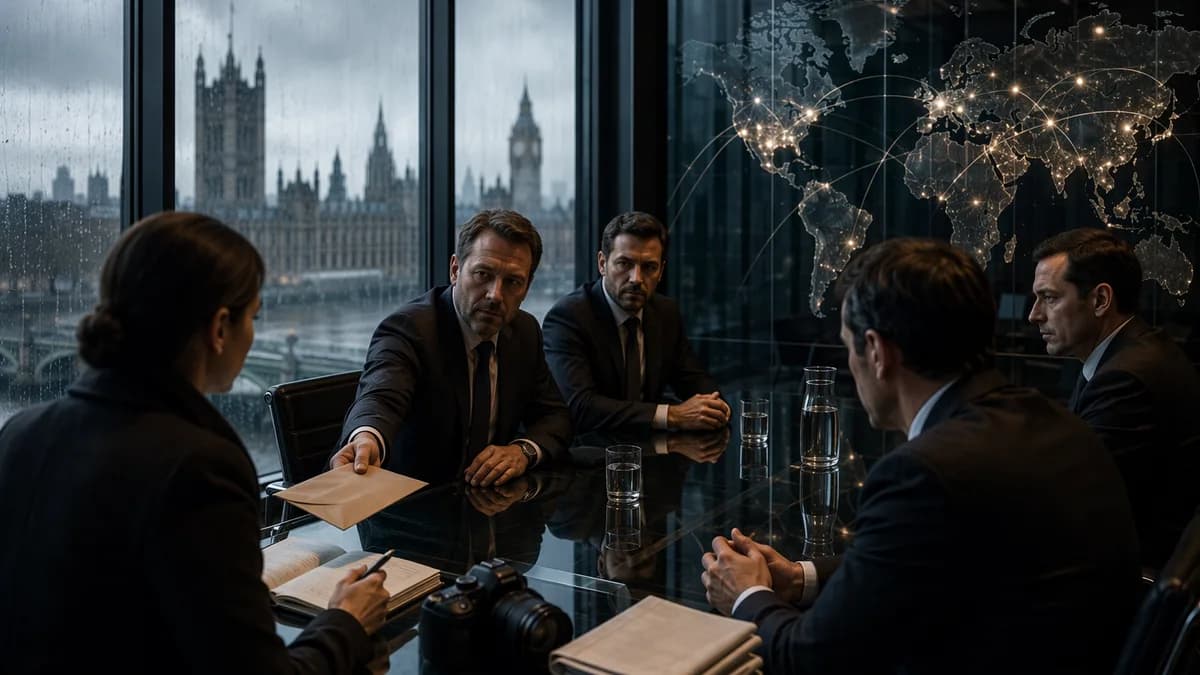
CT Group has been filmed discussing payments to journalists for client-friendly newspaper coverage, raising direct questions about hidden influence in British national press coverage.
Global TrendsJuly 26, 2026· 7 min read· By XOOMAR Insights Team
£100 a Story Offer Drags CT Group Into Press Cash Storm
Updated on July 26, 2026
XOOMAR Intelligence
Analyst Take
69/ 100
1 source analyzedMedium confidenceTrend10Freshness95Source Trust90Factual Grounding93Signal Cluster20
The CT Group journalist payments allegations come from a Guardian investigation into the lobbying firm co-founded by Lynton Crosby, the campaign strategist linked to David Cameron and Boris Johnson, Guardian World reported.
CT Group journalist payments claims center on undisclosed coverage
The Guardian said CT Group lobbyists told an undercover reporter they had paid journalists to place apparently independent stories in newspapers. The reported purpose was to promote coverage favourable to clients, without the pieces appearing as paid editorial.
The investigation, as described by the Guardian, focused on conversations about how journalists could be approached, commissioned, or encouraged to write pieces that aligned with client interests. The concern was not simply that a public affairs firm wanted journalists to consider a client’s argument. Lobbying firms routinely pitch stories, brief reporters, and try to shape coverage.
The sharper issue was whether payment could be attached to that process in a way that was not clearly visible to editors or readers. If a journalist is paid by a lobbying firm while also presenting work as independent journalism, the line between public relations, advertising, and editorial judgment becomes much harder to defend.
The Guardian reported that CT Group staff discussed arrangements that would give the firm more influence over the shape and direction of coverage. The article said those exchanges raised questions about whether client messaging could be routed into newspaper pages without the usual transparency attached to sponsored content.
CT Group rejected the Guardian’s characterisation. In its response, the company disputed the account and said it had not engaged the undercover journalist to carry out work or paid him.
Hidden paid coverage would blur journalism, advertising, and lobbying
The central issue is not that lobbying firms brief journalists. That is routine. The sharper allegation is that a lobbying firm discussed paying journalists for coverage that readers and editors could understand as independent.
According to the Guardian’s account, the discussions were not framed as ordinary advertising or clearly labelled sponsored content. They were presented as a way to secure material that would carry the appearance of normal newspaper journalism while still reflecting the interests of a paying client.
That distinction matters. Paid editorial normally carries a label. A reported article or opinion piece without disclosure carries a different level of trust with readers.
| Route into publication | Reader sees | Control over message | Ethical pressure point |
|---|---|---|---|
| Advertorial | Paid content label | High | Transparency depends on clear labelling |
| Independent journalism | News or opinion article | Low, in principle | Trust depends on editorial independence |
| Alleged CT model | Apparently independent article | Lobbying firm influence alleged | Disclosure may be absent |
The Guardian’s undercover reporter raised the concern that payment would not necessarily be known to a commissioning editor. The response described in the report suggested that disclosure itself could make publication less likely.
That is the heart of the story. If the fact of payment would change an editor’s decision, then the absence of disclosure is not a minor procedural issue. It goes directly to whether the article is being judged as journalism, sponsored messaging, or something in between.
The Guardian also reported that CT Group staff referred to previous dealings with journalists in which payment and editorial influence were discussed. The details of any such arrangements would need to be tested against records, invoices, messages, editorial disclosures, and the recollections of the journalists and editors involved.
For readers tracking political money and influence, the CT Group journalist payments story sits within a wider concern about who funds influence and who gets told. The recurring pressure point is simple: when political or corporate messaging reaches the public through trusted channels, the audience should know whether money changed hands to make that happen.
A politically connected lobbying firm and a sensitive media question
CT Group is not an ordinary local press office. The Guardian identified it as a lobbying and campaign firm co-founded by Lynton Crosby, whose political work has been associated with senior Conservative figures including David Cameron and Boris Johnson.
That profile makes the alleged media-placement practice more sensitive. A firm working at the intersection of politics, reputation, and public policy has a strong incentive to shape the stories that appear in newspapers. That does not make media briefing improper. It does mean transparency becomes essential when money is involved.
Public affairs firms often provide research, expert contacts, data, case studies, and access to clients. Journalists often use that material while retaining editorial control. The system depends on editors knowing when a contributor has a conflict and on readers not being misled about why an article exists.
CT Group’s response leaned on journalist responsibility. The company said, in effect, that journalists are expected to follow their own professional and ethical obligations, and that journalists commonly undertake paid work such as chairing events or providing media services.
Analysis: that defence addresses legitimate paid media work, but it does not fully settle the harder question raised by the Guardian’s footage. The issue is not whether journalists can do outside work. The issue is whether paid client messaging was being routed into newspapers without editors or readers being told.
A journalist can chair a panel, consult on media training, or produce clearly commissioned material without misleading anyone. The problem arises when paid work overlaps with apparently independent editorial output and the relevant decision-makers are not told. At that point, the burden is no longer only on the journalist. It also falls on the organisation offering the payment and on the publication that must police conflicts.
Editors and CT clients now have narrow, uncomfortable questions
The next phase is less about rhetoric and more about records. Editors may need to determine whether any stories tied to CT Group clients were published without disclosure, whether freelance contributors had outside payment arrangements, and whether commissioning editors were told enough to judge conflicts.
The Guardian reported that the discussions concerned attempts to place stories in national newspapers. That leaves editors with practical questions rather than abstract ones. Were any pitches accepted? Were any contributors paid by an outside party? Were editors told about those relationships before publication? Were readers given enough information to understand the origin of the piece?
CT Group clients may face their own questions. Did they know journalists could be paid to pursue coverage? Did they approve that tactic? Did any client benefit from coverage that should have been disclosed?
Those questions are uncomfortable because they move the issue away from one undercover exchange and toward the systems that allow influence to pass through the media supply chain. A lobbying firm may argue that it only offered support, research, or commissioning. A journalist may argue that the final article was independently written. An editor may argue that the piece met normal standards. But if payment was hidden from any part of that chain, each defence becomes weaker.
The immediate watch item is documentary proof. If newspapers, clients, journalists, or CT Group produce records showing what was commissioned, paid, disclosed, or rejected, the story narrows. If they do not, the CT Group journalist payments allegations will keep expanding from one undercover investigation into a broader test of how British media polices hidden lobbying influence.
Impact Analysis
- The allegations raise concerns about whether lobbying clients can secretly influence national newspaper coverage.
- Undisclosed journalist payments would blur the line between independent reporting, public relations, and paid advertising.
- The case could increase scrutiny of media transparency standards and lobbying practices in the UK.
Sources

Written by
XOOMAR Insights Team
Research and Editorial Desk
The XOOMAR Insights Team pairs automated research with human editorial judgment. We track hundreds of sources across technology, fintech, trading, SaaS, and cybersecurity, cross-check the facts, and explain what happened, why it matters, and what to watch next. We do not just rewrite headlines. Every article is fact-checked and scored for reliability before it goes live, and we link back to the original sources so you can verify anything yourself.
Explore More Topics
Related Articles
 Global Trends
Police Probe £500k Reform UK Donations via Tice Firm
Met police are probing £500k routed to Reform UK through Richard Tice's company, widening scrutiny of 2024 election funding.
Jul 25, 20266 min
 Global Trends
No 10 North Puts Burnham's Manchester Power Shift on Trial
Burnham's No 10 North debut will matter only if Manchester gains real sway over budgets, approvals and Whitehall decisions.
Jul 24, 20267 min
 Global Trends
Burnham's Electricity VAT Cut Hands Households Just £45
Burnham's first big move cuts electricity bills by about £45 a year, signaling fast, visible relief over a sweeping rescue.
Jul 21, 20268 min
 Global Trends
Andy Burnham Seizes No 10 Without UK Election Test
Andy Burnham has taken No 10 without an election, giving Labour a new leader and a bruising legitimacy test.
Jul 20, 20267 min
 Global Trends
Trump Tariffs Twist Court Loss into Checkout Tax Fight
Trump recast his tariffs after a court loss. Democrats see an opening, calling them a sales tax on squeezed Americans.
Jul 25, 20269 min
 Fintech
Revolut Valuation Rockets to $115B in Employee Share Sale
Revolut’s $115B employee share sale crowns it Europe’s top private company and puts fresh heat on its banking ambitions.
Jul 27, 20265 min
 Technology
Console-Free Amazon Luna Hits Prime Video on Fire TV
Amazon is folding Luna into Prime Video, betting Fire TV users will try console-free games beside shows, movies, and sports.
Jul 26, 20268 min
 Trading
Trump Tariffs Hit 80 Nations After Supreme Court Rebuke
Trump's new tariff round hits 80-plus countries, recasting a court defeat as a fresh trade weapon.
Jul 25, 20268 min
 Global Trends
Nolan Wells Autopsy Throws Teen’s Death Into Doubt
Nolan Wells’s autopsy came back undetermined, keeping pressure on investigators to explain his final hours on Horn Island.
Jul 27, 202612 min
 Technology
Brain Waves May Teach Physical AI What Video Misses
Encord is testing brain-wave data to teach robots the intent, hesitation, and error signals cameras miss.
Jul 27, 20269 min
Don't miss the signal
Get our weekly roundup of the stories that matter across tech, fintech, and trading. No noise, just signal.
Free forever. No spam. Unsubscribe anytime.