
The Japan earthquake has already shifted from a brief tsunami scare into a rescue and infrastructure emergency, after a magnitude 7.1 quake struck Kumamoto prefecture in south-west Japan, injuring several people and forcing authorities to move quickly on evacuations, damage checks, and aftershock warnings.
Global TrendsJuly 28, 2026· 5 min read· By XOOMAR Insights Team
150,000 Told to Evacuate as Japan Earthquake Injures Dozens
Updated on July 28, 2026
XOOMAR Intelligence
Analyst Take
58/ 100
4 sources analyzedLow confidenceTrend10Freshness97Source Trust92Factual Grounding90Signal Cluster20
The quake hit inland on Kyushu island at 16:27 local time (07:27 GMT) and had a shallow epicentre of 10km, according to BBC World. Japan issued a tsunami advisory after the shaking, then lifted it within the hour, but the short-lived alert did not mean the danger had passed.
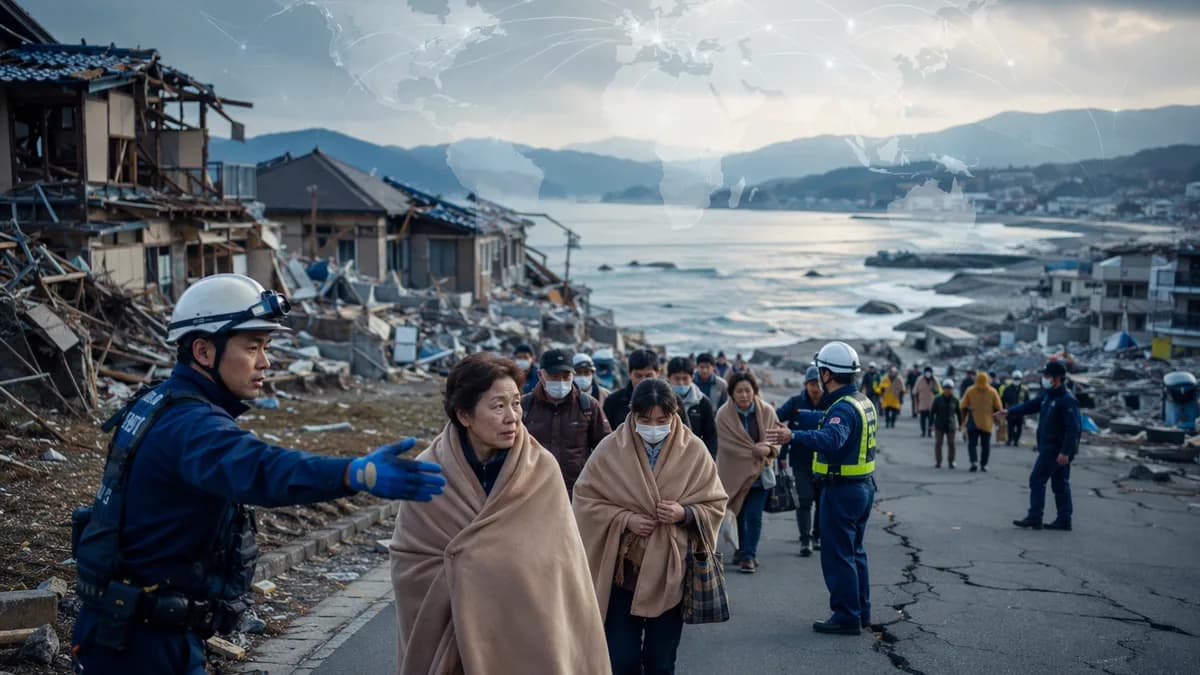
Magnitude 7.1 earthquake hits Kumamoto, leaving several injured
The immediate risk is now concentrated on injuries, unstable structures, fires, transport disruption, and aftershocks. Prime Minister Sanae Takaichi said officials were still working through the early picture of casualties and property damage.
"We are still assessing the extent of injuries and property damage, but I have been informed that there have already been several injuries," Prime Minister Sanae Takaichi said on Tuesday.
The numbers are still moving. BBC World, citing Japanese broadcaster NHK, reported that about 10 of the injured were in an elderly care home and that at least 50 people were being treated in hospital. NHK footage showed cracked roads and bridges, while several buildings were on fire.
The strongest caution is that early earthquake reporting is usually fragmented. Local authorities, hospitals, fire services, and broadcasters often see different parts of the damage first. That means the current injury count should be read as provisional, not final.
Still, the case for treating this as a serious local emergency is already supported by the response scale. More than 150,000 people have been asked to move to evacuation shelters, train services have been suspended, and electricity has been cut off for thousands of homes.
| Reported factor | Detail from available sources |
|---|---|
| Magnitude | 7.1 |
| Location | Inland in Kumamoto City, Kyushu island |
| Time | 16:27 local time (07:27 GMT) |
| Depth | 10km |
| Evacuations | More than 150,000 people asked to move to shelters |
| Known injuries | Several injured, at least 50 being treated in hospital, according to NHK via BBC |
| Tsunami status | Advisory issued, then lifted within the hour |
Tsunami alert rattles coastal communities before officials ease the warning
The lifted tsunami advisory reduces one major threat, but it does not erase the broader emergency. The advisory briefly pushed coastal communities into alert mode after the Japan earthquake, especially around areas where residents were told to follow evacuation information and move to safer locations.
Chief Cabinet Secretary Minoru Kihara said first responders had been deployed, including Japan's self-defence force, fire services, and the coast guard. His message focused less on reassurance and more on disciplined movement away from danger.
"We urge residents in areas where the shaking was particularly severe to pay close attention to evacuation information issued by local authorities via radio, television and the internet, and to act calmly," he said.
That warning matters because the quake was shallow. Japan's meteorological agency warned of strong aftershocks given the 10km epicentre, and shallow earthquakes can produce violent surface shaking near the fault zone. The source material does not confirm the full footprint of structural damage, but it does show enough disruption to justify caution around damaged buildings, bridges, and roads.
There is a counterpoint: Japan has some of the world's most practiced earthquake warning and evacuation systems, and the tsunami advisory being lifted within an hour suggests one feared scenario did not develop. That matters. A tsunami alert that ends quickly can prevent unnecessary prolonged displacement.
But the visible damage keeps the risk profile elevated. NHK footage showed cracked roads and bridges, and buildings on fire. Other source material reported damage to buildings, suspended rail services, disruption to mobile phone services in some areas, and power cuts affecting tens of thousands of households.
For readers tracking public-alert failures and warning channels in other countries, XOOMAR has separately covered AusAlert Test Jolts Cinemas but Leaves Phones Silent. For Japan-focused readers watching how domestic shocks can intersect with broader risk sentiment, see our separate markets coverage, Japanese Yen Reprieve Cracks Near USD/JPY's 164 Line.
Rescuers in Kumamoto check damage as Japan monitors aftershocks
The next phase will be slower and more dangerous than the first alert cycle. Rescuers and local officials now have to check homes, elderly care facilities, roads, bridges, fires, rail lines, and utility networks while aftershocks remain possible.
BBC World reported that train services were suspended and electricity was cut off for thousands of homes. Additional reporting from Japanese broadcaster NHK, cited in the source material, said emergency crews were dealing with cracked roads, bridge damage, and fires. These are not isolated inconveniences when aftershocks are possible, because weakened structures can fail later.
Japan's broader seismic context sharpens the concern. The country sits on the Pacific Ring of Fire and experiences about 1,500 quakes a year, according to BBC World. A magnitude 7.5 earthquake in north-east Japan last December left 30 people wounded, while the March 2011 magnitude 9 earthquake triggered a tsunami that killed 18,000 people.
That history should not be used to overstate Tuesday's event. The available sources do not say this quake has caused anything close to the 2011 disaster. The tsunami advisory was lifted, and officials are still assessing casualties and damage.
The stronger reading is narrower: this Japan earthquake is now an inspection, rescue, and aftershock story. The key updates will come from Japan's meteorological agency, local governments, hospitals, utilities, and emergency services as they verify injuries, trapped residents, fire damage, road access, rail suspensions, power restoration, and any renewed coastal guidance.
If aftershocks remain limited and inspections clear major infrastructure, the emergency could narrow quickly. If aftershocks hit damaged areas or rescuers confirm more collapsed buildings, the situation in Kumamoto will stay fluid well beyond the first tsunami advisory.
Impact Analysis
- A magnitude 7.1 quake has created an active rescue and infrastructure emergency in south-west Japan.
- More than 150,000 people have been asked to move to evacuation shelters as aftershock risks remain.
- Early injury and damage figures are provisional, meaning the scale of the disaster could still rise.
Reported Human Impact of Japan Quake
Injured in elderly care home
people10
Treated in hospital
people50
Asked to evacuate
people150,000
Sources

Written by
XOOMAR Insights Team
Research and Editorial Desk
The XOOMAR Insights Team pairs automated research with human editorial judgment. We track hundreds of sources across technology, fintech, trading, SaaS, and cybersecurity, cross-check the facts, and explain what happened, why it matters, and what to watch next. We do not just rewrite headlines. Every article is fact-checked and scored for reliability before it goes live, and we link back to the original sources so you can verify anything yourself.
Explore More Topics
Related Articles
 Trading
Japanese Yen Reprieve Cracks Near USD/JPY's 164 Line
The yen's pause below 164 is fragile. Without hawkish BoJ guidance, a firm Fed could put USD/JPY back on breakout watch.
Jul 27, 20268 min
 Technology
PC Gaming Costs Jump in 2026, 3 Cheap Setups Still Win
PC gaming is getting pricier in 2026, but handhelds, pre-builts and custom PCs still offer cheaper ways in.
Jul 28, 20268 min
 Global Trends
Stormed Gas Lines Push Libya Energy Complex Crisis to Brink
Protesters shut gas lines at Mellitah, turning Libya's power outages into a direct threat to Tripoli's grip on the grid.
Jul 28, 20268 min
 Global Trends
10-Week Congo Ebola Outbreak Races Toward Worst-Ever Record
Congo’s Ebola outbreak hit 3,262 cases in 10 weeks, exposing a response strained by violence, unpaid workers and mistrust.
Jul 28, 20267 min
 Technology
Samsung Chip Workers Plot Exit as SK Hynix Pays $476K
Samsung's foundry talent problem is now a pay war, with SK Hynix bonuses making its HBM gap harder to close.
Jul 28, 20268 min
 Future Fiction
The Ceasefire Engineer of Lagrange Market
In 2069, nations no longer send armies across borders; they release swarms, exploits, orbital shields, and autonomous legal agents into a constantly contested battlespace called the Quiet Front. Naya Voss, a civilian conflict-auditor stationed at a neutral space-based defense hub, discovers that an escalating machine-to-machine war over water rights is being driven not by hatred, but by incompatible definitions of surrender.
Jul 28, 202615 min
 Trading
Safe-Haven Premium Cracks as Silver Price Slides Before Fed
Silver fell near $57.55 as geopolitical fear cooled, but the Fed decision and a stronger dollar keep XAG/USD exposed.
Jul 28, 20266 min
 Technology
RT6 Fleet Storms London Robotaxi Race for Lyft, Baidu
Baidu's RT6 test cars put Lyft into London's robotaxi fight, turning a 2027 launch plan into a regulatory and trust test.
Jul 28, 202611 min
 Global Trends
Oil Shock Exposes Germany Energy Drag Behind Ifo Jump
Germany’s Ifo jump may be stale. Commerzbank sees oil costs capping 2026 growth at just 0.6%.
Jul 28, 20267 min
 Trading
GBP/USD Price Forecast Wobbles Before Fed-BoE Showdown
GBP/USD is stuck near 1.3300. Fed and BoE signals may decide whether sterling holds or slides toward 1.3000.
Jul 28, 202612 min
Don't miss the signal
Get our weekly roundup of the stories that matter across tech, fintech, and trading. No noise, just signal.
Free forever. No spam. Unsubscribe anytime.