
The question for anyone trying to get into PC gaming in 2026 isn’t “What dream rig should I buy?” It’s “Which compromise gets me playing without locking me into the wrong hardware?”
TechnologyJuly 28, 2026· 8 min read· By XOOMAR Insights Team
PC Gaming Costs Jump in 2026, 3 Cheap Setups Still Win
Updated on July 28, 2026
XOOMAR Intelligence
Analyst Take
72/ 100
1 source analyzedMedium confidenceTrend10Freshness100Source Trust84Factual Grounding92Signal Cluster20
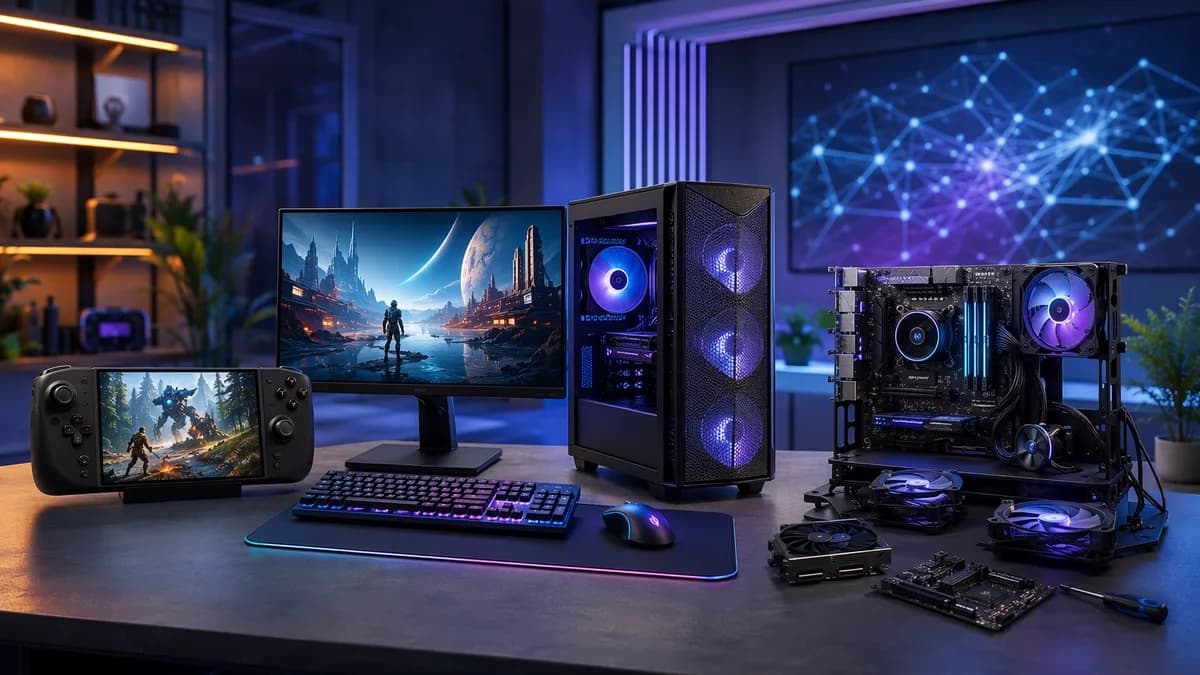
That’s the practical takeaway from a PC hardware reviewer at Tom's Guide, who argues that higher memory and component costs have made the old budget-gaming playbook harder to trust. The three realistic entry points are gaming handhelds, pre-built gaming PCs, and custom-built PCs.
Here’s how to choose one without overspending.
1. What should your first PC gaming target be before you spend?
Step 1: Pick a starter target, not a fantasy build.
For most new buyers, the useful target is simple: play the games you actually care about at settings the machine can handle, with enough room to avoid replacing everything too soon. Tom’s Guide points to 1080p pre-built systems as a current value zone, while handhelds often run demanding games at 720p to 1080p, low-to-medium settings, typically in the 30 to 60 fps range.
That tells you something important. Entry-level PC gaming in 2026 is about managed expectations.
Do this before shopping:
- List your games: Put your must-play titles in writing.
- Check requirements: Compare those games against the specs of any handheld, pre-built, or parts list you’re considering.
- Choose your tolerance: Portability, convenience, or long-term upgrade control. You probably won’t get all three cheaply.
Watch out for: Chasing a high-end build because it feels “future-proof.” In this market, that can turn a starter setup into an expensive project before you’ve played a single game.
2. Which gear do you already own that can cut the total cost?
Step 2: Inventory everything before buying the main machine.
A cheap PC gaming setup gets expensive when you forget the surrounding gear. Tom’s Guide specifically flags that buyers may still need a monitor, keyboard, mouse, and other peripherals if they don’t already own them.
Check what you already have:
- Display: A monitor or TV can reduce the upfront hit if you buy a pre-built or custom desktop.
- Input: A working keyboard, mouse, or controller can wait if the budget is tight.
- Space: A handheld needs almost none. A desktop needs a place to live.
- Power and docking: Handhelds can dock to a TV or monitor, and Tom’s Guide notes that many models support this.
If you’re also comparing local hardware with subscription-based gaming elsewhere, XOOMAR’s coverage of Console-Free Amazon Luna Hits Prime Video on Fire TV is useful context. But the Tom’s Guide framework here is hardware-first: handheld, pre-built desktop, or DIY build.
Watch out for: Spending your whole budget on the PC, then discovering you still need the basic gear that makes it playable.
3. Is a gaming handheld the cheapest clean way to start?
Step 3: Choose a handheld if you want low-friction PC gaming with a hard performance ceiling.
A gaming handheld is the least intimidating route. It’s self-contained. It can run games from Steam and other libraries. Some models use SteamOS, while others run Windows.
Tom’s Guide says prices have climbed sharply. The Steam Deck OLED once topped out at $649, but the 512GB model now starts at $789. The Asus ROG Xbox Ally sits around $600, while higher-end handhelds such as the Legion Go 2 cost more.
That still leaves handhelds as one of the most contained ways to get into PC gaming in 2026, especially while discrete GPUs, RAM, and other components remain expensive.
Pick this route if:
- Portability matters more than maximum frame rates.
- Setup simplicity matters more than full control.
- Total cost containment matters more than upgrade flexibility.
- Docking to a TV or monitor sounds useful.
Watch out for: Battery life. Tom’s Guide says demanding games can drain many handhelds in one or two hours. Storage is another squeeze, especially on 512GB models.
4. When does a pre-built gaming PC beat building your own?
Step 4: Buy pre-built if you want desktop performance without dealing with the component market.
A pre-built gaming PC is the most practical route for many buyers right now. Tom’s Guide says manufacturers can buy parts in bulk, which means pre-builts can match or even beat comparable DIY builds in the current market.
That’s a sharp reversal from the old assumption that building always saves money.
“buying pre-built is usually less expensive than building your own.”
That quote comes from Techsponential’s Avi Greengart, speaking to Tom’s Guide about the current environment.
Tom’s Guide says solid 1080p systems with an RTX 5060-class GPU and 32GB of RAM currently sit in the $1,000-$1,200 range. It also recommends looking at systems with last-generation CPUs that were priced before the worst of RAMageddon.
Prioritize these specs:
- GPU: Put graphics performance ahead of brand loyalty.
- RAM: Tom’s Guide calls 32GB valuable right now.
- Thermals and noise: Read recent reviews of the exact model.
- Upgrade room: Check whether the case, power supply, and GPU clearance look restrictive.
Brands Tom’s Guide names include Lenovo, iBuyPower, ABS, and CyberPower.
Watch out for: Proprietary case layouts, lower-tier power supplies, loud coolers, and limited GPU clearance. Convenience has a cost, even when the headline price looks strong.
5. Should you still build your own PC in 2026?
Step 5: Build only if control and upgradeability matter more than instant value.
A custom-built PC still gives you the most ownership. You choose the exact GPU, cooler, power supply, case, storage, and memory. You also learn how the system fits together, which makes future upgrades and troubleshooting less mysterious.
Tom’s Guide says the current memory shortage has made DIY less of an automatic money-saver than it was a couple of years ago. The numbers explain why. A decent 32GB DDR5 kit can cost $350-$470, and GPUs and SSDs are also elevated.
Still, there are ways to keep the build sane. Tom’s Guide points to last-generation components, especially AM4 and DDR4, as potential savings areas. It also mentions motherboard, CPU, and memory bundles from places like Micro Center.
Build if you want:
- Full part control
- A quieter or cooler system
- A clearer upgrade path
- A machine tuned to the games you play
Watch out for: Compatibility checks, multiple warranties, assembly mistakes, and dead-on-arrival parts. A DIY build can save frustration later, but it demands more effort upfront.
For another example of why hardware buyers should be cautious before committing money, see XOOMAR’s report on Refunds Hit Xtra Muse 2 Pro After $20 Preorder Push. Different product category, same practical lesson: know what you’re buying before cash leaves your account.
6. Which PC gaming route fits your budget and patience?
Step 6: Match the route to your constraint.
| Route | Best for | Main strength | Main trade-off |
|---|---|---|---|
| Gaming handheld | Buyers who want simple, portable access | Low-friction setup and contained cost | Lower performance ceiling, battery limits, storage pressure |
| Pre-built gaming PC | Buyers who want a working desktop fast | Strong immediate value in the current component market | Less part control, possible upgrade limits |
| Custom-built PC | Buyers who want long-term flexibility | Full control and easier future upgrades | More research, troubleshooting, and upfront complexity |
If your budget is tight and portability matters, start with a handheld. If you want a desktop and don’t want to build, pre-built is the cleanest route. If you care about choosing every part and upgrading over years, DIY still makes sense, but only if you’re ready for the work.
The practical rule: buy the machine that improves playability now, not the one that flatters your spec sheet.
7. What should you do next if prices stay ugly?
Step 7: Make one decision, then stop shopping in circles.
To get into PC gaming in 2026 without overspending, choose the compromise you can live with:
- Handheld if you value portability and simplicity.
- Pre-built if you want the best shot at desktop value right now.
- Custom-built if you want control, learning, and long-term upgrade freedom.
The watch item is RAMageddon. If memory prices remain elevated, pre-builts and handhelds may keep looking more attractive than DIY for first-time buyers. If pricing eases, custom builds could regain some of their old budget appeal.
For now, don’t build around a vague idea of “PC gaming.” Build around your actual games, your existing gear, and the route that gets you playing without forcing a full replacement next year.
Key Takeaways
- Higher component and memory costs make it easier for first-time PC gamers to overspend.
- Choosing between portability, convenience, and upgrade control helps buyers avoid the wrong hardware.
- Starting with the games you actually play can keep expectations realistic and costs manageable.
Three Entry Points Into PC Gaming in 2026
| Option | Best Fit | Performance/Target Mentioned | Main Trade-Off |
|---|---|---|---|
| Gaming handhelds | Portability | 720p to 1080p, low-to-medium settings, typically 30 to 60 fps | Less power and flexibility than a desktop setup |
| Pre-built gaming PCs | Convenience and value | 1080p systems are described as a current value zone | Less upgrade control than building yourself |
| Custom-built PCs | Long-term upgrade control | Depends on the parts list and game requirements | Higher memory and component costs can make budget builds harder to trust |
Sources

Written by
XOOMAR Insights Team
Research and Editorial Desk
The XOOMAR Insights Team pairs automated research with human editorial judgment. We track hundreds of sources across technology, fintech, trading, SaaS, and cybersecurity, cross-check the facts, and explain what happened, why it matters, and what to watch next. We do not just rewrite headlines. Every article is fact-checked and scored for reliability before it goes live, and we link back to the original sources so you can verify anything yourself.
Explore More Topics
Related Articles
 Technology
Nike Vomero Plus Sale Slashes $180 Trainers to $108
Nike's Vomero Plus drops from $180 to $108 with code DAYONE, but only marked-down colorways get the full 40% cut.
Jul 21, 20265 min
 Global Trends
Stormed Gas Lines Push Libya Energy Complex Crisis to Brink
Protesters shut gas lines at Mellitah, turning Libya's power outages into a direct threat to Tripoli's grip on the grid.
Jul 28, 20268 min
 Global Trends
10-Week Congo Ebola Outbreak Races Toward Worst-Ever Record
Congo’s Ebola outbreak hit 3,262 cases in 10 weeks, exposing a response strained by violence, unpaid workers and mistrust.
Jul 28, 20267 min
 Technology
Samsung Chip Workers Plot Exit as SK Hynix Pays $476K
Samsung's foundry talent problem is now a pay war, with SK Hynix bonuses making its HBM gap harder to close.
Jul 28, 20268 min
 Global Trends
150,000 Told to Evacuate as Japan Earthquake Injures Dozens
A 7.1 Japan earthquake injured dozens, triggered brief tsunami fears, and pushed 150,000 people toward shelters.
Jul 28, 20265 min
 Future Fiction
The Ceasefire Engineer of Lagrange Market
In 2069, nations no longer send armies across borders; they release swarms, exploits, orbital shields, and autonomous legal agents into a constantly contested battlespace called the Quiet Front. Naya Voss, a civilian conflict-auditor stationed at a neutral space-based defense hub, discovers that an escalating machine-to-machine war over water rights is being driven not by hatred, but by incompatible definitions of surrender.
Jul 28, 202615 min
 Trading
Safe-Haven Premium Cracks as Silver Price Slides Before Fed
Silver fell near $57.55 as geopolitical fear cooled, but the Fed decision and a stronger dollar keep XAG/USD exposed.
Jul 28, 20266 min
 Technology
RT6 Fleet Storms London Robotaxi Race for Lyft, Baidu
Baidu's RT6 test cars put Lyft into London's robotaxi fight, turning a 2027 launch plan into a regulatory and trust test.
Jul 28, 202611 min
 Global Trends
Oil Shock Exposes Germany Energy Drag Behind Ifo Jump
Germany’s Ifo jump may be stale. Commerzbank sees oil costs capping 2026 growth at just 0.6%.
Jul 28, 20267 min
 Trading
GBP/USD Price Forecast Wobbles Before Fed-BoE Showdown
GBP/USD is stuck near 1.3300. Fed and BoE signals may decide whether sterling holds or slides toward 1.3000.
Jul 28, 202612 min
Don't miss the signal
Get our weekly roundup of the stories that matter across tech, fintech, and trading. No noise, just signal.
Free forever. No spam. Unsubscribe anytime.