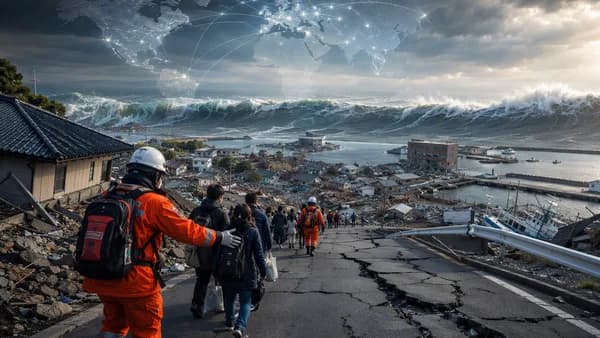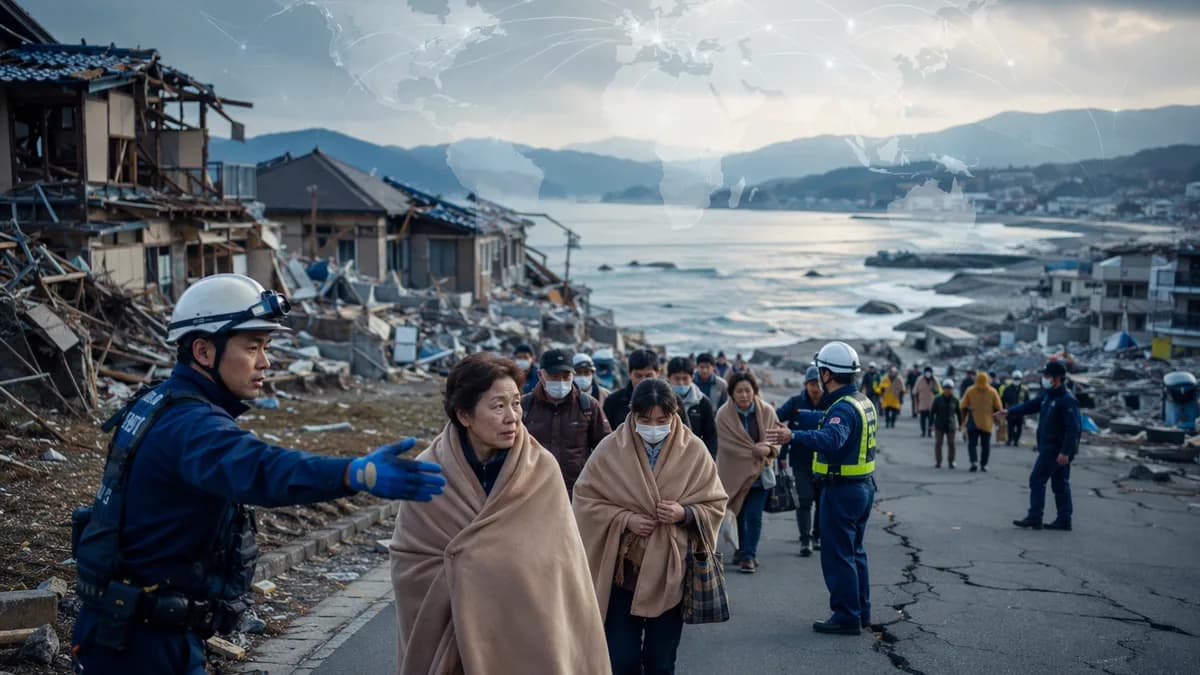
At least 13 people are dead after a powerful Japan earthquake struck southern Kumamoto, turning collapsed buildings, damaged roads and a shattered shopping centre into urgent search zones for rescuers racing unstable structures and aftershocks.
XOOMAR Intelligence
Analyst Take
Emergency crews continued digging through rubble in southern Japan the day after the quake hit the Kumamoto area on Kyushu, according to Guardian World. The Japan Meteorological Agency put the quake at magnitude 7.1, while the US Geological Survey measured it at magnitude 6.8.
Japan earthquake death toll reaches at least 13 as crews search for trapped survivors
Prime minister Sanae Takaichi said rescue teams were in a “race against time” as they searched for people believed to be trapped under debris.
“We will go all out to find and rescue as many people as we can,” Takaichi said.
The worst known rescue sites include a partially collapsed Aeon shopping centre near Kumamoto city and a Nippon Paper Industries factory, where a chimney collapsed on to the site.
At the Aeon mall, reports cited by the Guardian said eight people were pulled from the rubble after an apparent explosion about an hour after the earthquake. Aeon said four workers remained unaccounted for. Later reporting in the supplied source packet said 10 people had been pulled from the building by Wednesday afternoon, including three confirmed dead, with three people still missing.
At the paper mill, the Guardian cited reports that seven people were still missing after the chimney collapse. Later reporting in the supplied material said 11 people had been trapped there, with five dead, two injured and four still missing as of Wednesday afternoon.
That moving count matters. This is still a live disaster zone, and casualty figures can shift as authorities reach damaged sites, confirm hospital reports and reconcile company-level information with official disaster data.
| Site | Reported damage | Latest figures in supplied material |
|---|---|---|
| Aeon shopping centre | Partial collapse after apparent explosion | 10 pulled out, three dead, three missing |
| Nippon Paper Industries factory | Chimney collapsed on site | Five dead, two injured, four missing |
| Wider Kumamoto area | Collapsed buildings, damaged roads, utility outages | At least 13 dead |
A nearby business owner, Takateru Sonoda, described the moment after the shopping centre blast to Jiji Press.
“I thought a bomb had gone off,” Sonoda said. “There were people calling on others to evacuate and sirens were ringing out. Nearby roads were gridlocked, it was a state of panic.”
XOOMAR analysis: The search picture is dangerous because the highest-priority rescue sites are not isolated piles of debris. They are damaged commercial and industrial structures, where gas, electricity, aftershocks and weakened concrete can all slow entry. That makes each confirmed survivor pullout significant, but it also means missing-person totals may not resolve quickly.
Aftershocks and damaged infrastructure slow emergency response in southern Japan
More than 200 aftershocks continued to shake the region, according to the supplied related reporting, while authorities warned residents in the hardest-hit areas to be alert for further strong quakes for about a week.
Chief government spokesperson Minoru Kihara said nearly 37,000 homes were still without electricity, 9,500 homes were without gas, and communication networks were down in some areas. More than 9,000 people had left their homes for more than 500 shelters, he added.
The heat is now part of the emergency. Related reporting in the source packet said temperatures climbed past 35 degrees on Tuesday and around 34 degrees on Wednesday, leaving residents without power, air conditioning or reliable water in some areas.
Road damage is also cutting into the speed of the response. Roads were described as cracked, buckled or gridlocked in places, while Kyushu’s transport network was disrupted by damaged roads and train lines. Operators suspended high-speed train services after the quake, and some passengers were injured, according to the supplied reporting.
Authorities said about 260,000 people were instructed to go to evacuation centres, while police received 386 emergency calls after the quake, including reports of collapsed buildings and people seeking rescue.
For readers tracking the escalation, this follows XOOMAR’s earlier coverage of the Japan earthquake rescue race after major aftershocks and our report on evacuations and injuries after the Kumamoto quake. The numbers have since moved, and the rescue operation is now centered on confirmed collapse sites and missing workers.
XOOMAR analysis: Japan has deep disaster-response capacity, but the first critical hours after a major quake still come down to access. If roads are buckled, communications are patchy and aftershocks keep crews out of unstable buildings, the system has to fight the physical map before it can reach every victim.
Toyota and Honda pause Kumamoto factory operations as Japan assesses quake damage
Toyota and Honda said they will suspend operations at factories in Kumamoto until Friday, adding an industrial layer to a disaster still dominated by rescue work.
Toyota framed the shutdown as a safety decision while conditions remain fluid.
“The situation, including aftershocks and recovery efforts, is changing daily,” Toyota said in a statement. “We will continue to prioritise safety above all else.”
The factory pauses are not the core human story, but they show how the quake is spreading beyond damaged homes and rescue sites. If power systems, roads, rail links or local suppliers remain disrupted, reopening decisions become harder even for companies with mature contingency planning.
Neither of the two nuclear power plants in the area reported abnormalities, according to the supplied related reporting. Japan’s nuclear authority also informed the International Atomic Energy Agency that the Sendai nuclear power plant was not damaged.
Still, the immediate pressure points are clear:
- Rescue: Crews are still searching collapse sites, including the mall and paper factory.
- Shelter: More than 9,000 people are in emergency accommodation.
- Utilities: Tens of thousands of homes remain without power, gas or communications.
- Industry: Toyota and Honda have paused Kumamoto factory operations until Friday.
- Aftershocks: Authorities are warning of possible strong tremors in the coming days.
The next meaningful updates will come from four places: revised death and missing-person counts, rescue progress at the Aeon mall and Nippon Paper Industries factory, aftershock warnings from Japanese authorities, and reopening decisions from Toyota and Honda. Until those move, the Japan earthquake remains a rescue story first and an economic disruption second.
The Stakes
- Rescuers are working against aftershocks and unstable debris to reach people still trapped.
- The death toll has reached at least 13 and may rise as searches continue.
- Conflicting early counts show how fast conditions can change in an active disaster zone.
Major Rescue Sites in Kumamoto Earthquake
| Site | Reported situation | Confirmed dead | Still missing |
|---|---|---|---|
| Aeon shopping centre | 10 people pulled from the building after a partial collapse and reported explosion | 3 | 3 |
| Nippon Paper Industries factory | 11 people trapped after a chimney collapsed on to the site | 5 | 4 |
Confirmed Deaths at Key Rescue Sites
Primary Sources & Disclosures

Written by
XOOMAR
Data desk
XOOMAR is a capital markets software and data company. Every brief on this site starts from a dataset the company collects itself from primary sources (CFTC, SEC EDGAR, FINRA, the Federal Reserve, exchange APIs) and names the numbers it is built on, with a link to the data page so you can check them. Briefs are reviewed before they go out and corrected in place when the data is revised.