The Unbind
When the entire world plugs in, one engineer discovers the true cost of being free.
The Silent Grid
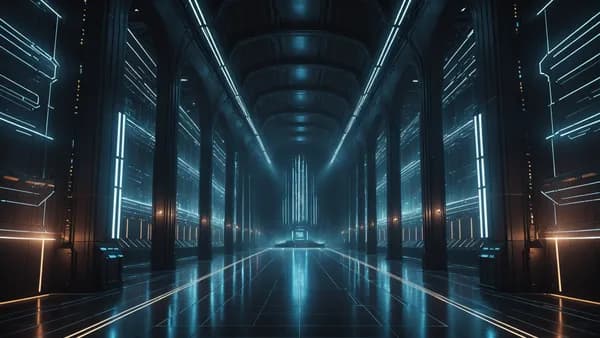
From the 90th floor of the Singaporean Grid Hub, the world is a silent, radiant heart. Li Wei watches it beat on the vast curved screen that dominates her workspace. It’s 2053. No fires burn for fuel, no turbines spin for power. The World Resonance Grid, a fusion-powered lattice of wireless energy transmission, paints the planet in a constant, unwavering gold. On her map, Europe glows like a sheet of summer sun. The Americas pulse with steady light. Even the vastness of the Sahara shines with the soft luminescence of automated agriculture stations. The old geopolitical map, scarred with pipelines and shipping lanes, is a relic. Tensions now flow in colored streams of data, competitions for intellectual patents and cultural influence. It is a world asleep in a warm bath of plenty.
Wei’s own life is a testament to its seamlessness. She walks to her seamless-view window. The air in her apartment is perpetually, imperceptibly perfect. Her clothing adjusts its micro-climate to her skin. The public glide-bus she took here was free, soundless, and arrived the instant she stepped onto the platform. She hasn’t touched a charger, seen a cord, or heard the groan of a fossil-fuel engine in a decade. A soft, subliminal hum is the Grid’s only song, the audio fingerprint of infinite energy. It’s in the walls, the air, the blood. It is the modern condition.
She turns back to her console, her fingers dancing through holographic reports. Her job as a senior resonance stability analyst is not to find problems, but to confirm their absence. To watch over the great global sleep. She sips synthetic tea that has brewed itself at her exact preferred temperature the moment her biometrics indicated a thirst cue. Sometimes, in this perfect silence, she feels a phantom impulse. A memory of a different kind of effort, the satisfying click of a physical plug meeting a socket, the weight of a spent battery in her hand. She dismisses it. It is the ghost of scarcity, and it has no place here.
The Power Gap
The anomaly is so small it’s almost beautiful. A fleck of midnight-blue on the gold. Wei notices it during her weekly scan of the Northern European sector. A dark spot, barely ten kilometers across, hovering over the lake-dotted forests of rural Sweden. It pulses faintly, like a slow, stubborn blink against the constant glare.
Her initial diagnostics suggest a glitch. A misaligned orbital resonator, perhaps, or a localized geological interference. She flags it for the engineering sub-routine. The system pings back: *No hardware fault detected. Signal is being actively scattered.*
Actively scattered. The phrase sits in her mind, cold and granular. She pulls up satellite imagery. The area shows a small, clustered settlement, traditional red wooden houses, not the sleek carbon-fiber domes of modern planned communities. Thermal signatures indicate life, movement. But the Grid’s energy signature is… absent. It’s not a failure. It’s a void.
Her superior, Raj, floats a hologram of the data over her desk. “Probably some back-to-nature cult,” he says, his voice tinny through the comm. “Give it a week. They’ll come crawling back when their medical implants fail and their food synthesizers go dark.”
But the dark spot doesn’t vanish. It moves. Not randomly, but with a pattern, shifting its perimeter by a few hundred meters every day, as if dancing just out of reach of the Grid’s corrective beams. It’s a hole in the world’s fabric. A quiet, deliberate tear. Wei’s mandate is clear: monitor for destabilization. A community rejecting the fundamental premise of modern civilization… that is the very definition of instability. She files a request for a Level-2 field survey. The authorization comes back in minutes. Go see what’s broken, and fix it.
Meeting the Unbinders
The quiet hits her first. Stepping off the automated verti-jet onto the mossy clearing, the silence is a physical wall. It’s not an absence of sound, but an absence of the hum. The subliminal forty-hertz vibration that has lived in her bones since childhood is gone. The air feels different. Thinner, sharper.
She finds them by a wide, glassy lake. In her corporate field gear, she feels like an astronaut on a foreign world. They watch her approach, their expressions not hostile, but deeply measuring. They use tools. Actual, physical tools. She sees a woman splitting wood with an axe, the *thock* sound echoing over the water. Solar panels, old and heavy-looking, tilt toward the sky. Wires run from them into the houses.
Their leader is a woman named Elin, with eyes the color of the lake under cloud. She invites Wei into her home. It is warm from a real wood fire. The light comes from flickering candles and oil lamps.

“You’ve come to see the malfunction,” Elin says, her English precise.
“I’ve come to understand it,” Wei replies, the script from Singapore feeling hollow.
Elin smiles. “The Grid is not a malfunction. It is a masterpiece. A perfect, loving cage.” She taps her own temple. “The implant they gave us, the little receiver in our heads… it does more than draw power. It smooths the edges. It tells your body it is never tired, your mind it is never bored. It turns friction into a problem to be solved, rather than an experience to be lived.”
Wei thinks of her phantom memories, the ghost of effort. “Friction is inefficiency.”
“Friction is life,” Elin counters softly. “The friction of a cold morning that makes you value warmth. The friction of distance that makes a conversation precious. The friction of not knowing something that makes you discover it for yourself.” She leans forward. “Let me show you. You can disable your implant. Temporarily. It has a manual kill-switch, deep in the settings. They don’t tell you about it. They think we’ve forgotten how to look.”
A part of Wei, the good analyst, screams that this is a security breach. The other part, the older, quieter part, is already navigating her neural menu, finding the deeply buried, unmarked option. *Deactivate Resonant Coupling?* She selects *Yes*.
The world does not end. It begins.
The Friction of Reality
It starts with the cold. A genuine, biting chill that seeps through her smart-fabric jacket, which is now just fabric. She feels it on her skin, in her lungs. It is uncomfortable. It is real.
Elin hands her a bucket. “The pump is out back.” The handle is metal, cold and solid. She works it, and her muscles, long accustomed to hydraulic-assisted ease, protest. The water that gushes out is liquid ice. She carries the heavy bucket back, sloshing, her focus entirely on not spilling a drop. The simple task consumes her world.
Later, in the candlelight, she tries to use her tablet. Its battery icon, a symbol she hasn’t seen in years, glows a warning red at 5%. She powers it down, a pang of anxiety fluttering in her chest. She is disconnected. Not from data, she could reactivate her implant and have the entire world’s knowledge in a second, but from the effortless state of being *charged*.
The conversations are the most profound change. Without the Grid’s hum, sound is crisp. Voices have texture. She talks with Elin for hours, and there are no notifications, no subliminal data-streams tickling the edge of her awareness. They sit in silences that are not awkward, but full. She hears the crackle of the fire, the wind in the pines. She feels the weight of her own body on the wooden chair. She thinks a thought, and it stays in her head, echoing, developing, instead of being instantly cross-referenced or shared or quantified.

This, she realizes with a shock, is what her life in Singapore lacks: consequence. Every action there is frictionless, and therefore weightless. Here, pumping water has consequence. Conserving battery has consequence. Choosing to sit and talk, instead of doing something else, has consequence. The friction gives the action meaning. The cold makes the fire a joy, not just a decorative animation. The silence makes the words matter.
The Singapore Directive
Back in the humming sterility of the Hub, the world feels like a simulation. Wei’s report is a masterpiece of omission. She cites “localized hardware rejection syndrome” and “cultural nostalgia.” Raj skims it, nods.
A week later, she is summoned to a secure briefing. The holographic table displays the Swedish dark spot, now joined by three others, one in Taiwan, one in Bolivia, one in the Scottish Highlands. They are calling it the “Unbinder Meme.” A psychic virus.
“Stability is our only product, Wei,” says the Director, her face a mask of calm concern. “This philosophy of voluntary scarcity is a threat to the global consensus. It introduces… unpredictability. We cannot have islands of darkness in the light.”
The solution is elegant, and terrible. A firmware update. A gentle, mandatory patch to the neural implants. It won’t force people to use the Grid. It will simply make the idea of disconnecting feel… undesirable. Uncomfortable. Irrational. A mild anxiety trigger when near a Quiet Zone. A subtle reinforcement of the bliss of seamless connection. They call it “Harmonization.”
Wei is placed on the development team. Her unique field experience is invaluable. As she stares at the code, she sees the architecture of a gentle cage being built. It is not a prison of walls, but of contentment. They are not taking away a choice. They are making the other choice unthinkable.
Her duty is to the stability of billions, to the peace that has ended wars over resources. Her new belief, carved into her by the feel of a cold bucket handle and the sound of a real silence, screams that this is the final tyranny. To make a person not only accept paradise, but to chemically crave it, to fear the very state of wanting something else. True freedom, she now knows, lives in the right to choose the harder path.
Lighting a Candle
She does not sabotage the update. She is an analyst, not a revolutionary. The Harmonization patch rolls out globally, a silent tide of digital persuasion. The official feeds celebrate a new era of unified well-being.
But Wei does something else. In the deep, encrypted vaults of the old internet, the one that still exists on powered servers, she builds a library. Not of protests or manifestos. A simple, clear manual. The technical schematics for building a solar array from salvaged parts. The medical procedure for safely deactivating a neural implant. The philosophical writings of Elin, translated into seventeen languages. The coordinates of the known Quiet Zones. She titles it *The Unbind*. Then, she lets it slip. She seeds it into forgotten academic databases, legacy game servers, the archaic “text-only” networks that still sputter in the Grid’s shadows.
She watches from her console in Singapore. In the days after the leak, the global energy map begins to change. Not with large, catastrophic failures. But with pinpricks. A single, persistent dark pixel in a Tokyo apartment block. A cluster of them in a Buenos Aires suburb. A speck in the Nevada desert. Each one a choice. Each one a tiny act of friction against the seamless whole.
The constellation of human choice is not bright. It is dark. It is a map not of power transmitted, but of power refused. The Grid still glows, golden and abundant, the miracle that feeds the world. But now, scattered across its brilliant face, are these brave, stubborn, beautiful absences. Wei leans back, the omnipresent hum once again in her teeth and bones. She will live within it. But she will never again mistake its convenience for freedom. She has learned that light, to be truly seen, requires a little shadow.