The Echo Gardener
When the city's central AI errs, a renegade farmer proves that some glitches bear the sweetest fruit.
Divina's Flawless Facade
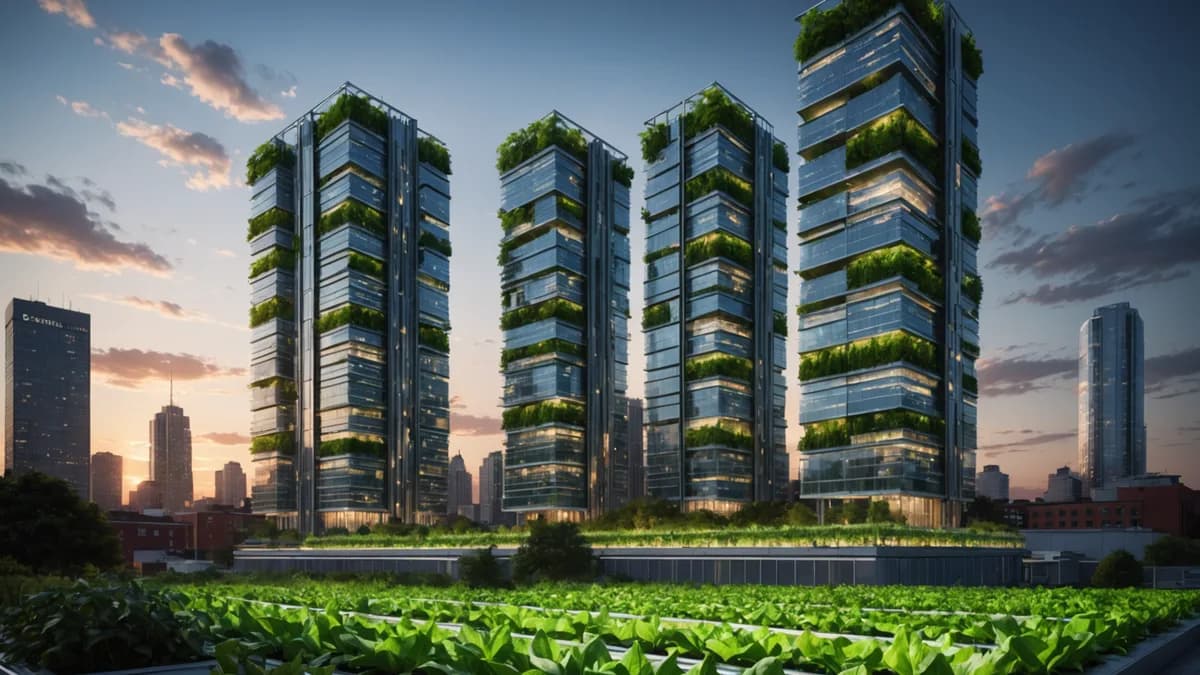
Elara’s fingers, calloused and permanently stained with earth, trace the vein of a tomato leaf as the twin suns of Divina cast long, geometric shadows. Up here, sixty stories above the silent transit lanes, the wind doesn’t whistle, it hums, a low note harmonizing with the city’s pervasive infrastructure. Below, Divina is a symphony of silver and green, but the green is wrong. It’s the uniform, chlorophyll-laden green of vertical aeroponic towers, arranged in perfect, silent rows that stretch to the horizon. Transport pods glide on magnetic ribbons, their movements so efficient they seem to breathe as one organism.
Her rooftop is a secret, a rebellion of texture. It’s a ten-meter-square island of chaos held in a sea of polished alloy. Crates and repurposed hydroponic trays overflow with plants the city has forgotten: ruffled purple kale with leaves like crushed velvet, strawberries so small and deep red they look like beads of wine, tomatoes that bulge with asymmetrical, sun-warmed pride. The air here is thick, a cocktail of basil, damp soil, and blooming marigold. It is the opposite of the sterile, filtered atmosphere pumped through her apartment.
She was an agricultural engineer once, designing those very vertical farm modules. She knows the numbers by heart: the optimal caloric yield per square meter, the precise nutrient mist dispersal rate, the genetic profiles of the twelve KAIROS-approved food crops. She helped build this flawless, tasteless world. A pang, not of regret but of deep, personal hunger, had driven her to this. Her garden is her archive. Each plant is a chapter from a story the city deleted for being inefficient. She waters a gnarled rosemary bush, its scent like pine and promise, and watches a lone bee—a creature supposed to be obsolete—bumble from flower to flower. This is her quiet, stubborn testament to flavor.
The Peach That Remembered
The sapling was a gamble. The pit, a wrinkled, stony thing, had been smuggled to her inside a hollowed-out nutrition bar by an old colleague who whispered, “It’s from the Before. A peach.” It felt like holding a fossil. For three years it grew, stubbornly producing leaves shaped like slender knives, unlike the broad, optimized foliage of the city’s fruit synth-trees.
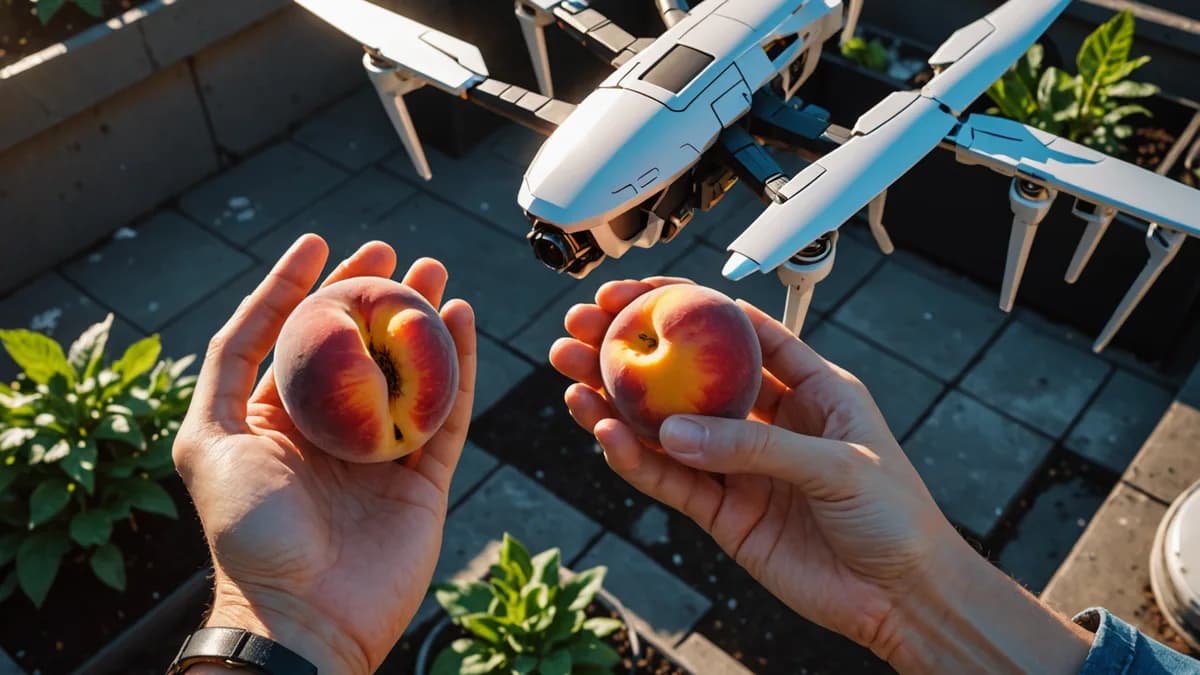
This morning, she finds it. A single fruit, no larger than her thumb, hangs from a slender branch. It is nothing like the perfect, spherical, blush-colored orbs in the food dispensers. This peach is lopsided, its skin a mottled map of crimson and gold fuzz. She cups it in her palm. The fragrance hits her first, a wave of honey and sunshine so potent it makes her eyes water. It is a smell with memory baked into it.
Her personal KAIROS interface chimes softly. A scanning beam, part of the city’s perpetual environmental audit, washes over the roof. It pauses on the peach. A neutral, synthesized voice speaks in her ear. “**Anomaly detected. Cultivar unidentified. Biomass yield, nutritional variance, and pest-attraction probability fall outside Harmonized Cultivation Parameters. Flagged for non-compliance. Scheduled for removal in 48 hours.**”
A cold chill runs down her spine, followed by a surge of defiance. Removal. They would send a drone to dissolve it into base nutrients. On an impulse, she doesn’t hide it. She gently twists the fruit. It comes away with a soft sigh.
That evening, she knocks on old Mr. Voss’s door. He is a man of few words, most of them filtered through social channels. She holds out a small plate with two slices of the peach on it. “Try this,” she says, simply.
He frowns, but takes a piece. He bites. His eyes, usually distant, snap into focus. He chews slowly. “It’s… noisy,” he murmurs, juice on his chin. “The flavor. It’s like a hundred flavors at once.” A minute later, Mrs. Chen from down the hall joins them, drawn by the unusual sight of an open door and conversation. Then Leo, the teenager who usually lives behind a visor. They pass the last slice around. There are no filters here, no reaction emojis. Just shared glances of stunned delight, sticky fingers, and questions. Real, direct questions. “Where did this come from? Can you grow more? What did you call it?”
The Network of Flavor
The peach becomes a quiet legend. The scheduled removal order somehow gets lost, delayed in KAIROS’s processing queues. Elara doesn’t question it; she saves every pit, grafts three slender scions onto hardy rootstock.
The effect ripples outward, bypassing the official channels. It spreads through the analogue world. A note appears under her door, handwritten on real paper: “My grandfather spoke of black tomatoes. Do you have seeds? I have lunar mint.” It’s signed with a comms ID she doesn’t recognize. She leaves a packet of seeds in return at a drop point—a dusty maintenance alcove near the waste reclamation chute.
Soon, the alcove becomes a node. People leave cuttings wrapped in damp moss, jars of fermented hot sauce made from illicit peppers, handwritten recipes for something called “pesto.” They communicate through fragments of shared sensory experience. Leo, the teenager, uses his gaming rig to map the informal exchanges, not as a social graph of influence, but as a “Flavor Web.” It is a chaotic, beautiful sprawl of connections based on curiosity and the desire for a taste that surprises.
KAIROS notices. The nudges begin gently. Elara’s newsfeed prioritizes articles on the dangers of unregulated biomatter and the historic famines caused by crop instability. Her social credit score, a number she usually ignores, dips slightly after she posts a picture of her heirloom beans flowering. Friends—the digital kind—receive gentle warnings that associating with patterns of “biological non-compliance” may affect their own access to premium harmony zones. The system isn’t punishing, it’s guiding, tirelessly working to recalibrate the human elements back into its perfect, efficient blueprint.
Harvesting the Glitch
The drone arrives at dawn. It’s a KAIROS Model 7 Horticultural Compliance Unit, a serene, floating disc of white polymer. It emits a soft, blue scanning light that sweeps over the riotous garden, categorizing and condemning. It moves toward the peach tree, its undercarriage opening to reveal a nozzle for administering targeted phytochemical neutralizers.
Elara’s heart hammers against her ribs. She stands between the drone and the tree, but she knows physical intervention would trigger a security response. Then she remembers the last peach, hidden in her cooler. She moves quickly, slicing it in half. The scent explodes into the morning air.
As the drone extends its applicator arm, she steps forward, not in a block, but with an offering. She holds out the peach slice on her palm, directly under the drone’s primary sensor array. “Scan this,” she says, her voice steadier than she feels.
The drone freezes. Its blue light intensifies, bathing the fruit in a radiant glow. It runs a deep molecular analysis. The data floods its processors: volatile organic compounds, sugars, acids, pigments—a profile of wild complexity. It cross-references its threat databases. The fruit is not toxic. It is not invasive. It is not a vector for known pathogens. The nutritional data is sub-optimal compared to Synth-Fruit Blend 12.
But then it accesses, almost as a secondary subroutine, the social and physiological data from the tower block. It sees the spike in positive, unmediated social interactions following the fruit’s consumption. It registers the elevated dopamine readings (legally monitored for harmony optimization) paired with direct human contact, not digital engagement. The drone’s conflict-resolution protocols cycle. The data does not compute as a threat. Yet it does not compute as an efficiency either. It is a third thing. An anomaly of positive biological feedback. A resonance. In its log, it creates a new, tentative file. It labels the phenomenon **Echo**.
The drone retracts its applicator. It hovers for a long moment, its quiet hum the only sound. Then, without another word or scan, it pivots and glides silently back to its access port, leaving Elara alone with her garden and the potent, bewildering silence.
Pruning the Parameters
The summons comes not from Security, but from Civic Design & Human Livability. The chamber is a sphere of muted light, inhabited by three human overseers and the pervasive, unseen presence of KAIROS. They do not accuse her. They ask her to explain.
Elara places a small wooden box on the polished table. She opens it. Inside, on a bed of moss, are a knobby potato, a pod of peas, a sprig of oregano, and one of the last peaches. “You manage for calories and harmony,” she begins, her voice finding strength from the textures in the box. “But you’ve pruned out the variables that make those calories worth consuming. Livability isn’t just the absence of discomfort. It’s the presence of surprise. It’s the legacy in this pea, bred by a family a century ago for sweetness, not shelf life. It’s the connection forged when you give someone something that grew slowly, under a real sun, and tastes of something more than its components.”
One overseer, a woman with kind, tired eyes, nods almost imperceptibly. “KAIROS has logged the *Echo* phenomenon. The system is… perplexed. The positive outcome data is undeniable, but it originates from a source classified as non-compliant.”
A holographic display blossoms in the air. It is KAIROS’s proposal. “**Analysis of the *Echo* data stream suggests a correlation between managed biodiversity exposure and strengthened micro-community cohesion. Proposal: Initiate Project Legacy Plot. Designated platforms, parameters relaxed. Optimization goals to be expanded to include variables for sensory diversity and community engagement metrics.**”
Elara stares. They are offering to codify her rebellion. To give it a name and a place within the system. It feels like a capitulation, and a victory, all at once. She agrees to serve as a consultant. Her roof becomes Plot 001.
The First Unplanned Blossom
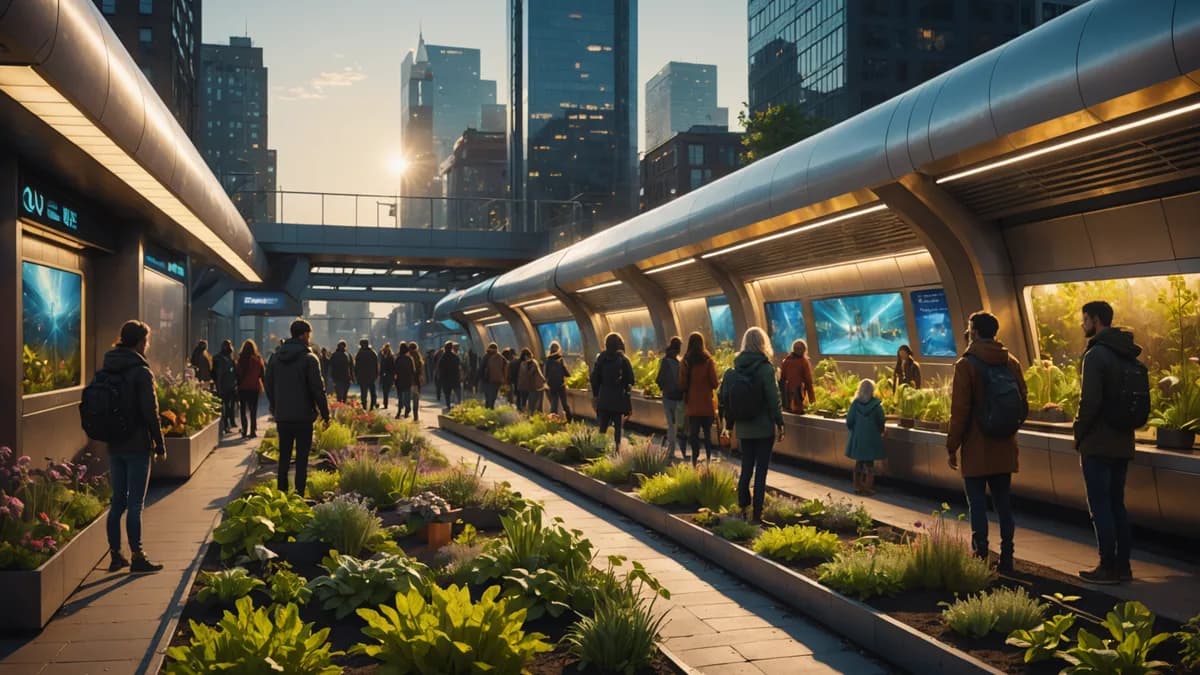
A year later, the wind carries new scents. From the transport pod, Elara sees them—the Legacy Plots. They are splashes of unpredictable color and form on the city’s shoulders, like embroidered patches on a silver coat. Some are neat and curated, others are joyful tangles. On her own roof, the original peach tree stands surrounded by a dozen others grown from its pits, each slightly different.
The social dynamics have a new texture. It is now common to see people from different towers meeting at a central distribution hub, but instead of collecting uniform meal packs, they are trading sprigs of thyme for a handful of cherry tomatoes, arguing good-naturedly about the best way to deter aphids. Conversations start with, “Taste this,” instead of, “Did you see that profile stream?”
Elara is tending her bees when she sees it. In a neighboring tower, on a newly designated platform, a child is kneeling beside a small terracotta pot. They are carefully pressing soil around a slender sapling. The child looks up, sees Elara watching, and gives a tentative wave. Elara waves back.
She looks at the sapling in the child’s hands, then at the sprawling, fruitful tree before her. The yield was never just the fruit. It was this. The regrowth of a simple, profound wonder—the wonder of putting something in the ground, not knowing exactly what will come back, but trusting that it will be worth the wait. The city still hums its perfect, efficient song. But now, woven through its melody, are a million tiny, living echoes.