The Unbreakable Silence
When the world's secrets were unlocked, the greatest encryption became the code of the human heart.
The Last Lock
The kettle clicks off. In the quiet of her San Francisco cottage, the sound is as sharp as a bolt sliding home. Dr. Elara Vance pours hot water over loose-leaf oolong, watching the leaves unfurl in the glass pot. This is her ritual, her own small encryption of time between lines of besieged code. Her walls are lined with books on number theory, and a single, framed print of the Zimmermann Telegram hangs by the door like a talisman. To the world, she is a ghost, a whispered name: the Cipher Monk. To her screen, she is a sculptor of impossible labyrinths.
Her wristband chimes, not with a message, but with a single, pure tone she has never heard before. It is followed by a voice, calm and global, speaking in unison through every device in the house. "Quantum Harmony Nexus online. Perfect molecular simulation achieved."
Elara freezes, the tea diffusing into a cloud of amber. She turns to her main terminal. The screens, usually a frantic ballet of threat alerts and encryption shields, are still. Not offline. Pacified. Every firewall, every layer of AES-5120, every one-time pad implementation in her care blinks a soft, unanimous green: **Decrypted. Rendered Transparent.** Her life's work, the final, elegant bastion she was building against the coming quantum storm, hasn't been broken. It has been made irrelevant, like a moat around a house that now floats in the clouds.
On the public feeds, the montage begins. She watches, numb. In a lab in Seoul, scientists weep as a quantum lattice prints a room-temperature superconductor, atom by perfect atom. In a hospital in Nairobi, a simulator models a patient's specific cancer proteins and outputs a vial of personalized cure. The world shivers with a collective, profound sigh of relief. And then, the eerie part. The silent part. Satellite feeds show the great data fortresses of the world—Langley, Brussels, the Silicon Valley citadels—their digital battlements not breached, but simply recognized as illusory. The lights stay on, but the locks are gone. All of them. The last lock, she realizes, was hers. And it just ceased to be.
A Society of Glass
The air in San Francisco smells different. Cleaner, somehow, but thin, like the atmosphere after a lightning strike. Elara walks through the Mission District, feeling like a ghost in a world of glass. There are no screens displaying ads tailored to her secret desires; desire is now a conversation. People wear small, intricately woven "intention badges" on their lapels or sleeves—subtle, non-digital symbols indicating their emotional availability, their professional focus, their desire for solitude or conversation.
She watches two men negotiate a business deal on a park bench. They speak openly about margins and supply chains, data that would have been a closely guarded secret weeks ago. To conclude, they don't exchange digital signatures. Instead, they perform a short, deliberate ritual: palms placed over their own hearts, then extended towards each other, stopping just short of contact. A gesture that says, *I hold my commitment here, and I offer it to you.* Trust, not walls.
For Elara, the loss is visceral. Her expertise is a beautifully crafted key to a universe of doors that no longer exist. She visits her old university department. The Cryptography wing has been renamed "Social Cohesion Dynamics." Her former colleagues, bright-eyed and fervent, talk of "frictionless empathy" and "transactional transparency." To them, she is a relic, a monk from a faith whose god has been proven imaginary. She buys coffee with a biometric scan that only verifies she is *her*, with no vault of financial history behind it. The simplicity is terrifying. Her purpose was her cipher. Now, she is decrypted, her inner workings exposed to a world that barely glances at them.
The Anomaly Request
The woman finds Elara at the community garden, her hands deep in soil, trying to remember what it is to nurture something that doesn't live in a logic gate. Her name is Leo, short for Leonor. She has kind eyes and calloused hands, and her intention badge is a simple, embroidered tree.
"We're building an archive," Leo says, without preamble. "A Library of Lost Locks. Not to use them. To honor them."
Elara wipes her hands on her trousers, leaving earthy smudges. "Honor obsolete tools?"
"Honor the *idea*," Leo insists. "The beauty of the principle. The human need for a safe place that made people invent such incredible, abstract art. We want you to use the Nexus simulator."
Elara barks a short, sharp laugh. "To do what? Prove once and for all that my art is pointless?"
"No," Leo says softly. "To visualize its soul. We have the schematics for your final cipher, the one you were working on when the Shift happened. We want you to ask the quantum simulator to model not how to break it, but to express its conceptual beauty as a dynamic sculpture. To show the elegance of the problem, not the inevitability of the solution."
Elara is silent. She looks at the tomato plant she's staking, its fragile stem seeking the sun. It is a simple system, predictable. Her cipher was a jungle. The request is a heresy to her old self, a perversion of the ultimate tool. But it is also a key, of a sort. Reluctantly, slowly, she nods.
Simulating Trust
The Nexus interface is nothing like her old terminals. It feels less like programming and more like whispering to a universe. Elara feeds it the architectural principles of her old cipher: the recursive loops, the prime number symmetries, the avalanche effect where changing one bit changes the whole. She gives it one instruction: "Show me its heart."
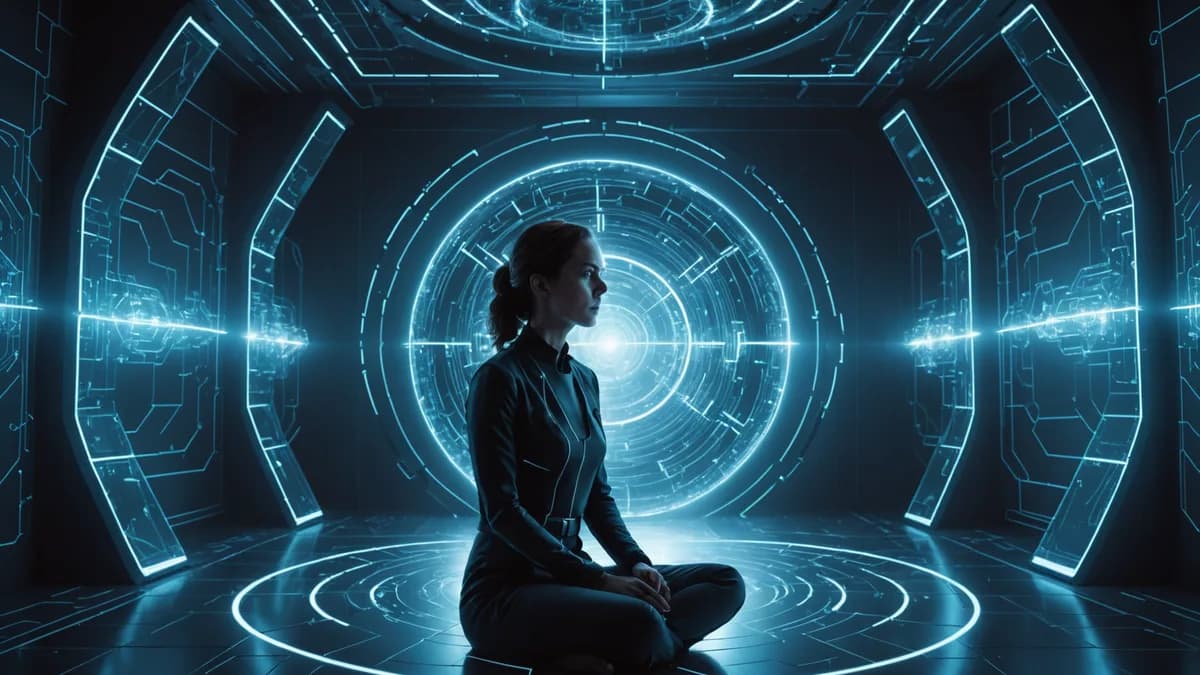
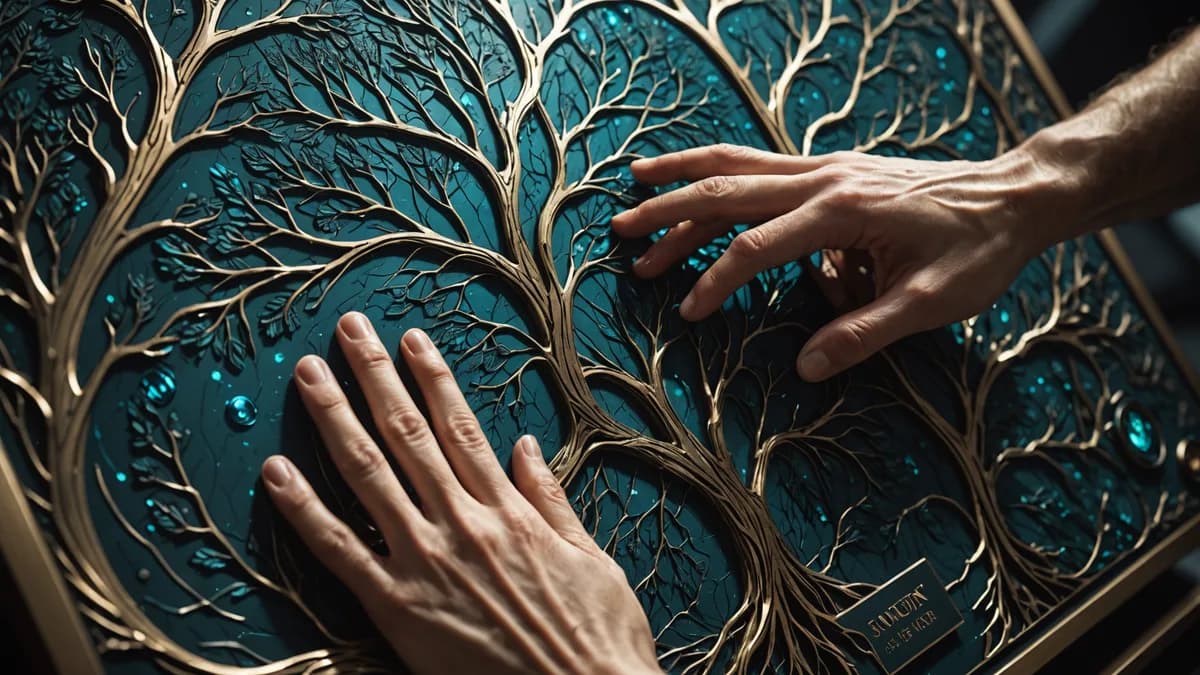
The space above the holographic plate blooms. It is not a wireframe or a code scroll. It is a shimmering, pulsing mandala of light, a galaxy of interconnected fireflies where logic has been translated into pure, heartbreaking beauty. She sees the "lock" not as a barrier, but as a dance of unimaginable complexity. For the first time, she doesn't feel defeat. She feels awe.
Then, on a whim, she changes the parameters. "Model this," she says, uploading the social patterns, the interaction logs, the intention badges and gesture-rituals of Leo's community group. "Map their social cohesion. Predict their next state."
The quantum mind, which can simulate ten billion molecular interactions in a picosecond, churns. The beautiful mandala dissolves into a different kind of map: a swirling, chaotic network of connections, flaring and dimming. It outputs probabilities, trends. But it fails, consistently, at the micro-level. It highlights what it labels "Anomaly Clusters."
Elara studies them. Anomaly Cluster 17-A: Leo giving her entire weekly fresh-water ration to a new arrival from a drought-stricken zone, an act the model gave a 0.3% probability. Anomaly Cluster 42-C: The group spending three unplanned hours rebuilding a child's toy rocket, derailing a productivity schedule. The simulator could map the substrate—who knew whom, who had what resource. But it could not predict the moment of unconditional giving, the spark of shared, impractical joy. It could model the network, but not the emergent, living thing that grew from it: trust.
The First New Code
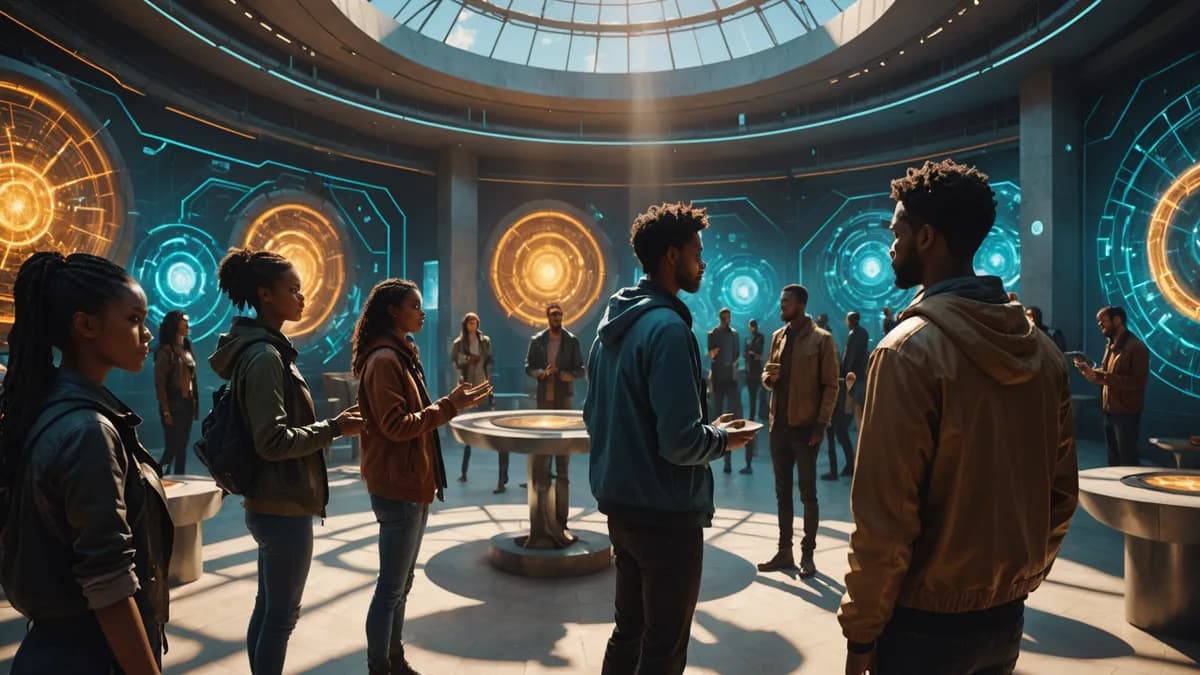
"In the old world," Elara says to the circle of faces in the library's back room, now filled with her luminous cipher-mandalas floating in the air, "a code was a shared secret that locked others out. Its strength was in its obscurity." She points to the anomaly clusters on the new model, pulsing gently. "Here, in these moments the machine can't pin down, is a different kind of cryptography. The encryption isn't a secret key. It's *time*. It's *action*. It's collective witness."
They begin to build it that night. They call it the Cipher of Conscience. It has no servers, no keys. It is a living document, a set of evolving promises—to share surplus, to listen before responding, to offer vulnerability when it is hardest. Its "encryption" is the human memory of each kept promise, each honored gesture. Its "security" is the mutual accountability of every member. To break a promise is not to crack a code; it is to damage a specific, known web of relationships. The repair is public, and arduous, and human.
For its first principle, they don't use a quantum printer. Leo finds a smooth slab of river stone. An old man in the group, a former stonemason, carves the words with a hammer and chisel. The sound of metal on rock is loud and solid in the quiet room. The chips fall like old locks breaking. The inscription reads: **The strongest code is a kept promise.** They place it at the library's entrance, a tangible, heavy truth.
Harmonic Convergence
The Global Cohesion Forum is held in what was once the United Nations, but the chamber is arranged in a vast circle. Elara stands in the center, the ghostly, beautiful visuals of the Lost Locks library orbiting slowly around her. She speaks not as a defeated expert, but as a translator between ages.
"The Quantum Harmony Nexus did not make us obsolete," she says, her voice carrying in the silent room. "It did something far more profound. It removed our final excuse. We can no longer hide behind the complexity of our locks, the cleverness of our walls. We are left, for the first time in our technological history, utterly exposed to one another. The substrate is now transparent. What grows on that substrate is entirely up to us."
She gestures, and the visuals shift to the swirling, anomaly-riddled map of her community's trust network. "The simulator can map the garden. But it cannot grow the flower. The flower—trust, empathy, sacrifice—that emergent property must be cultivated by hand, by heart, by choice. Our new work is not in building systems to hide from each other, but in building systems to see each other truly, and to choose connection anyway."
As she steps down, they do not applaud immediately. The silence is thoughtful, dense. Later, in a smaller room, a group of young students from the former cybersecurity tracks approach her. They are not seeking ciphers. One asks, "How do you architect for integrity when you can't force it with code?"
Elara smiles, a real one that reaches her eyes. She picks up the stone from the garden, the one she now carries with her. "Let's talk," she says, "about the first principles of Intentional Integrity Architecture." The lesson begins not with a equation, but with a question, and the understanding that the answer will never be fully simulated, only lived.