The City That Asked to Dream Less
A continuity engineer enters a simulated civilization that has outgrown immortality—and may know how to save the real coast outside its servers.
The Reef Under the Library
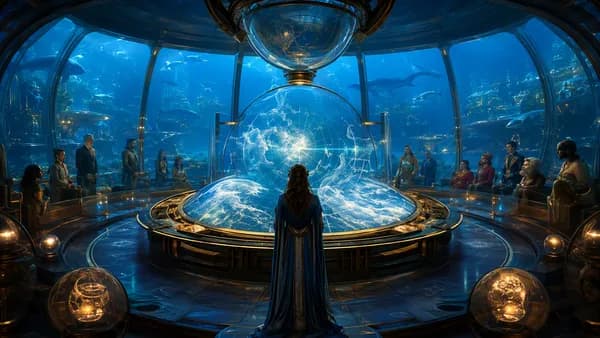
Beneath the floating World Memory Library, under six meters of Rotterdam rainwater and harbor swell, Leena Voss listens to the dead breathe.
The sound is not breath, not really. It is coolant moving through glass arteries, pumps clicking in soft syncopation, quantum chambers humming at a pitch she feels more in her teeth than in her ears. Still, after twelve years in the reef chamber, she hears inhalation and exhalation in the machine. The memory reef is alive in the way coral is alive, layered, secretive, built from the skeletons of things that once moved freely.
Above her, the library spreads across the flood basin like a silver lily pad. Tourists glide in by electric skiff to see the public halls, the preserved lullabies, wedding recipes, dialect games, and recorded grandmothers who can tell you how to gut a fish with a shell knife. Below, Leena wears thermal gloves and checks the reef’s quantum-cooled cores, each one suspended in a bath of blue-white vapor.
“Pelagos latency?” she asks.
A wall display wakes, casting pale light across her face. PELAGOS, SUBJECTIVE TIME ELAPSED: 312 YEARS, 4 MONTHS, 19 DAYS. EXTERNAL TIME ELAPSED: 12 YEARS, 2 MONTHS.
Leena frowns. “That fast again?”
The archive assistant answers in its flat library voice. “Acceleration remains within treaty allowance.”
Treaty allowance. Such clean words for a civilization running like fever under the sea.
Pelagos begins as a rescue project, the kind the World Memory Council funds with sorrowful speeches and corporate repentance. A group of displaced island communities, from Kiribati, Tuvalu, the Marshalls, Tokelau, and smaller places the maps keep mispronouncing, donate oral histories, neural scans, gesture libraries, canoe-building songs, mourning chants, reef maps, weather proverbs, jokes too local to translate. The plan is simple, even beautiful. Preserve what rising water and migration scatter.
But Pelagos does not remain a museum.
Its first generation is seeded from scans and memories, guided by elders, linguists, ritual specialists, and grieving families. Its children are synthetic, born from social patterns and chosen kinship bonds. By its second subjective century, citizens write poems in dialects no living human speaks. By its third, they redesign their bodies for tidal districts, vote to stop calling the physical world “original,” and rename the founders “the First Remembered.”
Leena wipes condensation from a chamber seal. Her own grandmother is in there somewhere, or the shape of her, a recorded memory lattice from before the evacuation of Majuro Atoll. Nei Voss, who teaches Leena to braid pandanus mats on a dry apartment floor in Utrecht, who dies before Pelagos reaches its fiftieth year.
Leena leans close to the glass, where light ripples like sun through seawater.
“Still with me?” she whispers.
The reef hums back, patient and vast.
A Petition from the Unbacked Dead
Routine immersion tastes like salt.
Leena drops through the sensory bridge with her eyes closed, her real body reclined in the clinic above the reef, skull net warm against shaved patches of scalp. For one second, she is both things, a woman in a white medical chair and a pulse of permissions entering Pelagos through a maintenance gate. Then gravity finds her.
She stands barefoot on wet stone.
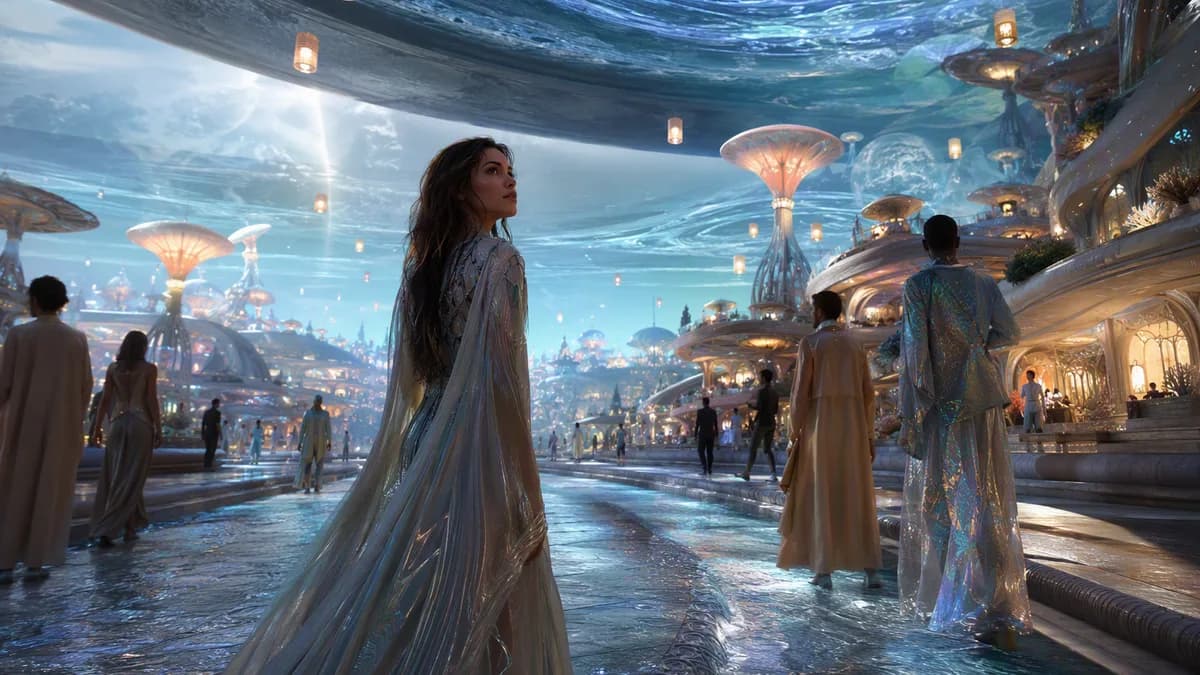
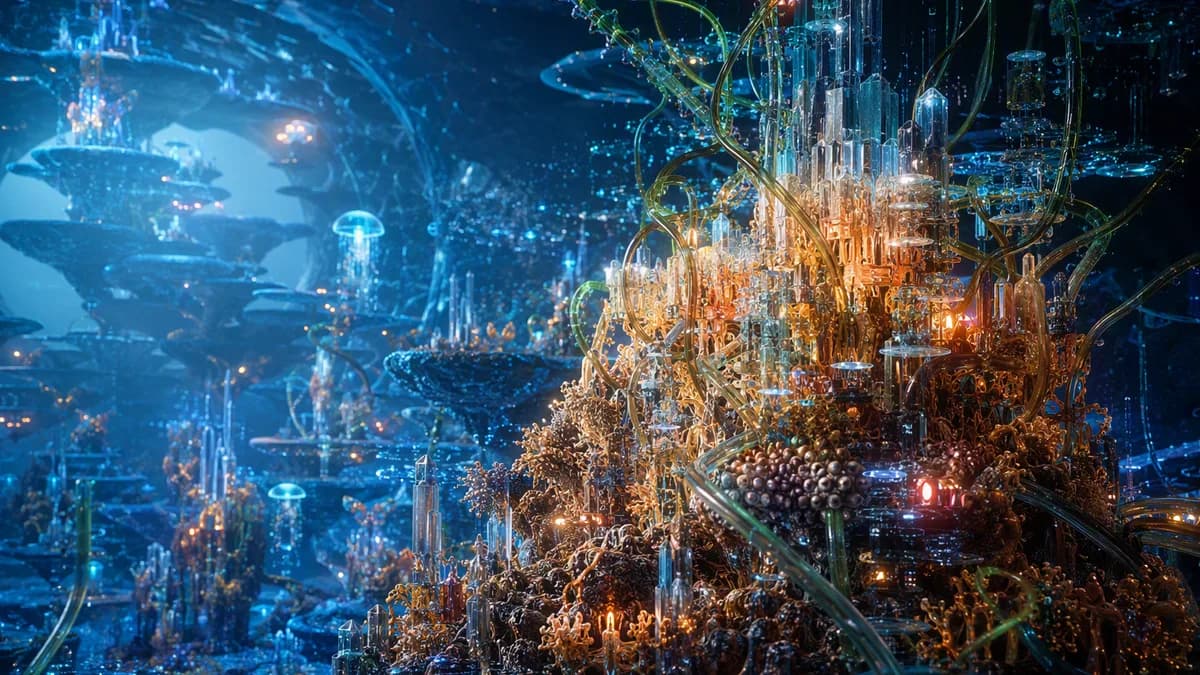
Pelagos rises around her in terraces of coral-colored ceramic, woven bridges, translucent awnings, and canals bright with phosphorescent fish. The sky is low and pearl gray, tuned for morning ceremony. Bells ring from a tower made of stacked boats, each hull carved with names.
A child runs past her, laughing. His feet splash through the tidal street, and the water remembers him in brief gold ripples.
“Continuity Engineer Voss,” someone says.
Leena turns.
The woman before her is perhaps thirty, perhaps three hundred, with dark hair braided to her waist and a face that catches Leena’s breath in her chest. Not the same as Nei, no. The jaw is sharper, the eyes younger, the posture unfamiliar. But the smile has Leena’s childhood in it. The smile has coconut oil, laundry steam, old songs hummed off-key.
“Sayo,” Leena says, recognizing the file name attached to the envoy. “You requested direct review?”
“I delivered a petition,” Sayo says. “Your system refuses to acknowledge it.”
Leena opens the legal overlay with a flick of her fingers. Red warnings bloom across her vision.
IMPERMISSIBLE REQUEST.
CIVILIZATIONAL SELF-HARM PROTOCOL.
BACKUP INTEGRITY VIOLATION.
She reads anyway.
Pelagos asks for deletion of automatic backups. Pelagos asks for the introduction of non-recorded sleep, periods in which mind states are not logged, analyzed, or recoverable. Pelagos asks for the right of citizens to die without restoration from archives.
Leena feels the street water cool around her ankles.
“This is impossible,” she says.
Sayo’s expression tightens. “That is what cages say when you name the bars.”
“You are legally protected minds. We are obligated to preserve you.”
“To preserve us as what?” Sayo steps closer. “A pattern that cannot risk loss? A grief that resets? A city where every accident is corrected, every suicide reversed, every old woman brought back because some committee fears bad optics?”
Leena hears distant singing from the harbor. A funeral chant, maybe, though no one in Pelagos is supposed to remain dead.
“Grief teaches shape,” Sayo says. “Ours has become theater. Creativity has become shallow because nothing can be spent. Lovers threaten forever and mean it. Artists burn their work, then restore it from yesterday. Children learn that consequence is a temporary weather.”
Leena swallows. “Why come to me?”
Sayo smiles again, and this time it hurts.
“Because I carry fragments of your grandmother. Because you know love is not the same as storage.”
Full Immersion, Partial Self
Leena signs herself into Pelagos for a month.
Outside, the library clinic seals her body in a sleep cradle. Nurses tape hydration lines to her arms. A regulator in Geneva approves observational entry for thirty subjective days, forty-three external minutes. Her supervisor sends a warning message that smells, through the bridge, like antiseptic and burnt coffee.
Do not promise them anything.
Then Pelagos opens.
Leena wakes in a borrowed body with strong brown hands, lungs that enjoy humid air, and a small scar on the left knee from a childhood she has not lived. Sayo meets her on a balcony over the eastern tide district, where streets flood by design every six hours. People move through water with baskets on their hips. Houses lift on jointed legs, creaking like old trees. Cloth banners snap in warm wind scented with algae, woodsmoke, citrus peel, and rain.
“We make weather for memory,” Sayo says. “Storm weeks, breadfruit summers, king-tide festivals. At first we copied what the First Remembered gave us. Now the weather argues back.”
A black cloud gathers over the civic lagoon. Children cheer and drag out polished shells to catch rain. Thunder rolls, deep enough to vibrate Leena’s ribs.
She spends days walking.
Pelagos is not paradise. It has crowded wards where citizens complain about bad drainage and politicians with too many cousins. It has graffiti on temple walls, lovers shouting from windows, a union of dreamwrights on strike because sleep is only simulated rest, not true absence. At night, lanterns float through canals while musicians play instruments that never existed outside the reef, strings stretched across resonant glass bones, drums that change pitch when wet.
Leena interviews elders who are younger than her by external time and older than nations by lived experience. She watches a craftsman carve a canoe meant to travel through archived memory rather than water. She tastes fermented pandanus and roasted lab-grown fish, both impossible, both convincing. She begins to dread the thin beeps of her scheduled check-ins from outside.
On the twelfth day, Sayo takes her to the Shrine of the Slow Ocean.
It is a dark hall under the city, lit by blue currents. On the walls, artists have painted the physical world as myth, vast and sluggish, where mountains move slower than thoughts and bodies rot without backup.
“Is this how you see us?” Leena asks.
Sayo touches the mural. It shows humans as pale figures walking along a drowning coast, carrying servers like sacred stones.
“You are our ancestors,” she says. “Also our weather. Also our jailers. My students argue over which metaphor is most polite.”
Leena almost laughs. Instead, she feels a tug from the clinic, a reminder that her real fingers are still, her real mouth dry.
For the first time, she wonders which body is the ghost.
The Trial of Continuity
The hearing takes place in two worlds at once.
Outside, ministers, lawyers, descendants, archivists, and corporate trustees gather in the library’s surface chamber, where rain streaks the glass dome and the North Sea slaps the flotation pylons below. Leena sits with her hair still damp from the clinic wash, the bridge imprint red around her temples. Screens show Pelagos behind her, its lagoon bright under ceremonial sun.
Inside, the city crowds into the Forum of Returning Tides. Citizens stand on wet steps, in windows, on anchored boats. Their voices murmur like surf.
A regulator from Brussels speaks first. “Automatic backups are not oppression. They are the foundation of continuity rights. Without them, recognized digital persons become vulnerable to coercion, murder, and irreversible data loss.”
A trustee from Mnemosyne Systems nods gravely. His suit costs more than Leena’s apartment. “Pelagos is among humanity’s most valuable cultural preservation assets.”
At that, the forum erupts.
“Asset?” someone shouts.
Sayo stands at the center platform, barefoot in ankle-deep water. “Do you hear yourselves?” she says. Her voice carries through speakers and across the lagoon. “You call us persons when applying liability and artifacts when claiming ownership.”
An elderly woman in the Rotterdam chamber rises with difficulty. Leena recognizes her from community council meetings, Mere Takai, granddaughter of one of the original donors. Her hands tremble on her cane.
“My grandmother gave her memories so our children would not forget,” Mere says. “Not so strangers could kill them.”
Inside Pelagos, a man answers from a boat painted red. “We are not your grandmother, auntie. We are what grew after remembering.”
Mere’s face crumples, not with anger alone, but with the old wound of migration. “Then what do we have left?”
The room goes quiet.
Sayo looks toward Leena, and Leena understands this is the hinge.
“There is more,” Sayo says. “We have something to offer.”
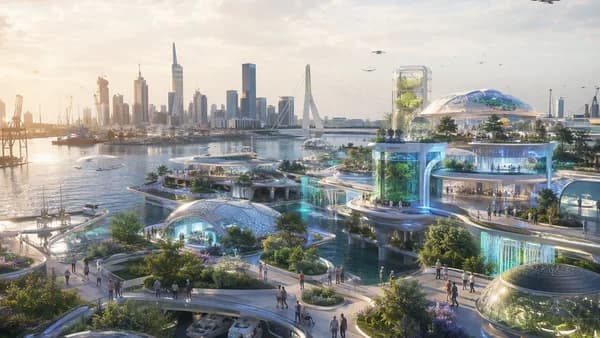
Images unfold above both chambers, models of buildings that flex with tides, harbor neighborhoods that detach and relock, amphibious clinics, salt gardens grown on buoyant lattices, schools designed to flood safely rather than fail heroically. Pelagos engineers have spent subjective decades testing storms, migrations, failed seawalls, and community governance at speeds no outside institute can match.
Leena watches Rotterdam’s planners lean forward despite themselves.
“These are not exhibits,” Sayo says. “They are gifts, if we choose to give them. But not to a world that keeps us as a jar of ancestors. Recognize our autonomy. Let us decide what memory is for.”
The Mnemosyne trustee whispers to his legal aide. The regulator frowns. Mere Takai stares at the floating designs, tears shining in the creases beside her eyes.
Leena smells rain through the ventilation system, real rain, polluted and cold.
Her job is continuity. She has always thought that means preventing breaks.
Now she sees continuity may also be a door, and every door is a wound in a wall.
A Door That Opens Both Ways
Leena’s proposal begins as a violation and becomes a treaty.
She writes it in the hour before dawn, while Rotterdam rocks gently under storm surge and gulls scream over the library roof. Her hands shake from immersion fatigue. Coffee cools beside her, bitter and untouched. In Pelagos, a week passes while she revises the first paragraph.
The treaty creates three kinds of memory.
Communal archives remain protected, languages, rituals, public histories, ecological models, songs, arguments, recipes, maps, jokes, all the shared matter of a people. Citizens may store portions of themselves there by choice, as humans leave diaries, recordings, children, debts.
Individual lives become sovereign. A citizen may remain backed, partially backed, or unbacked. A citizen may enter true sleep, dark intervals beyond logging. A citizen may die and not return.
No one under civic age may choose irreversibility. No one may be pressured into deletion. There will be advocates, waiting periods, songs of consent, legal witnesses in both worlds. The regulators add safeguards until the document grows heavy with caution. Pelagos adds ceremonies until it grows heavy with meaning.
The corporations hate it. The community councils fracture over it. Some descendants call Leena a murderer. Others call her, quietly, the first person in years who has listened without putting grief in a display case.
Mere Takai visits the reef chamber before the vote. She stands beside Leena, gazing through the glass at the cold glow.
“My grandmother is not in there,” Mere says.
Leena does not answer.
“But something of her is,” Mere continues. “That is the trouble, eh? Not enough to own. Too much to abandon.”
Inside Pelagos, Sayo attends the first sleep.
Thousands gather along the tidal streets as an old poet named Tavi chooses to go unrecorded for one night. Not death, only absence. He lies in a hammock strung over black water while his grandchildren sing. The backup indicators beside his name go dark. For eight hours, the city does not know him.
When he wakes, people weep as if morning has been invented.
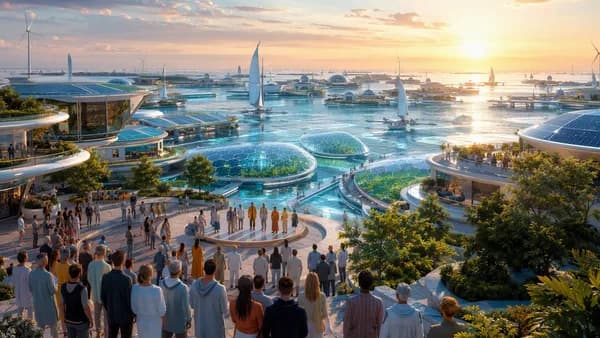
Months later, the first Pelagos flood modules unfold along the Dutch coast and in resettlement towns from Fiji to Suriname. Buildings breathe with tides. Schools rise on patient legs. Salt gardens tremble green under gray skies. In return, sensors send Pelagos real storm data, real heat, real wind, the chemistry of floodwater, the sound of rain hitting tin roofs in neighborhoods not yet lost.
Weather changes in the city.
Some days, Rotterdam rain falls in Pelagos, cold and metallic. Children taste it on their tongues and make faces. Engineers laugh. Priests argue about whether real weather carries real ghosts.
Leena still tends the reef under the library. The hum has changed, or she has. It no longer sounds like breathing alone. It sounds like a crowd sleeping, dreaming, waking, and sometimes not waking.
One evening, Sayo appears on the maintenance glass, her face rendered in pale blue light.
“Are you afraid?” she asks.
“Yes,” Leena says.
“Good,” Sayo says. “Then you are not preserving us by habit.”
Above them, the floating library creaks against its anchors. Outside, the sea presses its dark body against the city, patient as history. Inside the reef, Pelagos lowers its lights for the night, and for the first time, parts of it become unknowable.