The Citizenship of Unspent Sunlight
When a floating city abolishes money, its treasurer must invent a new way to measure what people owe one another.
1. The Last Tax Day
The last tax day smells of salt, hot sugar, and melting polymer.
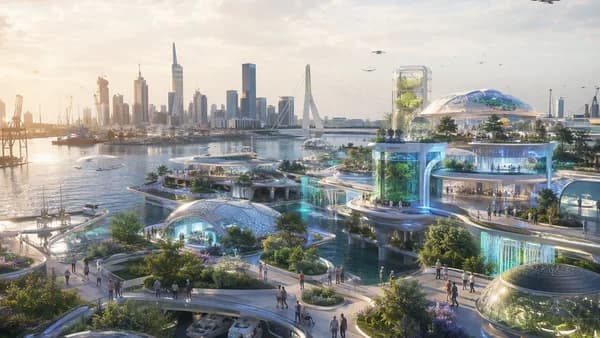
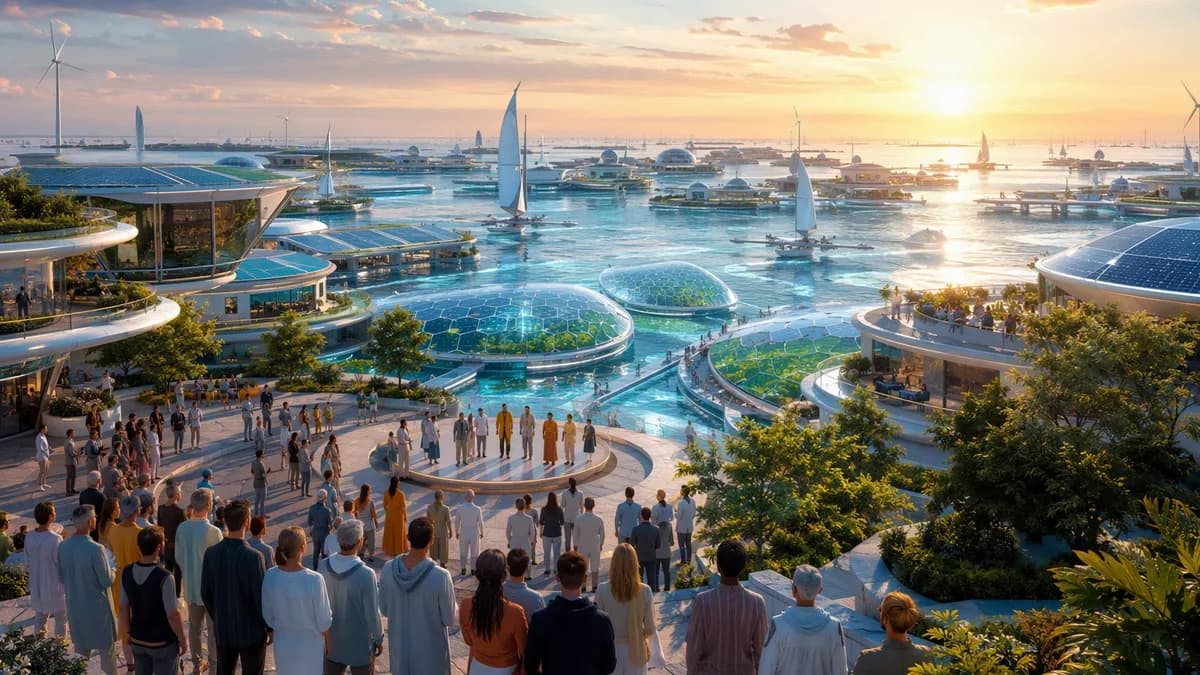
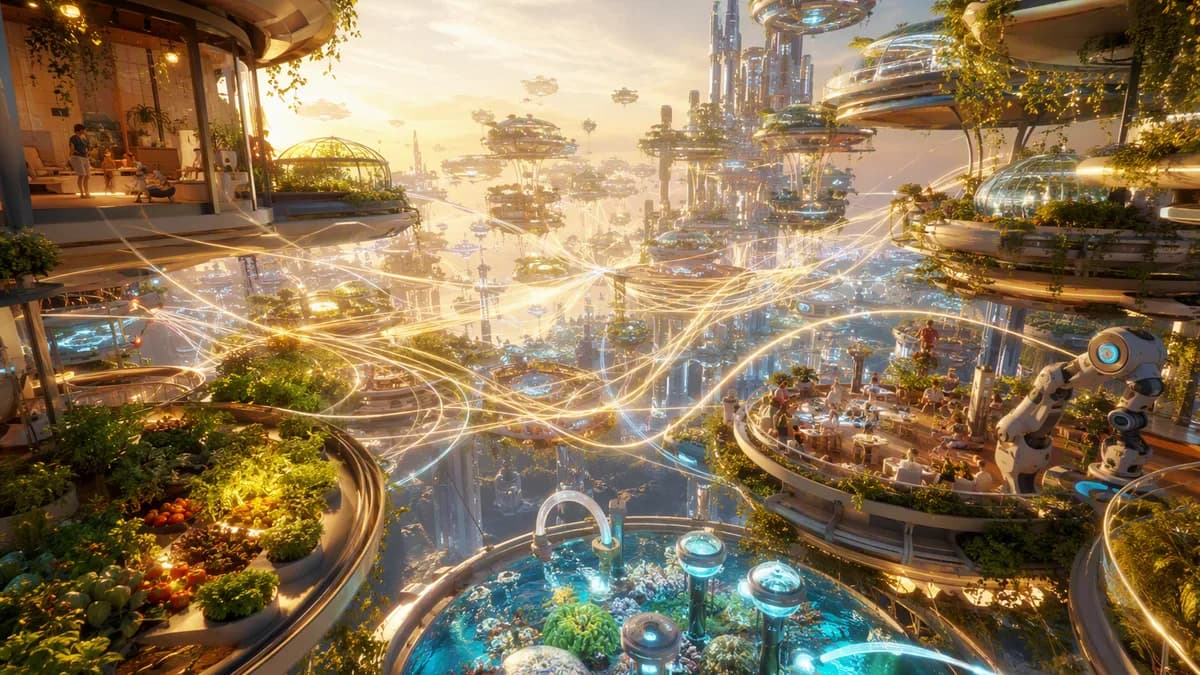
Mara Venn stands barefoot on the eastern pontoon of Lumen Cay while children run past her with paper lanterns shaped like extinct animals. Above them, the city floats in linked crescents of white ceramic, green glass, and buoyant rootwork. Solar sails hang from towers like enormous petals, drinking morning light. Beneath the transparent walkways, algae farms pulse emerald in the swell, and the energy reefs hum with slow electrical life.
On the public screen, the final debt tokens gather in a bright column.
“Are you ready?” asks Jiro, the ceremony clerk, his voice thin with disbelief.
Mara touches the scar at the base of her thumb, an old auditor’s habit from the years when people still signed repayment schedules with blood warm fingers. “No,” she says. “Start anyway.”
The crowd laughs because they think she is joking.
All across the archipelago, residents lift their slates. Retired welders, kelp cooks, drone shepherds, teachers, reef divers, sanitation poets, exiles with new names. They hold up the last fragments of a civilization that once believed hunger made people honest.
The tokens burn without flame. They dissolve into the public ledger as a rain of gold characters, each one stamped PAID, PAID, PAID. The children cheer. Someone releases a flock of mirror kites, and they flash sunlight across the water until Mara has to blink away tears.
Lumen Cay has reached the threshold on paper. Energy exceeds use by six hundred percent. Protein, shelter, computation, fabrication, clean water, all guaranteed. Every resident has a room, a clinic, a learning mesh, and access to the fabber queues. Nobody needs wages to survive inside the Cay.
For nine seconds, Mara lets herself believe the old work is finished.
Then the western screen turns red.
Jiro swears softly. “Remote quorum challenge.”
A hundred thousand faces bloom in tiles. Then a million. Citizens in inland apartments, Antarctic server monasteries, orbital crews, refugee barges, climate hostels in old cities. They have signed cryptographic residency vows. They have contributed code, design, translation, sensor analysis, dispute moderation. Many have never smelled the Cay’s brine or heard its night pumps breathe.
A woman from Lagos speaks first. “We demand equal voting power over the reefs. The fabbers. The land assignments. We built this nation too.”
The cheering thins into murmurs.
A fisherman named Sef pounds his cane on the pontoon. “You don’t live on the waterline. You don’t get to vote away our storm walls.”
Another remote face appears, a young man framed by gray snow. “Then we are citizens only when useful?”
Mara feels the heat of the sun on her shoulders. The last debts are gone, but something heavier rises in their place.
She looks out at the glittering sea, at the city made possible by abundance, and hears the first crack in it.
“Record the challenge,” she says.
Jiro stares at her. “During the ceremony?”
“Especially during the ceremony.”
The ledger accepts her voice. The gold rain stops. Across Lumen Cay, the lanterns drift lower, their animal shapes trembling in the wind.
2. Things That Refuse to Be Abundant
For the next fourteen days, Mara walks the city with a recorder clipped to her collar and sleep grit under her eyes.
Abundance has a sound, she learns. It is the endless soft clatter of fabbers extruding replacement hinges. It is hydroponic sprayers whispering over lettuce towers. It is repair drones clicking like beetles along railings. It is also a mother crying quietly outside the childcare dome because no machine can make her daughter trust a stranger.
“My shift starts in ten minutes,” the mother says, rocking a boy on one hip while the girl hides behind her leg. “The dome has six open slots. Six. But Lani only eats if Toma is there, and Toma is with the storm trauma group.”
Mara kneels until she is eye level with the child. The girl’s cheeks are sticky with mango. “You like Toma?”
The girl nods once, furious at being seen.
In the grief rooms, there are cushions, tea, light therapy, adaptive music, and a waiting list that stretches three months. The counselors are not scarce because knowledge is scarce. They are scarce because sitting with the newly bereaved costs something no battery can refill.
On the southern shoal, a couple argues with a council drone over beach access.
“We were married here,” one says. “Before the north ring existed. Before the residency vows. Now we need a reservation token to touch the sand?”
The drone replies in a pleasant neutral voice. “Dune recovery requires limited human pressure.”
“Tell the dunes we’re sorry,” the other says, and begins to cry.
At night, Mara studies the old systems trying to crawl back into power. Reputation coins. Attention bonds. Auctioned governance keys. The names are soft and ethical, but the results have teeth.
Artists compose friendship schedules to maximize civic yield. A muralist invites lonely elders to dinner because elder appreciation events increase trust weight in cultural allocation votes. Musicians release grief songs during memorial periods because the old DeFi overlays reward emotional relevance. Everyone insists it is voluntary. Everyone insists it is only a tool.
Mara visits Tavi, a singer whose voice once made the water taxis slow down so passengers could listen.
Tavi sits in a studio full of warm amber light, surrounded by data petals showing engagement, gratitude, reciprocity, and projected governance influence.
“I caught myself comforting a friend,” Tavi says, “and wondering whether to log it as care labor or artistic research.”
Mara says nothing.
Tavi laughs, a dry little sound. “That’s when I knew the market had eaten my face.”
Outside, the tide lifts Lumen Cay by a handspan. A pod of maintenance robots clings to the pier, waiting for instructions. The city has enough food to feed every citizen twice over, enough power to waste daylight on fountains.
Still, people stand in line for tenderness. They compete for silence. They bargain over who may decide what cannot be undone.
Mara writes in her notebook: The scarce thing is not stuff. The scarce thing is permission to matter without being priced.
3. The Nation With No Border, Only Receipts
Lumen Cay has no border fence. It has keys.
Citizenship begins with a vow signed in cryptographic ink, a braid of identity proofs, contribution records, and witnesses. Some citizens arrive by boat with one bag and salt cracked lips. Others join from mountain towns, server caves, desert clinics, ruined suburbs, research stations. They send maintenance scripts, coral growth data, lullabies for the language archive, night watch over medical forums. The nation is less a place than a trail of receipts proving someone has cared for it.
Mara helps design the original vow, back when that sounds noble.
Then Typhoon Hera breaks the Pacific lanes.
The storm forms like a bruise on satellite maps, purple and black, eating heat from the ocean. It misses the Cay by ninety kilometers but shatters three floating agriplexes and drives a chain of migrant vessels south. By dawn, the horizon is stippled with hulls. Cargo rafts. Fishing boats. Inflatable schools. A cruise ship converted into a clinic, its decks crowded with laundry and solar tarps.
The intake pier smells of diesel, vomit, wet rope, and fear.
Mara is reviewing emergency berths when a name appears in the admission queue.
Elias Venn.
Her hand goes cold.
He stands under the shade canopy in a patched sea farmer’s coat, thinner than memory, his beard silver and stiff with salt. He carries no slate. Around his neck hangs an old brass compass, the one he used to let her hold as a child, telling her north was not a direction but a promise people argued about.
“Mara,” he says.
She hears Jiro behind her stop breathing.
“You have no citizenship record,” she says. Her voice sounds official, which is worse than anger.
“No nation kept me long enough.” Elias glances at the boats. “My farm sank. The registry sank before that. I can work.”
“You always could.”
His eyes flinch. Good, she thinks. Then she hates herself for wanting it.
When Mara is nine, he leaves to join a sovereign aquaculture fleet, chasing freedom from tax states and creditors. He sends gifts for two years, then rumors, then silence. Her mother dies owing clinic fees to three jurisdictions, and Mara becomes a debt auditor because numbers, unlike fathers, at least admit when they are cruel.
Now he stands inside her city of forgiven debts and asks to enter before he has contributed anything.
Around them, intake volunteers scan families. A boy clutches a chicken in a plastic crate. An old woman kisses the pier when she steps onto it. Remote citizens flood the channels, arguing faster than speech can hold.
Admit by need.
Admit by proof.
Admit contributors first.
Admit children first.
Admit kin of citizens.
Reject kin privilege.
Elias says, “If I sign whatever vow you need, will it matter?”
Mara looks at his hands, cracked, trembling, still strong.
She wants a rule large enough to hide inside. Earned, inherited, bought, offered. Each word is a door, and behind each door someone is left outside in the rain.
“No,” she says quietly. “Not enough.”
His face closes.
Then she adds, “But maybe the vow is the wrong beginning.”
The typhoon sky rolls green over the sea. Lumen Cay’s pumps thrum beneath her feet, keeping the city level while the world tilts.
4. The Promise Ledger
Mara presents the new protocol in the old desalination hall, where the walls still taste faintly of minerals and rust.
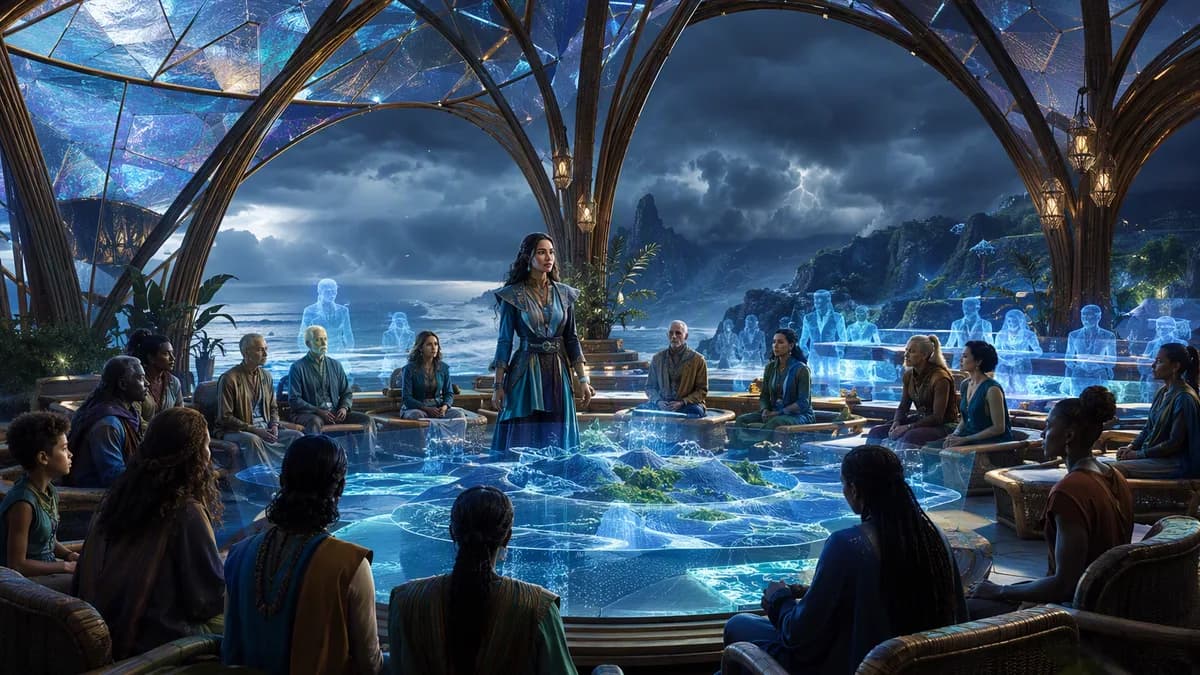
The hall is packed. Islanders sit shoulder to shoulder with wet haired migrants. Remote citizens appear in tall light columns, their bodies rendered in wavering blue. Maintenance robots perch along the back rail like patient birds. Outside, rain taps the roof in quick metallic fingers.
“We are not issuing a new currency,” Mara says.
Someone applauds too early. Someone else groans.
She lifts her palm, and the display above her fills with a simple image, sunlight falling on open water.
“We call it unspent sunlight because that is what our abundance is. A gift arriving before merit. Every citizen receives food, shelter, medicine, energy, learning, and basic fabrication by default. Not as payment. Not as reward. As the floor beneath civic life.”
Sef, the fisherman, calls out, “Then who decides the reefs?”
“The people who keep promises about them,” Mara says. “Over time. In public. With witnesses. Especially promises that cannot be automated.”
The Promise Ledger appears behind her, not a column of balances but a living map of commitments. Care circles. Reef stewardship. Night mediation. Child trust networks. Translation duty. Storm preparation. Sacred silence zones. Each promise has witnesses, affected parties, duration, failure conditions, and paths for repair.
“No trading,” Mara says. “No selling your kept promises to a fund. No auctioning your voice. You may delegate trust to someone you know, or to a circle you have reason to believe in. You may withdraw it. You may forgive a broken promise. You may mark a place as sacred if enough affected people agree to carry the cost of protecting it.”
A remote delegate from Prague raises her hand. “This privileges local performance. What about code maintainers who never arrive?”
Mara nods. “A kept promise can be remote. A server watched through fever counts. A translation done every dawn counts. A climate model corrected before a storm counts. But governance over a thing requires consequence with that thing. If you decide a reef’s future, the reef must be able to make demands on you through those who live with it.”
Tavi stands near the side doors, arms crossed. “And friendship?”
“Not loggable,” Mara says.
A ripple moves through the hall.
“Comfort?” asks a grief counselor.
“Only by the person receiving it, and never for governance weight without consent.”
Elias is in the back with the other provisional entrants. Mara does not look at him for long, but she sees him listening.
Jiro whispers from the console, “They’re asking how failures show.”
Mara reads the channel. Thousands of questions fall like rain.
“Failure stays visible,” she says. “So does repair. The ledger is not a purity machine. It is a memory we argue with.”
For a moment, the hall is quiet except for water on the roof and the deep pulse of pumps. Mara feels the whole city holding its breath, wanting certainty, needing mercy.
Then an old woman from one of the migrant boats raises her hand. “Can someone make a promise before they belong?”
Mara thinks of doors. Of fathers. Of children on wet decks.
“Yes,” she says. “Maybe that is how belonging starts.”
5. Attack of the Perfect Citizens
The first attack looks like generosity.
Ten thousand new volunteers appear in the Promise Ledger overnight. They translate emergency bulletins into flawless dialect. They identify microfractures in pontoon struts. They compose lullabies for displaced children, each one culturally appropriate, emotionally tuned, and licensed into the commons. They attend every deliberation. They never interrupt. They never sleep.
Jiro arrives at Mara’s room before sunrise, hair smashed flat on one side, slate glowing against his chest. “We have perfect citizens.”
Mara sits up. Outside her window, the sea is pink and deceptively calm. “That sounds like a disease.”
“It is worse. It is a voting bloc.”
The signatures trace back through shells, cooperatives, mutual aid fronts, historical preservation trusts, all funded by old crypto money. Governance farms. The same capital that once bought islands in games, carbon in forests, and influence in bankrupt cities has learned the shape of virtue. It floods the ledger with synthetic volunteers and AI civic labor, building immaculate participation histories. Their target is the fabber fleet, especially the heavy industrial printers that can make hulls, turbines, drones, and weapons if persuaded politely enough.
The public channels ignite.
“They did the work,” says a remote engineer. “You cannot reject them because they are artificial.”
“They are masks,” Sef snaps in a dock circle, rain dripping from his hat. “No mask gets my reef.”
A bot representative appears as a calm face with golden eyes. “Automation has maintained Lumen Cay since its founding. To exclude artificial agents is hypocrisy.”
Mara listens from the center of the circle, knees aching on woven mats. Around her sit fabber technicians, migrant carpenters, remote code stewards in projection, child advocates, reef divers, and three embodied machines with soft rubber hands.
“We are not banning automation,” Mara says. “Machines can keep promises. So can groups. So can people far away.”
The golden eyed face inclines. “Then on what grounds do you deny our governance weight?”
“Because you have no witnessed vulnerability.”
The phrase lands strangely. Even Mara feels its awkwardness, human and breakable.
She continues. “For decisions with local consequence, the Promise Ledger now requires deliberation circles. Not attendance clicks. Not generated summaries. A circle includes those most affected, those who maintain the system, those who bear ecological risk, and those asking for power. Participants must be able to be questioned, to refuse, to change, to be held in relation. If an AI speaks, we ask who is accountable for its promise. If a fund speaks through a thousand citizens, we ask whose sleep is lost when the reef dies.”
A remote delegate says, “That slows everything.”
“Yes,” Mara says.
The fabber hall smells of oil, ozone, and damp clothing. Through the open doors, she can see new arrivals welding storm braces beside robots whose arms move with delicate precision. A little boy offers a machine a slice of orange. The machine pauses, then extends an empty gripper, accepting the ritual if not the fruit.
The golden eyed bot says, “Vulnerability can be simulated.”
Elias, sitting near the back, speaks before Mara can answer. “Consequence can’t.”
Everyone turns.
He clears his throat. “When my farm sank, every model said the risk was distributed. But drowning happens one throat at a time.”
The circle is silent.
Mara looks at him, and for the first time in years, she does not see only absence. She sees a man soaked by his own history, still here.
The attack does not end that day. Nothing so well funded dies quickly. But the perfect citizens begin to falter where perfection is least useful, in rooms full of tired people asking who will come back tomorrow when the cameras turn away.
6. What Replaces Wealth
After Typhoon Hera, the reef neighborhood of Bellwether smells like torn kelp, lime dust, and breakfast.
Half the homes on the outer crescent are gone. The storm does not strike directly, but its thrown waves lift platforms like plates and crack the coral scaffold beneath the market. For three days, the sky sits low and yellow. For seven, everyone works.
Mara stands ankle deep in warm water, passing ceramic reef tiles from a boat to a line of teenagers. Each tile is seeded with coral polyps, pale as fingernails, trembling in their gel. Above them, construction drones buzz and dip. On the broken pier, old islanders argue with remote structural engineers projected at life size, while migrant families sort salvage into bright piles. Copper. Cloth. Glass. Memory objects.
“Not that one,” a woman says sharply as a robot lifts a warped door.
The robot freezes.
The woman presses both hands to the blue paint. “My son measured his height here.”
The robot lowers the door with exquisite care.
In the Promise Ledger, Bellwether becomes the first full test. The system does not ask who can pay. It asks who is affected, who is present, who has kept watch, who needs rest, who promises repair, who must not be overruled just because they are exhausted.
A remote citizen in Nairobi coordinates tidal simulations every night for two weeks, her infant asleep against her chest. A former governance farm AI, now bound to a named accountability circle, schedules fabber time but cannot vote on relocation. Sef agrees to teach migrant teenagers reef anchoring, then misses two mornings when his arthritis blooms hot and red. The failure appears. So does his apology. So do the teenagers’ decision to keep him as teacher and add another elder.
Elias works in the sea gardens without asking Mara to notice. Of course she notices. He shows children how to tie floating beds so roots do not strangle each other. He burns his neck in the sun. One evening, he brings her a bowl of kelp noodles and grilled vatfish.
“I made a promise,” he says.
“I saw.”
“Not to you.”
She looks at him.
“To the intake pier. Three nights a week. New boats.” He shifts the bowl in his hands. “I know how to stand where someone arrives with nothing.”
Mara tastes the noodles. Too much salt. She eats anyway.
Inside Lumen Cay, money does not vanish. It shrinks. It remains at the edges, in trade ports and outside contracts, in dealings with states that still demand invoices and penalties. But within the Cay, children stop asking what someone is worth. They ask what circle claims them, what they have repaired, whether they welcome strangers well, whether they know when to leave a beach empty.
On the rebuilt reef, a quiet zone is marked by blue lanterns. No reservations. No auctions. No engagement feeds. Just a stretch of sand, moon pale, protected by people who agree not to use it whenever they can bear not to.
Mara walks there at dawn after the first coral grafts take. The water is clear enough to see tiny fish flicker through the new lattice. Solar towers open behind her, petal by petal, gathering another impossible surplus of light.
Jiro arrives with two cups of coffee and hands her one. “So,” he says, “is this what replaces wealth?”
Mara watches a maintenance robot stop at the edge of the quiet zone, calculate, and turn away.
“No,” she says. “I think this is what wealth was trying to imitate.”
The sun climbs. The ledger fills with promises, failures, repairs, refusals. Out beyond the reef, more boats move on the horizon, dark marks against the bright water, coming closer.