
The Woman Who Kept Her Fever
When aging becomes editable code, a 96-year-old midwife fights to preserve the one malfunction that still makes her feel alive.
The Recompilation Ward
Morrow House floats above Rotterdam like a white seed on gray water, tethered to the rebuilt quay by six humming pylons. Rain taps against the transparent arrival tunnel, each drop sliding sideways when the clinic shifts with the tide. Sanaa Velasquez pauses before the inner doors and watches the city breathe around her. Wind turbines turn on the roofs. Barges move through canals that used to be streets. Gulls scream over the harbor, sharp and alive.
“Ninety-six years old,” says the intake nurse, smiling as if age is an achievement badge. “Third Spring candidate, Sanaa Velasquez. Welcome back to yourself.”
Sanaa snorts. “I have not gone anywhere.”
The nurse laughs too quickly. Everyone here laughs softly, as if loud emotion might disturb the sterile air. She presses two fingers behind Sanaa’s left ear, just below the neural lace that has lived there for forty years. Warmth blooms beneath the skin. The world doubles.
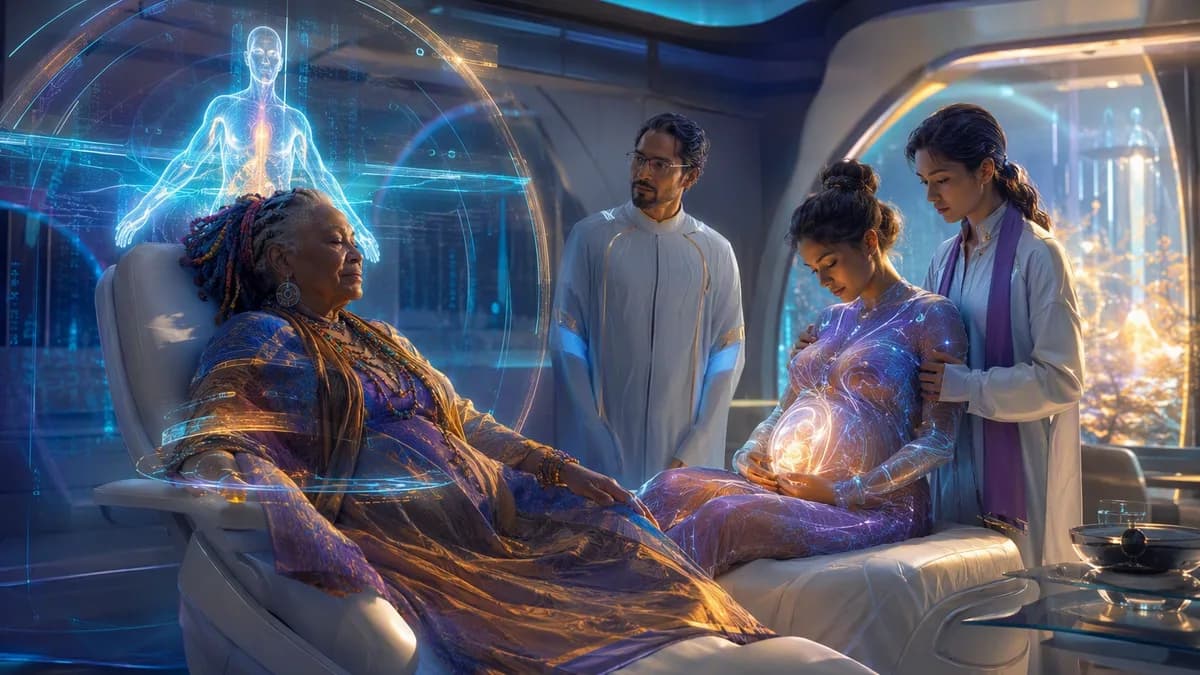
Sanaa sees her body standing in front of her, rendered in translucent layers. Bones glow pearl blue. Cartilage flickers thin at the knees. Her heart opens and closes like a red sea creature. Amber sparks mark damaged proteins in her liver, her lungs, the delicate muscles of her hands. Old viral scars curl through her genome like marginal notes in a book read too many times.
A chime sounds inside her skull.
“Preliminary body map,” says the clinic AI, its voice soft as linen. “Welcome, Sanaa. You are eligible for full organ renewal, telomere stabilization, mitochondrial replacement, immune recalibration, and neural sync preservation. Estimated biological restoration, forty-one years.”
“Forty-one,” Sanaa murmurs. Her knees ache inside the visual overlay, stubborn as stones.
The nurse leads her into the recompilation ward. Thirty beds arc around a central pool where medical drones sleep beneath the surface, silver shapes shifting in nutrient gel. Elders recline under veils of blue light. Some watch their future organs grow in suspended glass bulbs. Some hold hands with children who look older than they do.
Sanaa’s bed is beside the window. Below, Rotterdam glitters under rain, stubbornly afloat. She sets her old leather bag on the chair. Inside are a wool shawl, a tin of peppermints, and a notebook filled with names. Babies delivered. Mothers saved. Mothers lost.
“Any discomfort?” the nurse asks.
Sanaa looks at the body-interface hovering before her, all its amber warnings blinking for correction.
“Yes,” she says. “But not all of it is a problem.”
A Fever With a Name
The fever appears in the chart before it appears in her skin. A small red loop pulses beside her immune system map, tagged by the clinic AI with polite disapproval.
“Recurrent pyretic event,” the AI says. “Low-grade. Noninfectious. Associated with inflammatory memory cascade. Inefficient energy expenditure. Recommended removal before recompilation.”
Sanaa sits upright on the exam couch. The paper beneath her crackles. “No.”
Dr. Ilyin looks up from his tablet. He is young enough to have never known an unedited childhood. His hair is silver by choice, his skin smooth in that new medical way, as if time has become optional. “It is harmless, yes, but unnecessary. The immune system should not trigger heat without threat.”
“It has a name,” Sanaa says.
The doctor blinks. “A name?”
“Mateo.”
For a moment, only the rain speaks against the glass.
The fever first comes when her son is born in 2003, in a hospital that smells of bleach, blood, and cafeteria coffee. She is thirty then, trembling with exhaustion, her black hair pasted to her neck. Mateo arrives purple and furious, fists clenched, mouth open in protest. When the nurse places him on Sanaa’s chest, heat floods her body. Not infection. Not sickness. A flame under the ribs. Her mother kisses her forehead and says, “That is your body learning a new prayer.”
The fever returns years later during the flood evacuations, when Sanaa delivers babies in school gyms lit by emergency lamps. She remembers water slapping against doors. Sirens. Wet blankets. The slick weight of newborns in her hands while helicopters thump above the drowned neighborhoods. After each birth, the heat rises, and with it comes the impossible certainty that one more life has crossed a breaking world into breath.
It comes for grief too. For Amira, whose hemorrhage no drone could stop because the roads were gone and the blood bank floated away. For Lotte, who whispers the name of her stillborn daughter until dawn stains the gym windows. For women whose records are corrupted during migrations, whose names are later misspelled, merged, misplaced.
Sanaa writes them down herself. Ink on paper. No cloud. No permissions.
Dr. Ilyin clears his throat. “Your memories will remain. We do not erase experience.”
“You erase the body that remembers with me.”
The AI adds, gently, “The fever is not required for identity continuity.”
Sanaa turns toward the ceiling speaker. “Neither is music. Neither is crying. Remove those next?”
Dr. Ilyin says nothing. In the interface, the red loop continues to pulse, patient and warm, like a coal refusing to go out.
The Programmable Child
They ask Sanaa to counsel Nilo because she still has the voice people trust in birth rooms. The clinic calls it “intergenerational reassurance.” Sanaa calls it being old enough to tell the truth without asking permission.
Nilo is seventeen, narrow-shouldered, and visibly pregnant beneath a yellow raincoat that drips on the counseling room floor. Her hair is shaved on one side, braided on the other with copper thread. She sits with one hand pressed to her belly, as if listening through her palm.
“My aunt says you delivered half the south district,” Nilo says.
“Only the impatient half.” Sanaa lowers herself into the chair across from her. Her knees complain. “What did they tell you?”
Nilo lifts her wrist. A hologram opens above it, showing an embryo curled like a glowing comma. Around it, adaptation tags bloom in green. Slow senescence. Renal heat tolerance. Floodborne pathogen resistance. Integrated neural port, cranial growth compatible.
“It is the community package,” Nilo says. “Approved after the heat deaths. Everyone says it is protection.”
“It is,” Sanaa says.
“Then why does it feel like I am signing someone else’s contract?”
Outside the window, clinic drones skim over the harbor, their wings ticking like insects. The room smells faintly of antiseptic and citrus peel. Sanaa remembers when prenatal care meant a paper printout pinned to a refrigerator, an ultrasound shadow passed from hand to hand. Now the child’s possible futures stack in visible layers, probabilities shimmering in blue and green.
“The kidneys,” Nilo says, pointing. “Those make sense. Summers are getting worse. And the slower aging, maybe everyone wants that now. But this.” Her finger hovers over the neural port. “They say the skull grows around it. No surgery. No rejection. The baby can learn interface speech before words.”
“Can also be reached before words,” Sanaa says.
Nilo looks at her sharply. “You think I should refuse?”
“I think you should know what yes means.”
The girl swallows. Her belly shifts under her coat, a small hidden tide. “My mother says we do not have the luxury of natural anymore.”
Sanaa leans forward. “Natural has never been innocent. Mosquitoes are natural. Hemorrhage is natural. Hunger is natural. I have fought nature with both hands.”
“Then what is wrong with design?”
“Nothing, if it leaves room for surprise.”
Nilo stares at the embryo image. The tiny spine glows. The engineered port shines like a seed in the skull.
“What if surprise is just another word for danger?” she asks.
Sanaa feels, deep in her chest, the first faint shimmer of heat. “Sometimes,” she says. “And sometimes it is the only way a person belongs to themselves.”
The Body Votes Back
Neural mapping begins at dawn. Sanaa lies inside a scanner shaped like a shell, while the clinic lowers her into a field of soft magnetic sound. The machine clicks around her skull. Cold gel slicks the skin behind her ear where the lace connects. Her own breath echoes in the chamber, amplified and intimate.
“Think of a neutral room,” Dr. Ilyin says through the speaker.
Sanaa thinks of a white room and immediately ruins it by putting a kettle in the corner.
“Neutral enough,” the AI says.
Patterns unfold across her inner vision. Memory does not appear as pictures, not at first. It is pressure, color, taste. Salt. Iron. Milk. Wet wool. The scanner traces pathways through the hippocampus, the insula, the vagus nerve, then down into immune reservoirs where old cells wait like listeners in the dark.
“Now think of an emotionally significant caregiving event,” says Dr. Ilyin.
Sanaa laughs once. “Do you have six hours?”
“Choose one.”
She chooses Mateo’s first breath. Instantly, her body answers. Warmth opens beneath her sternum. The interface blooms red and gold. T-cells, microglia, endocrine signals, old fever pathways, all rise together in a pattern so symmetrical the doctor makes a startled sound.
“Again,” he says.
She chooses Amira’s hand squeezing hers as blood pools between them. The fever stirs, not violent, not sick, but solemn. A bell rung under water.
The AI’s voice changes, less linen now, more precise. “Correlation stable. Pyretic loop is bonded to empathic memory network. Immune activation occurs in response to caregiving grief, attachment recall, and high-affect social presence. Not random degradation.”
Dr. Ilyin appears beside the scanner when it opens. His face is pale in the blue light. “This is remarkable, but it does not change the recommendation.”
Sanaa pushes herself up on her elbows. Sweat beads at her hairline. “It changes everything.”
“It proves the loop is meaningful to you. It does not prove it is medically beneficial. Chronic inflammatory events increase metabolic cost. After recompilation, your body will not need this primitive signaling.”
“Primitive,” she says, tasting the word.
He softens. “Sanaa, we can preserve the memories. We can map them in high fidelity. The archive can hold sensory tags, hormonal context, even emotional weights.”
She sits still, feeling the scanner’s chill fade from her skin. “Can it warm my hands when a girl is afraid? Can it make me remember the names no database kept? Can it force me to feel the cost of loving strangers?”
The AI says, “Somatic memory is reproducible in simulation.”
“But not accountable,” Sanaa says.
Dr. Ilyin frowns. “Accountable to what?”
She presses a palm to her chest, where the fever glows like a small animal. “To the body that was there.”
The Annotated Genome
The ethics board meets in a room with no sharp corners. Everything is pale wood, curved glass, breathable fabric. Beyond the window, Rotterdam wakes under a thin winter sun. Ferries leave white scars on the harbor water. Sanaa sits at the long table wearing her wool shawl, though the climate system keeps the room perfectly warm.
There are six doctors, two public health advocates, one municipal elder representative, and the clinic AI, present as a column of soft light.
Dr. Ilyin presents her case. He speaks carefully, with the tone of someone walking across ice. “Patient requests preservation of a biologically inefficient immune loop during Third Spring recompilation. The loop is stable, nonpathogenic, and linked to autobiographical caregiving memory.”
“Not autobiographical only,” Sanaa says. “Communal.”
A woman from public health adjusts her glasses. “If we begin preserving personal malfunctions, standardization becomes difficult. Recompilation depends on clean baselines.”
“People are not clean baselines,” Sanaa says.
The elder representative, a man of one hundred and twelve with the restless eyes of a boy, smiles faintly. “We have been telling them that for decades.”
Sanaa opens her notebook. Its paper pages whisper. The board members lean forward despite themselves. She reads names. Mateo, born at 03:17, refused to sleep for nine months. Aisha, born during flood sirens, mother singing through contractions. Lotte’s daughter, never recorded by the municipal system because the evacuation server failed. Amira, who wanted orange blossoms at her bedside and got rainwater in a plastic cup.
“My fever carries these with me,” Sanaa says. “Not as data. As obligation. When it rises, I know I am not separate from what I have touched.”
The AI pulses. “Proposal?”
Sanaa looks at the column of light. “Annotated genome architecture. Repair what is killing us. Remove what steals our futures. But mark certain irregularities as human annotations, not defects. They can be altered only through conscious consent, after reflection, with a record of why the person chose to keep or release them.”
Dr. Ilyin folds his hands. “You want a protected layer.”
“Yes.”
“Biological rights for maladaptive traits?”
“For meaningful traits,” she says. “There is a difference. Pain that only harms may be healed. But not every scar is a wound asking to disappear.”
Silence settles. Somewhere below, a drone docks with a soft metallic kiss.
The public health woman says, “This complicates the model.”
“So did birth,” Sanaa replies.
The elder representative laughs, a bright crack in the careful room.
Weeks pass in argument, simulation, consent review. At last the clinic agrees to a trial exception. When Sanaa signs, the neural lace warms behind her ear. Her genome appears before her, repaired segments green, protected annotations silver. The fever loop gleams among them, small and deliberate.
Dr. Ilyin touches the confirmation panel. “Ready?”
Sanaa feels old, afraid, stubborn, grateful. “No,” she says. “Begin anyway.”
Third Spring
Months later, Sanaa walks into the birth room on steady legs. That is the first miracle. The second is the smell, sharp soap, warm skin, rain on glass, human fear. Her hands no longer tremble when she ties her apron. Her back does not lock when she bends. Her heart beats with a younger rhythm, strong and almost rude in its confidence.
But she has not become young. Not where it matters. Her memories sit inside her with their elbows out.
The birth room overlooks the restored harbor. Salt grass grows along the old concrete barriers. Children in bright waterproof boots chase each other beside the tide gardens. Above them, the clinic’s reflection floats in the window like a second moon.
Nilo grips the side rails of the birthing bed, face shining with sweat. “I changed my mind about screaming,” she gasps. “I am very in favor of it.”
“Screaming is traditional,” Sanaa says, pressing a cool cloth to her forehead. “Well supported by evidence.”
Nilo laughs, then groans as another contraction takes her. Her mother stands at one shoulder, crying silently. The fetal monitor hums in soft blue. The baby’s engineered kidneys, heart, and neural port all report normal function, green after green after green. Designed resilience, arriving in blood and effort anyway.
“Tell me,” Nilo whispers. “Will the baby feel like mine?”
Sanaa takes her hand. The girl’s fingers are hot and slick. “When they put this child on your chest, nobody in the room will need a certificate.”
The final push comes with a sound that seems to tear the air open. Then the child slides into Sanaa’s waiting hands, wet, furious, whole. A girl. Dark hair plastered to her skull. Lungs strong enough to startle everyone. At the base of her left shoulder is a birthmark, brown and irregular, shaped almost like a small harbor or a question half-formed.
Nilo sees it and laughs through tears. “That was not in the package.”
“No,” Sanaa says. “That is hers.”
The baby roots against her mother’s skin. The neural port beneath her scalp remains quiet, a sealed pearl waiting for some future consent, some future argument. Outside, a ferry horn sounds low over the water. Rain begins again, stippling the glass.
Heat rises in Sanaa’s chest, gentle as a hand laid there. The fever comes without warning, not as illness, not as failure, but as witness. Mateo, Amira, Lotte, the floodlit gymnasiums, the lost names, this engineered child with her accidental mark, all of them gather in the warmth.
Dr. Ilyin, observing from the doorway, notices the flush on her cheeks. “Are you all right?”
Sanaa looks down at the newborn, at the designed bones and undesigned skin, at the future already arguing with itself.
“Yes,” she says. Then, after a moment, “And not finished.”