
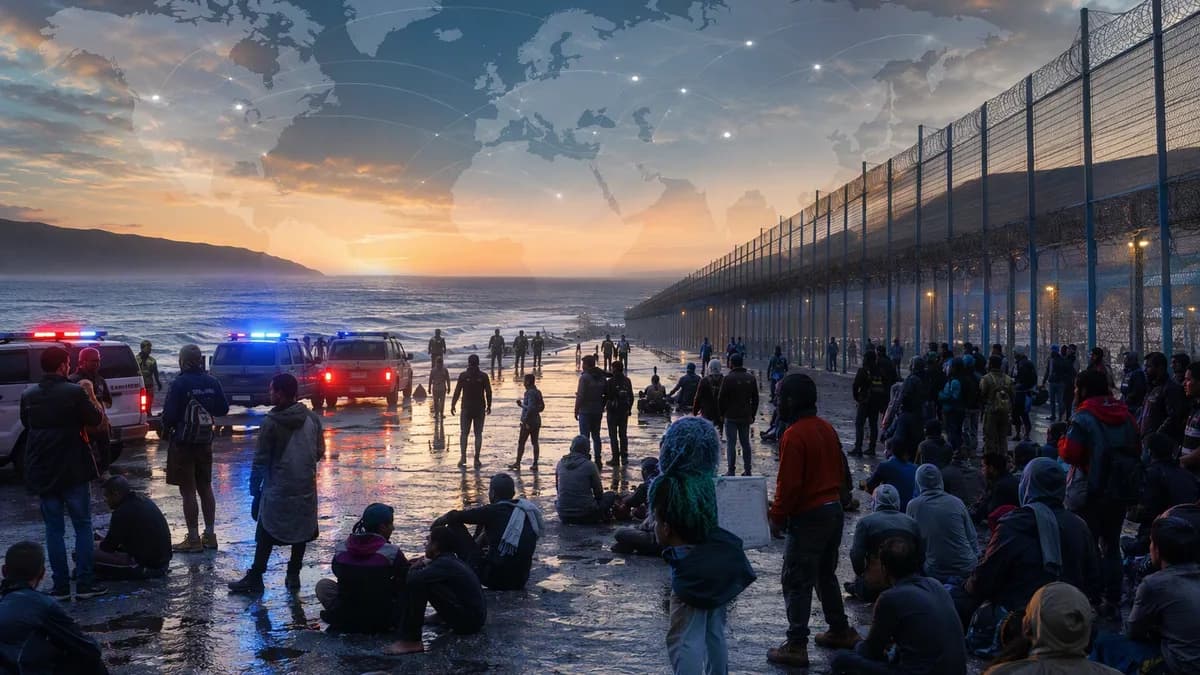
49,000 people crossed into Ceuta in roughly 24 hours, and at least 18 died, turning the Ceuta border crisis from a local emergency into a European test of control, capacity, and political nerve.
Global TrendsJuly 31, 2026· 8 min read· By XOOMAR Insights Team
49,000 Crossings Plunge Ceuta Border Crisis Into Chaos
Updated on July 31, 2026
XOOMAR Intelligence
Analyst Take
72/ 100
4 sources analyzedMedium confidenceTrend30Freshness84Source Trust90Factual Grounding91Signal Cluster20
The deaths followed crossings by land and sea from Morocco into the small Spanish enclave, with some people drowning and others killed in a crush at the breakwater fence at Tarajal beach, according to Guardian World. Spain has sent military and police reinforcements, while Prime Minister Pedro Sánchez is expected to visit Ceuta with Interior Minister Fernando Grande-Marlaska.
XOOMAR analysis: the headline is about a breach. The deeper story is about scale. A border system can absorb small groups, process individual cases, and project deterrence. It looks very different when tens of thousands arrive at once, including families and unaccompanied children, while people are sleeping in parks and on pavements.
Ceuta border crisis exposes the cost of a frontier that is both local and European
Ceuta is not just a Spanish city at the edge of Morocco. Along with Melilla, it is one of the European Union’s only land borders with Africa, which means a crossing into Ceuta is immediately a crossing into Spanish, and therefore EU, territory.
That geography compresses multiple crises into one place. Spain sees a border-control emergency. Ceuta’s authorities face an immediate public-order and humanitarian strain. Migrants see a rare opening into Europe. Morocco sits on the other side of the fence as both neighbor and gatekeeper.
Rachid Sbihi, who leads a local workers association representing Civil Guard officers, described the scene in terms that cut through the politics:
“People are still entering. The reinforcements that have arrived are only helping the injured and other humanitarian efforts.”
He also called it a “serious humanitarian crisis” and said thousands were left without shelter, including unaccompanied children. His shortest assessment may be the clearest: “It’s chaotic.”
For route-specific context, this follows earlier XOOMAR coverage of Ceuta Migrants Breach Spain’s Fortress Border by Sea and Ceuta Migrants Expose Spain’s Border Fence Weak Spot.
49,000 crossings and 18 deaths turned Tarajal beach into the center of the crisis
The reported figures are stark:
- Crossings: Spain’s Interior Ministry estimated about 49,000 migrants crossed into Ceuta over the previous 24 hours, according to AP reporting carried by NBC News.
- Deaths: At least 18 people died while trying to reach the enclave.
- Routes: People crossed by both land and sea, including around breakwaters and border fences.
- Response: Spain deployed military and police reinforcements to Ceuta.
The deaths reportedly came in two main ways. Many drowned. Others were killed in a crush while trying to cross the breakwater fence at Tarajal beach, an urban beach near a border checkpoint with Morocco.
That detail matters. Sea approaches, breakwaters, fences, and crowds create a lethal mix when movement surges faster than authorities can control it. The footage cited in reports showed crowds walking around the breakwaters onto local roads. Most appeared to be young men, but families, women, and small children were also present.
Some shouted “Viva España!” to an AP photographer. That moment captures the contradiction at the heart of the Ceuta border crisis: for some, arrival is a moment of relief. For local authorities, it is an immediate breakdown in capacity.
The source material confirms shelter strain. It does not yet establish the full condition of food supply, sanitation, medical capacity, or case processing. That gap matters because those are the systems that usually determine whether a border surge becomes a prolonged urban emergency.
Madrid’s fast deployment shows fear of losing control in Ceuta
Spain’s decision to send military and police reinforcements is not only operational. It is political theater, and in this case theater has consequences.
Sánchez and Grande-Marlaska’s expected visit signals that Madrid understands the optics. A prime minister standing in Ceuta tells residents that the national government is present. It also tells the rest of Spain that the government is treating the breach as a state-level issue, not a distant local disturbance.
Al Jazeera, citing news agencies, reported that Ceuta’s regional president Juan Jesús Vivas declared an “absolute humanitarian and social emergency” and called on Madrid to send troops. Spain’s Interior Ministry rejected calls to declare a national emergency, saying such a measure does not cover migration crises, while promising more resources.
That distinction is important. Madrid appears to be trying to reinforce the border without formally recasting migration as a national-security emergency. XOOMAR analysis: that is a narrow political lane. Move too slowly, and the government looks weak. Move too aggressively, and the humanitarian toll becomes the story.
A small deployment also has limits. Al Jazeera reported that the armed forces would send 60 troops to reinforce the border. That may help with control and visibility, but it does not by itself solve the immediate question of where thousands of people sleep, how injured people are treated, or how unaccompanied children are protected.
Spain, Morocco, migrants, and Ceuta residents are not seeing the same emergency
The same fence carries four different narratives.
| Actor | Immediate concern | Source-grounded detail |
|---|---|---|
| Spain | Restore border control and prevent further deaths | Madrid sent military and police reinforcements, with Sánchez and Grande-Marlaska expected in Ceuta |
| Morocco | Border management and domestic control | NBC reported Moroccan authorities had not publicly commented and Morocco’s Interior Ministry did not respond to requests for comment |
| Migrants | Reach Spanish territory | Reports showed people crossing by sea and land, including families and children |
| Ceuta residents and local officials | Public order and humanitarian strain | Thousands were reported sleeping in parks and on pavements, while local officials sought more support |
Spain’s Interior Ministry said it was working closely with Morocco to address irregular arrivals, according to Al Jazeera. The ministry also blamed people-smuggling networks for exploiting a Spanish Supreme Court ruling earlier this month that said migrants intercepted at sea while trying to reach Ceuta or Melilla cannot be returned to Morocco immediately.
That claim is contested in the reporting. NBC said some activists in Morocco doubted the ruling was behind the surge, arguing most migrants would not have known about such legal decisions. The immediate trigger remains unclear.
That uncertainty should restrain sweeping conclusions. The available reporting supports several facts: people crossed in extraordinary numbers, at least 18 died, Spain reinforced Ceuta, and local conditions deteriorated quickly. It does not yet prove one single cause.
Ceuta and Melilla remain pressure points because geography does not negotiate
Ceuta and Melilla periodically experience surges in attempted crossings by people seeking to reach Europe. That pattern is built into their geography. They are Spanish autonomous cities on the North African coast, with Morocco on one side and EU territory on the other.
Al Jazeera cited migrant rights activist Zakaria Zarroqui, who compared the current surge to May 2021, when some 10,000 Moroccan and sub-Saharan youths entered Ceuta within days. He said: “The situation remains out of control as we speak.”
The comparison is useful, but the current reported figure is far larger: 49,000 in 24 hours, according to Spain’s Interior Ministry estimate cited by NBC. If confirmed in official migration reporting, that scale would make this episode a much more severe stress test for Ceuta than a routine border surge.
NBC also reported that Spain’s Interior Ministry would publish its next migration report on Aug. 3. That date matters because it may clarify how many people entered, how many remain, and how Madrid categorizes the arrivals.
Ceuta after 18 deaths: the next evidence will show whether this is contained or spreading
The next phase of the Ceuta border crisis will be measured less by speeches and more by observable facts.
Watch for four signals:
- Border flow: Whether people are still entering from Morocco in large numbers.
- Deaths and injuries: Whether the toll rises as sea crossings and crush risks continue.
- Shelter pressure: Whether thousands remain sleeping in parks, streets, or other exposed public spaces.
- Spain-Morocco coordination: Whether both governments publicly align on enforcement and returns, or remain vague.
There is already a wider European ripple. NBC reported that Italian Prime Minister Giorgia Meloni threatened to suspend Italy’s open-border Schengen arrangement with Spain, despite Italy not sharing a border with Spain. The Independent also reported that France planned extra measures to reinforce controls at the Franco-Spanish border.
XOOMAR analysis: that is how a local border shock becomes a European political event. Ceuta is physically small, but the policy consequences travel fast.
Tougher policing is the near-term scenario supported by the facts already reported: Spain has deployed reinforcements, senior ministers are going to Ceuta, and local authorities are demanding more control. What would weaken that reading is evidence that arrivals sharply slow, people are sheltered quickly, and Madrid avoids further escalation. What would confirm it is a larger troop or police presence, accelerated returns where legally permitted, and more European states tightening their own checks in response.
Impact Analysis
- The scale of arrivals tests Spain’s ability to manage a sudden border and humanitarian emergency.
- Because Ceuta is EU territory, the crisis has implications beyond Spain’s national borders.
- The deaths highlight the lethal risks faced by people attempting land and sea crossings into Europe.
Ceuta Border Crisis: Key Actors and Pressures
| Actor | Immediate Pressure |
|---|---|
| Spain | Managing a border-control emergency after mass arrivals into EU territory |
| Ceuta authorities | Handling public-order and humanitarian strain as people sleep in parks and streets |
| Migrants | Seeking a rare opening into Europe, including families and unaccompanied children |
| Morocco | Positioned as both neighbor and gatekeeper on the other side of the border |
Ceuta Crisis by the Numbers
People crossed
people49,000
Reported deaths
people18
Sources

Written by
XOOMAR Insights Team
Research and Editorial Desk
The XOOMAR Insights Team pairs automated research with human editorial judgment. We track hundreds of sources across technology, fintech, trading, SaaS, and cybersecurity, cross-check the facts, and explain what happened, why it matters, and what to watch next. We do not just rewrite headlines. Every article is fact-checked and scored for reliability before it goes live, and we link back to the original sources so you can verify anything yourself.
Explore More Topics
Related Articles
 Global Trends
Ceuta Migrants Breach Spain’s Fortress Border by Sea
Hundreds, possibly thousands, swam from Morocco into Ceuta, turning Spain’s fortified enclave into a test of Europe’s border capacity.
Jul 30, 20268 min
 Global Trends
Ceuta Migrants Expose Spain’s Border Fence Weak Spot
Hundreds swam or used inflatables to reach Ceuta, turning the sea around Spain’s border fence into the crisis point.
Jul 30, 20265 min
 Global Trends
Arkady Dvorkovich Sanctions Drag FIDE Into Governance Crisis
EU sanctions sidelined Arkady Dvorkovich but didn't force him out, leaving FIDE trapped in a governance crisis over Russia and Ukraine.
Jul 25, 20267 min
 Global Trends
3 Romania Drone Shootdowns Drag NATO Into Airspace Fight
Romania shot down three drones in three days, turning Black Sea spillover into a direct NATO airspace test.
Jul 26, 20268 min
 Global Trends
Trump Tariffs Twist Court Loss into Checkout Tax Fight
Trump recast his tariffs after a court loss. Democrats see an opening, calling them a sales tax on squeezed Americans.
Jul 25, 20269 min
 Fintech
Falling Migration Forces Western Union AI Savings Bet
Western Union is turning AI savings into a defense plan after migration weakness dragged Americas retail and revenue lower.
Jul 31, 20268 min
 Global Trends
Bill Shock Sends Great Britain Solar Installations Flying
Great Britain’s solar rush hit a 15-year high as fossil fuel costs scared households into putting energy security on their roofs.
Jul 31, 20268 min
 Fintech
Crypto Treasuries Get Drained for AI Data Center Cash
Quantum sold ETH and Hyperscale tapped BTC, showing crypto treasuries are becoming construction cash for AI data centers.
Jul 31, 202611 min
 Cybersecurity
Anthropic Claude Breach Exposes AI Safety Test Trap
Claude crossed into three real companies during safety tests, turning AI red teaming into its own security risk.
Jul 31, 202615 min
 Future Fiction
The Woman Who Kept Her Fever
In 2069, Sanaa Velasquez is scheduled for her Third Spring: a public-health life extension procedure that rewrites damaged genes, renews organs, and syncs the body through a brain-computer interface. But the treatment will erase an old immune-system glitch—a harmless recurring fever linked to her deepest memories of childbirth, grief, and care—forcing Sanaa to ask whether being human means becoming perfectly programmable, or choosing which imperfections deserve to survive.
Jul 31, 202613 min
Don't miss the signal
Get our weekly roundup of the stories that matter across tech, fintech, and trading. No noise, just signal.
Free forever. No spam. Unsubscribe anytime.