
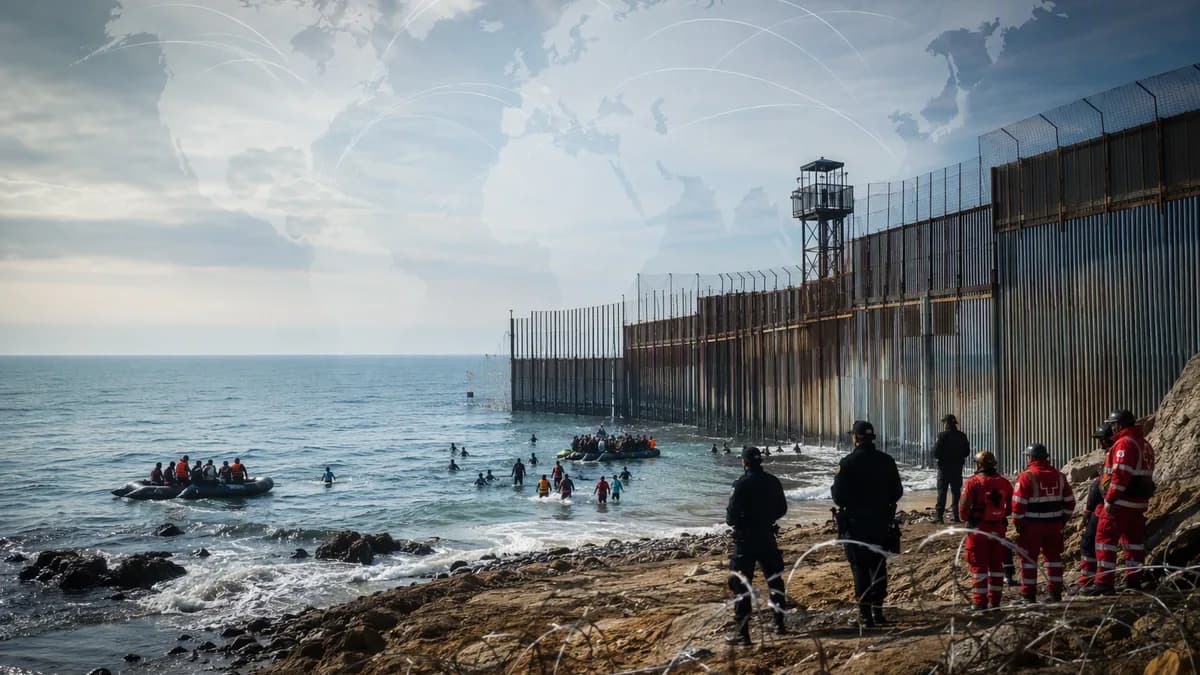
Ceuta migrants are exposing the weak point in Spain’s border fence: the water around it. Hundreds of people have entered Ceuta, Spain’s North African enclave on Morocco’s coast, with many swimming or using inflatables to get around the border barrier, according to BBC World.
Global TrendsJuly 30, 2026· 5 min read· By XOOMAR Insights Team
Ceuta Migrants Expose Spain’s Border Fence Weak Spot
Updated on July 30, 2026
XOOMAR Intelligence
Analyst Take
60/ 100
4 sources analyzedLow confidenceTrend10Freshness96Source Trust92Factual Grounding92Signal Cluster40
Others ran through a gate in the border fence, the BBC reported. Juan Jesús Vivas, Ceuta’s leader, said the arrivals were overwhelming local resources and urged Spain’s central government to intervene. Spanish media estimated between 2,000 and 3,000 people entered Ceuta on Thursday, according to Reuters, though the Guardia Civil had not confirmed that figure.
Ceuta migrants turned the sea route into Spain’s pressure point
Thesis: The crossings show that Ceuta’s land fence is no longer the only front line. The images reported by the BBC and other outlets show migrants entering by sea from Morocco, swimming around the border fence or using inflatables. That shifts pressure from fixed barriers to rescue capacity, patrol coverage and beach access points.
Ceuta has long been a focal point for migrants trying to reach Europe. Together with Melilla, it forms the European Union’s only land border with Africa, a status that gives the two Spanish enclaves outsized political weight whenever crossings rise. For prior context on the route, read XOOMAR’s earlier coverage, Ceuta Migrants Breach Spain’s Fortress Border by Sea.
Counterpoint: Not everyone entered by water. The BBC said some people ran through a gate in the border fence, while related reports said others scaled or breached border infrastructure. That matters because the crisis is not confined to one crossing method.
Still, the sea route is the defining feature of this surge. A Guardia Civil spokesperson cited by The Guardian said migrants were “massively entering from the sea” through the Tarajal breakwater, while videos showed crowds around breakwaters and beaches. The route forces Spain to treat the event as both a border-control problem and a maritime emergency.
| Reported element | Detail from supplied sources |
|---|---|
| Entry route | Swimming, inflatables, sea crossings from Morocco, and some entries through or over border fencing |
| Reported scale | Spanish media estimated between 2,000 and 3,000 entries on Thursday, not confirmed by Guardia Civil |
| Local warning | Juan Jesús Vivas said resources were being overwhelmed |
| State response | Spain said it would deploy extra troops and police to Ceuta, according to related reports |
Shelters, police and emergency services are absorbing the surge before confirmed totals arrive
Thesis: Ceuta’s immediate problem is capacity, not just counting. Vivas said the number of arrivals has overwhelmed resources. AP separately reported that he told journalists:
“In the last few days, more than 1,500 migrants, including adults and minors, have reached Ceuta by sea,”
“The reception centers are collapsed and saturated.”
That is the operational bind. When hundreds or thousands arrive in a short span, shelters, police, maritime rescue teams and medical services have to respond before verified totals are available. The absence of confirmed Guardia Civil numbers does not reduce the pressure on the ground.
The humanitarian risk is also clear from the route itself. Swimming around a border fence or breakwater can mean exhaustion, currents, injuries and rescues at sea. AP reported that Spain’s Civil Guard, maritime rescue services and the Red Cross had been using boats to pick up swimmers before taking them to Ceuta.
Counterpoint: Summer weather often brings more sea crossings. AP noted that good weather usually produces a seasonal rise in attempts. That makes part of the surge familiar to Spanish authorities.
The reported scale is what changes the calculation. Local authorities described the current number of swimmers as unusual, and Vivas said centers were saturated. Analysis: when a small enclave has to receive, identify, shelter and police a sudden wave of arrivals, the burden moves quickly from migration management to crisis logistics.
Madrid’s response now runs through Tarajal, Rabat and domestic politics
Thesis: Spain cannot manage the Ceuta migrants surge through local enforcement alone. The central government is sending reinforcements after Ceuta called for help. The Guardian reported that Spain’s interior ministry announced 60 members of the armed forces and 30 additional Guardia Civil officers would be deployed to Ceuta.
Reuters, via Yahoo, reported that the Interior Ministry said three platoons of 20 soldiers each, a diving unit and a military vessel would be deployed by Friday, while special police intervention units were being reinforced to a total of 200 personnel. Those details point to a broader response than routine border policing.
Madrid also depends on Morocco. The crossings began from the Moroccan side, and Spain’s ability to slow the route rests partly on cooperation with Rabat. AP reported that Interior Minister Fernando Grande-Marlaska praised Moroccan authorities, saying the relationship was “close and based on loyalty” and that Morocco was also limiting irregular departures.
Counterpoint: More forces may stabilize the border without resolving the reception problem. Vivas has called for more resources and intervention because the strain is already inside Ceuta, not only at the fence. If shelters remain saturated, a reinforced perimeter still leaves Spain with people sleeping outside reception facilities.
The political pressure is already visible. The Guardian reported that Alberto Núñez Feijóo, leader of the conservative opposition People’s Party, called the situation desperate and said Spain faced a “national security crisis.” XOOMAR has covered how public safety cases can quickly become national political flashpoints, including Salman Rushdie Attacker Faces Life After Terror Conviction, though the Ceuta case is a separate border and migration emergency.
The next practical test is narrow: whether arrivals slow after reinforcements reach Ceuta, whether Spain releases confirmed figures, and whether any injuries or deaths are officially reported from the sea crossings. If numbers keep rising despite more patrols at Tarajal, the pressure will move back to Madrid and Rabat, where enforcement, shelter capacity and diplomatic coordination now sit on the same clock.
Impact Analysis
- The surge highlights the limits of land border fences when crossings shift to the sea.
- Ceuta’s local authorities say arrivals are overwhelming resources and want Madrid to intervene.
- The crisis underscores the political sensitivity of the EU’s only land borders with Africa.
Ceuta crossing methods
| Route | What happened | Why it matters |
|---|---|---|
| Sea route | Migrants swam or used inflatables around the border fence from Morocco into Ceuta. | It exposes a weak point beyond fixed land barriers. |
| Land/gate route | Some people ran through a gate or breached border infrastructure. | It shows pressure remains across multiple entry points. |
Estimated migrant arrivals in Ceuta on Thursday
Low estimate
people2,000
High estimate
people3,000
Sources

Written by
XOOMAR Insights Team
Research and Editorial Desk
The XOOMAR Insights Team pairs automated research with human editorial judgment. We track hundreds of sources across technology, fintech, trading, SaaS, and cybersecurity, cross-check the facts, and explain what happened, why it matters, and what to watch next. We do not just rewrite headlines. Every article is fact-checked and scored for reliability before it goes live, and we link back to the original sources so you can verify anything yourself.
Explore More Topics
Related Articles
 Global Trends
Ceuta Migrants Breach Spain’s Fortress Border by Sea
Hundreds, possibly thousands, swam from Morocco into Ceuta, turning Spain’s fortified enclave into a test of Europe’s border capacity.
Jul 30, 20268 min
 Global Trends
300,000 Flee as European Wildfire Maps Expose Risk
European wildfire maps show fires outrunning evacuations and response, with 300,000 people displaced across France and Spain.
Jul 27, 20268 min
 Global Trends
Cockroach Protests Crack Modi’s BJP Fortress in Delhi
Cockroach protests forced a minister out and exposed fresh weakness in Modi’s BJP after years of dominance.
Jul 27, 20268 min
 Global Trends
3 Romania Drone Shootdowns Drag NATO Into Airspace Fight
Romania shot down three drones in three days, turning Black Sea spillover into a direct NATO airspace test.
Jul 26, 20268 min
 Global Trends
Trump Tariffs Twist Court Loss into Checkout Tax Fight
Trump recast his tariffs after a court loss. Democrats see an opening, calling them a sales tax on squeezed Americans.
Jul 25, 20269 min
 Technology
Apple TV August 2026 Crowns Ted Lasso, Then Turns Dark
Ted Lasso leads Apple TV’s August slate, but the month quickly shifts into crime, sports, kids animation and sci-fi.
Jul 30, 20269 min
 Fintech
$100M Bet Pushes Cashea Into Venezuela Credit Void
Cashea raised $100M to push BNPL into Venezuela's broader credit system, claiming 10M accounts and 40,000 stores.
Jul 30, 20266 min
 Technology
Costco Undercuts Galaxy Watch 9 With $40 Cut and $50 Card
Costco's Galaxy Watch 9 preorder beats Samsung's list price and adds a $50 gift card plus two chargers.
Jul 30, 20265 min
 Technology
AI Floods Chrome With 1,072 Security Bug Fixes in June
Google says AI helped patch 1,072 Chrome bugs in June, more than the prior two years. Security is becoming a speed race.
Jul 30, 20269 min
 Fintech
Hippo Growth Strategy Wields Rejection for Profits
Hippo's growth play is tighter underwriting: premiums jumped 61%, but CEO Rick McCathron says profit starts with risks it refuses.
Jul 30, 20268 min
Don't miss the signal
Get our weekly roundup of the stories that matter across tech, fintech, and trading. No noise, just signal.
Free forever. No spam. Unsubscribe anytime.