The Cartographer of Unclaimed Orbits
A Mars-born ritual designer must invent a shared culture for a generation ship before its passengers forget why they chose to leave.
1. The City That Learned to Breathe
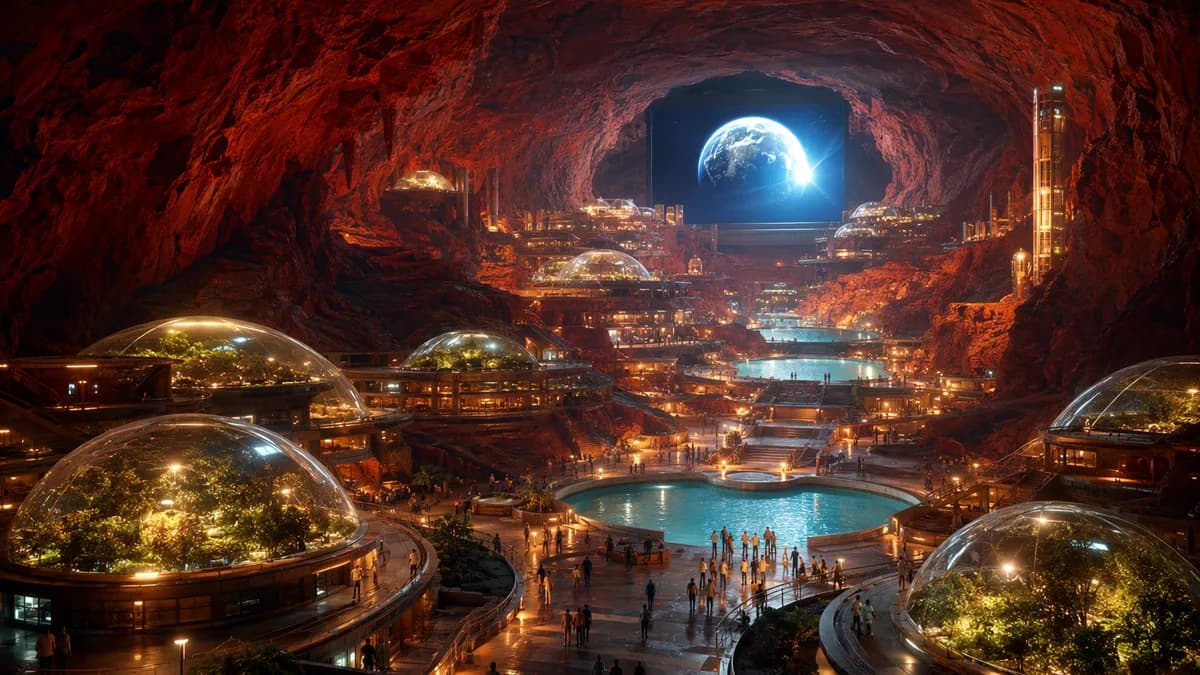
In Clarion, sunrise arrives at 06:10 on the east wall.
It spills across the lava tube in calibrated gold, brightening the terraced apartments and the wet green ladders of bean vines. Children pause with spoons halfway to their mouths. Old people lift their faces. Nobody in Clarion has ever seen the real sun climb over a horizon without a filter, not with naked eyes, not through the thin red sting of Mars air. Still, every morning, the city pretends.
Lio Varga grows up in Weather Room Seven, a narrow family suite named Rain. Their sleeping alcove is Drizzle, the kitchen is Thunder, and the shared bath down the corridor is Monsoon. No one in the Varga line has felt rain strike skin. Lio’s grandmother, who is Earth-born and suspicious of simulation, insists that real rain smells like soil waking up.
“Like the algae tanks after a flush?” Lio asks at eight.
“No,” Grandmother says, offended. “Like a planet remembering itself.”
Clarion remembers differently. It remembers in valves, filters, pressure seals, and the slow human discipline of breathing together. Water is not a resource here. Water is Auntie, witness, debt. At weddings, couples touch a shared bead of water to their tongues. At naming days, infants receive three drops on the forehead, one for body, one for memory, one for the city that keeps them alive. When someone dies, their recovered water is entered into the public ledger, and the family is thanked for returning what was only borrowed.
By twenty-seven, Lio has become a cultural cartographer, though their maps show few roads. Instead they chart habits, chants, taboos, jokes, gestures. In the dust towns beyond Clarion, mourners hold dust-wake funerals, opening a pinch of red soil into the ventilated chapel so the dead may “walk weather” for one last minute. In the low-gravity courts of Phobos, dancers hook toes under rails and spin like thrown ribbons, laughing when newcomers vomit into polite bags. In the algae wards, workers sing harvest songs that keep time with the pulsing pumps.
Lio records it all: how people make meaning from constraint, how fear becomes etiquette, how survival hardens into beauty.
One evening, their mother finds them in the archive vault, surrounded by recordings and scent samples.
“You collect ghosts,” she says.
“No,” Lio says, listening to a miner child recite oxygen warnings as a skipping rhyme. “I collect beginnings.”
Above them, Clarion exhales. Fans hum through stone older than bones, and the city that learned to breathe teaches its children that home is not where air is free. Home is where everyone agrees not to waste it.
2. The Miners Who Own the Dark
Hestia Yard does not look like a town until Lio learns where to look.
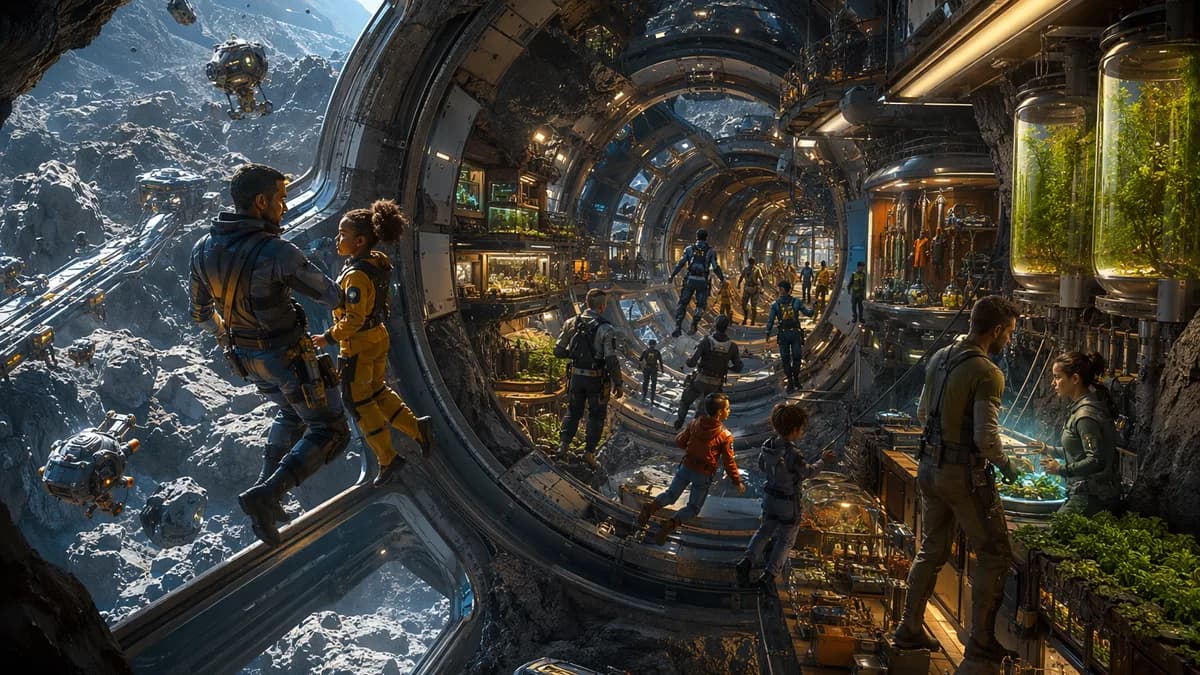
From the shuttle window, it is a scarred nickel-iron rock turning slowly against a blackness so complete it seems polished. Then the docking lights blink awake. Blue, amber, green. Habitats appear in the seams: cylinders threaded through the asteroid, cargo blisters clamped to metal, gardens glowing behind thick glass like trapped summers.
The first thing Lio hears inside is not voices. It is structure. The deep ticking of thermal stress. The sigh of pumps. The faint clank of someone working beyond a bulkhead. Hestia Yard rotates at half a meter per second, enough to persuade the body that floors matter. Lio’s stomach disagrees for the first hour.
Their host, Mara Qin, meets them at Dock Spine C with a shaved head, silver fingertips, and a child asleep in a pouch across her chest.
“Welcome to the dark we bought ourselves,” she says. “Don’t touch yellow handles unless you want twelve people angry at your funeral.”
The miners are rich enough to fund universities on Mars and poor enough to schedule private crying rooms in seven-minute blocks. Their walls are thin. Their meals are communal. Their children know the value of platinum before they know the names of Earth oceans. At dinner, Lio sits between a drill engineer and two teenagers who speak in clipped bursts.
“Spin six?” one says.
“Spin six if Aunt Jaro signs. Otherwise drift tax.”
“Valve rat says no.”
“Valve rat owes me three minutes shower.”
They laugh, but every joke contains a measurement, every insult a safety lesson. Their dialect braids orbital math, family gossip, pressure codes, and old Earth swear words polished down to bright stones. A child drops a cup, and six adults glance at the same wall gauge before anyone scolds.
Later, Mara takes Lio through the trust corridor, a narrow passage lined with handprints in heat-reactive paint. Every person who reaches working age presses a palm there and recites the Yard vow.
“What does it say?” Lio asks.
Mara smiles. “Nothing poetic. ‘I will not hide damage. I will not fake sleep during alarm. I will not spend air for pride.’”
They stop beside a small print, no bigger than Lio’s hand.
“My brother,” Mara says. “He was nine when he found a hairline crack and told us instead of being scared he’d get blamed. Saved all of Ring Two.”
Lio touches their recorder but does not turn it on. Some things should be heard first by the skin.
In Clarion, culture grows around scarcity. Here it grows around trust sharpened to a blade. One careless person can waste a decade of air, crack a family, bankrupt a lineage, kill a sleeping child. So Hestia Yard teaches its people to confess fast, repair together, and never mistake silence for peace. Silence here is a tool. Like a wrench. Like a prayer.
3. The Ship With Too Many Ancestors
Patient Heron is not yet a ship. It is a question being assembled in sunlight.
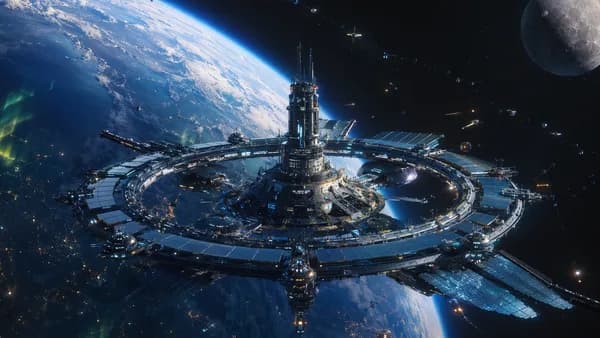
Lio arrives by transfer skiff and sees scaffolds glittering across kilometers of unfinished hull. Habitat rings hang open like ribs. Mirror fields turn with insect grace, drinking solar fire. Welding drones flicker along the spine, white sparks vanishing into vacuum. The ship is meant to travel for centuries, perhaps longer than the civilizations that build it. For now it smells, inside the pressurized sections, of hot plastic, machine oil, and human argument.
The argument begins before Lio unclips from the arrival couch.
“Mars Standard cannot be the base calendar,” says an Earth delegate, voice sharp through the conference wall. “It is politically impossible.”
“Politically impossible is asking children born in transit to celebrate monsoon holidays they have never seen,” a Martian elder replies.
A lunar biologist says, “We need reproductive law settled before launch, not improvised by teenagers in Year Fifty.”
From the Belt bloc comes a dry voice. “If teenagers in Year Fifty are still listening to us, we have designed the wrong culture.”
Lio smiles despite themself.
They are hired as cultural cartographer, ritual designer, and, unofficially, sponge for everyone’s panic. Patient Heron has too many ancestors. Mars sends engineers and soil poets. Earth sends seed vaults, languages, religions, museums compressed into crystal. Hestia Yard and other cooperatives send miners, fabricators, quiet children with fast hands. Lunar biolabs send geneticists who speak of embryos the way priests speak of candles. Every faction fears being diluted. Every faction insists it is not afraid.
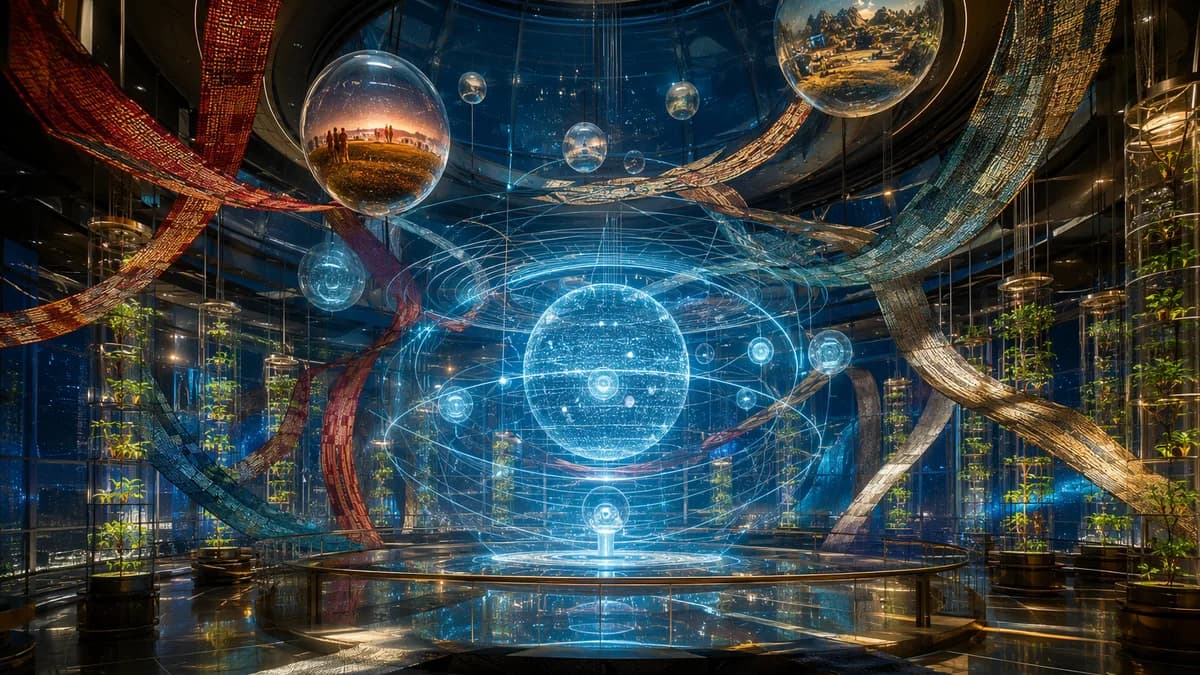
In the planning chamber, Lio stands before a table projection of the ship, its rings rotating in ghostly blue.
“You want a Departure Compact,” they say. “Not a constitution alone. Not a museum. Not a loyalty oath. You want a framework for people who will be born inside corridors, fall in love under grow lamps, rebel against ancestors they know only through recordings, bury parents whose destination remains theoretical, and still choose not to tear the ship into tribes.”
The room quiets.
An Earth sponsor, immaculate in a dark suit with magnetic cuffs, folds his hands. “Can you make them remember why they left?”
Lio looks through the viewport at a construction worker drifting outside, boots locked to a beam, body outlined by the sun.
“No,” Lio says. “Memory decays when treated like cargo. But I can help them practice asking.”
The sponsor frowns. The Martian elder leans back, interested. The Belt representative gives one short laugh, the sound of a bolt snapping clean.
Outside, Patient Heron grows panel by panel, a vessel built from rival hungers. Inside, Lio begins to understand the danger. A ship can carry air, seeds, tools, laws. But ancestors take up more room than anyone budgets for, especially when they refuse to be dead.
4. A Festival for People Who Will Never Arrive
Lio’s proposal fits on one thin sheet and frightens nearly everyone.
They call it the Unfinished Map.
Once every ship year, all work pauses except life support, navigation, and care duties. Each deck gathers in its largest available space. Children bring drawings. Engineers bring maintenance scars. Cooks bring something fermented or sweet. The ship’s current story is read aloud, not as sacred history but as last year’s best attempt. Then anyone may challenge it. Anyone may add, cut, mourn, accuse, praise, or ask why Patient Heron continues forward.
By the end of the festival, the passengers make a new map, part route, part confession, part promise. It includes where they came from, what they have lost, what they refuse to become, and what they do not yet know how to name.
“No flag?” asks the Earth sponsor, blinking as if Lio has suggested launching without engines.
“No permanent anthem,” Lio says.
The Martian elder, Sera Ochoa, grips her cane. Her knuckles are pale under brown skin. “You make the mission soft. A people who revise their reason may revise it into nothing.”
“A reason that cannot survive questions is already nothing,” Lio says gently.
Mara Qin has come from Hestia Yard to represent the cooperatives. She stands with arms crossed, silver fingertips tapping her sleeve. “Our codes are not poetry. They are survival. If some Year Eighty child votes to stop silence protocol because it feels oppressive, people die.”
“The Compact separates safety law from story ritual,” Lio says. “No one votes away pressure discipline during a festival.”
“But they can mock it,” Mara says.
“Yes,” Lio says. “And then someone who knows why it exists must answer.”
That, more than anything, alarms them.
Debates bloom through Patient Heron’s unfinished halls. Lio hears them in lift shafts and meal lines, in the chapel module where five faiths share storage, in the nursery ring where wall murals still smell of fresh polymer. People want a founding myth with clean edges. They want bravery without regret, unity without compromise, descendants without disobedience.
In a temporary mess, a young lunar geneticist named Anvi corners Lio over bowls of kelp noodles.
“What if they decide to turn back?” she asks.
“Then they will need a story strong enough to hold that too.”
“You sound calm.”
“I’m terrified,” Lio says.
Anvi studies them, then laughs into her noodles. “Good. I distrust calm ritualists.”
That night, Lio floats alone in the observation blister. The sun is a white wound. Mars is a red bead. Earth is a blue rumor. Patient Heron surrounds them with metal bones and unfinished rooms, waiting to become either a prison of inherited commands or a living place.
Lio presses their palm to the glass. No culture survives by staying pure. It survives by teaching its children how to argue without opening the airlock.
5. The First Child of the Corridor
The alarm begins as a soft chime, polite enough to be mistaken for a meal notice. Then the lights snap blue.
“Pressure drop, Nursery Ring Three,” says the ship voice. “Seal breach suspected. Nonessential personnel clear corridor.”
Lio is in Compact hearings when the first vibration shivers through the deck. Across the table, Mara’s face changes before anyone speaks. Not fear. Calculation.
“Who’s in Ring Three?” Lio asks.
A technician scans fast. “Paint crew, two medics, three family candidates touring. One pregnant, flagged high risk.”
The next sound is worse than the alarm: a human voice over comms, trying not to scream.
“This is Tavi Okonkwo. My partner’s bleeding. Door C won’t cycle. We’re losing pressure in the corridor.”
Lio moves before permission forms in the room. By the time they reach the emergency station, their hands are already pulling up schematics. Nursery Ring Three is unfinished, half murals and half exposed conduit. A micrometeor fragment, no larger than a fingernail, has punched through an unarmored service panel. Automatic foam seals part of it, but not enough. The trapped group has minutes before hypoxia thickens their blood and thinking frays.
“Everyone on that corridor goes silent except designated voices,” Mara snaps, taking a console. “No panic chatter. No prayers on open comms. Breathe through nose. Count on fingers.”
Lio hears Hestia Yard in her tone.
They open a channel. “Tavi, this is Lio Varga. Put your hand on the nearest cold pipe.”
“What?”
“Do it. Feel the ship. You are here. We are here. Tell me your partner’s name.”
“Mei. Mei Santos. Contractions are close. Too close.”
A Martian engineer shouts from the repair bay, “We can reroute sealant, but we need water mass in the line.”
Lio thinks of Clarion, of ceremonies where three drops matter. “Use the nursery reserve.”
Sera Ochoa protests from behind them. “That water is consecrated for first births.”
“This is a first birth,” Lio says.
Silence, then Sera nods once.
Anvi arrives breathless, hair escaping its cap, med kit banging against her hip. “I can talk them through delivery if we get pressure stable.”
“You’ll improvise?” Lio asks.
“I’m Earth-trained,” Anvi says, already plugging in. “Improvisation is half the curriculum. The other half is apologizing afterward.”
Sealant pumps thud. Somewhere beyond the walls, water meant for ritual becomes emergency mass, pushing foam into the wound. Mara enforces silence protocols with merciless calm. Lio talks Tavi through Martian breath counting, four in, six out, no wasted panic. Anvi’s voice enters the corridor warm and firm.
“Mei, listen to me. Your child is impatient, not doomed.”
For seven minutes, Patient Heron is not Mars, Earth, Belt, Moon. It is hands on consoles, teeth clenched, recycled air tasting of metal, one woman groaning in a half-painted nursery under blue emergency lights.
Then a thin cry cuts through the comm.
No one speaks. The cry comes again, furious, wet, alive.
Tavi sobs. “She’s here.”
Mara covers her eyes with one silver hand. Sera whispers a water blessing too softly for the mic. Anvi laughs, and the laugh breaks into tears.
“What’s her name?” Lio asks.
Mei’s voice comes faintly, exhausted. “Corridor, if the council allows it.”
The hearing resumes three days later, but the room is different. Everyone has heard the recording. Everyone has imagined the child blinking up at unfinished stars painted on a curved wall. She is not Martian, Terran, lunar, or Belt-born. She belongs first to a moving place that nearly failed her and then learned, all at once, how to keep her alive.
6. Leaving Without Leaving Behind
Launch day on Mars smells like warm dust and wet leaves.
Clarion opens every public chamber, and the old lava tube fills with bodies. People crowd onto terraces, balconies, maintenance ladders. The east wall shows Patient Heron in solar orbit, complete at last, its habitat rings turning with solemn grace. Children sit cross-legged under vines. Elders hold cups of water in both hands. Somewhere a baby fusses, and someone hushes him by humming an algae harvest song off-key.
Lio stands in Weather Room Seven with their mother and grandmother, though every official channel has begged them to board a shuttle for the launch platform. Their name is on plaques inside Patient Heron. Their voice is stored in the Compact archive. There is a cabin available, small but private, labeled Cultural Continuity Specialist.
They do not take it.
“You could still go,” their mother says.
On the wall, the ship catches sunlight and becomes a bright needle.
“I know.”
Grandmother sniffs. “Your work sails without you. That is either wisdom or cowardice.”
“Probably both,” Lio says.
She laughs, then presses a cup into their hands. The water trembles with reflected gold.
Across the system, the first Unfinished Map begins.
On Hestia Yard, miners gather in the trust corridor. Children project chalk-bright routes over old handprints while Mara Qin reads the opening line: We travel because staying still also changes us. A boy objects immediately, claiming it sounds like something a committee says before stealing dessert. The adults let the objection stand.
On Earth, in a coastal city that has built three seawalls and still floods during king tides, schoolchildren add recordings of rain to the Map. Real rain drums on the roof above them, impatient and ordinary. One child asks whether Patient Heron’s descendants will believe such a sound ever existed without speakers.
On the Moon, biologists place seed trays under lamps and argue over whether loyalty belongs to origin, offspring, or the living system between them.
Aboard Patient Heron, Corridor Santos-Okonkwo sleeps against Mei’s chest while Tavi reads the first shipboard revision. The nursery mural is finished now. It shows Mars dust, Earth ocean, asteroid metal, lunar glass, and a long blank curve where children are invited to draw what comes next.
The engines ignite without flame visible to naked eyes, but instruments translate the burn into music, a low chord that vibrates through Clarion’s walls. Lio feels it in their ribs. Around them, people lift their water cups. No one cheers at first. The departure is too large for cheering.
Patient Heron begins to move outward, not fast, not like stories promised when rockets were still symbols of conquest. It leaves the inner system with the patience of a migrating animal, carrying arguments, seeds, repair codes, lullabies, grudges, and one festival designed to be unfinished.
Lio watches until the ship is only a bright mark among other bright marks.
Their grandmother touches the screen. “There they go.”
Lio looks at the water in their cup, at the tiny shaking surface holding a false sunrise.
“No,” they say softly. “There we widen.”