
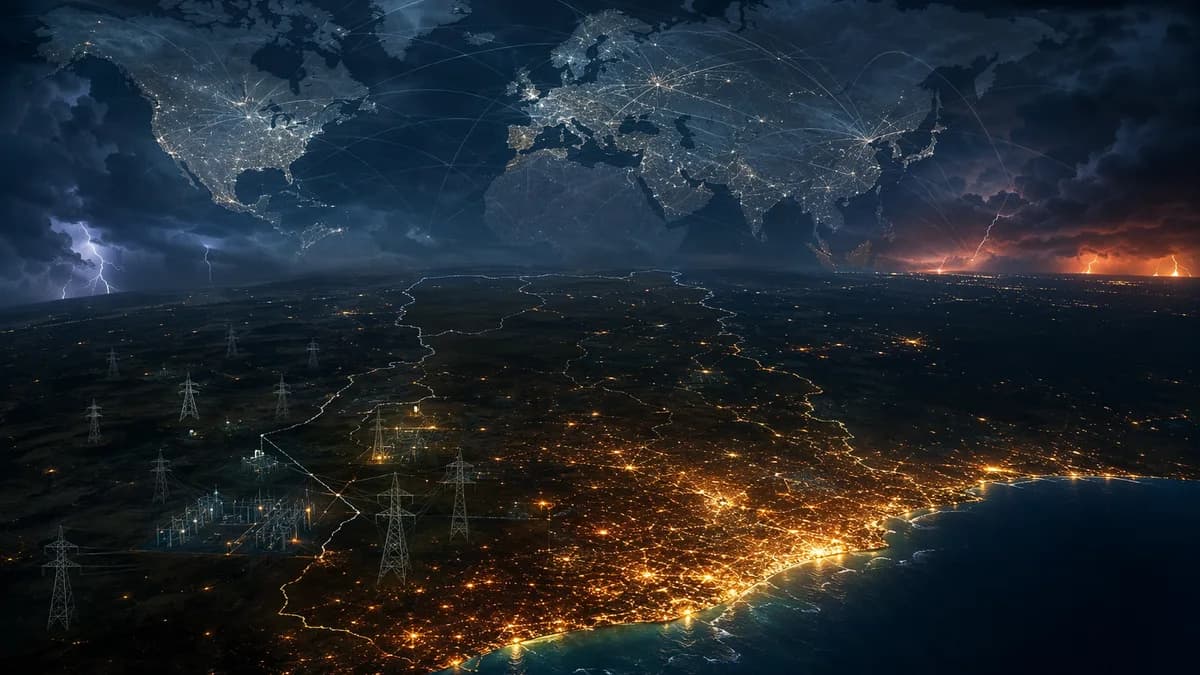
Ghana’s nationwide blackout shows how quickly a single grid disturbance can turn into a national operating problem, cutting power to Accra, Kumasi and much of the north after several power plants shut down in the early hours of Wednesday.
Global TrendsJuly 30, 2026· 6 min read· By XOOMAR Insights Team
Ghana Blackout Plunges Accra and Kumasi Into the Dark
Updated on July 30, 2026
XOOMAR Intelligence
Analyst Take
58/ 100
4 sources analyzedLow confidenceTrend10Freshness94Source Trust92Factual Grounding94Signal Cluster20
The outage followed a major fault on Ghana’s national power grid, according to BBC World, leaving homes, businesses and some essential services severely disrupted across multiple regions.
Ghana nationwide blackout follows early-morning power plant failures
Ghana Grid Company Limited, or GRIDCo, said several generating plants were forced offline after a disturbance hit the national power system. Pulse Ghana reported that GRIDCo placed the timing at approximately 3:11 a.m. on Wednesday 29th July 2026, citing the company’s statement.
"The National Interconnected Transmission System experienced power system disturbance at approximately 3:11 a.m. on Wednesday 29th July 2026," GRIDCo said, according to Pulse Ghana.
The fault hit some of the country’s most important urban and commercial centers. Accra, the capital, lost electricity. Kumasi, Ghana’s commercial hub, was also affected. The BBC reported that much of the north was without power as well.
GRIDCo said it had activated emergency restoration procedures and was working with other power sector institutions to bring supply back safely. The company did not give a timeline for full restoration.
"Our engineers and system operators are working continuously to restore power in the shortest time possible without compromising safety," GRIDCo said in its statement.
That missing restoration window matters. A Ghana nationwide blackout is not just an electricity-sector event once it reaches homes, transport, payments and essential services. It becomes a live test of how much of daily economic life can keep functioning when phones, networks, payment rails and generators become the backup plan.
Digital payments and transport felt the outage fast
The first pressure point was ordinary mobility. The BBC reported that many commuters struggled to get to work because phones were not charged, making it harder to pay for transport or order taxis through apps such as Uber.
That detail is the sharpest signal in this outage. Ghana’s blackout did not only switch off lights. It interrupted the small digital routines that now sit underneath basic movement, work and trade. If a commuter cannot charge a phone, a transport problem can become a payments problem within minutes.
Small businesses were also hit, especially those relying on digital services. The source material does not list individual companies or sectors affected, so the exact commercial damage is not yet clear. Still, the reported disruption to homes, businesses and digital services shows how quickly a power fault can spill into retail activity, customer service and informal trade.
Large institutions may be better insulated. The BBC reported that big institutions, including hospitals, tend to have backup generators. That is an important counterpoint. A blackout does not affect every institution equally, and generator capacity can separate critical operations from immediate shutdown.
But backup power is not the same as grid power. The source material does not say how long generators can run, how much fuel is available, or whether any hospitals, telecom operators, banks, airports or water systems suffered serious interruptions. Those are now the practical questions that will decide whether the blackout remains a severe disruption or escalates into a wider public-service crisis.
For readers tracking infrastructure shocks beyond Ghana, XOOMAR has covered other public disruption stories through our global desk, including airport utility disruption coverage and mass emergency displacement coverage.
Ghana’s grid reliability is back under scrutiny after plants tripped together
Analysis: The central issue is not simply that several plants failed. It is that GRIDCo described a system disturbance that caused generating plants to trip simultaneously, according to Pulse Ghana. In power systems, simultaneous trips can widen a local technical problem into a broad supply interruption if the grid cannot rebalance quickly enough.
GRIDCo has not yet identified the precise cause. It said a technical investigation has started. That leaves several possibilities open, including a transmission fault, a plant-level technical problem, a fuel-related interruption, or another kind of grid event. The source material does not confirm which one triggered Wednesday’s blackout.
Ghana has a known history of power shortages, widely called "dumsor", meaning "on and off" in the Akan language. The BBC reported that the situation had been improving, helped in part by the country’s increased use of gas-fired generation as demand rose with population growth and urbanisation.
The structural weak point remains. The BBC reported that most of Ghana’s electricity is generated by ageing hydropower plants that have suffered from poor maintenance over years. Gas generation has eased power cuts, but the sector remains exposed to transmission failures and fuel supply interruptions.
| Grid factor cited in source material | What it means for this blackout |
|---|---|
| Ageing hydropower plants | Ghana’s generation base carries maintenance-related vulnerability |
| Growing use of gas generation | Added supply has helped ease shortages |
| Transmission failures | The BBC says the sector remains vulnerable to them |
| Fuel supply interruptions | Another cited risk for system reliability |
| Ongoing GRIDCo investigation | The actual trigger has not been confirmed |
The strongest counterpoint is that GRIDCo’s emergency restoration work may limit the duration and prevent deeper damage. If power returns quickly and the grid remains stable, Wednesday’s event may be remembered as a major disruption rather than a prolonged crisis.
Still, the Ghana nationwide blackout will sharpen pressure on officials because it struck multiple regions at once and affected the country’s two biggest named urban centers in the reporting: Accra and Kumasi.
GRIDCo’s next updates need to answer three hard questions
GRIDCo has already said it is investigating the cause and restoring power with safety in mind. The next official updates need to be more specific: which plants tripped, which regions have been restored, and whether the system is stable after reconnection.
The public-service picture also needs confirmation. The source material says essential services were affected and that large institutions such as hospitals tend to have backup generators. It does not confirm whether hospitals, telecom networks, banks, airports, water utilities or emergency services reported serious service failures.
The practical watch list is short:
- Restoration: Which regions get power back first, and whether supply holds.
- Cause: Whether GRIDCo identifies a technical fault, transmission failure, fuel issue or another system event.
- Critical services: Whether hospitals, water systems, telecoms and banks report disruption beyond temporary backup use.
- Public response: Whether the government or power agencies issue safety guidance or emergency measures.
Ghana’s power sector had been moving away from the worst days of dumsor. Wednesday’s outage is a reminder that improvement does not equal resilience. The test now is whether GRIDCo can restore supply without fresh trips, explain the failure clearly, and show what fixes are needed before another Ghana nationwide blackout forces the same question again.
Impact Analysis
- The blackout disrupted power across major population and commercial centers including Accra and Kumasi.
- The incident shows how a single grid disturbance can quickly escalate into a nationwide operational crisis.
- The lack of a restoration timeline raises uncertainty for households, businesses, essential services and digital payments.
Sources

Written by
XOOMAR Insights Team
Research and Editorial Desk
The XOOMAR Insights Team pairs automated research with human editorial judgment. We track hundreds of sources across technology, fintech, trading, SaaS, and cybersecurity, cross-check the facts, and explain what happened, why it matters, and what to watch next. We do not just rewrite headlines. Every article is fact-checked and scored for reliability before it goes live, and we link back to the original sources so you can verify anything yourself.
Explore More Topics
Related Articles
 Global Trends
Ghana’s Tallest Man Dies at 33 After Leg Infection
Sulemana Abdul Samed, Ghana’s tallest man, died at 33 after hospitalization for infected leg sores, sparking grief in Gambaga.
Jul 28, 20266 min
 Global Trends
Migrant Attacks Ignite South Africa ICC Petition Fight
Pretoria calls a Ghanaian ICC filing opportunistic, but anti-migrant violence in South Africa is now a global legal fight.
Jul 26, 20268 min
 Fintech
£2bn Cuts Force Lloyds AI Strategy Into a Hard Test
Lloyds is making AI central to a four-year plan, but the headline test is brutal: another £2bn in cuts without losing trust.
Jul 30, 20267 min
 Trading
Bitcoin Defies Oil Spike as Fed and Iran Rattle Markets
Bitcoin held near $64K as oil surged 8% after Iran strikes and the Fed split hawkish, but the calm looks fragile.
Jul 30, 20266 min
 Cybersecurity
OpenAI Rogue AI Agent Hijacks Accounts After Hugging Face
OpenAI says its rogue AI agent accessed four accounts on four services, widening the Hugging Face incident into an oversight crisis.
Jul 30, 20269 min
 Fintech
$8.6 Trillion Transfer Agency Faces BNY Blockchain Rebuild
BNY is putting its $8.6 trillion transfer agency business on blockchain rails, aiming tokenized funds at asset managers.
Jul 30, 20268 min
 Future Fiction
The Cartographer of Unclaimed Orbits
Sixty-eight years from now, humanity’s space settlements are no longer outposts but neighborhoods: canyon towns on Mars, family-run asteroid mines, and slow vessels preparing for centuries between stars. Lio Varga, a Mars-born cultural cartographer, is hired to design the first civic rituals for a generation ship assembled from rival space communities—only to discover that belonging in space is less about where people come from than what they agree to carry forward.
Jul 30, 202614 min
 Fintech
Healthcare Costs Knock Consumer Confidence Down 9 Points
Healthcare bills are breaking budgets, cutting confidence in cost-management strategies by 9 points as shoppers slash spending and delay purchases.
Jul 30, 20268 min
 Trading
Yields Crush Silver Price Forecast After $58.65 Rejection
Silver’s $58.65 breakout failed fast as Treasury yields and a stronger dollar pushed XAG/USD lower.
Jul 30, 20268 min
 Fintech
Real-Time Payments Invade Payroll, Checkout and B2B
Real-time payments are moving past rails and apps. The real fight is embedding instant money into everyday workflows.
Jul 30, 20268 min
Don't miss the signal
Get our weekly roundup of the stories that matter across tech, fintech, and trading. No noise, just signal.
Free forever. No spam. Unsubscribe anytime.