
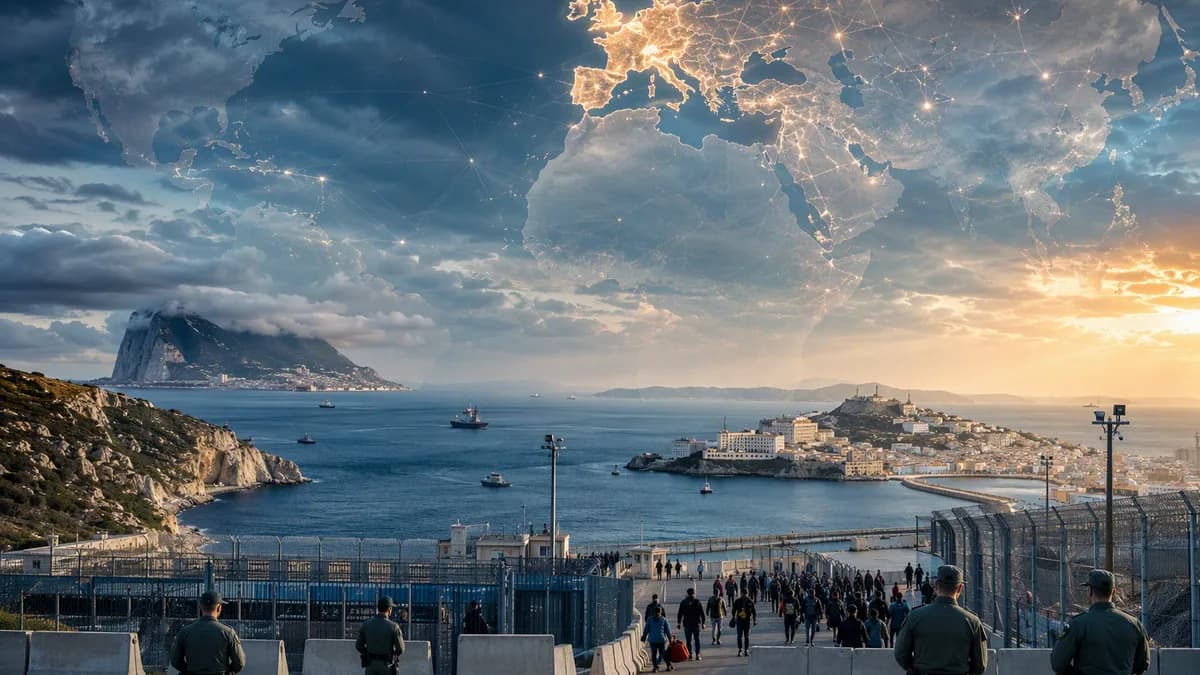
The Ceuta migrant crossings have turned a border emergency in Spain’s North African enclave into a direct challenge to Schengen, with Madrid accusing some EU partners of using the crisis to fracture European solidarity rather than reinforce it.
Global TrendsAugust 1, 2026· 8 min read· By XOOMAR Insights Team
Ceuta Migrant Crossings Shatter Europe's Schengen Trust
Updated on August 1, 2026
XOOMAR Intelligence
Analyst Take
60/ 100
4 sources analyzedLow confidenceTrend10Freshness95Source Trust92Factual Grounding94Signal Cluster40
Spain condemned what Prime Minister Pedro Sánchez called the “selfish, polarising and unlawful” reaction of some EU countries after about 60,000 migrants crossed from Morocco into Ceuta, according to BBC World. The immediate trigger was Italy’s temporary suspension of the Schengen arrangement with Spain, after Prime Minister Giorgia Meloni called the scenes “shocking”.
“The European Union cannot afford this kind of selfish, polarising and unlawful reaction,” Sánchez said.
XOOMAR analysis: the deeper signal is blunt. Europe’s open-border model still depends on national governments trusting each other under pressure. Ceuta shows how fast that trust can crack when migration, domestic politics, and frontier security collide.
Ceuta migrant crossings turn Schengen solidarity into a loyalty test
Spain says it regained control in less than 48 hours, returned almost all of those who reached Ceuta, and prevented any “unauthorised onward movement towards continental Europe”. That matters because Sánchez’s core argument is legal as much as political: Ceuta is not part of the Schengen area, so punishing Spain’s Schengen status over events in the enclave is, in Madrid’s view, misplaced.
Italy saw the same images differently. Meloni described the situation as “uncontrolled immigration” and a threat to national security before suspending Schengen arrangements with Spain for one month. Finland and Denmark backed Italy’s stance, while Czech Prime Minister Andrej Babiš urged a temporary suspension of Spain’s Schengen membership.
That split is the crisis. The ground situation in Ceuta appears to be easing, with Spanish MEP Juan Fernando López Aguilar telling the BBC the situation was “beginning to get under control” and migrants were “returning peacefully”. The diplomatic damage is still spreading.
For more on how the enclave’s geography shapes these flare-ups, see XOOMAR’s earlier context on Ceuta migrants exposing Spain’s border fence weak spot and Ceuta migrants breaching Spain’s fortress border by sea.
The hard numbers behind the Ceuta surge and Italy’s Schengen move
The verified figures are stark:
| Measure | Source-supported detail |
|---|---|
| Arrivals | About 60,000 migrants crossed from Morocco into Ceuta |
| Date cited | Officials refer to those who reached the enclave on 30 July |
| Deaths | Spain’s interior minister Fernando Grande-Marlaska said the death toll had risen to 67 |
| Spanish response time | Sánchez said control was restored in less than 48 hours |
| Italy’s measure | Schengen arrangement with Spain suspended for one month |
| Schengen size | The Schengen Area spans 29 European countries |
| Ceuta’s status | Spanish enclave in North Africa, not part of the Schengen area, and with Melilla forms the EU’s only land borders with Africa |
Madrid sent troops, more police, drones, divers and boats to Ceuta. It also deployed armed forces to Melilla, where hundreds of crossings were reported. France tightened checks on its border with Spain and said it would increase police presence by Saturday. Portugal said it was considering reinforcing border checks.
The practical effect of Italy’s suspension is still not fully defined in the supplied reporting. DW said it was unclear how the temporary suspension would be implemented on the ground. The likely pressure points are checks, documentation demands, delays, and uncertainty for movement between Spain and Italy, but the available source material does not provide operational details.
XOOMAR analysis: Italy’s move is politically louder than it is yet operationally clear. That makes it useful for signaling resolve, but risky for Schengen credibility if other governments copy it before facts on onward movement are settled.
Madrid, Rome, Brussels, and Rabat are pulling the crisis apart
Spain’s line is that it contained the Ceuta migrant crossings before they became a wider EU mobility problem. Sánchez told European Commission President Ursula von der Leyen that Spain had prevented any “unauthorised onward movement towards continental Europe”. EU Commissioner Magnus Brunner also said, after a call with Spanish Foreign Minister José Manuel Albares, that “not a single person has crossed to mainland EU”.
Italy’s line is that the pictures from Ceuta justified emergency action. Meloni’s message lands at two levels: border security and domestic politics. The source material supports the security framing directly. Her social media post described “uncontrolled immigration” as a national security threat.
Brussels is trying not to choose between two bad options. Von der Leyen said the images from Ceuta were “unacceptable” and added:
“We cannot allow anyone to come to our Union without abiding by our rules.”
That statement backs enforcement. It does not endorse Italy’s suspension. Brussels must defend Schengen while avoiding a public rupture between member states already split over migration.
Morocco sits at the center of the operational question. Sánchez said Moroccan authorities were co-operating and blamed trafficking gangs for the surge, calling it a “violation of Spain’s territorial integrity”. He said:
“Trafficking mafias took a self-serving interpretation of a Supreme Court ruling” which “spread like wildfire”.
That ruling came in June, when Spain’s Supreme Court said migrants stopped at sea while trying to reach Ceuta or Melilla could not be summarily returned to Morocco without due process.
Ceuta’s pressure points keep repeating because the legal and political incentives clash
Ceuta has been here before. In 2021, about 8,000 people entered the enclave over several days, worsening Spain’s diplomatic tensions with Morocco. This year’s surge is far larger, but the underlying mechanism is familiar from the supplied material: Ceuta is reachable by swimming several kilometres, summer often brings pushes toward the enclave, and attempts are typically organised over social media.
Spain also has a broader migration position that puts it at odds with Rome. In April, Madrid approved plans to give legal status to 500,000 undocumented migrants, integrating them into the workforce. Meloni had already criticised Sánchez at that time, saying the policy would “affect its neighbours”.
Then, in June, the European Parliament approved tougher migration rules granting authorities broader powers to return irregular arrivals. That sequence matters. Spain is trying to defend due process, border control, and a relatively open integration policy at the same time. Italy is pressing the deterrence side harder.
XOOMAR analysis: Ceuta exposes the contradiction EU governments keep trying to manage. Frontline states want solidarity when border pressure spikes. Interior and destination states want assurance that arrivals won’t move onward. EU institutions want rules to hold. National governments bend those rules when the pictures become politically toxic.
Travelers, asylum policy, and Spain’s domestic pressure now sit inside the same Schengen dispute
For travelers and businesses, the immediate concern is not panic. It is friction. If temporary checks expand or become more intrusive, movement between Spain and other European countries can face delays and documentation demands. France has already tightened checks. Portugal is considering more controls. Finland said it had started preparations for restoring internal border checks “if the need arises”.
For asylum and migration policy, the risk is precedent. If Italy’s one-month move becomes a template, member states may reach for Schengen restrictions whenever migration politics flare up, even when the contested territory is not itself inside Schengen.
For Spain, the domestic stakes are punishing. Ceuta’s local authorities had to absorb chaotic scenes, deaths, returns, security deployments, and humanitarian needs in a compressed time frame. Nationally, Sánchez has to show control without abandoning the legal limits set by Spain’s own Supreme Court.
For the EU, the damage is trust. Schengen works when governments believe external and internal controls are being managed predictably. The Ceuta migrant crossings have made that belief shakier.
Tougher checks and sharper rhetoric are the scenarios to monitor now
The next phase is likely to be fought through emergency meetings, border deployments, and carefully worded statements rather than a clean institutional showdown.
Spain has called for urgency among EU interior ministers and will press for solidarity language, operational support, and resistance to unilateral Schengen moves. Italy will try to prove that its suspension forced attention to security risks. Brussels will likely seek technical coordination because a formal confrontation would expose deeper cracks.
The evidence that would support Spain’s thesis is straightforward: no onward movement to mainland Europe, continued Moroccan co-operation, and a visible return to order in Ceuta. The evidence that would weaken it would be renewed crossings, documented movement beyond the enclave, or more EU states restoring checks.
Ceuta is now more than a Spanish border crisis. It is a live test of whether Schengen rules still bind governments when migration pressure becomes politically explosive.
Impact Analysis
- The crisis exposes how quickly Schengen solidarity can weaken under migration pressure.
- Spain’s argument hinges on whether events in Ceuta should affect its Schengen status.
- The split among EU governments shows migration remains a major fault line in European politics.
EU responses to the Ceuta migrant crossings
| Actor | Position | Action or argument |
|---|---|---|
| Spain | Condemned the response as selfish and unlawful | Argued Ceuta is outside Schengen and said it regained control in less than 48 hours |
| Italy | Framed the crossings as a national security threat | Temporarily suspended Schengen arrangements with Spain for one month |
| Finland and Denmark | Backed Italy’s stance | Supported a tougher response to Spain over the crossings |
| Czech Republic | Called for further suspension | Andrej Babiš urged a temporary suspension of Spain’s Schengen membership |
Sources

Written by
XOOMAR Insights Team
Research and Editorial Desk
The XOOMAR Insights Team pairs automated research with human editorial judgment. We track hundreds of sources across technology, fintech, trading, SaaS, and cybersecurity, cross-check the facts, and explain what happened, why it matters, and what to watch next. We do not just rewrite headlines. Every article is fact-checked and scored for reliability before it goes live, and we link back to the original sources so you can verify anything yourself.
Explore More Topics
Related Articles
 Global Trends
49,000 Crossings Plunge Ceuta Border Crisis Into Chaos
A 49,000-person surge into Ceuta left at least 18 dead and put Spain's EU border strategy under brutal pressure.
Jul 31, 20268 min
 Global Trends
Ceuta Migrants Breach Spain’s Fortress Border by Sea
Hundreds, possibly thousands, swam from Morocco into Ceuta, turning Spain’s fortified enclave into a test of Europe’s border capacity.
Jul 30, 20268 min
 Global Trends
Ceuta Migrants Expose Spain’s Border Fence Weak Spot
Hundreds swam or used inflatables to reach Ceuta, turning the sea around Spain’s border fence into the crisis point.
Jul 30, 20265 min
 Global Trends
Russia Exposes Ukraine Air Defence Shortage in Deadly Strike
Ukraine stopped just one of 27 ballistic missiles, exposing a dangerous air defence shortage after a strike killed nine.
Aug 1, 20266 min
 Global Trends
300,000 Flee as European Wildfire Maps Expose Risk
European wildfire maps show fires outrunning evacuations and response, with 300,000 people displaced across France and Spain.
Jul 27, 20268 min
 Technology
Autonomous Drone Inspection Exposes 30-Day Outage Risk
A Skydio drone found hidden substation bolt failures, helping Southern California Edison avoid a 30-day outage and giving lenders a new risk signal.
Aug 1, 20267 min
 SaaS & Tools
App Store Hidden Gems Defy AI Agent Hype With Real Jobs
New app launches are up 60% in 2026, and focused App Store hidden gems show useful software isn't yielding to AI agents.
Aug 1, 20268 min
 Fintech
Pix BNPL Cracks Open Credit for 60 Million Brazilians
Ebanx and Pagaleve are turning Pix into BNPL, targeting 60 million Brazilians without credit cards.
Aug 1, 20266 min
 Technology
Dead Captain Locks The Mermaid Mask Into Summer's Best Case
The Mermaid Mask turns a dead submarine captain into a breezy, sharp summer mystery game that is hard to put down.
Aug 1, 20268 min
 Technology
12 Keychain Gadgets That Fight Tiny Daily Disasters
Your keyring isn't a gadget shelf. The best keychain gadgets solve small failures fast, from dead cables to dark stairs.
Aug 1, 20269 min
Don't miss the signal
Get our weekly roundup of the stories that matter across tech, fintech, and trading. No noise, just signal.
Free forever. No spam. Unsubscribe anytime.