The Rainwright of Pelagos Nine
In a city beneath the warmed Atlantic, a weather composer must decide who deserves the next storm.
1. The City That Learned to Breathe Water
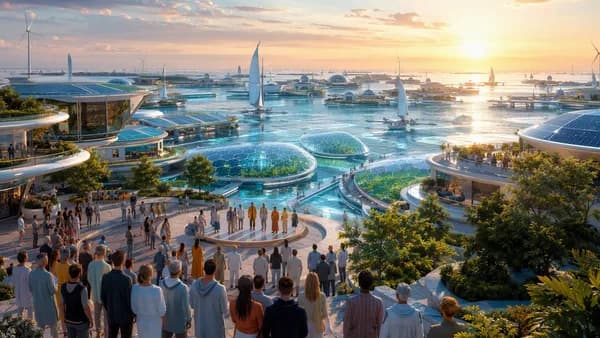
Pelagos Nine hangs beneath the Sargasso like a lantern lowered into a green cathedral.
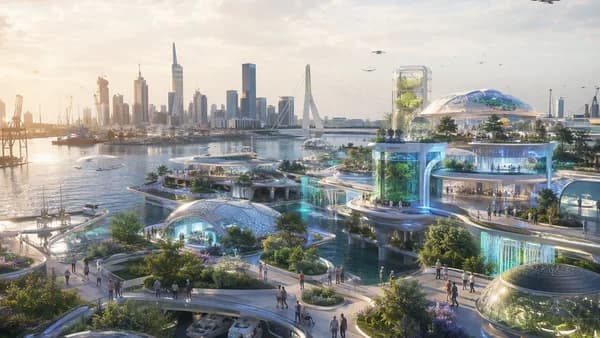
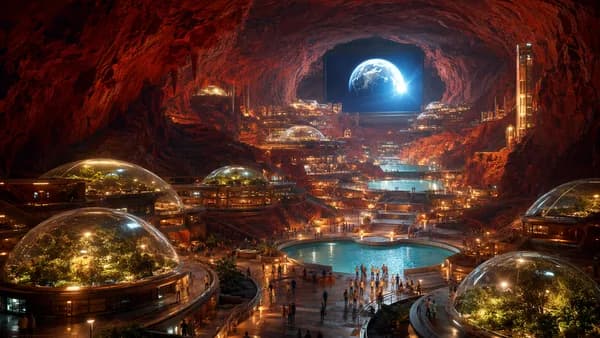
From the outside, the city is all curves and ribs, stacked neighborhoods of glass, ceramic, and black carbon struts bolted into the continental shelf. Its domes glow honey-gold at dawn, though dawn arrives here as a dim silver wash through eighty meters of Atlantic. Above the city, kelp forests sway in long amber ribbons, their floats knocking softly against one another like prayer beads. Fish move through them in blue flashes. Maintenance eels curl around cables warm with current.
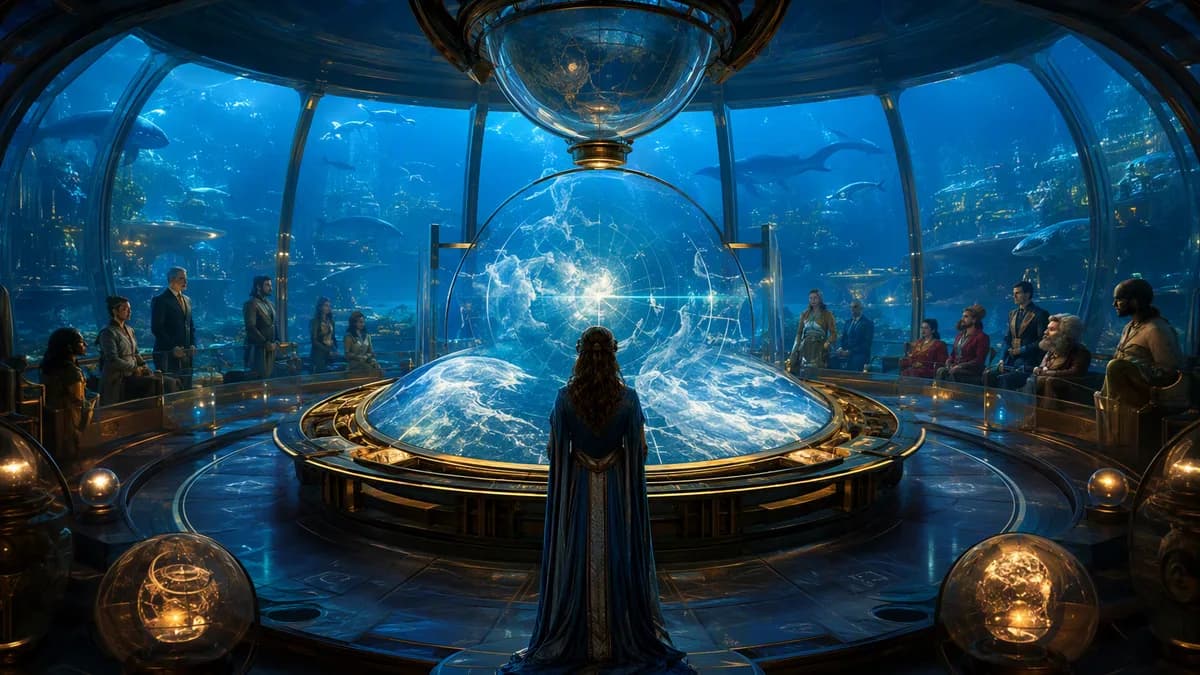
Mara Venn stands in the control chapel with bare feet on wet stone.
The chapel is not religious, not officially, but everyone speaks quietly in it. Its ceiling is a transparent half-dome facing the sea. Data blooms across the glass in pale threads: ocean heat, wind shear, drone swarms, mirror angles, stratospheric dust density, humidity reserves over three continents. The numbers hum through the floor. Pumps throb in the walls like a second heart.
Mara lifts both hands over the brass console. The old rainwrights once used keyboards and retinal grids. Mara prefers the haptic field, a suspended skin of pressure and sound. When she touches a warm spot, cloud seed drones shift over the Atlantic. When she drags two fingers through a blue line, a mirror array tilts in orbit, shaving heat from one air mass and offering it to another.
To most citizens, she writes the forecast.
To Mara, she composes weather.
“North Sargasso convection is climbing,” says Ilo, her apprentice, from the lower platform. He is seventeen, all elbows and nerves, with a braid floating in the damp air. “If we hold the corridor as scheduled, we get forty-two hours of soft rain over the canopy.”
“Soft rain,” Mara says, listening.
The field sings in tones too low for most people to notice. Pressure is a cello. Heat is brass. Moisture is a choir that never breathes. She hears the scheduled rain as a gentle chord, enough to rinse salt from the canopy and pull nutrients up from the dark.
Pelagos Nine depends on such chords. The city eats kelp, algae, farmed mussels, lab yeast, salt-tolerant greens grown under lamps. It drinks reclaimed water with a mineral bite. It survives because every current is counted.
Mara was not born beneath glass. She remembers soil under fingernails, cicadas screaming in heat, her father looking at a sky that would not open.
Now she gives rain to a city that learned to breathe water, and she tries not to think of all the places still holding their breath.
2. A Petition from the Dry Interior
The petition arrives at 03:12, when most of Pelagos Nine sleeps in its stacked rooms and the kelp lamps dim to mimic moonlight.
At first Mara thinks it is another routing complaint from the Azores platforms. Then the message unfolds across the chapel dome, stamped with three dry seals: High Kansas Basin, Soil Vault Cooperative, Shade Town Assembly.
Ilo rubs his eyes. “Kansas still has assemblies?”
Mara does not answer. She is reading.
The file carries no music, only human voices. A woman speaks first, her accent flat and wind-scoured. Behind her, something rattles against metal siding.
“My name is Tessa Roe, elected cloud liaison for Basin Cluster Fourteen. We have lost the spring wheat, the amaranth, and half the bean terraces. Our soil vaults are sealed at emergency humidity. We can sustain the children for nine weeks on stored protein.”
The image sharpens. Tessa Roe stands in a shade town, its roofs made of white ceramic cloth stretched between skeletal towers. Behind her, people move through brown dust with scarves over their mouths. A boy kneels beside a cracked basin that might once have been a pond. He presses both palms to the mud as if asking it for a pulse.
Their request follows in exact numbers.
They do not ask for salvation. They ask for a scheduled Atlantic rain corridor to be bent inland by fourteen degrees, slowed over the revived prairie catchments, and seeded at three altitudes. They have done the mathematics. They know what it costs.
Ilo whispers, “No.”
Mara looks at the projected current model. If the corridor shifts, Pelagos Nine loses the rain that drives the kelp canopy’s nutrient turn. Warm surface water will sit too long above the farms. Oxygen will fall. Bloom rot will spread through the upper fronds. Twenty-eight percent of the next harvest, gone. Maybe more if the current stalls.
The petition includes that too.
“We understand Pelagos Nine will suffer agricultural loss,” Tessa says. Her voice catches, not theatrically, not enough for mercy to hide inside it. “We ask because no other corridor can reach us before our third monsoon fails. We ask because the atmosphere over your city still has a door.”
Mara pauses the recording.
Outside the chapel, a cleaning ray glides past the glass, its wide mouth grazing algae from the dome. Its wings ripple. Its shadow crosses Tessa Roe’s frozen face.
Ilo says, “They left the coasts. Didn’t they?”
Mara hears her grandmother’s voice, years gone: Nobody leaves land because they want less sky.
She restarts the message. This time, when the boy in the background touches the mud, Mara watches his hands.
3. The Ethics of Manufactured Weather
The Tide Council meets in the Commons Well, a cylinder of open water running through the city’s center. Balconies spiral around it, crowded with citizens in work skins, kitchen aprons, pressure harnesses, school uniforms. The water in the well rises and falls with the city’s breath, lit from below by green lamps and the slow glimmer of passing fish.
Mara stands on the speaking platform. Salt dries on her lips.
“A storm is never created,” says Councillor Senn, reciting the old law. He is a reef shepherd with scarred hands and white hair cropped close to his skull. “Only borrowed.”
“Stolen,” someone calls from above.
A murmur rolls through the balconies.
Mara nods. “Stolen, if we refuse to name the debt.”
Across from her, Yara Pell lifts a flour-dusted hand. She runs three communal kitchens in Lower Ceramic. Everyone knows her kelp cakes, crisp at the edges, peppered with dried shrimp. “My youngest was born in the famine year,” Yara says. “I mixed algae foam with sawgrass fiber and called it soup. Don’t ask me to be noble with other people’s hunger. I have done that already.”
“I’m not asking for nobility,” Mara says. “I’m asking for arithmetic with faces.”
A baby begins to cry somewhere high in the chamber. The sound is thin and sharp against the watery hush.
Niko Vale, chief algae engineer, projects the kelp models in the air. Amber turns to gray. Gray turns to black. “If we lose canopy stability, it is not just one harvest. Rot changes microbial balance. Mussels die. Oxygen debt spreads. We built Pelagos after the coastal riots because sentiment did not feed anyone.”
“We built Pelagos,” Mara says, “because the land burned, flooded, salted, and starved. Some of us came down here with mud still in our shoes.”
Senn’s gaze softens, then hardens again. “And we survived by learning limits.”
The council does not jeer. That is what makes it worse. These are not cruel people. They are parents who count lunch portions. Divers who stitch torn reef nets in darkness. Teachers who train children to seal hatches before they learn long division. They know the shape of fear because it lives with them politely, eating at their tables.
Ilo stands behind Mara, silent. She can feel him willing her to stop, or continue, or make the impossible harmless.
Mara looks up through the Commons Well. Far above, beyond glass and kelp and a skin of moving sea, the atmosphere waits with its weight of unshed rain.
“If we keep every storm above our own roof,” she says, “we become another kind of drought.”
No one answers at first. Then Yara Pell looks down at her floury hands as if they belong to history.
4. The Map of Forgotten Rivers
Mara spends the next two nights inside the archive vault, where the air smells of cold metal, dust filters, and old plastic.
The vault is a dry room, a luxury in Pelagos Nine. Paper lives here behind glass. Soil samples sleep in labeled tubes. There are photographs of coastlines that no longer exist: Miami streets shining with floodwater, Lagos seawalls under red sunrise, Norfolk houses lifted on stilts like startled birds.
Mara searches the High Kansas Basin through a century of satellite surveys. She layers heat maps, aquifer records, migration trails, crop failures, failed cloud seeding attempts. The land appears in colors of injury: rust, white, bruised purple. Then she pulls up hydrology from before the great warming, before the river cuts dried and the floodplains went to dust.
Blue veins spread across the table.
One catches her breath.
“Venn Creek,” she whispers.
It is not named for her family. She knows that. Still, her fingers hover over the ghost channel as if over a grave. Her grandmother’s farm lies there, or the coordinates of it do, a square of former cropland beside a river that has not run in forty years.
She opens an old family image from her private cache. Her grandmother, Anja Venn, stands knee-deep in green soy, hair tied in a red scarf, one hand shading her eyes. Behind her, a thunderhead builds like a mountain. Mara remembers the smell of that farm from childhood visits: cut stems, hot dust, rain striking warm tin.
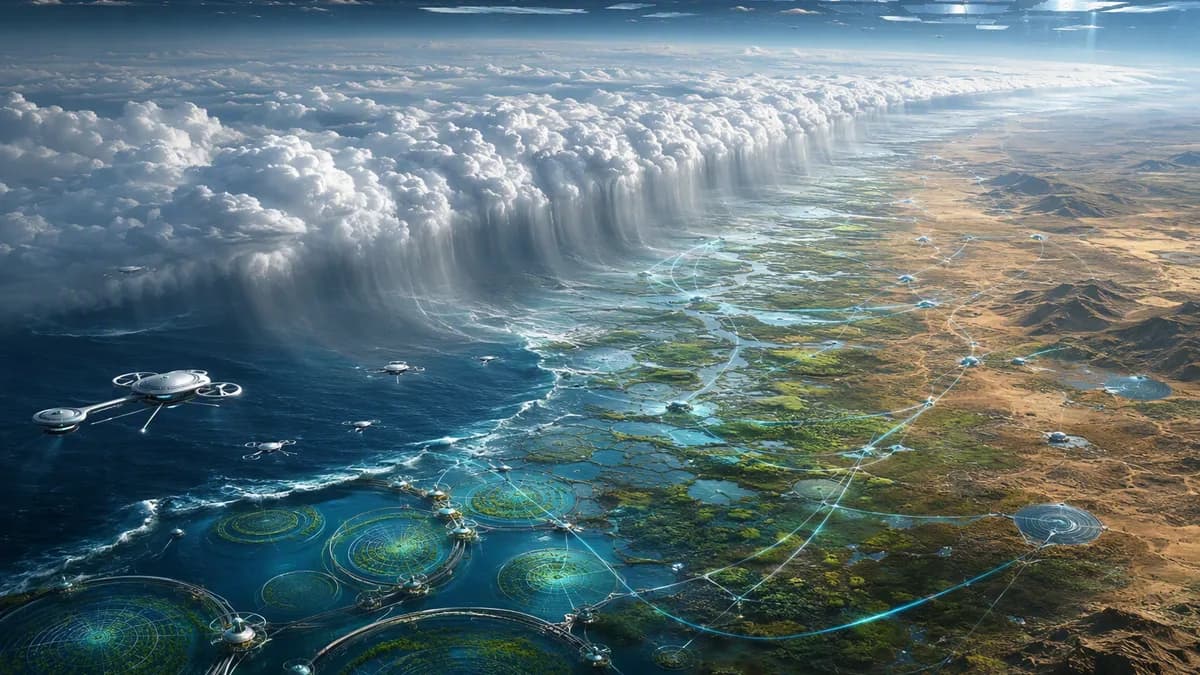
The archive model updates. If the rain corridor falls fast, most water runs off dead soil and tears through shade towns. But if released low and slow, held in a narrow atmospheric river, it can wake the ghost channels. Floodplains can spread the water instead of swallowing it. Soil vaults can vent. Catchments can fill.
Pelagos still loses the scheduled nutrient pulse.
Unless.
Mara overlays ocean data. The kelp canopy is closed for harvest fattening, dense enough to trap surface warmth. If sections open before the storm shift, if the city releases cold deepwater through the eastern intakes, if algae engineers seed stabilizing bacteria, the nutrient shock will be violent but brief.
One harvest dies. The system lives.
Maybe.
At dawn, she brings the design to Niko Vale. He studies it in silence while the algae tanks behind him glow emerald and gold.
“You are asking me,” he says, “to wound the farm so it does not starve.”
“Yes.”
“And if your slow river breaks apart?”
“Then Kansas gets mudslides and we get rot.”
He laughs once, without humor. “Beautiful.”
Mara waits.
Niko turns toward the tanks. Tiny bubbles climb through the green light, each one a pocket of breath made visible. “My grandmother came from Oklahoma,” he says. “She hated the sea until the day she died.”
“Will you help me?”
He closes his eyes. When he opens them, he looks older. “I will help you make the wound clean.”
5. Storm Rehearsal
Pelagos Nine practices for weather the way old cities once practiced for fire.
Sirens do not wail. They sing.
A low note rolls through the neighborhoods at morning shift, vibrating in cups, teeth, and window glass. Children in Blue Dome Primary stop their lesson and answer with their own small voices, matching pitch to pressure. Their teacher lifts two fingers.
“Seal tone,” she says.
“Seal tone,” they sing back, and slap their palms over the hatch plates beneath their desks.
In the kelp farms, divers clip emergency lines to their belts. The canopy above them is being opened in long dark lanes, fronds guided aside by drone arms. Sunlight falls through the gaps in pale, trembling columns. Fish scatter. The water tastes different already, metallic with churned depth.
Mara stands in the chapel, strapped at the waist to the console as buoyancy shifts ripple through the city. Around her, the forecast no longer sounds like a chord. It is a bowl filled too close to the rim.
“Basin liaison online,” Ilo says.
Tessa Roe appears in the haptic field, reduced to a flickering bust of light. Her face is wrapped against dust, only her eyes visible. Behind her, towers of ceramic cloth snap in a hot wind.
“We see your river forming,” Tessa says.
“We see your crosswinds,” Mara answers. “You need to cool the western ridge.”
“Our shepherds are trying. Drone loss is high.”
“How high?”
Tessa looks aside. Someone speaks off-screen, too faint to hear. “Thirty-one percent.”
Ilo inhales sharply.
Mara presses both hands into the field. Over the Atlantic, cloud seed drones spread like silver gnats. In orbit, mirrors tilt by fractions, bright as fish scales against black. The rain corridor bends. Not enough.
“Pelagos eastern intakes opening,” Niko reports through comms. His voice is tight. “Deepwater surge in three, two, one.”
The city groans.
A cold current slams through the farms. On the chapel dome, kelp bends eastward in a single vast shudder. Nutrients boil up from the dark, brown and silver and alive. Sensors flare yellow.
“Hold it,” Mara says.
“I am holding,” Niko snaps. “Tell your sky to behave.”
Tessa’s image flickers. “First drops at Basin Twelve.”
Everyone in the chapel goes quiet.
Through Tessa’s feed comes a sound Mara has not heard from land in years: rain striking dust. It begins as ticking, sparse and uncertain. Then the dust darkens. People step from beneath shade roofs and lift their faces.
“Too fast over the north catchment,” Tessa says. Her voice shakes. “Mara, we need drag.”
“I see it.”
Mara lowers the atmospheric river, spreading its belly across the ghost channels. The system resists. Weather is not obedient. It bucks against heat, terrain, ocean memory. She adjusts, and Tessa adjusts, and unseen cloud shepherds across the Basin adjust with them.
Strangers carrying the same glass bowl, Mara thinks.
Above Pelagos, the stolen rain passes inland.
Below it, the kelp begins to tear.
6. After the First Shared Rain
Three days later, the city smells of iodine, bruised kelp, and boiled grain.
Lower market is quieter than usual. The fish stalls are half empty. Yara Pell serves thin soup with chopped mussel and lemon algae, one ladle per person, no seconds. Nobody complains in Mara’s hearing, which feels worse than anger.
In the farms, brown mats of dead kelp drift against collection nets. Divers move among them with knives and soft bags, saving what can be saved, cutting rot before it spreads. Niko stands waist-deep in a processing pool, sleeves rolled to his shoulders, eyes red from sleeplessness.
“Twenty-six percent,” he tells Mara when she arrives.
“Lost?”
“For now.” He wipes a blade clean on his thigh. “Could have been thirty-five. Your wound clots.”
Mara nods. Gratitude feels too small, apology too easy.
On the fourth day, the Basin sends images.
Children run barefoot through puddles the color of tea. A woman opens a soil vault and presses damp earth to her mouth. Water fills old channels in shining curves, not torrents, not miracles, but movement. In one image, rain falls on the coordinate where Mara’s grandmother’s farm once stood. There is no house. No red scarf. Only wet ground, darkening under a gray sky.
The Tide Council watches in silence.
Then Tessa Roe speaks from the wall. Her face is washed clean. She looks exhausted enough to be carved from bone. “We record debt to Pelagos Nine,” she says. “Water received, food lost, risk shared. We ask to enter continued commons negotiation.”
Yara Pell raises her hand before Mara can speak. “Next time,” the cook says, “your people testify before the forecast is set. Not after. I want to hear the hunger before it arrives as numbers.”
Tessa bows her head. “Agreed.”
Senn adds, “And Pelagos testimony goes inland. You will watch our farms fail if your rain requires it.”
“We will watch,” Tessa says.
So the Weather Commons begins, not with celebration, but with ledgers, arguments, live feeds, grief statements, crop models, lullabies from flooded nurseries and dry towns. Every forecast grows longer. Every map gains voices downstream, downwind, below.
Mara remains a rainwright, though the word changes in her mouth. She controls less than people imagine. She persuades, bargains, listens for strain in systems too large for command. In the chapel, the weather still sings, but now she hears other sounds threaded through it: a child laughing in Kansas mud, a diver cursing in kelp rot, a cook scraping the bottom of a soup pot.
One evening, Ilo asks, “Did we do the right thing?”
Outside the dome, new kelp shoots tremble in the current, small and bright as green flame.
Mara thinks of stolen storms, sleeping rivers, cities under glass, and all the thirsty places waiting just beyond the edge of someone else’s forecast.
“We did a thing we can answer for,” she says.
Above them, the Atlantic gathers heat again, patient and immense.