
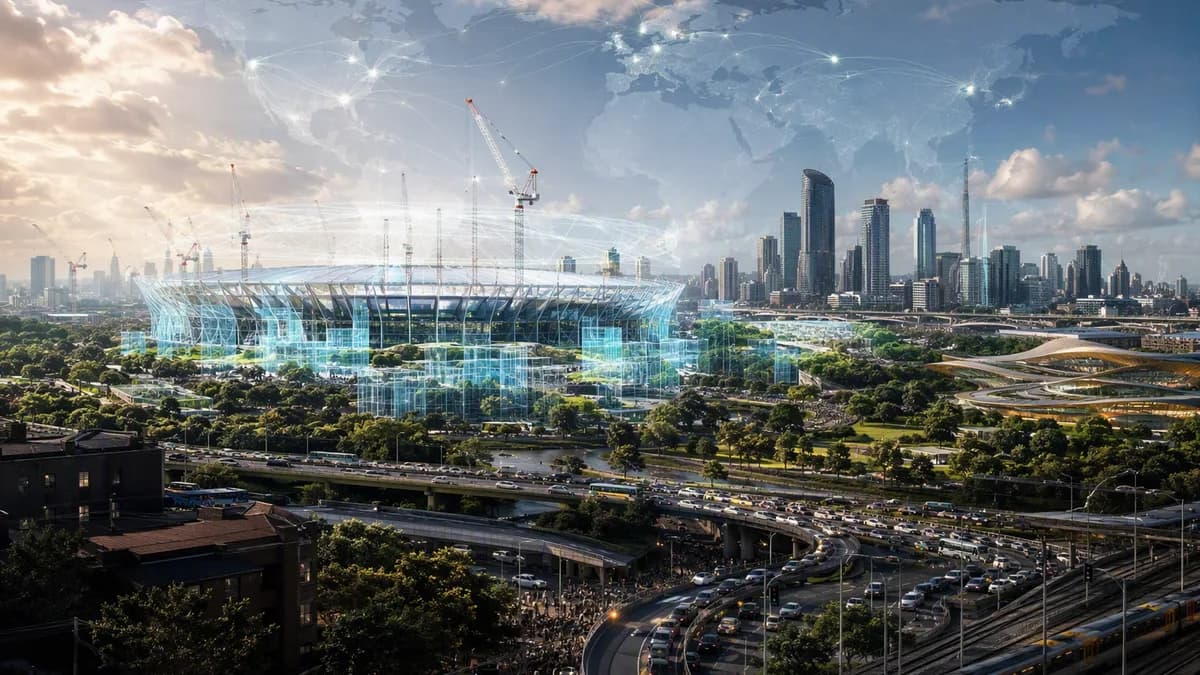
The question Brisbane now has to answer is whether the Victoria Park Olympic stadium can sit inside the city’s largest inner-city parkland without turning that park into a venue-first precinct.
Global TrendsAugust 2, 2026· 7 min read· By XOOMAR Insights Team
Brisbane Olympic Stadium Plan Ignites Fantasy Backlash
Updated on August 2, 2026
XOOMAR Intelligence
Analyst Take
68/ 100
4 sources analyzedMedium confidenceTrend10Freshness94Source Trust90Factual Grounding92Signal Cluster20
Queensland’s government has released new concept images for the Brisbane 2032 stadium precinct, showing green space, wetlands, pedestrian bridges and public areas around a 63,000-seat stadium and new national aquatic centre, according to Guardian World. The pitch is clear: legacy, access, civic pride.
The counterclaim is just as clear. Opponents say the images skip the hard infrastructure that decides whether the plan works: carparks, roads, transport links, crowd plazas and access from the Inner City Bypass. Concept art can start a public conversation. It can’t replace a delivery plan for one of Brisbane’s most contested public sites.
Can a stadium precinct still feel like Victoria Park?
The government says two-thirds of Victoria Park will remain green space after construction of the stadium and aquatic centre. The draft precinct plan also shows two pedestrian bridges over the Brisbane Inner City Bypass, an expanded York’s Hollow wetland, and a public amphitheatre near the stadium.
Premier David Crisafulli framed the project as a generational public asset.
“This state-shaping precinct is about legacy”
He also compared the ambition to South Bank after Expo ’88, saying Victoria Park would be “the legacy of 2032”.
That is the government’s strongest argument. Victoria Park, also known as Barrambin by traditional owners, has been underused and previously hosted a golf course. A better connected, more open park would be a real gain if the public space claim survives detailed design.
But the renderings create a political problem. The softer the images look, the more pressure falls on the missing technical detail. A 63,000-seat venue does not function on grass and goodwill. It needs crowd movement, service access and transport capacity that are not fully answered by attractive images.
Which numbers help, and which numbers are still missing?
Some figures are now fixed enough to anchor the debate.
| Issue | Detail in source material |
|---|---|
| Games year | 2032 Olympic and Paralympic Games |
| Main venue | New oval-shaped 63,000-seat stadium at Victoria Park |
| Parkland pledge | Government says two-thirds remains green, public space |
| Major additions | National aquatic centre, pedestrian bridges, expanded York’s Hollow wetland, amphitheatre |
| Funding frame | Part of a $7.1 billion Games venues infrastructure program, with Brisbane Times reporting Crisafulli said the footbridges would not be funded through that existing allocation |
| Consultation | Opens Monday, August 3, and runs until September 27, according to related reporting |
The gaps matter more than the glossy parts. The public still needs firm detail on how much open land remains genuinely usable day to day, where crowds wait before and after events, how people reach rail connections, what road changes are needed, and how the park operates outside Games time.
This is where the Victoria Park Olympic stadium debate becomes less about architecture and more about accounting. Not just financial accounting, though that matters. Spatial accounting too. Every access path, crowd-holding area, road adjustment and bridge landing has a footprint.
XOOMAR analysis: the government’s “two-thirds green space” claim needs a clear test. Public green space should mean open, usable and accessible, not leftover lawns around event infrastructure.
Why are opponents calling the renders a “fantasy vision”?
Save Victoria Park spokesperson Sue Bremner said the images were “misleading” and accused the government of using them to distract from budget concerns.
“What we saw today was not a plan. It was another insulting fantasy vision with no details.”
She then asked the questions that will define the next phase:
“Where are the car parks? Where are the roads? Where’s the connection to the train station? Where are the crowd-holding plazas? The ramp from the [bypass]?”
Those are not aesthetic complaints. They are operational questions.
The government’s concept images show an inviting park precinct. Critics are asking whether the unshown elements will consume the very public space the government says it is protecting. The sources do not provide enough detail to resolve that dispute.
That uncertainty feeds the trust deficit. Victoria Park has already become a controversial choice because of parkland loss concerns, First Nations concerns about a culturally significant site, and logistical issues linked to its location. Once a government sells a venue through images before publishing enough design assumptions, residents will assume the trade-offs are being delayed.
Who sees the Brisbane Olympic precinct differently?
The government sees a central city legacy project. Its argument is that a once-in-a-generation event can open up an underused site, improve access and leave Brisbane with public assets after the flame goes out.
Park advocates see a permanent conversion risk. Their concern is not only the stadium bowl. It is the surrounding machinery of a major event venue, including roads, plazas, transport links and crowd infrastructure.
Sporting stakeholders have a different interest. Brisbane Times reported Test cricketer Marnus Labuschagne attended the announcement on behalf of Queensland Cricket. The source material does not establish a detailed sporting business case, but the presence of sporting stakeholders shows the precinct is being watched beyond local park politics.
Residents and everyday users face the simplest test. Will they still have a park they can use freely, or will they inherit a managed venue precinct with green edges?
That accountability question appears in other public-policy fights too. XOOMAR has covered how political narratives shape infrastructure and public cost debates in Passengers Pay Early as Heathrow Higher Fares Loom, and how Australian political disputes can harden around identity and trust in Gillard Turns Jacinta Allan Ouster into Sexism Fight. Victoria Park now sits in that same pressure zone: public promise versus public proof.
Does Brisbane’s Olympic legacy claim survive the parkland test?
The government wants Victoria Park to be Brisbane 2032’s answer to South Bank. That comparison is politically useful because it gives the public a familiar model: a major event leaves behind a loved civic place.
But the comparison also raises the bar. A legacy precinct cannot be judged by Games-time images. It has to work on ordinary weekdays, after the broadcasters leave and the crowd barriers come down.
The Victoria Park Olympic stadium may benefit from being central. It may also suffer because central sites have less tolerance for vague planning. Nearby neighbourhoods, existing park users and city commuters will feel construction and access changes long before 2032.
XOOMAR analysis: the project’s credibility now depends on measurable commitments, not more renderings. The next useful documents should show public space calculations, access assumptions, transport links, environmental impacts and how consultation can still change outcomes.
What evidence will decide whether the concept art becomes a real plan?
The next phase is likely to get more contentious because detailed planning will expose the trade-offs hidden by the current images. That does not mean the project fails. It means the political sale gets harder.
The government will probably keep stressing legacy, green space and city access. Critics will keep pressing for numbers: trees affected, land retained, crowd movement, car access, rail connections, bridge funding and long-term park control.
The evidence that would strengthen the government’s case is straightforward: published designs showing the stadium precinct can handle major crowds while preserving genuinely open parkland. The evidence that would weaken it is just as clear: late-arriving roads, hardstand areas, parking or access works that shrink the public park after consultation has already closed.
The Victoria Park stadium plan can still become a credible city-building project. But it has to stop looking like a promise painted over a park and start behaving like a transparent plan Brisbane can interrogate before 2032.
Impact Analysis
- The project will shape Brisbane’s largest inner-city parkland for decades after the 2032 Olympics.
- The debate highlights the tension between Olympic legacy promises and practical infrastructure demands.
- Public trust may depend on whether future plans prove the precinct can remain a park-first space.
Victoria Park Olympic Precinct: Government Vision vs Critics’ Concerns
| Government Pitch | Critics’ Concerns |
|---|---|
| A legacy precinct for Brisbane 2032 with civic value beyond the Games. | Concept images are seen as a “fantasy vision” without delivery detail. |
| Two-thirds of Victoria Park would remain green space after construction. | Opponents question whether roads, carparks, crowd areas and access needs will reduce usable parkland. |
| Plans include wetlands, pedestrian bridges, public areas and an aquatic centre. | Critics say key infrastructure such as transport links and Inner City Bypass access is missing from the vision. |
Sources

Written by
XOOMAR Insights Team
Research and Editorial Desk
The XOOMAR Insights Team pairs automated research with human editorial judgment. We track hundreds of sources across technology, fintech, trading, SaaS, and cybersecurity, cross-check the facts, and explain what happened, why it matters, and what to watch next. We do not just rewrite headlines. Every article is fact-checked and scored for reliability before it goes live, and we link back to the original sources so you can verify anything yourself.
Explore More Topics
Related Articles
 Technology
Pluto TV Ads Steal Twice the Time Tubi Viewers Lose
Pluto TV ran more than twice Tubi's movie ad time in a stopwatch test, making free streaming feel a lot less free.
Aug 2, 20268 min
 Global Trends
5-Minute Core Blast Carves Abs Without Wrecking Your Back
A five-minute core routine targets abs, obliques, hips and glutes with back-friendly tweaks for busy days.
Aug 2, 20268 min
 Technology
$14B AMD AI Deal Pulls Core Scientific From Bitcoin Mining
Core Scientific’s $14B AMD AI leases mark a hard pivot from bitcoin mining, with options that could expand capacity to 2.5 GW.
Aug 2, 20265 min
 Technology
Watch Adults Marathon Day Online Without the Date Trap
The 20-minute Adults prequel streams on FXX, Hulu, and Disney+, but check listings first. The listed air times don't fully match.
Aug 2, 20267 min
 Trading
Swiss Franc Sinks as Carry Trade and Gold Turn Toxic
CHF’s haven bid faded fast after the Iran shock. TD says carry pressure and Gold now matter more than the old crisis playbook.
Aug 2, 20268 min
 Global Trends
Twin Falls In-N-Out Shooting Kills Multiple at Lunch
A gunman killed multiple people at a newly opened Twin Falls In-N-Out before dying. Police say the public threat is over.
Aug 2, 20266 min
 Global Trends
Trump Shelves Iran Strikes Unless a Deal Lands Fast
Trump says Iran strikes are shelved only if a rapid deal opens Hormuz and ends the nuclear threat. The pressure hasn't vanished.
Aug 2, 20265 min
 Fintech
Russia Digital Depository Rules Squeeze Crypto Firms
Russia's draft rules could force crypto depositories to hold up to $2.8M in liquid capital before September's framework.
Aug 2, 20267 min
 Fintech
Hyperliquid Turns Crypto Perps Into DeFi Toll Road
Hyperliquid is turning perp liquidity into infrastructure, letting wallets and exchanges sell derivatives without building their own books.
Aug 2, 20268 min
 Trading
AUD/USD Sinks as Bullock's Rate Threat Backfires on Aussie
AUD/USD fell near 0.6970 as Bullock's hawkish RBA warning raised growth worries instead of lifting the Aussie.
Aug 2, 20265 min
Don't miss the signal
Get our weekly roundup of the stories that matter across tech, fintech, and trading. No noise, just signal.
Free forever. No spam. Unsubscribe anytime.