
In five minutes, this 5-minute core blast gives you a repeatable at-home abs routine that trains your core without defaulting to endless sit-ups or aggressive twisting.
Global TrendsAugust 2, 2026· 8 min read· By XOOMAR Insights Team
5-Minute Core Blast Carves Abs Without Wrecking Your Back
Updated on August 2, 2026
XOOMAR Intelligence
Analyst Take
73/ 100
4 sources analyzedMedium confidenceTrend10Freshness100Source Trust84Factual Grounding90Signal Cluster40
The workout comes from a Tom's Guide fitness routine that the writer says she uses on lunch breaks to maintain core strength outside Pilates, according to Tom's Guide. It uses 50 seconds of work, 10 seconds of transition, and one or more rounds.
This guide keeps the original structure, then shows you how to run it safely if your lower back gets cranky or your hips feel locked up after sitting. If you're the kind of reader squeezing movement between market alerts, AI infrastructure news like our coverage of the $14B AMD AI deal pulling Core Scientific from Bitcoin mining, or volatile macro stories such as WTI crude snapping back 5% as Iran conflict jolts oil, the appeal is obvious: no gym trip, no long setup, no wasted time.
Build a 5-minute core blast that supports your back and stiff hips
The original 5-minute core blast is built around five moves:
| Move | Main focus from the source |
|---|---|
| Arm raise x kneeling twist | Obliques |
| Leg liftovers | Hips and glutes |
| Crunch x toe taps | Deep core |
| Boat pose x arm raise | Deep core and stabilizers |
| Supported side crunches | Obliques |
The structure is simple.
"Routine: 50 seconds on / 10 seconds off. 1+ round"
That matters because the routine isn't trying to destroy your abs. It's a consistency tool. One round takes five minutes. Two rounds take 10. The Tom's Guide writer says she mostly sticks to one round four to five times per week, sometimes adding a second round when she has time.
The key shift: stop thinking of this as a six-pack chase. The source frames the workout around deep core strength, hips, glutes, obliques, and stabilizing muscles that help protect the spine.
Before you start: set up the mat, timer, and pain rules
Use an exercise mat or soft floor, a timer, and enough space to lie down, kneel, and extend your arms and legs. The source says you can do the workout with bodyweight or with a weight, including an adjustable dumbbell or regular hex dumbbell.
If you use weight, start lighter than your ego wants. The routine includes rotation and balance work. A heavy dumbbell can turn clean core training into sloppy compensation fast.
Watch for three things:
- Back pain: If the kneeling twist hurts your back, the source says to skip it or reduce the weight first.
- Control loss: If your lower back arches during floor moves, make the movement smaller.
- Bad discomfort: The source is blunt: if the moves don't feel good, "stop and rest."
Mild muscular effort is fine. Pinching, increasing pain, or a movement that makes you brace defensively is your signal to modify.
Step 1: prime your core with the 50/10 timer
Set your timer for five intervals of 50 seconds on and 10 seconds off.
Before the first move, take a few breaths and check your position. The source repeatedly cues control: keep reps similar across rounds, work both sides of the body, and listen to your body if something irritates your back.
How to run the round
- Arm raise x kneeling twist: 50 seconds
- Rest or transition: 10 seconds
- Leg liftovers: 50 seconds
- Rest or transition: 10 seconds
- Crunch x toe taps: 50 seconds
- Rest or transition: 10 seconds
- Boat pose x arm raise: 50 seconds
- Rest or transition: 10 seconds
- Supported side crunches: 50 seconds
If you do more than one round, the source suggests you can complete reps on one side only, then switch to the other side in the next round.
Step 2: use arm raises and kneeling twists without bullying your lower back
Start with the arm raise x kneeling twist. The source says arm raises work the fronts of the shoulders, while the rotation in the kneeling twist targets the obliques, the muscles along the waist that work during side motions and twisting.
Keep the twist gentle. This isn't a contest to see how far you can rotate.
Form cues:
- Elbows: Keep a slight bend if that helps you control the weight.
- Ribs: Avoid flaring your ribs as you raise the arms.
- Twist: Rotate only as far as you can without back discomfort.
- Weight: Reduce it or go bodyweight if your back complains.
Watch out for speed. Fast twisting with a dumbbell is where this move can stop feeling like core training and start feeling like a bad idea.
Step 3: add leg liftovers so your hips and glutes join the work
Move into leg liftovers. You place a weight on the floor and lift your leg up and over it. The source says this needs core engagement to stabilize your body while also strengthening the hips and glutes.
This is the move that makes the routine useful for people with tight hips. It asks the hip to move while the trunk stays organized.
How to make it cleaner:
- Brace first: Set your core before the leg moves.
- Move slowly: Clear the weight without swinging.
- Support hand: Keep one hand down if you need it.
- Progression: The source says you can take your supporting hand away and bring both hands to your hips or overhead for extra challenge.
That progression is not for everyone. Tom's Guide notes that it will work your core harder, but might not suit your lower back. Skip it if you have injuries or concerns.
Step 4: train deep core control with crunches, toe taps, and boat pose
The middle of the 5-minute core blast hits the deep core with crunch x toe taps and boat pose x arm raise.
For crunches and toe taps, your lower back rests against the mat throughout. The source says to keep your navel drawn in and breathe expansively against your ribcage to help engage the diaphragm and TVA muscles, the deep core muscles responsible for stability.
Crunch x toe taps checklist:
- Lower back: Keep it supported by the mat.
- Gaze: Keep it soft as your shoulders peel away.
- Feet: Lower one or both feet with control.
- Breath: Exhale when the muscles meet the most resistance.
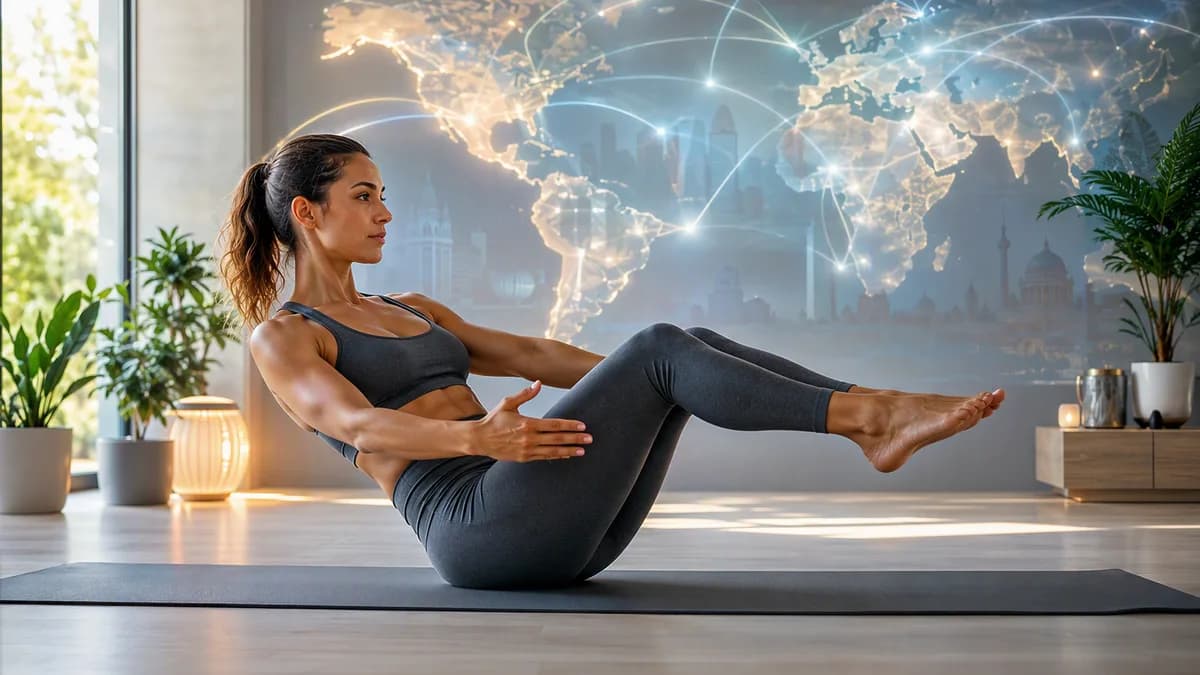
Then comes boat pose x arm raise. Boat pose is an isometric core exercise, and the arm raise adds a balance and stability challenge while also strengthening the shoulders.
If your form slips, scale it immediately. The source recommends removing the arm raise or placing one or both feet on the ground for support.
Step 5: finish with supported side crunches for obliques and hip control
Finish with supported side crunches from a supported side plank position. The source says this strengthens the obliques as you draw your elbow and knee together.
This is where slower is better. The writer notes that the slower you move, the more you'll feel it, so take your time and build control into each rep.
Default setup:
- Shoulder: Keep the supporting shoulder strong, not collapsed.
- Hips: Stay stacked instead of rolling backward.
- Elbow and knee: Draw them together under control.
- Tempo: Slow reps beat rushed reps.
For a harder version, the source says you can try the move from a forearm side plank with both legs away from the mat. Don't jump there if your back or shoulder position falls apart.
Step 6: turn the 5-minute abs workout into a weekly habit
The Tom's Guide writer says she has been doing one round four to five times per week, with occasional two-round sessions. That's the useful model: repeatable, short, and easy to attach to a normal day.
Try it:
- After a walk: Use it as a core finisher.
- After strength training: Add one round without extending the session much.
- During a work break: Treat it as a five-minute reset.
- Before Pilates or mobility work: Use it only if it makes you feel better, not more restricted.
Don't chase harder versions just because the workout is short. The source's best advice is buried in the details: use control, breathe properly, and stop if the movement doesn't suit your body.
Leaner-looking abs won't come from this routine alone. The Tom's Guide writer credits Pilates and an 80/20 approach to a balanced diet, while also pointing to health conditions, sleep, stress, muscle-building workouts, and genetics as factors that affect visible definition.
Your next action is simple: run one five-minute round this week with bodyweight only. If your back feels fine and your reps stay controlled, add a second round later. If something feels off, reduce the range, remove the weight, or stop and rest.
Key Takeaways
- The routine offers a quick at-home core option that takes just five minutes.
- It emphasizes core strength without relying on endless sit-ups or aggressive twisting.
- The format may appeal to people managing tight hips or lower-back discomfort from sitting.
5-Minute Core Blast Moves and Focus Areas
| Move | Main Focus |
|---|---|
| Arm raise x kneeling twist | Obliques |
| Leg liftovers | Hips and glutes |
| Crunch x toe taps | Deep core |
| Boat pose x arm raise | Deep core and stabilizers |
| Supported side crunches | Obliques |
Core Blast Interval Structure
Work
seconds50
Transition
seconds10
Sources

Written by
XOOMAR Insights Team
Research and Editorial Desk
The XOOMAR Insights Team pairs automated research with human editorial judgment. We track hundreds of sources across technology, fintech, trading, SaaS, and cybersecurity, cross-check the facts, and explain what happened, why it matters, and what to watch next. We do not just rewrite headlines. Every article is fact-checked and scored for reliability before it goes live, and we link back to the original sources so you can verify anything yourself.
Explore More Topics
Related Articles
 Global Trends
62 Theater Trips Expose the Best Movies of 2026 So Far
After 62 theater trips, one critic says five 2026 movies earned the big screen, while five made the couch look smarter.
Aug 1, 20269 min
 Global Trends
Jade Plant Dropping Leaves Reveals Rot, Heat, or Pests
Leaf clues reveal whether your jade plant is shedding from rot, drought, sun stress, pests, or shock.
Jul 24, 20268 min
 Technology
Pluto TV Ads Steal Twice the Time Tubi Viewers Lose
Pluto TV ran more than twice Tubi's movie ad time in a stopwatch test, making free streaming feel a lot less free.
Aug 2, 20268 min
 Technology
$2,499 Price Trips Up De'Longhi PrimaDonna Aromatic
De'Longhi's $2,499 flagship nails convenience, but cheaper models make its luxury price hard to defend.
Aug 1, 20267 min
 Future Fiction
The Rainwright of Pelagos Nine
In 2089, humanity survives climate upheaval through a network of underwater refuge-cities and orbital-atmospheric weather systems that can steer rain, fog, and heat away from catastrophe. Mara Venn, a former coastal farmer turned rainwright, discovers that one drought-stricken inland region can only be saved by flooding the kelp farms that feed her own city, forcing her to rethink what civilization owes to places it has left behind.
Aug 2, 202613 min
 Technology
MCP Update Frees AI Agents From a Cloud Fragility Trap
MCP is now stateless, letting AI agents survive pod restarts and load balancers without brittle routing hacks.
Aug 2, 20268 min
 Global Trends
Brisbane Olympic Stadium Plan Ignites Fantasy Backlash
Queensland's glossy Victoria Park stadium vision is under fire as critics warn the Brisbane 2032 plan hides the hard transport questions.
Aug 2, 20267 min
 Technology
$14B AMD AI Deal Pulls Core Scientific From Bitcoin Mining
Core Scientific’s $14B AMD AI leases mark a hard pivot from bitcoin mining, with options that could expand capacity to 2.5 GW.
Aug 2, 20265 min
 Technology
Watch Adults Marathon Day Online Without the Date Trap
The 20-minute Adults prequel streams on FXX, Hulu, and Disney+, but check listings first. The listed air times don't fully match.
Aug 2, 20267 min
 Trading
Swiss Franc Sinks as Carry Trade and Gold Turn Toxic
CHF’s haven bid faded fast after the Iran shock. TD says carry pressure and Gold now matter more than the old crisis playbook.
Aug 2, 20268 min
Don't miss the signal
Get our weekly roundup of the stories that matter across tech, fintech, and trading. No noise, just signal.
Free forever. No spam. Unsubscribe anytime.