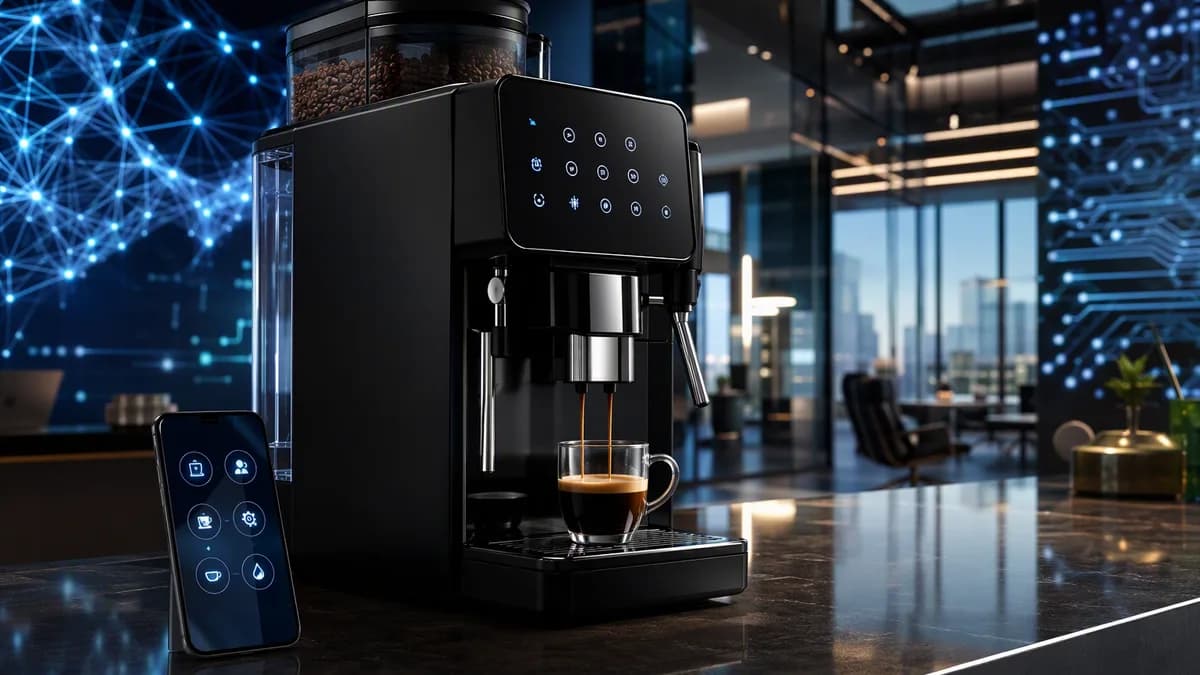
That tension matters. The machine can make 38 drinks, handles hot and iced options, includes hot and cold milk frothing, and works with the De’Longhi My Coffee Lounge app, according to Tom’s Guide. It also costs $2,499 in the U.S. and £1,549 in the U.K.
My view: the PrimaDonna Aromatic is defensible only if you value friction removal more than espresso purity. It’s for households that want repeatable coffee with minimal effort, not for people who want to turn every shot into a project.
The problem is that convenience has a ceiling. Tom’s Guide says you can get “80% of the same performance” from the $1,500 De’Longhi Rivelia and “99.9% of the same performance” from the $2,000 De’Longhi Eletta Explore. That makes the PrimaDonna Aromatic feel less like a breakthrough and more like a luxury tax on ease.
“I’m saying you might be able to save your money without sacrificing quality here.”
That line should haunt De’Longhi’s flagship pitch.
The best case for the De’Longhi PrimaDonna Aromatic is not that it makes the most nuanced espresso. Tom’s Guide found the espresso “a little weak,” though still drinkable for straightforward coffee fans. The better argument is that it makes coffee happen quickly, repeatedly, and with fewer decisions.
That matters more than coffee obsessives like to admit. A machine that demands effort becomes decoration. A machine that produces espresso, milk drinks, hot foam, cold foam, and iced recipes from a screen has a better shot at becoming a daily habit.
Here’s the real before-and-after:
- Before: Decide what to make, adjust settings, froth milk, clean up, repeat tomorrow.
- After: Tap through a bright LCD screen, pick from 38 recipes, choose hot or cold, and let the machine do the boring parts.
- Trade-off: You gain speed and consistency, but you give up the manual control that espresso hobbyists actually enjoy.
The iced angle also gives the PrimaDonna Aromatic year-round usefulness. Tom’s Guide liked suggested recipes such as Iced orange coffee, Iced raspberry tonic espresso, and Iced espresso Mojito. That’s more compelling than another black-box machine promising generic “premium” coffee.
Still, De’Longhi overreaches with the “cold brew” framing. Tom’s Guide said the cold brew was “pretty nasty” and noted the coffee extracted hot, making it closer to an iced Americano than true cold brew. That’s the kind of detail that separates useful convenience from menu inflation.
An app on a coffee machine can easily become gadget bloat. The My Coffee Lounge app proves both sides of that argument.
On the useful side, the app surfaces suggested recipes and provides a Health status section showing descaling needs, water tank level, and grounds drawer status. That’s exactly the kind of app function that belongs on an appliance. It reduces uncertainty. It helps maintenance happen before the machine punishes you.
On the weak side, Tom’s Guide ran into connectivity problems. The “Statistics” section never loaded. The custom recipe feature also failed, showing the message: “Couldn’t load any drink”. For a machine at this price, that’s not a minor annoyance. It cuts into the whole premise.
The app earns its place only if it helps users discover and repeat drinks they actually want. If it becomes another screen that half-works, it turns the PrimaDonna Aromatic into the same kind of app-dependent overreach we see across connected home tech. For readers tracking that broader shift, Martha Stewart's Hint AI App Hunts Costly Home Repairs is a useful companion read.
The stronger version of this product is obvious: fewer novelty prompts, more reliable recipe creation, and maintenance alerts that never miss.
A 27.7-pound superautomatic espresso machine is not going in and out of a cabinet. The PrimaDonna Aromatic will live on the counter, so its design is part of the ownership cost.
Tom’s Guide describes it as narrow but deep, with dimensions of 18.2 x 10.3 x 16 inches. The 10.3-inch width helps, especially since the water tank sits on the side. The 18.2-inch depth is the real constraint. Buyers need to measure before falling for the screen and recipe list.
Visually, this is familiar De’Longhi territory: shiny, functional, unobtrusive. Tom’s Guide notes that without the name, it could be mistaken for the Magnifica Duo, Dinamica, or Eletta. That may sound like faint praise, but it’s also the point. This machine isn’t trying to be sculpture. It’s trying to disappear into the morning routine.
What the source does not fully answer is just as important: long-term cleaning access, bean hopper convenience, and how the finish holds up over years of daily use. The box includes cleaning accessories, descaler, and an ice cube tray, but ownership is not decided by accessories. It’s decided by whether the machine stays pleasant after the honeymoon.
The counterargument is strong: many people should skip the De’Longhi PrimaDonna Aromatic.
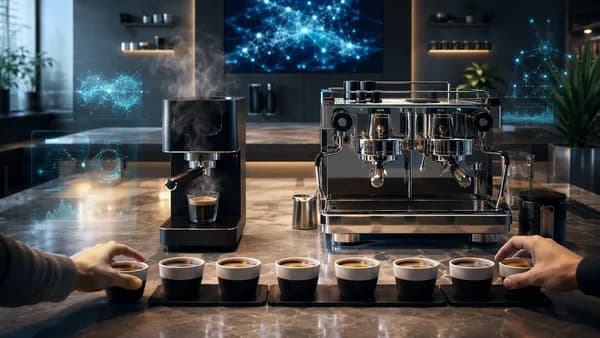
Tom’s Guide compares it directly against De’Longhi’s own cheaper machines. The Rivelia is listed at $1,499/£749. The Magnifica Duo is $999. The Eletta Explore is cited at $1,999 and also has hot and cold milk capability, though with a smaller water tank. Those are not trivial differences.
| Machine |
Price cited by Tom’s Guide |
Relevant comparison |
| De’Longhi PrimaDonna Aromatic |
$2,499 / £1,549 |
38 drinks, app-compatible, hot and cold milk frother |
| De’Longhi Rivelia |
$1,499 / £749 |
Tom’s Guide says it delivers 80% of the same performance |
| De’Longhi Eletta Explore |
$1,999 |
Tom’s Guide says it delivers 99.9% of the same performance |
| De’Longhi Magnifica Duo |
$999 |
Much cheaper De’Longhi automatic option |
If you drink mostly black coffee, this machine is probably overbuilt. If you make the occasional milk drink, same answer. If you care about dialing in shots manually, the PrimaDonna Aromatic is solving a problem you don’t have.
That price-to-performance skepticism is not limited to this machine. The same uncomfortable question sits behind Bambino Crushes $2,000 Espresso Machine in Blind Test: when does a higher price actually buy a better cup, and when does it just buy a smoother path to an acceptable one?
The PrimaDonna Aromatic’s strongest defense is convenience. Its weakest defense is espresso quality per dollar.
Before spending $2,499 on the De’Longhi PrimaDonna Aromatic, buyers should ask three blunt questions.
How many people will use it every day? How often will they choose milk drinks or iced recipes instead of plain coffee? And is convenience genuinely the priority, or does the price merely feel like a shortcut to better taste?
The PrimaDonna Aromatic makes sense for a household that wants polished, repeatable, cafe-style drinks with almost no learning curve. It makes less sense for casual drinkers, espresso purists, or anyone who sees the app as the main attraction rather than a support tool.
The next thing to watch is whether De’Longhi fixes the app reliability gap. If recipe creation and statistics load consistently, the machine’s software becomes a real part of the value. If not, buyers are left paying flagship money for hardware that cheaper De’Longhi machines already approach.
The best luxury appliance is not the one that impresses guests. It’s the one that quietly earns its spot every morning.
- The PrimaDonna Aromatic’s $2,499 price is hard to justify if cheaper De'Longhi machines offer similar performance.
- Its strongest appeal is convenience, with 38 drinks, iced options, milk frothing, and app control.
- Buyers may be paying more for ease and polish than for a major leap in espresso quality.