
The $299 Breville Bambino beat the $1,999 Lelit Mara X3 across every drink category in a blind taste test, a result that should make home coffee buyers pause before treating machine price as a proxy for better espresso.
TechnologyJuly 31, 2026· 8 min read· By XOOMAR Insights Team
Bambino Crushes $2,000 Espresso Machine in Blind Test
Updated on July 31, 2026
XOOMAR Intelligence
Analyst Take
71/ 100
3 sources analyzedMedium confidenceTrend10Freshness100Source Trust84Factual Grounding89Signal Cluster20
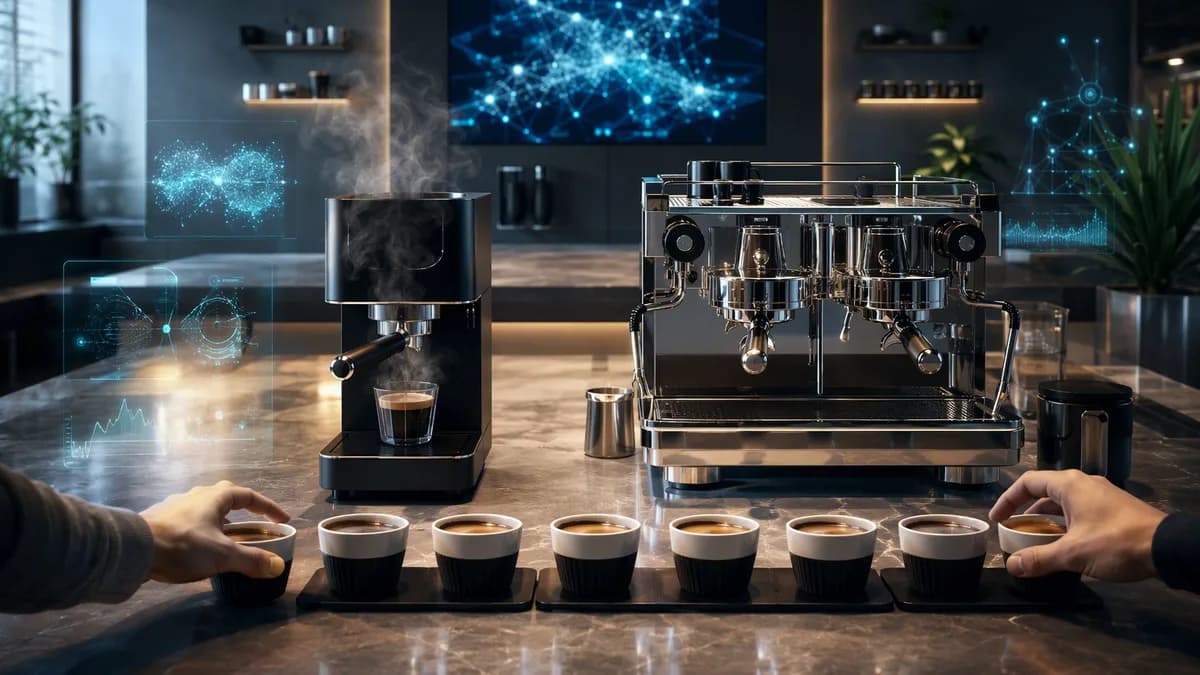
That finding comes from a head-to-head test by Tom's Guide, which compared a $300 vs $2,000 espresso machine setup using the same premium beans, the same high-end grinder, and blind tasters who did not know which machine made which drink. The result doesn’t prove cheap machines are always better. It proves something more useful: price can buy hardware and control, but it doesn’t automatically buy the better cup.
For buyers, that shifts the real question. Are you paying for taste, workflow, consistency, steam power, design, or the pleasure of owning serious gear?
Buyers face the uncomfortable $300 vs $2,000 espresso machine result
The test used two machines with wildly different price tags: the Breville Bambino at $299 and the Lelit Mara X3 at $1,999. The drinks tested were Black Americano, oat milk flat white, and straight espresso.
The Bambino won all three categories in the final tally.
| Drink tested | Winner |
|---|---|
| Black Americano | Breville Bambino |
| Oat milk flat white | Breville Bambino |
| Espresso | Breville Bambino |
That’s the sting. The expensive machine didn’t merely lose one milk drink where oat milk might mask subtle differences. It lost the straight espresso round too, where flaws usually have nowhere to hide.
Pete described the Bambino espresso as having “a lot of body and a bit of acidity” and later called it “So much nicer.”
The caveat matters. The author tasted the drinks before serving them and preferred the Lelit Mara X3 every time. She also raised the obvious possibility: knowing which cup came from the expensive machine may have shaped her own preference. Or she may simply prefer the more acidic profile she got from the Lelit.
So should one blind test settle the buying decision? No. But it should break the assumption that a $2,000 machine will necessarily taste four, five, or six times better than a $300 machine.
Test design puts pressure on the machine, not the coffee
This comparison was useful because Tom’s Guide controlled several variables that often distort home espresso debates.
The same beans were used: Carter Coffee’s Two Trees Geisha, priced at £21 ($28) for 200g, with tasting notes of passion fruit, white peach, and an aromatic finish. The grinder was a Mazzer Philos costing $1,500. That is far outside what many buyers would spend, but the point of using it was to remove grinder quality as the weak link.
The author also dialed in each machine separately:
- Lelit Mara X3: grind setting click 22
- Breville Bambino: grind setting click 25
- Americano and flat white recipe: 18g coffee in, 36g espresso out, 25-28 seconds
- Americano dilution: topped with 8 ounces of water, thirty seconds off the boil
- Straight espresso recipe: 12g coffee in, 24g espresso out
That detail matters because the test was not “same grind, same button, hope for fairness.” It adjusted for how each machine extracted.
Still, what exactly was being measured? Taste, yes, but also the author’s dialing-in skill, shot preparation, and each machine’s ability to perform under that setup. A fair espresso comparison lives or dies on tiny variables: dose, grind, extraction time, water behavior, puck prep, milk steaming, and the palate of each taster.
This is where the Bambino result becomes more interesting. The cheaper machine didn’t win because the test ignored technique. It won in a setup where technique and grinder quality were taken seriously.
Machine makers have to justify the hardware premium
Premium espresso machines are not sold on taste alone. They are sold on control, feel, build, stability, and the promise that a more serious machine gives the user more room to improve.
The Lelit Mara X3 brings features that a budget machine does not: a 58mm portafilter, a live manometer, a customizable pressure paddle, and real wood finishes, according to the source material. Those are not cosmetic footnotes for enthusiasts. They change how the user interacts with the shot.
But the blind test narrows the claim manufacturers can safely make. If tasters prefer the $299 machine in the cup, then the premium case has to move beyond “better coffee” and become more specific.
What does the expensive machine actually buy?
- Control: More ways to alter pressure and extraction.
- Feedback: Tools such as a manometer give the user more information.
- Workflow: More enthusiast-oriented parts can make the process feel more precise.
- Design: Materials and finishes matter to buyers who keep the machine on display.
- Learning curve: More variables can reward users who enjoy experimenting.
That last point cuts both ways. More control helps if the user knows what to do with it. For casual buyers, it can become expensive complexity.
XOOMAR readers see this value question across consumer hardware categories, from Google Home Speaker Corners Sonos Era 100 on Price to Samsung QD-OLED Monitor Crashes Below $300 in Rare Deal. Coffee gear adds a harsher twist: the final product depends heavily on user technique, beans, and grinder quality.
End users should spend on beans and grinder before chasing prestige
The most useful buying lesson from this $300 vs $2,000 espresso machine test is not “buy the Bambino.” It’s “fix the inputs before blaming the machine.”
Tom’s Guide used a $1,500 grinder, then explicitly said most people do not need that grinder to achieve similar results. The author recommended the Baratza Encore ESP at $199 or the Comandante C40 MK4, usually around $300, for most buyers.
That’s the sharper takeaway. A budget espresso machine paired with good beans and a capable grinder can embarrass a premium machine if the premium setup is poorly dialed in, underfed by weak coffee, or operated casually.
Different buyers should read the result differently:
- Casual latte drinkers: The Bambino result is strong evidence that a lower-cost machine can satisfy, especially when milk is part of the drink.
- Straight espresso drinkers: The result is encouraging, but the split preferences show palate matters more here.
- Aspiring hobbyists: The Lelit may still appeal because the process, controls, and hardware feedback are part of the value.
- Heavy households: This test does not prove which machine handles repeated drinks better over time.
- Design-focused buyers: The Lelit’s premium materials may still matter if the machine is also furniture.
The trap is upgrading the espresso machine before upgrading the boring parts. Stale beans, poor grind quality, and sloppy dialing-in can turn a premium machine into an expensive disappointment.
Retailers and premium brands now need measurable proof
For retailers, this kind of blind test is awkward. It undercuts the easy upsell.
A $1,999 machine can still be worth it, but the sales pitch has to become more concrete. If the premium product wins on consistency, steaming performance, recovery between drinks, quieter operation, or long-term ownership, those advantages need to be demonstrated clearly. A prettier machine and a bigger price tag are not enough.
This is where the Tom’s Guide test is both powerful and limited. It tested taste across three drink formats. It did not provide long-term durability data. It did not measure repeated back-to-back drink performance. It did not quantify maintenance costs or repair outcomes. It did not calculate café payback math.
That restraint matters. A buyer cannot conclude from this test that the Breville Bambino is the better long-term machine for every kitchen. The supported conclusion is narrower and more damaging to premium assumptions: in this blind tasting, under these controls, tasters preferred the cheaper machine.
For premium appliance brands, that’s the market signal. If budget machines keep producing credible espresso with good beans and a proper grinder, high-end machines must justify price through repeatability and ownership quality, not vague promises of “barista” results.
The next espresso fight is repeatability, not raw price
The next battle in home espresso won’t be won by the most expensive machine. It will be won by the machine that helps a half-awake user make a good drink again tomorrow.
The evidence to watch is practical: blind taste results across more beans, more users, repeated shots, milk steaming under load, and consistency after weeks of use. If cheaper machines keep winning or splitting blind tests, premium brands will need to show their edge in measurable ways. If expensive machines start pulling ahead across repeated sessions, the case for prosumer gear gets stronger.
For now, the $300 vs $2,000 espresso machine lesson is clear enough: buy better beans, buy a capable grinder, learn to dial in, then decide whether you truly need the premium machine. Price can buy a more serious tool. It can’t guarantee the better sip.
Key Takeaways
- The blind test challenges the assumption that a higher espresso machine price guarantees better-tasting coffee.
- Home buyers may get stronger value from a lower-cost machine if taste is their main priority.
- The result highlights that workflow, control, steam power, and design may matter as much as flavor when choosing a machine.
Breville Bambino vs Lelit Mara X3 blind taste test
| Category | Breville Bambino | Lelit Mara X3 |
|---|---|---|
| Price | $299 | $1,999 |
| Black Americano | Winner | Lost |
| Oat milk flat white | Winner | Lost |
| Espresso | Winner | Lost |
| Author's pre-blind preference | Not preferred | Preferred every time |
Espresso machine prices compared
Breville Bambino
$299
Lelit Mara X3
$1,999
Sources

Written by
XOOMAR Insights Team
Research and Editorial Desk
The XOOMAR Insights Team pairs automated research with human editorial judgment. We track hundreds of sources across technology, fintech, trading, SaaS, and cybersecurity, cross-check the facts, and explain what happened, why it matters, and what to watch next. We do not just rewrite headlines. Every article is fact-checked and scored for reliability before it goes live, and we link back to the original sources so you can verify anything yourself.
Explore More Topics
Related Articles
 Technology
Apple Upgrade Hides iPhone Sticker Shock in Monthly Fees
Apple's lease plan turns rising device prices into smaller monthly payments, making premium hardware feel cheaper without cutting the real cost.
Jul 28, 20268 min
 Technology
PC Gaming Costs Jump in 2026, 3 Cheap Setups Still Win
PC gaming is getting pricier in 2026, but handhelds, pre-builts and custom PCs still offer cheaper ways in.
Jul 28, 20268 min
 Global Trends
49,000 Crossings Plunge Ceuta Border Crisis Into Chaos
A 49,000-person surge into Ceuta left at least 18 dead and put Spain's EU border strategy under brutal pressure.
Jul 31, 20268 min
 Trading
Tokyo Slams USD/JPY at 163 as Yen Intervention Bites
MUFG says Japan likely stepped in near USD/JPY 163, forcing yen bears to price political risk back into the trade.
Jul 31, 20268 min
 Global Trends
13 Dead as Japan Earthquake Traps Survivors in Rubble
At least 13 are dead after the Kumamoto quake. Crews are digging through a collapsed mall and paper mill for survivors.
Jul 31, 20266 min
 Global Trends
Passengers Pay Early as Heathrow Higher Fares Loom
Passengers may pay for Heathrow’s £320m expansion planning bill decades before a third runway delivers anything.
Jul 31, 20268 min
 Technology
£713k Grid Fees Threaten Britain's Datacentre Land Grab
Ofgem wants heavy grid fees on datacentre projects after requests hit 73GW, exposing how AI demand is clogging Britain's power queue.
Jul 31, 20267 min
 Technology
Diarra From Detroit Season 2 Skips BET+ for Paramount+
Season 2 streams on Paramount+, not BET+, with two episodes out now and weekly Wednesday releases through Sept. 9.
Jul 31, 20269 min
 Technology
80% Luna Cut Rewrites OpenAI GPT-5.6 Pricing Math for APIs
OpenAI cut GPT-5.6 Luna API prices 80%, trimmed Terra 20% and made Sol faster, making high-volume AI workloads easier to justify.
Jul 31, 20267 min
 Global Trends
Shanahan Steals No. 1 in NFC West Head Coach Rankings
XOOMAR puts Kyle Shanahan over Sean McVay, arguing weekly coaching edge matters more than a Super Bowl ring.
Jul 31, 20267 min
Don't miss the signal
Get our weekly roundup of the stories that matter across tech, fintech, and trading. No noise, just signal.
Free forever. No spam. Unsubscribe anytime.