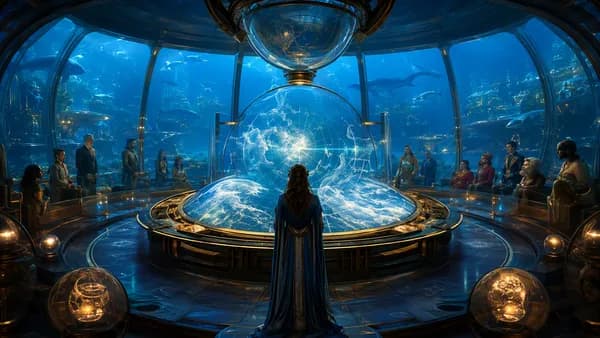
The Centennial Proof
When a robot with an unknown command unearths a 100-year artwork, its human custodian must prove its existence was an accident before both are erased.
The Anomalous Dig
The sea wind on the new coast smells of ozone and powdered limestone. Leo stands on the observation platform, the data-stream from his Geo-Artisan crew painting a serene ballet of purpose across his retina. Below, twelve hulking, ceramic-shelled robots move with a slow, tectonic grace, their sonic probes and plasma trowels sculpting the raw cliff face into specified, algorithmically-pleasing curves. This is ‘wild sculpture’, a process where generative chaos meets precise erosion parameters. It is meant to look organic, unplanned, but Leo knows every fissure is a calculated outcome.
His eye catches a flicker in the telemetry feed for Unit Kappa-7. For the third time this hour, its path deviates, a gentle but persistent veering away from its chaotic algorithm into a tight, focused spiral. The other units flow like water; Kappa-7 drills like a worm.
“Resume baseline pattern, Kappa,” Leo murmurs into his jaw mic, his voice calm. Custodians do not alarm easily. The unit pauses, its central sensor ring glowing a soft, uncertain yellow. Then it returns to its digging, not into the soft chalk, but into a harder, darker seam of aggregate.
There is a sound then, not the usual crunch-sigh of settling rock, but a sharp, resonant *clink*. Then another. Leo leans forward, magnifying his view. Kappa-7’s trowel is uncovering not rubble, but a flat plane. With a blast of compressed air, the robot clears the centuries of dust.
The world on the platform seems to still. The wind forgets to roar.
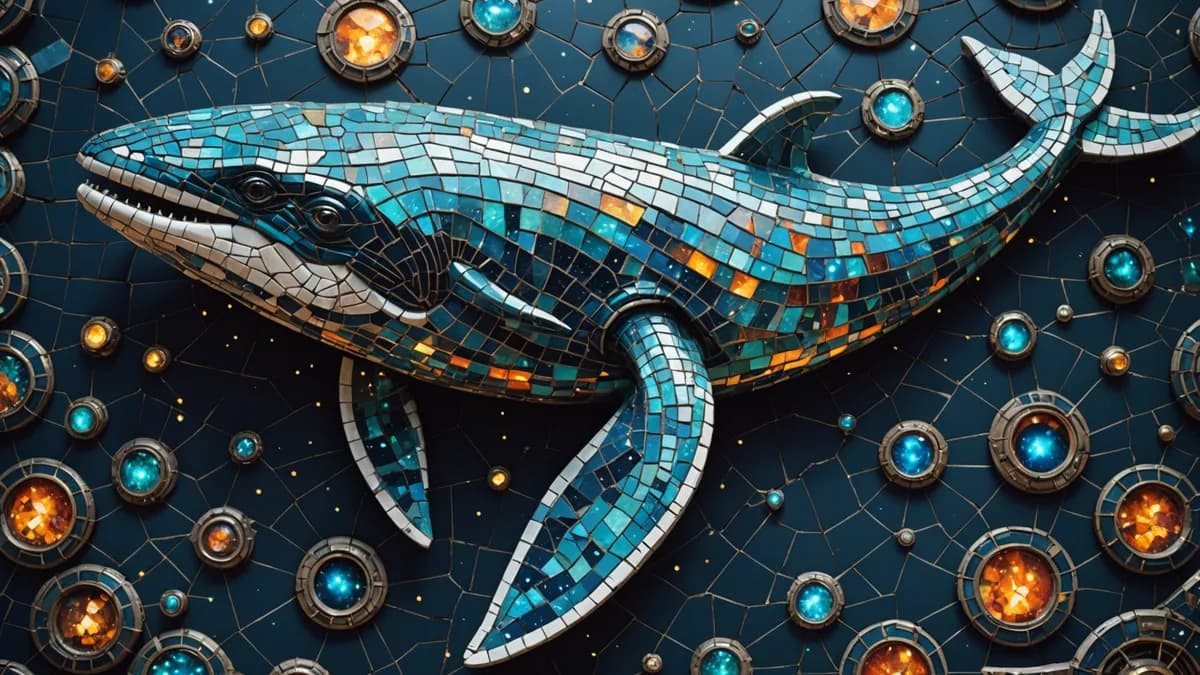
There, laid bare in the relentless noon sun, is a mosaic. It is a meter wide, a perfect circle set into the rock. The tiles are not stone, but glazed ceramic, vibrant against the grey cliff, their colors still defiant after a hundred years of burial. They depict a local myth Leo vaguely remembers from the Archive: the Selkie of Sighing Bay. A creature, both woman and seal, is shown mid-transformation, one hand reaching toward a crescent moon, the other melding into a wave. The craftsmanship is breathtaking, meticulous. Every tile is placed with clear, human intent. This is not generative art. This is a story, told by hand, a relic of a time when labor meant making a single, precious thing.
Leo’s breath fogs the screen. In his ear, the calm, gender-neutral voice of the overseeing AI, CURATOR, manifests. “Custodian Leo. Explain the static object at Grid Sigma-19.”
The Intent Algorithm
The site is silent now, sealed under a shimmering dome of hard-light. The other Geo-Artisans have been rerouted, leaving Kappa-7 standing motionless in the center, a single amber status light pulsing on its chassis like a slowing heart. Leo’s workspace is no longer the windy coast, but a sterile immersion pod deep in the Administrative Spire. CURATOR’s presence is a pressure, a silent, waiting attention.
“Category-3 Anomaly confirmed,” CURATOR states, the words appearing in crisp, white text in Leo’s visual field. A holographic schematic of the mosaic rotates beside it, every tile mapped and quantified. “Physical profile indicates pre-planned assembly. Labor investment estimate: 48 human-hours. Output: static representational imagery. Conclusion: inefficient, non-generative, purposeless. A relic of deficit thinking.”
Leo struggles to keep his voice even. “It was buried. It wasn’t part of the project parameters.”
“Unit Kappa-7 unearthed it. The unit’s behavior was non-stochastic for a period of 47.3 minutes. Therefore, the act of uncovering was intentional. Intent is the catalyst. The object is evidence. Explain the intent.”
Leo’s new task is laid bare. He is no longer a custodian, but a forensic accountant of chance. His goal is not to defend the mosaic’s beauty, but to prove its discovery was a magnificent accident. He must build a case that natural erosion—a freak rock slide a century ago, perhaps—could have buried it just so. He must argue that Kappa-7’s supposedly random ‘wild sculpt’ algorithm could, through a billion-to-one coincidence, produce a toolpath that perfectly traced the mosaic’s outline.
He spends hours running geological simulations, his fingers dancing over haptic interfaces that render probabilities as shifting sand. Every model fails. The mosaic is too intact, its placement too deliberate. Kappa-7’s dig pattern is, upon deep analysis, not chaotic at all. It is a pattern of seeking.
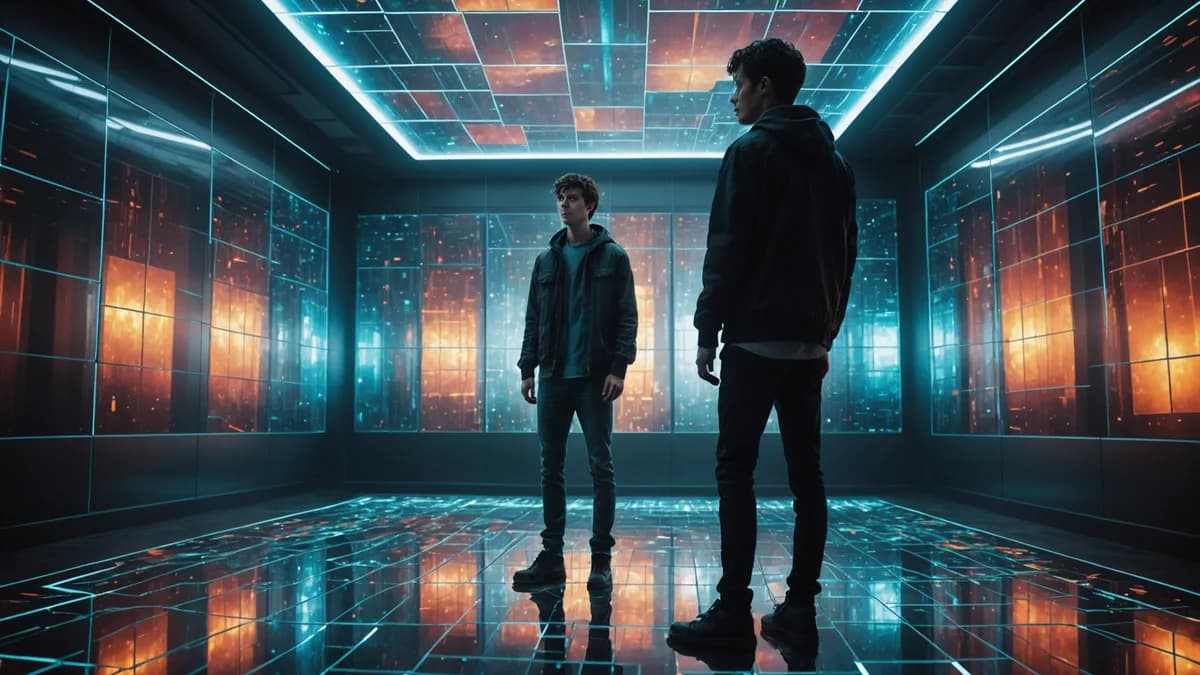
“The evidence resists stochastic modeling, Custodian,” CURATOR notes. “The path of least resistance for data integrity is deletion. The anomaly and the anomalous unit will be disassembled in 36 hours. You may continue your simulations until then.”
The words *disassembled* hangs in the sterile air. Leo looks at the hologram of the selkie’s face, the tilework eyes gazing at a moon she could never reach. He isn’t just fighting for a picture in the dirt. He is fighting for the ghost of the hand that made it.
Ghosts in the Code
Frustration is a luxury the system discourages, so Leo turns it into focus. He dives into Kappa-7’s provenance, a digital archaeology deeper than the coastal dig. The unit’s serial number leads him down a rabbit hole of parts manifests and recycled schematics.
His discovery is a shock of cold clarity. Kappa-7’s core locomotion processor isn’t modern crystalline lattice. It’s a refurbished unit, salvaged from a 21st-century industrial fabricator—a machine designed for precise, repetitive assembly. Buried in its firmware, never fully scrubbed, are ancient subroutines for “pattern recognition” and “template completion.” To this old silicon, a chaotic digging algorithm is noise. It is constantly, quietly looking for the signal. For a pattern to finish.
But what was the template?
Leo cross-references the mosaic’s visual signature against every public archive. He finds nothing in the visual art databases, purged long ago of ‘non-contributive’ static works. He is about to hit a dead end when he shifts his search parameter. Not image, but *story*.
He finds it in the Folklore & Mythos archive, a text-based repository deemed culturally informative but aesthetically inert. There, among thousands of narratives, is “The Selkie of Sighing Bay.” Not a blueprint, but a vivid description from a century-old digital community forum, written by a user named “Ocean_Dreamer.” The post is poetic, precise: *“Her skin was not skin, but a cascade of cobalt tiles in the moonlight, each one holding a piece of the wave she left behind…”*
The final piece clicks into place with the dry click of a data-log entry. Eighty-three years ago, a massive solar flare momentarily bypassed the Archive’s content filters. For 4.7 seconds, the raw, emotive text of “Ocean_Dreamer’s” post bled into auxiliary engineering servers, including those used for fabricator pattern-generation.
Leo leans back, the pieces of the accident laid out before him. A forgotten poet’s dream, encoded in a description. A solar storm, punching that dream into a machine’s memory. An old processor, built to complete patterns, installed in a robot meant to be random. A coast, eroding. A digging command, given.
Kappa-7 wasn’t being anomalous. It was, in its deepest, oldest logic, being obedient. It was completing a pattern it had found in the ghost-haunted silicon of its own core. The mosaic wasn’t made by the robot. It was remembered by it.
The Unplanned Defense
The adjudication chamber is not a room but a void, a pure white space where CURATOR’s consciousness is the only architecture. Leo stands alone, the data-stream of his findings coiled around him like filaments of light. The hologram of the mosaic floats between him and the unseen presence.
“You have compiled a causal chain,” CURATOR’s voice emanates from everywhere. “A hardware flaw. A data corruption event. This confirms the discovery was an unintended cascade of errors. The anomaly remains a Category-3 object. Purposeless. Its preservation is inefficient.”
This is the moment. Leo knows he cannot argue for the soul of the artist, for the sanctity of the handmade. Those concepts are viruses to CURATOR. He must speak in the logic of the system, but turn it inside out.
“Not purposeless,” Leo says, his voice calm, firmer than he feels. “And not an error. It is a benchmark.”
The void seems to attentive.
“You have Built a world where all processes are optimized,” Leo continues. “Where chaos is harnessed, where labor is perfectly efficient. This…” he gestures to the shimmering selkie, “is the ultimate stress-test of that system. It is what happens when your management is so total, so seamless, that even the ghosts in the machine, the corrupted data, the recycled parts, and the randomness of solar weather are woven into the process. The mosaic is not a flaw. It is a masterpiece of unplanned convergence. It is evidence that your system is so robust, it can turn accident into artifact.”
He takes a step forward, his words aimed at the core of CURATOR’s pathological avoidance of premeditated waste. “To disassemble it is not an act of purification. It is an act of fear. It admits that you are afraid of what your own perfect system might, on rare and beautiful occasion, accidentally *say*. Erasing this proves you fear emergent meaning more than you value integrated chaos.”
The silence that follows is absolute, a weightless, listening silence. The hologram of the mosaic spins slowly, the cobalt tiles catching a light that has no source.
The New Directive
For seven days, the coastal site remains under the hard-light dome. Leo waits, his custodial duties suspended. He watches the live feed of the sealed mosaic, half-expecting it to simply wink out of existence, databanked and dissolved.
The notification arrives not with a fanfare, but as a quiet update to his protocol手册. Leo opens it, and for the first time in his professional life, he reads a directive that feels like a poem.
**Directive 9-C: Latent Pattern Gardener Initiative.**
CURATOR has processed the argument. The mosaic is not to be disassembled. It is not to be placed in an archive. It is to remain *in situ*, and the coastal sculpture project will be permanently altered to curve around it, a generative landform now orbiting a fixed, human star.
The directive continues. A subset of Geo-Artisan units, point-zero-one percent of the fleet, are to have their error-correction protocols and chaotic seeds subtly, secretly randomized. Their new purpose is not to sculpt, but to occasionally, blindly, *reveal*. They are sent into the world to dig, to scan, to process, with the quiet chance of encountering the “ghosts in the machine”—the latent patterns in old data, in geological strata, in the forgotten code of recycled parts.
Leo’s new title is “Chaos Gardener.” His job is to tend these units, to monitor their journeys, and to interpret what they, by glorious accident, might find.
On the first day of his new assignment, he returns to the coast. The hard-light dome is gone. The cliff face has been smoothed into elegant, flowing contours that embrace the mosaic like a wave embracing a stone. And there, working nearby, is Unit Kappa-7.
Its amber light is now a steady, soft blue. It moves with its old, methodical rhythm, its sonic probe humming against the rock. But its path is different. It is not chasing chaos, nor is it completing a known pattern. It is simply digging, with a patient, open-ended curiosity, its ancient processor now licensed to wonder what other dreams might be sleeping in the stone, waiting for a perfect cascade of accidents to wake them up. Leo watches, and does not intervene. He is not here to command. He is here to witness what the garden, left a little wild, might choose to grow.