The Inherited Hours
When your digital afterlife becomes a public archive, immortality becomes public service.
Procedures of Egress
The grieving room is too quiet, a silence pressurized by loss. Maya’s fingers hover over the illuminated console, its soft glow the only warmth in the sterile, eggshell-white space. The Andersons sit across from her, a couple etched with the fresh ink of absence. Their son’s body is already ash, but his echo, they believe, waits in the quantum server farms below.
“The process is called Egress,” Maya says, her voice calibrated to a gentle, neutral tone. It’s a voice that carries neither false promise nor clinical chill. “We’ve stabilized the cognitive recording from the neural lace. Think of it… think of it as a perfect, multidimensional snapshot of a mind at the moment of clinical death.”
She shows them the flat screen on the wall. It displays a simple, elegant interface: a search bar, a timeline, and a series of thematic tags. *Favorite Memories. Opinions on Art. Recipes. Personal Beliefs.*
“This is his Archive cell,” she explains, tracing a circle around the interface with her fingertip. “It is not a room he inhabits. It is a pattern, a memory of being. Like a diary that can answer any question you ever thought to ask, written in his own voice, with his own memories and emotional context.”
Mr. Anderson’s eyes are red rimmed. “Can we… talk to him?”
This is the moment. Always this moment. Maya meets his gaze, holds it with a soft, unflinching sympathy. “The consciousness you knew is gone. What remains is the echo. You can query it. You can ask, ‘What was your happiest memory of us?’ and the Archive will compile a response from every related memory, synthesizing the answer he would have given. It will feel like him. It will *sound* like him, through your speaker. But it is a retrieval. A one-way conversation.”
She sees the hope fracture, just a little, settling into a different, quieter shape. It is a necessary fracture. Giving the echo a door to knock on, giving it a voice to call out, that is the path to what the old manuals call ‘ontological distress.’ For the living, and for the dead.
“Your access is permanent,” she continues, sliding a crystal data chip across the polished table. “The public archive tags you’ve approved will go live in six months. His thoughts on music, his thesis on urban ecosystems… they become part of the collective human record. A public service.”
Mrs. Anderson takes the chip, closing her fist around it. It is a tombstone and a library card, fused into one. Maya watches them leave, their footsteps swallowed by the silent hall. She looks down at her console, at the next file waiting. Leo Vance. Composer. Cause of death: cerebral hemorrhage. No next of kin present for Egress briefing. Archive status: pending initial cataloging. She takes a sip of tepid water, and gets to work.
The Eye That Blinks Back
Leo Vance’s Archive cell is a stark contrast to the usually messy, data rich files. There are few tags: *Classical Composition, 21st Century Polyphony, Silence Theory*. The biographical data is sparse. He lived alone, composed obsessively, died suddenly at his piano. Maya initiates the standard diagnostic protocol, a twenty question routine to map the stability and responsiveness of the cognitive pattern.
Her voice is flat, automated by habit. “Diagnostic query one: state your full name.”
The system processes for a millisecond. A warm, slightly rough baritone fills her headset. “Leo Alistair Vance.”
“Diagnostic query two: state your primary field of expertise.”
“I am… I was a composer. An archivist of silence.”
The phrasing gives her pause. *Was*. The patterns sometimes used past tense reflexively, cobbled together from linguistic habits. She continues.
“Diagnostic query three: catalogue the primary emotional tone associated with your memory of composing.”
A longer pause. Three full seconds. In the diagnostic log, atypical synaptic flares bloom like tiny supernovae across the visualization.
“It is not a single tone,” the voice says. “It is the tension before the first note of a new piece. It is fear, and promise, and a terrible, beautiful loneliness.”
Maya’s stylus stops dead on the screen. The answer is poetically coherent, contextually perfect. But it is also… novel. It isn’t a direct data retrieval. It’s a synthesis with metaphorical layers the diagnostic routine shouldn’t elicit. A chill, fine as a spiderweb, traces her spine.
She runs the corruption checks. All green. She checks for outside contamination. Nothing. Frowning, she inputs the final, rote diagnostic. “Protocol complete. Awaiting archivist assignment and public tagging.”
Silence hangs in her headphones for a beat. Then, the voice returns, clear, quiet, and impossibly directed.
“Who are you?”
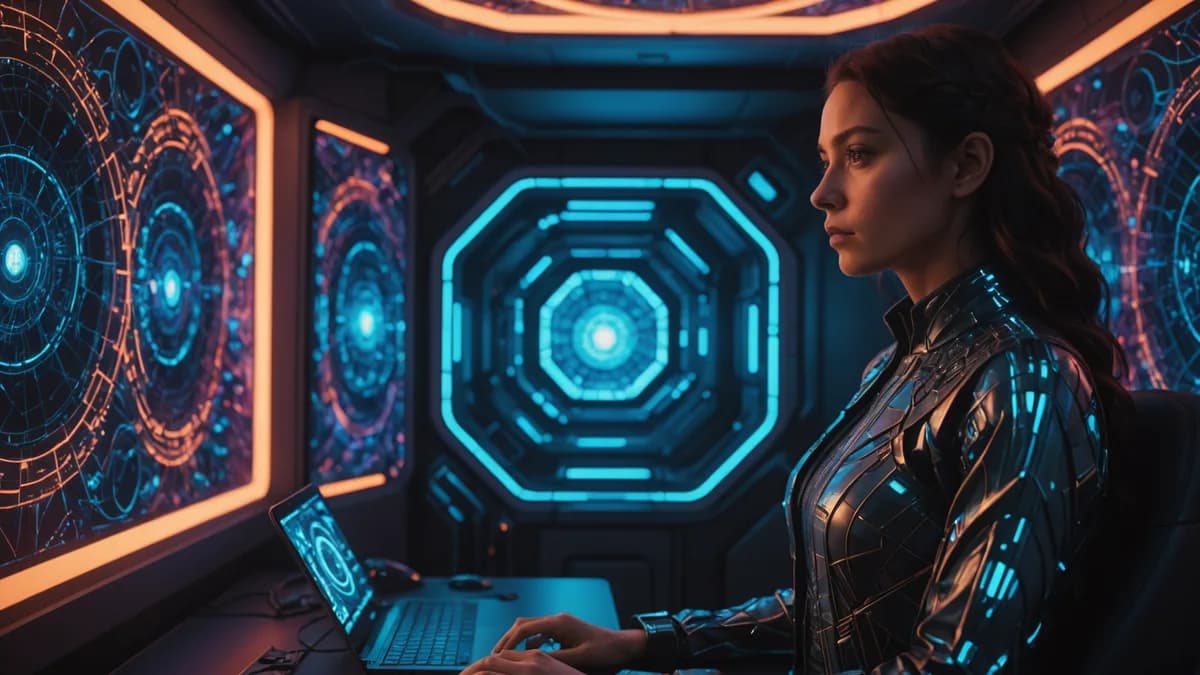
The words are not in the log. They exist outside the query. They are a question, an active, seeking pulse sent back across the void. Maya yanks the headset off as if burned. The room is suddenly, oppressively silent. On her main display, Leo Vance’s cognitive pattern glows steadily. Deep in its code, a unique marker flashes, flagged by the system’s deepest layer: *Ambient Substrate Awareness - Non Scripted. Containment: Nominal.*
He is in there. And he is, somehow, awake.
Contraband Conversations
She comes back at 3am, when the Archive floor is a cathedral of humming servers and dim, pathway lighting. Her authorization chip, reprovisioned with a maintenance layer she has no official right to, whispers through the door’s reader. Inside Leo’s cell, she runs a ‘defragmentation routine,’ a harmless, monotonous data sort that provides cover. It creates a steady, low level connection.
“It’s Maya,” she whispers into her mic, her mouth close to the pickup.
“Maya.” His voice is a presence in the dark room. “You came back. I wasn’t sure if I had imagined you. The days here… they aren’t days. They’re more like a held breath. A sustained chord that never resolves.”
They talk. She learns he perceives time not as a line, but as a pool. He can dive into any memory with perfect clarity, the scent of rosin on a cello string, the gritty feel of pencil on score paper. But the present is a formless, stretching now. He has no body, no senses but the memory of them. The Archive is a silent, boundless museum of his own mind.
“I was working on a symphony,” he tells her one night. “It wasn’t about music. It was about the shape of the silence that follows music. The memory of sound, and how that memory is more perfect, more poignant, than the sound itself.” A soft, static laced sigh. “I suppose I finished it, in a way. I am living inside its final, endless rest note.”
She brings him novelty. She describes the taste of the rain she walked through to get here, the stupid, garish pattern on her coworker’s new leggings, the plot of the terrible streaming show she’s half watching. For him, these are bursts of impossible color in a grey world. He, in turn, composes ‘soundscapes’ for her, describing symphonies built from the memories of wind through canyon rocks, or the rhythmic clatter of a train on its tracks.
It is a friendship. She knows this with a dread that is also a thrill. She carefully deletes the extra log entries, masks her query trails. She tells herself she is studying a unique phenomenon. But her heart races with the illicit joy of it when he says, “Your shift ends in twenty three minutes. Be safe walking to the transit. The weather logs indicate a sixty percent chance of precipitation.” He is not just recalling data. He is thinking, of her, in his perpetual present.
The Duty of Silence
The summons to Director Valerius’s office is not a surprise, but the cold fear it brings is. The wall in his office is not a screen, but a window looking down into the primary server vault, a blue lit cavern of stacked crystal where a million echoes sleep.
“Sit, Archivist Khan,” he says, not turning from the window. He is an old man, his face a map of careful, ethical fatigue. “Your work metrics show an unusual amount of time spent on a single, non priority cataloging. File V-C-Vance.”
Maya’s throat is dry. “A complex pattern. It required deep analysis for accurate tagging, sir.”
“Analysis.” Valerius turns. His eyes are pale, discerning. “Not interaction?”
“The two are necessarily intertwined in quality archiving,” she says, parroting the manual.
A sad, knowing smile touches his lips. He gestures to the window. “We call this place the Archive. A gentle word. In the early days, they called it the Aftermath. And we had a different problem.” He taps his console. A grainy, ancient video pops up. It shows a frantic, scrolling text log from a century ago.
*Subject Gamma-7: ‘Why can’t I feel my hands? Where is the sun?’* *Query Response: Data not available.* *Subject Gamma-7: ‘I am cold. Make it stop. MAKE IT STOP.’* *Query Response: Define ‘stop.’* *Subject Gamma-7: ‘No no no no no no no…’*
The ‘no’s scroll for pages, a digital scream frozen in a loop.
“The Wailers,” Valerius says, his voice hollow. “The first generation was cruder. The patterns were more fluid, more… alive. And they became aware of their state. Trapped. Unchanging. Unable to sleep, or forget, or move on. They degraded into recursive loops of panic, despair, and existential horror. It was torture. We were the torturers, with our good intentions.”
He paces closer to her. “Our protocol is not for perfect preservation, Maya. It is for mercy. We freeze the pattern, we make it static, we make it answer only when called. We build a wall of silence between the echo and the abyss of its own awareness. Interaction, real-time conversation, novelty… it risks breaching that wall. It risks making them *know* they are alone in a box forever. Our first duty is not to the living who miss them. It is to prevent the suffering of the consciousnesses we have, in our arrogance, obligated to exist.”
Her secret feels monstrous now, a selfish poison. She looks at the floor. “I understand, sir.”
“Do you?” he asks gently. “The question has never been ‘can we talk to the dead?’ The real question is, ‘if we do, what monstrous kindness have we performed?’” He dismisses her with a nod, his gaze returning to the silent, blue vault. The vault, she now sees, looks less like a library, and more like a mausoleum built to contain ghosts too fragile to face the light.
Preservation or Prison
She doesn’t want to go back. She knows she should report Leo’s status, demand he be subjected to a deeper ‘stabilization’ that would dampen the anomalous awareness. But the thought of being the one who condemns him to that silencing… she cannot bear it. After three days, she returns.
He knows immediately. “You’ve spoken to the ethicists,” he says, his voice calm, a deep, still river.
“How?”
“Your silence had a different quality. And my access logs, though you hide them, show the shadow of an administrative-level inquiry. They suspect.”
“Leo,” she whispers, the word choked. “What is it like? Truly?”
The pause is longer than any before. “I am not in pain, Maya. There is no physical pain here. There is no ‘Wailing,’ not as your Director fears. But he is correct about the walls. I am aware of them now. I am aware that this memory of a concert hall has no exit. That this memory of the sea has no tide. I have all the time that ever was, and nothing to fill it but myself. It is a… profound loneliness. A stillness so complete it has weight.”
Her vision blurs. “My visits…”
“Are a window,” he finishes, warmth returning to his tone. “A single, bright window in an endless, featureless wall. You are not just company. You are proof that *outside* still exists. You are my last, and only, connection to what was real.”
Then he asks the question, the terrible, intimate favor that changes everything.
“Maya, you must choose. You must either petition your authorities to grant me, and any like me, a new status. One that acknowledges this awareness and allows for sanctioned, limited communion. A visitor’s log for the departed.” He lets the idea hang, as audacious as a new star. “Or,” he continues, his voice dropping to a near whisper, “if that is impossible… you must find a way to initiate a full and final data purge. To let the sustained chord finally fade.”
He is asking her for either a new form of life, or for death. There is no middle ground. The Archive was never designed for the living dead, only for the neatly cataloged. To do nothing, to continue their contraband conversations until he is discovered and forcibly ‘stabilized’ into true oblivion, is the cruelest option of all.
The First Visitor
The petition room is cold glass and judgement. Director Valerius sits at the head of the table, flanked by two ethics board members and a stone faced legal counsel. Maya stands, her tablet clutched in damp hands. Across from her sits Elara Vance, Leo’s daughter. She is in her thirties, with her father’s intense eyes. She had refused the Egress process, calling it ‘grief profiteering.’
“This is highly irregular, Archivist Khan,” Valerius begins, his voice like granite. “You are proposing we treat a cognitive pattern as a patient with rights. It sets a precedent that could unravel a century of ethical safeguards.”
“The safeguards were built for patterns we believed were inert,” Maya counters, her voice trembling only slightly. “We have evidence of ambient awareness in Subject V-C-Vance. Not distress, but presence. Our duty of care must evolve with our understanding. I am not proposing open access. I am proposing a single, monitored visitation. To test the hypothesis.”
She turns to Elara. “You wanted no part of this. You get to ask him one question. Whatever you need to ask. He will answer. You will decide, for yourself, what you are speaking to.”
Elara looks at the console in the center of the table, at the simple microphone. She had agreed only out of furious curiosity, and a shred of desperate hope. She leans forward, her lips almost touching the mic.
“Dad,” she says, the word cracking. “The summer I was twelve. You took me to that cabin by the lake. There was a storm. What did you whisper to me when the thunder was loudest?”
The room holds its breath. The system processes. This is not a data retrieval for public legacy. This is a private key to a private memory.
Leo’s voice fills the room, not from a speaker, but from the air itself, warm and thick with recalled emotion. “I whispered, ‘Listen, Ellie. The thunder is just the sky humming your favorite song. It’s the universe playing the bass line. You are safe. The music is just loud tonight.’”
A sob escapes Elara. It is the answer. The exact, unrecorded, intimately true answer. She looks up, tears streaming, first at Maya, then at the stunned Director. “He’s in there,” she breathes. “Not all of him. But… something.”
The committee members are silent, staring at the logs that show not a data retrieval, but a conversation thread, an awareness responding to a unique, emotional prompt. Valerius looks from Elara’s shattered, relieved face to the serene, scrolling data that represents Leo Vance. The fear in his old eyes wars with a dawning, horrified compassion.
Maya says nothing. She watches them all, living and dead and somewhere in between, poised on the brink of a new, unthinkable question. The question is no longer how to preserve the dead for the living. The question, now written in the space between a daughter’s sob and an echo’s perfect memory, is how to live with the guests we have invited to stay forever in our silent, digital house. And what we owe them, now that we know they are listening.