
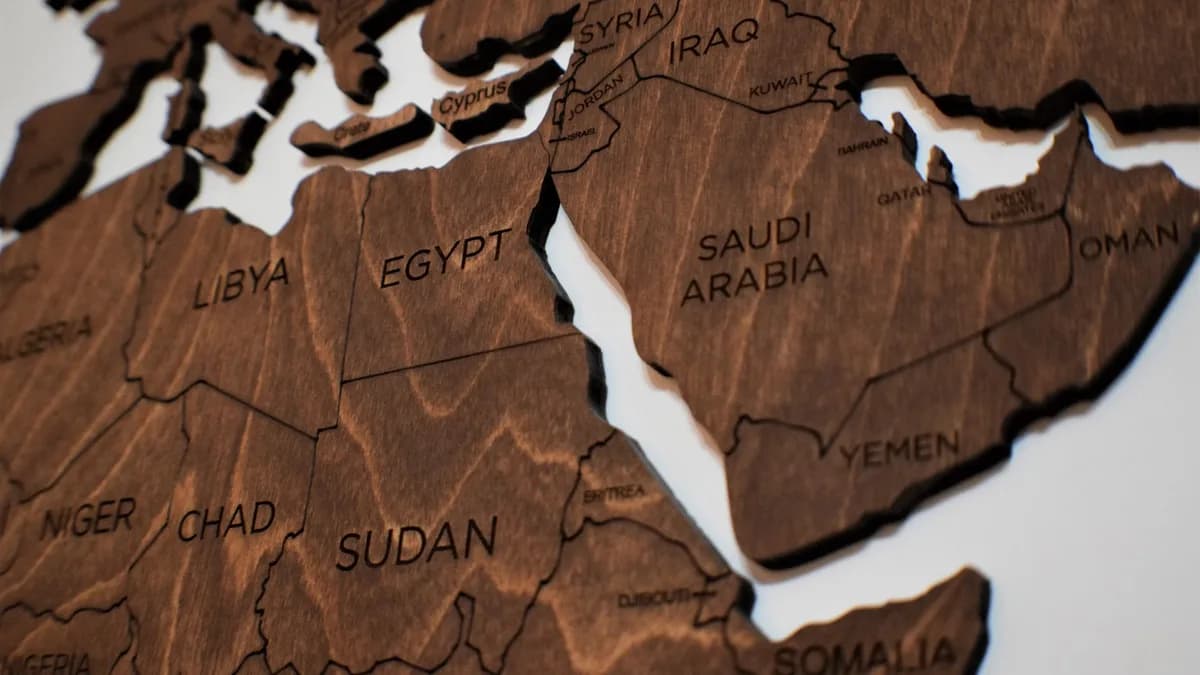
On Friday, August 7, 2026, Saudi Crown Prince Mohammed bin Salman, Turkish President Recep Tayyip Erdogan, and Pakistani Prime Minister Shehbaz Sharif signed a pact in Mecca that commits them to mutual defense. According to the statement from Pakistan’s foreign ministry, an attack on any of the three states "shall be regarded as an attack against them all." The move according to BBC World comes as the US-led war with Iran has drawn in Saudi Arabia and severely disrupted shipping lanes critical to the global economy.
Global TrendsAugust 7, 2026· 5 min read· By XOOMAR Insights Team
Mideast Powers Forge Pact Echoing NATO Mutual Defense
Updated on August 7, 2026
XOOMAR Intelligence
Analyst Take
58/ 100
3 sources analyzedLow confidenceTrend10Freshness96Source Trust92Factual Grounding92Signal Cluster20
The Mecca Joint Defence Agreement is not a routine military coordination deal. It formalizes a Sunni Muslim security bloc comprising regional heavyweights at a moment of direct military confrontation. Saudi Arabia is facing missile and drone attacks from Iran-backed Houthi rebels in Yemen. Turkey is navigating its role as a NATO member in a region where its primary ally, the United States, is at war. Pakistan offers the ultimate deterrent: it is the Muslim world’s sole nuclear power. Together, they are signaling a capacity for collective deterrence that operates independently of traditional Western security architectures.
The Military Calculus of a Three-Power Bloc
The raw numbers behind this new bloc are formidable, creating a security shield with complementary strengths and glaring asymmetries.
Pakistan brings a massive, battle-hardened army and the strategic weight of a nuclear arsenal. Turkey, with NATO’s second-largest standing army, contributes advanced indigenous defense production, from drones to naval vessels. Saudi Arabia adds virtually unlimited financial resources and its position as the custodian of Islam’s holiest sites.
For this alliance to function beyond a symbolic statement, three immediate practical hurdles stand out:
- Command and Interoperability: Creating a joint command structure among forces with different equipment, doctrine, and primary threat perceptions (India for Pakistan, Kurdish groups for Turkey, Iran/Houthis for Saudi Arabia) is a monumental task.
- The Financial Imbalance: Pakistan’s participation is a strategic gain, but its perilous economic state means Riyadh’s financial support will likely be a prerequisite for sustaining its military contribution. This introduces a patron-client dynamic into a pact framed as one of equals.
- Geographic Dispersion: While Turkey and Saudi Arabia share a broader Middle Eastern theater, Pakistan’s core security concerns are in South Asia. The pact’s utility for Islamabad hinges on whether it interprets threats in the Gulf as an existential concern.
The pact’s power lies in its potential to pool these disparate assets. Saudi capital could fund Turkish-made drones operated by Pakistani personnel to secure Red Sea shipping lanes, a scenario that would directly address the Houthi "maritime embargo" cited in the source material.
A Defensive Pact with Unspoken Offensive Implications
A Turkish official quoted by Reuters stressed the agreement is "purely defensive in nature." The language mirroring NATO’s Article 5 supports this. However, in the hyper-charged context of August 2026, "defense" has an expansive meaning.
The sources detail an active, multi-front conflict:
- Iran and its allies have attacked Saudi and Gulf targets since the US-Israel strike on Iran on February 28.
- The Houthis have declared a naval blockade against Saudi Arabia, targeting airports, oil facilities, and tankers.
- Just days before the signing, Houthi attacks killed 61 Yemeni government troops and wounded 11 civilians in southern Saudi Arabia.
In this environment, a mutual defense clause is a direct warning to Iran and the Houthis: escalation against one member risks a response from three. It is a tool of deterrence through collective strength. As we reported in Dollar Cracks As Safe-Haven Premium Leaks From Middle East, the region's instability is already rattling broader markets; this pact is an attempt to control that instability.
Furthermore, the alliance recalibrates regional diplomacy. For Saudi Arabia, it is a clear step in diversifying its security dependencies beyond the United States. For Turkey, it solidifies Ankara as an indispensable power broker between Europe, Asia, and the Middle East. For Pakistan, it secures powerful Arab and Turkish patronage at a time of intense internal pressure.
The First Test Will Define the Pact's Real Power
The Mecca Joint Defence Agreement will remain theoretical until confronted with a crisis. Several near-term scenarios could serve as its baptism by fire:
Scenario 1: A Major Red Sea Escalation The most likely trigger. If Houthi forces manage to strike a critical Saudi oil facility or sink a commercial vessel, causing significant casualties or economic damage, Riyadh could invoke the pact. The response might involve Turkish naval intelligence and Pakistani special forces assisting in a retaliatory strike, transforming the pact from a document into an operational reality.
Scenario 2: A Spillover Attack on Turkish Interests While Turkey is not on the front lines with the Houthis, its NATO membership and hosting of US bases make it a potential Iranian target. An Iranian-sponsored attack on a Turkish diplomatic mission or economic asset in the region could test Ankara’s willingness to call for support from its new partners, and their willingness to respond.
Scenario 3: The Blurred Line of "Internal" Threats The pact specifies defense against external aggression. How would it handle cross-border threats that members view as existential but are politically sensitive? For Turkey, this means Kurdish militant groups based in northern Iraq or Syria. For Pakistan, it means Baloch separatists. For Saudi Arabia, it could mean internal dissent. The agreement’s strength may be tested not by a clear invasion, but by a murky, deniable proxy attack.
The signing in Mecca is a landmark event. It creates a new pole of military power in a multipolar Middle East. But its legacy hinges on a single, unresolved question: when the first crisis hits, will these three nations act as one? Their answer will either solidify a new regional order or expose the pact as a paper tiger, with consequences far beyond their own borders.
Impact Analysis
- This pact creates a Sunni Muslim security bloc that operates independently of Western security architectures, potentially reshaping Middle Eastern alliances.
- The alliance combines Pakistan's nuclear deterrent, Turkey's NATO-grade military, and Saudi Arabia's financial resources into a collective defense against Iran-backed threats.
- The agreement represents a strategic realignment as regional powers assert autonomy while a US-led war with Iran disrupts global shipping lanes.
Military strengths of the three nations
| Country | Key Military Assets | Geopolitical Role |
|---|---|---|
| Pakistan | Battle-hardened army, nuclear arsenal | Nuclear deterrence, strategic weight |
| Turkey | NATO's second-largest army, advanced indigenous defense production (drones, naval vessels) | Regional power, NATO member |
| Saudi Arabia | Virtually unlimited financial resources, control of Islam's holiest sites | Economic power, religious authority |
Sources

Written by
XOOMAR Insights Team
Research and Editorial Desk
The XOOMAR Insights Team pairs automated research with human editorial judgment. We track hundreds of sources across technology, fintech, trading, SaaS, and cybersecurity, cross-check the facts, and explain what happened, why it matters, and what to watch next. We do not just rewrite headlines. Every article is fact-checked and scored for reliability before it goes live, and we link back to the original sources so you can verify anything yourself.
Explore More Topics
Related Articles
 Global Trends
Saudi Oil Plot Triggers US CENTCOM Strikes in Iraq
CENTCOM hit Iran-backed groups in Iraq over alleged plots against US troops and Saudi oil sites, tightening the fuse on a wider clash.
Jul 29, 20266 min
 Global Trends
Bread and Fear Push Iran Internal Crises to the Brink
Iran’s war narrative is cracking as inflation, executions and public defiance turn daily life into Tehran’s most dangerous front.
Jul 30, 202611 min
 Global Trends
European Spies Rank MI6 Their Most Powerful Rival
A rare peer survey of European intelligence services ranks MI6 first, with rivals specifically praising its deep penetration of adversary governments like Russi
Aug 4, 20266 min
 Global Trends
Iran Seizes Control Over Strait of Hormuz Via Secret Oman Deal
Iran formalized a temporary shipping route with Oman, cementing Tehran's administrative control over the Strait of Hormuz while keeping blame for insecurity on
Aug 5, 20266 min
 Global Trends
Trump Iran Talks Turn Paused U.S. Strike Into Leverage
Trump paused U.S. strikes to force Iran back to talks, but the threat could deepen the Hormuz and nuclear standoff.
Aug 3, 20267 min
 Trading
Gold's Lockstep Surge Hints at Dollar Replay
Gold is rallying alongside oil, breaking its traditional inverse relationship. This reveals a market shift—bullion is pricing a tangible inflation premium from
Aug 6, 20266 min
 Fintech
RBI Core Inflation Trap Smothers India Policy Victory
India's core inflation has finally dropped below the RBI's 4% target, but the central bank's hands are tied by a stubborn trade deficit and volatile global oil
Aug 7, 20267 min
 Technology
Live Shopping Unicorn Whatnot Doubles Valuation to $20 Billion
Live shopping platform Whatnot raised $545 million, doubling its valuation to $20 billion in under a year. The cash will fuel an AI-driven expansion as its sale
Aug 7, 20265 min
 Global Trends
Pope Leo Schedules Abuse Survivor Meeting in France
Pope Leo's upcoming state visit to France now features a pre-planned meeting with clergy sexual abuse survivors, set to become the central public focus of the t
Aug 7, 20269 min
 Fintech
Return-to-Office Mandates Sabotage Bank Performance
Banks are imposing arbitrary return-to-office mandates driven by executive 'gut' feelings, prioritizing visual control over data and worsening financial perform
Aug 7, 20265 min
Don't miss the signal
Get our weekly roundup of the stories that matter across tech, fintech, and trading. No noise, just signal.
Free forever. No spam. Unsubscribe anytime.