
South Korea’s $518 billion AI chip plan shows how brutally AI is outbidding crypto for long-duration capital. The most exposed group is not just chip rivals. It’s crypto investors and builders who expected digital assets to own the next speculative capital cycle.
TechnologyJune 29, 2026· 7 min read· By XOOMAR Insights Team
$518B AI Chip Bet in South Korea Leaves Crypto Behind
Updated on June 29, 2026
XOOMAR Intelligence
Analyst Take
59/ 100
4 sources analyzedLow confidenceTrend10Freshness97Source Trust88Factual Grounding91Signal Cluster40
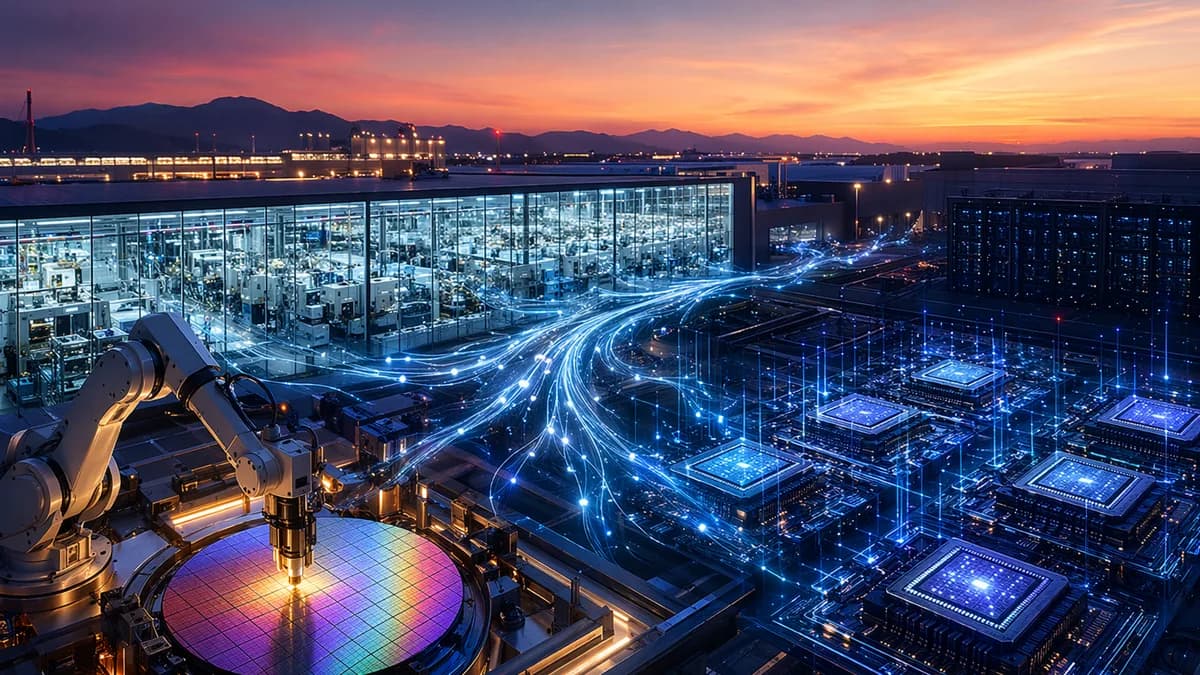
Samsung Electronics and SK Hynix plan to invest roughly 800 trillion won, about $518 billion, in four new chip fabrication plants in South Korea’s southwest, according to CoinDesk. The goal is to double national DRAM output within five years. A South Korean presidential adviser said AI demand could force the companies to finish the work by 2034 or 2035, more than a decade ahead of an earlier 2044 target.
That schedule shift is the signal. AI is no longer only a software equity story. It is turning into hard infrastructure: fabs, memory supply, AI training capacity, and supply contracts. Crypto, meanwhile, is still fighting to prove that capital should move beyond Bitcoin exposure and into a broader technology buildout.
South Korea AI chip plan turns a factory schedule into a crypto warning
The South Korea AI chip plan matters because factory timelines do not move by a decade on vibes. They move when buyers, suppliers, lenders, shareholders, and governments see enough demand to justify years of capital lockup.
A South Korean presidential adviser said AI demand could force Samsung and SK Hynix to complete the buildout by 2034 or 2035, more than a decade ahead of the earlier 2044 target.
Who gets hurt if that capital stays committed to AI? Crypto projects that need the same risk appetite.
CoinDesk frames the spending as part of the capital cycle that has pulled money away from digital assets this year. Crypto has had rallies, ETF headlines, and pockets of activity. It has not produced a comparable industrial spending loop. AI has.
The contrast is sharp:
| Capital destination | What investors can point to | What the source shows |
|---|---|---|
| AI chips | Fabs, DRAM output, HBM supply, Nvidia and OpenAI deals | Samsung and SK Hynix plan about $518 billion in new plants |
| Crypto | Bitcoin ETFs, miners, token markets | Record outflows from U.S. spot bitcoin ETFs, weaker prices, miners shifting toward AI hosting |
That does not make crypto irrelevant. It does mean the bar has changed.
Samsung and SK Hynix are buying time before AI customers run out of patience
For Samsung and SK Hynix, the buildout is a race to protect memory leadership while AI demand is still running hot. The driver is high-bandwidth memory, or HBM, the specialized memory used in AI training and large language models behind chatbots such as ChatGPT and Claude.
Why rush now? Because the buyers named in the source sit at the center of the AI boom.
CoinDesk says the two companies supply most of the world’s HBM and have struck supply deals with Nvidia and OpenAI. SK Hynix has become the dominant supplier of those chips, a position that made it South Korea’s most valuable listed company this month, passing Samsung for the first time in 25 years.
SK Hynix also announced plans last week for a roughly $29 billion U.S. stock listing to fund further expansion. That detail matters. It shows the AI memory cycle is pulling from multiple capital channels at once: corporate capex, equity markets, and national industrial planning.
For adjacent XOOMAR context on how AI demand is showing up across hardware and enterprise technology, see our coverage of AI data center memory pressure and BMW’s enterprise AI operations.
Crypto builders face a harsher capital comparison
Crypto’s problem is not that no money is entering the sector. It is that much of the most visible capital has clustered around Bitcoin as a financial asset, not around a broad crypto infrastructure cycle.
Where does that leave founders trying to raise for protocols, exchanges, apps, or token networks?
XOOMAR analysis: the South Korea AI chip plan makes crypto’s capital pitch look thinner unless it can show usage, revenue, or infrastructure demand that competes with AI’s numbers. AI buyers are placing orders through recognizable chains: chips, servers, hosting, model training, and enterprise contracts. Crypto’s case is more fragmented.
CoinDesk points to several signs of pressure:
- ETF flows: U.S. spot bitcoin ETFs have seen record outflows.
- Prices: Bitcoin is near closing the first half of 2026 below $60,000.
- Trend level: Bitcoin is sitting near its 200-week moving average, a level CoinDesk says has marked extended weak stretches before.
- Attention: Gabe Selby of CF Benchmarks said much of the new money and attention has flowed into AI plays, leaving crypto fighting for a smaller share of overall risk appetite.
That last point is the core issue. Crypto can still attract speculation. AI is attracting planning.
Bitcoin miners show where the hardware trade has shifted
Bitcoin miners are the cleanest bridge between the two worlds. They own compute-related infrastructure. They understand power, uptime, machines, and margins. Now, according to CoinDesk, even miners have been redirecting computing capacity toward AI hosting, where contracted payments beat the swings of mining revenue.
What does that say about the hardware trade?
It says predictable AI demand is winning against token-linked revenue volatility, at least for some operators. That is a practical choice, not an ideological one. If AI hosting offers contracted payments and mining revenue depends on coin prices, operators with usable infrastructure have a reason to follow the steadier check.
This is where the capital race becomes uncomfortable for crypto. The sector once benefited from the idea that decentralized networks would pull real-world infrastructure toward them. In this cycle, the source material shows the opposite pressure: infrastructure that might have supported crypto economics is being pointed toward AI workloads.
The South Korea AI chip plan reinforces that shift at national scale. Governments and corporate giants are not waiting for token incentives to build capacity. They are building for AI customers with visible demand.
Investors read the same $518 billion signal in very different ways
For South Korea, this is industrial policy with market consequences. The plan aims to double national DRAM output in five years, and the timeline has been dragged forward because AI demand is forcing the issue.
For Samsung and SK Hynix, the spending protects their position in memory chips tied to AI training. Supply deals with Nvidia and OpenAI give that buildout a clearer commercial anchor than most speculative technology cycles.
For crypto investors, the signal is harsher: risk capital has alternatives that look bigger, more tangible, and easier to underwrite.
Could Bitcoin still hold a place in portfolios? Yes. The ETF structure already frames Bitcoin as a macro asset for many investors. But that does not automatically fund the rest of crypto. A dollar moving into a spot bitcoin ETF is not the same as a dollar funding a new protocol, exchange rail, custody stack, or tokenized application.
XOOMAR analysis: this split could widen. Bitcoin may remain the primary institutional crypto product, while broader crypto startups face stricter diligence and fewer second chances. AI has given investors a simpler story to defend in committee: demand for models creates demand for memory, and demand for memory justifies fabs.
Crypto’s comeback now has to compete with fabs, not slogans
The next test is whether AI chip money keeps confirming the thesis. Evidence that would strengthen it includes more accelerated fab timelines, more large supply agreements tied to AI training, and continued miner migration toward AI hosting.
Evidence that would weaken it would look different: spot bitcoin ETF outflows easing, crypto prices recovering without relying only on macro relief, and crypto infrastructure producing demand that is not just another token-cycle rebound.
For now, the South Korea AI chip plan is a reminder that capital has become impatient. AI is offering investors factories, customers, listings, and national strategy. Crypto is offering Bitcoin exposure, trading activity, and a still-unfinished case for broader infrastructure demand.
Crypto is not dead. But it will not win this capital back through ideology. It needs cash flow, scale, and use cases that can stand beside a $518 billion chip commitment without sounding small.
The Bottom Line
- AI is attracting massive long-term infrastructure capital that crypto has not matched.
- The accelerated fab timeline signals strong confidence in future AI hardware demand.
- Crypto builders may face a harder funding environment as investors prioritize AI supply chains.
AI Infrastructure vs. Crypto Capital Demand
| AI chip buildout | Crypto sector |
|---|---|
| Samsung and SK Hynix plan about $518 billion in fab investment | Crypto is still trying to attract capital beyond Bitcoin exposure |
| Four new chip fabrication plants are planned in South Korea | No comparable industrial spending wave is cited |
| AI demand may accelerate completion to 2034 or 2035 from a prior 2044 target | Crypto projects face a tougher fight for long-duration risk capital |
Planned South Korea AI Chip Investment
Samsung and SK Hynix fab plan
$B518
Sources

Written by
XOOMAR Insights Team
Research and Editorial Desk
The XOOMAR Insights Team pairs automated research with human editorial judgment. We track hundreds of sources across technology, fintech, trading, SaaS, and cybersecurity, cross-check the facts, and explain what happened, why it matters, and what to watch next. We do not just rewrite headlines. Every article is fact-checked and scored for reliability before it goes live, and we link back to the original sources so you can verify anything yourself.
Explore More Topics
Related Articles
 Technology
AI Data Centers Send RAM Prices Into a 4X Shock for PCs
AI data centers are eating memory supply, sending 32GB DDR5 kits near $400 and making PC upgrades painfully expensive.
Jun 28, 20267 min
 Technology
Idle GPUs Haunt Netris Series A in a16z's $15M Bet
Netris raised $15M from a16z to automate AI neocloud networking and cut the costly lag between buying GPUs and selling live capacity.
Jun 25, 20268 min
 Technology
SoftBank CEO Torches Elon Musk’s Orbital Data Centers
Masayoshi Son says orbital data centers won’t win the AI race because chips, not power, dominate the cost stack.
Jun 27, 20267 min
 Technology
Blacklisted CXMT Pulls Apple Into Trump Memory Fight
Apple wants a political green light to buy CXMT RAM, turning a memory-price crunch into a U.S. China risk test.
Jun 27, 20267 min
 Technology
MRAgent Slashes AI Memory Costs as LangMem Burns Cash
MRAgent cuts prompt tokens to 118K versus LangMem's 3.26M, turning agent memory into a cost problem developers can't dodge.
Jun 27, 20268 min
 Trading
780% Sandisk Surge Turns AI Chip Rally Into a Frenzy
Sandisk's 780% run shows investors are betting on scarce AI hardware, not software promises. The rally is huge, but scarcity can get overpriced.
Jun 29, 20267 min
 Trading
Crypto Derivatives Flash Red as $1B Washout Fizzles
Bitcoin and Ether bounced, but derivatives still point bearish after nearly $1B in futures liquidations.
Jun 28, 20267 min
 Trading
Gold, Silver, Bitcoin Sink as Debasement Trade Snaps
The debasement trade is cracking as Fed hike risk lifts the cost of holding gold, silver and bitcoin.
Jun 28, 20267 min
 Global Trends
Hoka Kaha 3 Alternatives Beat This Pricey Trail Shoe
Months of testing left the Hoka Kaha 3 Low GTX looking too snug and sealed-up for summer trails. Better alternatives deserve a look.
Jun 29, 20268 min
 Technology
42% Off Prime Day Vacuum Deals Hit Shark and Dyson
Prime Day’s final vacuum deals cut up to 42% off Shark, Dyson and Bissell, with the best buys tied to pet hair, hard floors and robots.
Jun 29, 20269 min
Don't miss the signal
Get our weekly roundup of the stories that matter across tech, fintech, and trading. No noise, just signal.
Free forever. No spam. Unsubscribe anytime.