
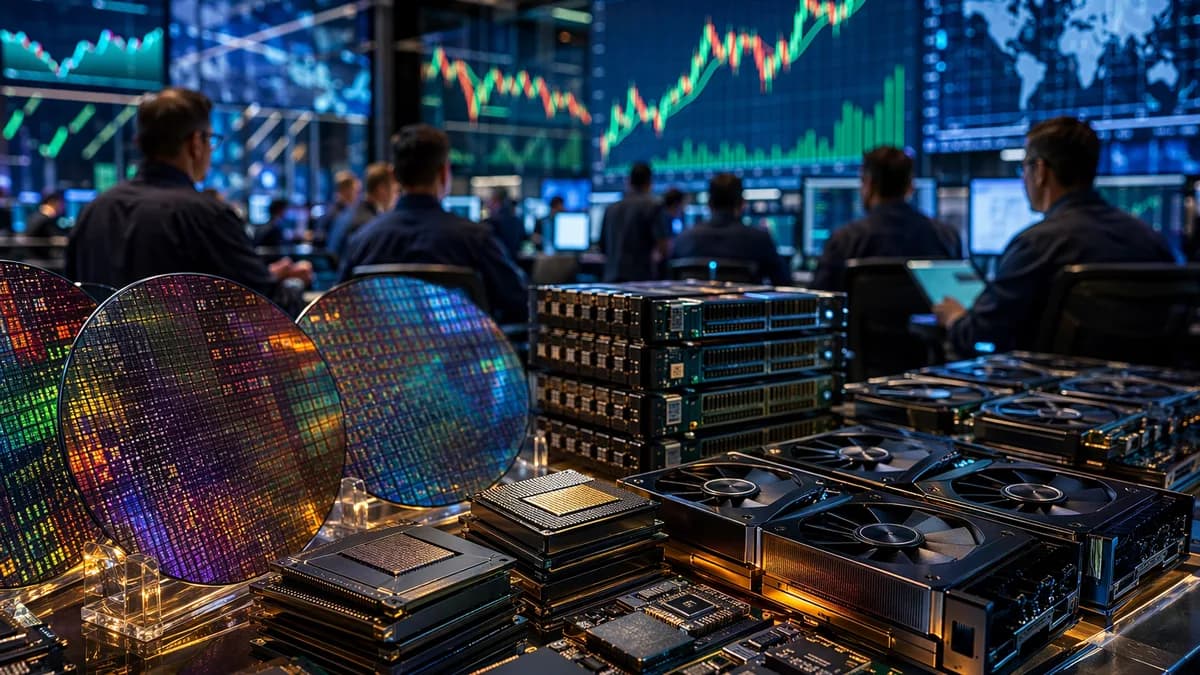
The 2026 AI chip rally says more about the AI trade than any software demo does. The rally has become a hard vote for scarcity, pricing power, and companies that physically ship the parts needed to keep data centers running.
TradingJune 29, 2026· 7 min read· By XOOMAR Insights Team
780% Sandisk Surge Turns AI Chip Rally Into a Frenzy
Updated on June 29, 2026
XOOMAR Intelligence
Analyst Take
69/ 100
3 sources analyzedMedium confidenceTrend10Freshness99Source Trust90Factual Grounding95Signal Cluster40
Shares in chipmakers and memory suppliers have surged through the first half of the year as investors chased the hardware underpinning the AI boom, according to Guardian World. The split is now clear: markets are rewarding semiconductor manufacturers whose profits have jumped, while some large software companies have lost momentum as investors question the payoff from heavy AI spending.
AI investors are rewarding factories, not software promises
The first half of 2026 has exposed a sharper divide inside the AI trade. Investors are paying up for companies with direct exposure to constrained supply: memory chips, semiconductors, storage, and the manufacturing base around AI infrastructure.
That’s the cleanest read on the AI chip rally. Hardware suppliers are selling into urgent demand from AI companies competing for data center capacity. Software companies, by contrast, still need to prove that AI features can translate into durable revenue and margins at a pace that justifies their spending.
This is XOOMAR analysis, but it follows directly from the reported market moves. When investors shift from software into chips, they’re not abandoning AI. They’re changing which part of AI they trust. The market is favoring the vendors with visible orders, higher selling prices, and profit growth now.
The risk is just as obvious. A rally backed by earnings can still outrun reality if investors start pricing scarcity as permanent.
Tripled valuations show how extreme the 2026 AI chip rally has become
The numbers are violent. Semiconductor and memory shares have been among the standout winners of the first half, based on Guardian analysis of London Stock Exchange Group data. The move has been driven by demand for companies tied directly to AI infrastructure, including major Asian memory manufacturers and US storage names.
Those companies have reported a big increase in demand as AI companies compete for chips to power data centers. That’s the core engine of the rally: AI workloads are pulling demand toward memory and semiconductor suppliers at the same time supply remains tight.
US names have also moved sharply. Memory and storage suppliers have attracted heavy investor demand as the market prices in stronger earnings, tighter supply, and higher selling prices across parts of the chip supply chain.
“Demand exceeding constrained supply led to a surge in memory chip prices and took suppliers’ shares on a spectacular ride upwards. Higher selling prices and greater demand is a powerful cocktail for explosive earnings growth,” said Dan Coatsworth, head of markets at AJ Bell.
For readers tracking the memory side of the trade, XOOMAR’s related coverage of Micron earnings and AI memory momentum is a useful companion. The broader lesson is the same: memory has shifted from a low-glamour input cost to one of the most watched pressure points in AI infrastructure.
Asia Pacific has become the trading floor for AI supply chains
The rally has made Asia Pacific markets a proxy for global AI infrastructure demand. South Korea’s market strength shows how heavily a national index can move when its dominant electronics and memory names become central to the AI buildout.
Japan has joined the broader rise. The Nikkei has climbed strongly in the first half of 2026, while chip-heavy exposure across the region has benefited from investor demand for listed AI infrastructure plays.
That concentration cuts both ways. If a small group of semiconductor winners drives a large share of index performance, the index becomes more fragile. A stumble in memory pricing, data center orders, or capex expectations can hit the broader market even if the domestic economy has not changed much.
Geopolitics sits underneath this too. AI hardware supply is no longer just a margin story. It is also a strategic supply story, with governments, companies, and investors all watching where critical memory and semiconductor components can be sourced.
The memory boom has real earnings behind it, but cycles still matter
This rally is not floating on hype alone. The source material points to higher profits, constrained supply, and clear demand from AI data centers. That separates the current semiconductor surge from a purely narrative-driven bubble.
But memory has always been cyclical. Fortune’s related reporting quoted Willy Shih, a Harvard Business School professor who has tracked semiconductor cycles since the 1980s, warning: “This too will pass.” His point is blunt: high prices invite capacity, capacity eventually arrives, and pricing power can crack.
The supply squeeze is still real. Fortune reported that DRAM contract prices were projected by TrendForce to rise 58%-63% quarter over quarter in Q2, the steepest jump in a decade, while Samsung said its pricing rose 90% in the first quarter alone. It also reported that servers now account for 60%-70% of memory demand, up from around 30% before the AI boom, according to Jefferies analysts.
The timing problem is the investor problem. Even when manufacturers add capacity, new supply can take time to arrive. That supports prices now, but it also sets up the familiar semiconductor risk: supply arrives after the market has already extrapolated today’s shortages too far.
Cloud giants and software vendors are paying the other side of the bill
The winners are clear: chipmakers and memory suppliers with pricing power. Their customers face the harder math.
The Guardian reported that shares in hyperscalers rolling out AI services have fallen in recent weeks as investors shifted holdings out of software and into hardware stocks. That rotation shows how quickly sentiment can move when investors start questioning whether AI spending will translate into adequate returns.
Some investors have balked at the scale of AI spending plans. The concern is not that AI demand has vanished. It is that the spending required to compete can raise borrowing, consume cashflow, and make software and cloud firms more capital-intensive than investors expected.
Consumers may also feel the cost pressure if higher component prices persist. For adjacent consumer tech context, see XOOMAR’s Prime Day 2026 deals coverage, where pricing and availability remain central to how shoppers experience the hardware cycle.
The second half of 2026 will test who has real pricing power
The AI chip rally can keep running if three things hold: earnings keep beating expectations, AI data center spending remains aggressive, and memory supply stays tight. Those conditions are still visible in the source material.
But the market is already showing nerves. Chris Beauchamp, chief market analyst at IG, said investors have started protecting gains after piling into AI and tech since the end of March.
“Having piled in to AI and tech since the end of March, there is a desire to protect profits, and investors continue to be in a mood to sell first and ask questions later,” Beauchamp said.
The practical lens for investors is simple. Watch margins, order backlogs, capital expenditure plans, inventory levels, and customer concentration more than share price momentum. A hardware boom backed by scarcity can look unstoppable right up until supply catches up or customers push back.
The AI hardware boom is real. The easy money looks less real from here. The second half of 2026 will reward companies that can defend pricing, control capacity, and show clean earnings visibility, while punishing those whose valuations depend on shortages lasting forever.
Disclaimer: This XOOMAR analysis is for informational and educational purposes only. It is not financial, investment, legal, tax, or professional advice. It does not provide buy, sell, hold, price-target, portfolio, or personalized recommendations. Verify information independently and consult qualified professionals before making decisions.
The Bottom Line
- Investors are shifting toward the physical infrastructure behind AI rather than software promises.
- The rally highlights how scarcity and pricing power are driving semiconductor valuations.
- The biggest risk is that markets may price today’s chip shortages as if they will last permanently.
AI Trade Split in First Half of 2026
| Hardware Suppliers | Software Companies |
|---|---|
| Chipmakers, memory suppliers, storage and semiconductor manufacturers are being rewarded by investors. | Some large software companies have lost momentum. |
| Benefit from constrained supply, visible orders, higher selling prices and profit growth. | Must prove AI features can generate durable revenue and margins. |
| Seen as direct beneficiaries of urgent data center demand. | Face investor questions over the payoff from heavy AI spending. |
Sources
Disclaimer: Content on XOOMAR is produced using AI-assisted research, drafting, and verification workflows and is intended for informational and educational purposes only. It does not constitute financial, investment, legal, tax, medical, or professional advice of any kind. All analysis reflects available information at the time of publication and may not be current. Verify information independently and consult qualified professionals before making decisions. Editorial policy

Written by
XOOMAR Insights Team
Research and Editorial Desk
The XOOMAR Insights Team pairs automated research with human editorial judgment. We track hundreds of sources across technology, fintech, trading, SaaS, and cybersecurity, cross-check the facts, and explain what happened, why it matters, and what to watch next. We do not just rewrite headlines. Every article is fact-checked and scored for reliability before it goes live, and we link back to the original sources so you can verify anything yourself.
Explore More Topics
Related Articles
 Trading
Bitcoin's $60K Rebound Exposes Crypto's AI Rally Problem
Bitcoin defended $60K, but ETF outflows and the Fed kept crypto lagging a hotter AI stock rebound.
Jun 25, 20267 min
 Trading
Micron Earnings Torch Crypto Bulls After 16% Stock Rip
Micron's 16% surge says AI memory demand still has teeth, giving equity traders a cleaner AI bet than Bitcoin.
Jun 25, 20265 min
 Trading
Pump Pain Turns Gasoline Price Gouging Into DOJ Showdown
Trump wants a DOJ probe into gasoline price gouging, but experts say pump prices may lag crude's drop for weeks.
Jun 25, 20268 min
 Trading
Fed Hike Odds Leap as Warsh Turns Policy Into a Black Box
Warsh's first Fed reset pushed September hike odds above 50%, but traders still don't know the rule behind the dots.
Jun 18, 20267 min
 Trading
Kevin Warsh Fed Meeting Turns the Mic into Market Risk
Warsh is expected to hold rates steady, but his first Fed message could reset how markets price cuts, inflation, and risk.
Jun 17, 202611 min
 Technology
AI Data Centers Send RAM Prices Into a 4X Shock for PCs
AI data centers are eating memory supply, sending 32GB DDR5 kits near $400 and making PC upgrades painfully expensive.
Jun 28, 20267 min
 Trading
0.6900 Cracks as AUD/USD Price Forecast Targets 0.6830
AUD/USD is losing 0.6900 as Fed hike bets lift the dollar, putting 0.6830 in sellers' reach unless oversold pressure stalls the move.
Jun 29, 20267 min
 Global Trends
Ouster Claims Hit Misan Harriman's Southbank Centre Exit
Misan Harriman says his Southbank Centre departure was planned in January, not forced by the backlash now surrounding him.
Jun 29, 20266 min
 Technology
Australia Social Media Fines Corner Meta on Child Accounts
Australia wants A$99 million fines and tougher evidence powers to force Meta and others to prove kids are off restricted services.
Jun 29, 20266 min
 Technology
5 Prime Day Deals Refuse to Die After Amazon's Sale
Prime Day is over, but five real discounts survived across Garmin, Ninja, Walmart+, Kasa, and Bose. Check price and stock fast.
Jun 29, 20267 min
Don't miss the signal
Get our weekly roundup of the stories that matter across tech, fintech, and trading. No noise, just signal.
Free forever. No spam. Unsubscribe anytime.