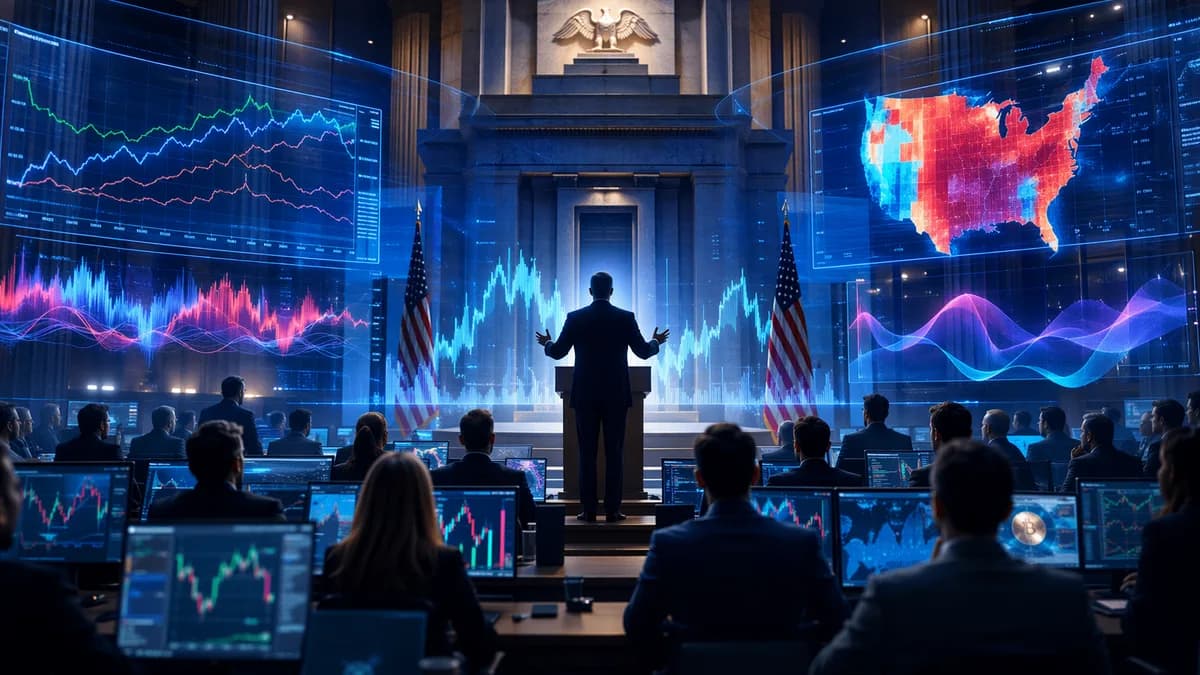
The Kevin Warsh Fed meeting that markets expect to deliver a Federal Reserve rate hold may still rewrite how investors read the Federal Reserve. The target range is not the live wire. The microphone is.
XOOMAR Intelligence
Analyst Take
The Fed is fully expected to hold its benchmark fed funds rate range at 3.50%-3.75% at the policy meeting ending today, Warsh’s first as chair, according to CoinDesk. That makes the decision itself the least surprising part of the day. The real test is whether Warsh starts pulling the central bank away from the communication habits that defined the Jerome Powell era: frequent press conferences, public projections, dot plots, and heavy forward guidance.
This follows the credibility question we raised in Kevin Warsh Fed Debut Puts Central Bank Credibility on Trial. A new chair does not get to reset inflation, payrolls, energy prices, or the FOMC vote count. But he can change what the Fed emphasizes. That can move rates before rates move.
Kevin Warsh's real first test at the Fed is the microphone, not the policy rate
Warsh has more room to reshape expectations than policy today. That is the cleanest read of this Kevin Warsh Fed meeting.
The FOMC sets policy by committee. Chase notes that the chair shapes the agenda, guides the discussion, and speaks for the group, but still has only one vote. That constraint matters. Warsh cannot simply impose a new rate path because he has taken Powell’s seat.
But he can change tone. He can make inflation sound more urgent. He can remove or soften language that points toward future easing. He can treat the Summary of Economic Projections as useful, flawed, or close to irrelevant. Each choice tells traders how to weight the Fed’s reaction function.
Bank of America expects Warsh and the Fed to sound more hawkish, reflecting stronger-than-expected economic data and persistent inflation pressure. It also expects policymakers to remove language suggesting a bias toward future rate cuts and upgrade their labor-market assessment after recent payroll reports surprised to the upside.
That creates the central tension. Investors want clarity. Warsh appears to want flexibility.
“Stop talking so much. More thinking, less talking.”
That was Warsh’s advice to the Fed last year, according to a Wall Street Journal profile cited by CoinDesk. If he brings that view into the press room, the first Warsh meeting may be less about where rates are today and more about how much the Fed wants markets to know about tomorrow.
Markets are pricing a steady Fed, but every Warsh phrase will trade like policy
The fixed point is the current rate range: 3.50%-3.75%. The moving part is the path investors infer after Warsh speaks for Japanese yen traders.
Chase said its strategists expect the Fed to keep interest rates steady through year-end, with inflation still above target and energy prices adding uncertainty. CoinDesk reported that Bank of America, in line with the market, expects this week’s projections to show rates unchanged through 2026, followed by modest cuts in 2027 and 2028.
The inflation data explain why a cut is hard to defend. Chase said the Personal Consumption Expenditures Price Index rose 0.4% in April, up 3.8% from a year earlier, while core PCE came in at 3.3% year over year. Employers added 172,000 jobs in May, above expectations, and unemployment held at 4.3%.
Those numbers give Warsh cover to sound patient. They also give him room to push the statement away from easing without actually threatening a hike today.
Small words matter here:
- Inflation: Does the Fed call price pressure persistent, temporary, or event-driven?
- Labor market: Does it upgrade employment strength after the May payroll report?
- Risk balance: Does it keep an easing tilt, move neutral, or hint that rates could rise if inflation fails to cool?
- Financial conditions: Does Warsh validate market pricing, or push back against it?
Bank of America warned that a more hawkish-than-expected chair could strengthen the dollar and pressure stocks and bonds. That is the tradeable risk. The meeting’s biggest number may not be 3.50%-3.75%. It may be the market-implied rate path after Warsh finishes answering questions.
For active traders, that makes the press conference a volatility event even without a rate move. It is the kind of setup where tools like real-time stock scanners that catch big moves first can matter more than the headline decision.
Warsh can start changing Fed communication without touching the rate statement
Warsh does not need to rewrite the policy statement to start changing the Fed. He can do it through process.
The first tool is the press conference itself. Former Chair Jerome Powell held one after every FOMC meeting. Chase reported that Warsh did not commit at his confirmation hearing to continuing that practice and hinted that he would prefer fewer post-meeting press conferences.
The second tool is forecast discipline. Warsh has criticized the Fed’s projection process and forward guidance. CoinDesk reported that Bank of America sees a chance Warsh declines to submit his own projections to the SEP.
“If you're not very good at something, you should do less of it,” Warsh said at a State Street conference last year, according to the Journal. “These forecasts have been abysmal. My dots wouldn't be perfect either, so I wouldn't give them.”
That would be more than symbolism. The dot plot has become one of the most traded pieces of Fed communication. If the chair downplays it, refuses to join it, or frames it as a loose collection of individual views rather than a policy promise, markets will have to rely more heavily on the statement and press conference.
Here is the communication menu Warsh can adjust without changing rates:
| Fed communication tool | Warsh’s possible shift | Market risk |
|---|---|---|
| Press conference | Fewer commitments, less forward guidance | Traders may price wider uncertainty bands |
| SEP and dot plot | Less emphasis, or no personal dot | Rate-path signals become harder to read |
| Policy statement | Remove easing bias, sharpen inflation language | Front-end yields may react before policy moves |
| Public speeches | Fewer Fed voices, tighter message discipline | Less noise, but also less real-time guidance |
The risk is overcorrection. A chair who sounds too certain can trap the Fed in a path. A chair who sounds too vague can unsettle markets that have spent years trading off central-bank breadcrumbs.
From Fed transparency to Warsh restraint, the language of money may be changing again
The supplied facts point to one clear historical shift: Fed communication has become highly structured, and Warsh has spent years questioning that structure.
The current framework gives investors several recurring signals: post-meeting statements, press conferences, the Summary of Economic Projections, dot plots, and speeches by Fed officials. BBH said Warsh stressed during his Senate hearing a desire for a communication regime leaning toward “strategic ambiguity,” questioned regular post-meeting press conferences, and argued for fewer speeches from Fed officials.
That is not a minor stylistic preference. In modern markets, communication is part of policy transmission. A carefully worded sentence can move borrowing costs, equity multiples, and the dollar without a single basis-point change.
BBH also cited a Brookings Institution survey showing how attached Fed watchers are to the existing framework. Among 52 respondents, 85% regarded the post-meeting press conference as “extremely useful or useful,” while 56% said the same about the SEP excluding dots and the dot plot.
That is Warsh’s trap. If he preserves the system unchanged, he looks less like a new regime and more like Powell with different phrasing. If he pulls away too fast, markets may treat the loss of guidance as a policy shock.
XOOMAR analysis: Warsh’s best path is probably staged restraint. First, establish continuity on the rate decision. Then, over several meetings, lower the market’s dependence on the dot plot and reduce the Fed’s habit of pre-committing to a path. A sudden break would give traders less information at the exact moment inflation and energy risks are still unsettled.
Traders, banks, households, and the White House all want different things from Warsh's first Fed message
The same Warsh sentence can help one group and hurt another.
Bond traders want a cleaner rate path. Equity investors want reassurance that the Fed won’t choke growth. Banks would likely prefer yield-curve relief, though the supplied source material does not give bank-stock performance or curve levels. Households care less about dot-plot philosophy and more about mortgage, credit-card, auto-loan, and savings rates.
Businesses will read Warsh for financing-cost signals. A chair who says inflation risks are rising and the Fed is less willing to look through price shocks sends one message to CFOs. A chair who says energy-driven inflation may prove temporary, while refusing to hint at cuts, sends another.
Bank of America expects Warsh to strike a patient tone. CoinDesk reported that the bank expects him to argue recent inflation pressures tied to geopolitical events, including the conflict involving Iran, may prove temporary, while avoiding any signal that rate cuts are imminent.
Crypto has its own sensitivity. CoinDesk reported Bitcoin at $65,096.92, down about 25% year-to-date, and lower since Warsh took office on May 22, as the U.S.-Iran conflict continues to overshadow domestic economic policy. That does not prove Warsh caused the move. It does show that risk assets are entering his first meeting with little tolerance for muddled signals.
For options traders, the rate decision may be less important than the implied-volatility response after the press conference. That is where Greeks and event risk matter, as we covered in Greeks Risk Splits 2026's Best Options Trading Apps.
A communication-first Fed meeting could reset borrowing costs before any rate cut arrives
An unchanged Fed decision is not a non-event. Borrowing costs move on expectations.
If Warsh removes easing language and stresses inflation persistence, markets can pull forward tighter financial conditions without the Fed lifting rates. If he describes price shocks as temporary and sounds comfortable waiting, investors may read that as permission to keep pricing eventual cuts.
That matters across the economy:
- Mortgages: Rate expectations feed into longer-term borrowing costs.
- Credit cards and auto loans: The policy path shapes consumer-credit pricing.
- Corporate debt: Issuers care about where markets think the Fed will be in six to twelve months.
- Savings yields: Banks and money-market products respond to expected policy direction.
- Portfolio positioning: Stocks, bonds, cash, crypto, and the dollar all react to the perceived policy path.
The practical read is simple. Do not stop at “no change.” Watch how Warsh describes four things: inflation persistence, labor-market strength, financial conditions, and the Fed’s tolerance for uncertainty.
The most important phrase may be the one that tells markets whether the Fed is still leaning toward easing, moving neutral, or preparing investors for the possibility that inflation can force a harder line.
Warsh's next three signals will show whether the Fed is entering a new communication regime
Warsh is likely to begin with continuity because the committee, the data, and market expectations limit his room for drama. But continuity on rates does not mean continuity in communication.
Three signals now matter most.
First, the next policy statement. If the easing bias disappears and inflation language hardens, Warsh will have started changing the reaction function without moving the target range.
Second, dissent management. Chase noted that at the April meeting, three FOMC members objected to including an easing bias even though they did not oppose holding rates steady. If Warsh can turn that disagreement into a cleaner consensus, his authority rises. If dissent widens, markets may struggle to identify the committee’s center.
Third, coordination after the meeting. If speeches by other officials echo Warsh’s framing, investors will treat the communication shift as institutional. If they contradict him, markets will treat his first press conference as personal style rather than Fed policy.
The first major repricing may not come from a surprise rate move. It may come from a change in how the Fed describes the tradeoff between inflation and employment.
That is the real stakes of the first Kevin Warsh Fed meeting. Rates can stay frozen at 3.50%-3.75%, while the market’s understanding of the Fed changes anyway.
Disclaimer: This XOOMAR analysis is for informational and educational purposes only. It is not financial, investment, legal, tax, or professional advice. It does not provide buy, sell, hold, price-target, portfolio, or personalized recommendations. Verify information independently and consult qualified professionals before making decisions.
Impact Analysis
- Markets expect the Fed to hold rates at 3.50%-3.75%, making Warsh’s messaging the main event.
- A shift away from Powell-era communication could change how investors interpret future Fed policy.
- Warsh cannot control the FOMC alone, but his tone can still move rate expectations before policy changes.
Fed Communication Under Powell vs. Potential Warsh Approach
| Area | Powell Era | Warsh First Meeting Focus |
|---|---|---|
| Policy rate | Rate decisions and forward guidance closely watched | No rate change expected |
| Communication style | Frequent press conferences, dot plots, projections, heavy guidance | Possible shift in tone, projections, and guidance |
| Market impact | Investors relied heavily on Fed signaling | Markets may reprice based on how Warsh frames the reaction function |
Primary Sources & Disclosures
Disclaimer: Content on XOOMAR is produced using AI-assisted research, drafting, and verification workflows and is intended for informational and educational purposes only. It does not constitute financial, investment, legal, tax, medical, or professional advice of any kind. All analysis reflects available information at the time of publication and may not be current. Verify information independently and consult qualified professionals before making decisions. Editorial policy

Written by
XOOMAR
Data desk
XOOMAR is a capital markets software and data company. Every brief on this site starts from a dataset the company collects itself from primary sources (CFTC, SEC EDGAR, FINRA, the Federal Reserve, exchange APIs) and names the numbers it is built on, with a link to the data page so you can check them. Briefs are reviewed before they go out and corrected in place when the data is revised.